(1831-34) $2.50 C. Bechtler, 250. / 20.C. Course Beads (Regular Strike)
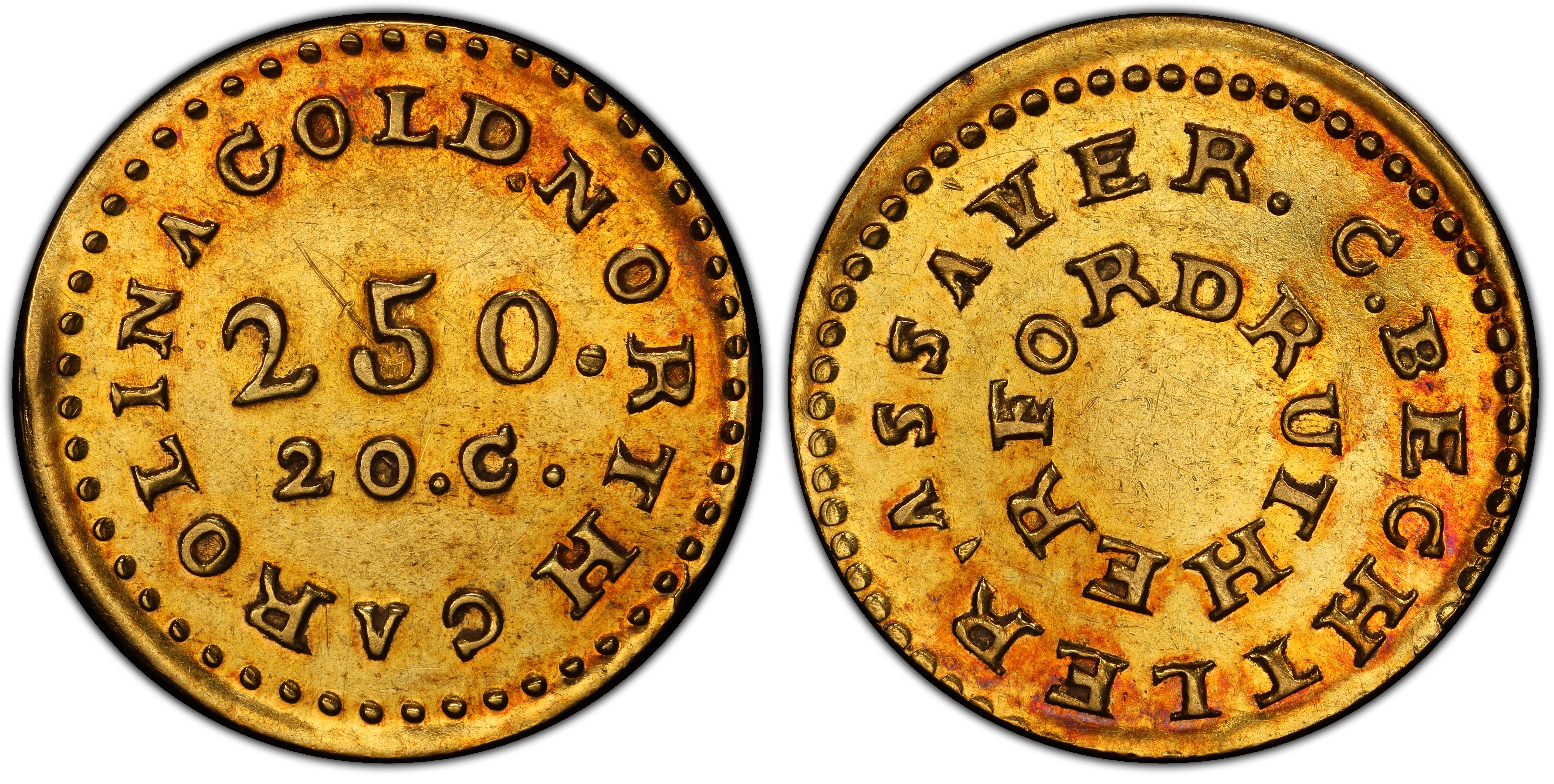
Obverse & Reverse
The Bechtler $2.50 gold piece stands as a tangible monument to America's first gold rush, an often-overlooked yet pivotal event that predated the California frenzy by two decades. In the late 1820s and early 1830s, significant gold discoveries in the foothills of the Appalachian Mountains, primarily in Georgia and North Carolina, created a peculiar economic dilemma. A flood of raw gold dust and nuggets entered local commerce, but with the nearest United States Mint a treacherous and costly journey away in Philadelphia, there was no efficient way to convert this newfound wealth into a spendable, standardized medium of exchange. Miners were often forced to sell their gold at a steep discount or rely on cumbersome barter. Recognizing this critical need, Christopher Bechtler, a German immigrant metallurgist, watchmaker, and gunsmith who had settled in Rutherfordton, North Carolina, in 1830, offered a solution. At the urging of local miners and merchants who were frustrated by Congressional inaction on establishing a local branch mint, Bechtler began his private coining operation in 1831. Unlike his short-lived Georgia predecessor, Templeton Reid, Bechtler's enterprise was a model of integrity and technical proficiency. He manufactured his own dies, rollers, and screw press, creating coins that were respected for their honest weight and consistent purity. His initial advertisement in the 'North Carolina Spectator and Western Advertiser' on July 2, 1831, announced his readiness to convert gold into coin, charging a modest seigniorage fee of around 2.5%. This particular coin, the Kagin-5 variety, represents one of his earliest efforts. Struck from 1831 to 1834, it boldly proclaims its origin as 'NORTH CAROLINA GOLD' and its fineness as '20.C' (carats), with a stated weight that calculates to 75 grains. Bechtler's coins were not merely tokens; they were the lifeblood of the regional economy, facilitating trade across the Southeast. Their reputation was so sterling that they were readily accepted in commerce, and some Confederate contracts during the Civil War even specified payment in Bechtler gold, a testament to their enduring trust. The Bechtler minting operation was prolific; by 1840, Christopher Bechtler reported to the Treasury Department that he had coined over $2.24 million in gold. His death in 1842 passed the business to his son, August, and later his nephew, Christoph Jr., but the coins struck by the patriarch are the most highly esteemed. The K-5 is a classic example of this foundational period, a rustic yet reliable coin born of necessity and entrepreneurial ingenuity, which effectively served as the dominant currency of the Appalachian gold fields until the establishment of the Charlotte and Dahlonega Mints in 1838.
Associated EventNorth Carolina Gold Rush
Reason For MintingTo convert raw gold dust from the Appalachian gold rush into a standardized, spendable currency due to the great distance and danger of transporting it to the U.S. Mint in Philadelphia.
Minter HistoryChristopher Bechtler, Sr. (1782-1842) was a German metallurgist, gunsmith, and watchmaker from Pforzheim, Baden, who immigrated to the U.S. in 1829. After a brief period in Philadelphia, he moved to Rutherfordton, North Carolina, in 1830, drawn by the burgeoning gold rush. A skilled craftsman, he established a private mint on his property 3.5 miles north of town, manufacturing all his own equipment. Renowned for his integrity, his coins contained their stated weight and purity, earning widespread public trust and circulating freely for decades. He minted over $2.24 million in gold between 1831 and 1840, creating the first U.S. gold dollars in the process, before passing the successful operation to his son upon his death.
Historical SignificanceBechtler's coinage was the most successful and prolific private minting enterprise in U.S. history, providing a stable and trusted currency for the entire Southeastern region during America's first gold rush and demonstrating the viability of private coinage to solve a critical economic need.
K-5
Denomination$2.50
Minting Period1831-1834
Assayer/MinterChristopher Bechtler, Sr.
Geographic OriginRutherfordton, North Carolina
Obverse DescriptionThe central design element is the denomination '250' with a small star or arabesque above it. The legend 'NORTH CAROLINA GOLD' is arranged around the periphery, and the fineness '20.C.' (20 Carats) is displayed below the denomination.
Obverse InscriptionNORTH CAROLINA GOLD / ★ / 250 / 20.C.
Reverse DescriptionThe minter's name, 'C. BECHTLER.', is at the top, and 'ASSAYER' is at the bottom periphery. In the center is the location, 'RUTHERFORD', arranged in an arc.
Reverse InscriptionC. BECHTLER. / RUTHERFORD / ASSAYER
CompositionGold
Stated Fineness20 Carats
Actual FinenessGenerally accurate to the stated 20 carats, though minor variations existed due to the technology of the time. U.S. Mint assays of C. Bechtler's coins found them to be of honest, reliable weight and fineness.
Weight4.86 grams
Diameter19.00 mm
EdgeReeded
Unknown for this specific variety, but part of the total $2.24 million coined by C. Bechtler from 1831-1840.
Survival EstimateFewer than 75 known
Rarity ScaleR-5
This coin is highly sought after as a product of America's first gold rush and the most successful private mint. Its direct connection to Christopher Bechtler, its crude but honest craftsmanship, and its status as one of the earliest Bechtler issues make it a cornerstone of any Territorial gold collection.
Key VarietiesThe primary varieties within the C. Bechtler $2.50 series are distinguished by inscriptions ('NORTH CAROLINA GOLD', 'CAROLINA GOLD,' 'GEORGIA GOLD'), stated fineness (20, 21, 22 carats), and die characteristics such as the size and spacing of letters and numerals. This K-5 variety is known for its 'Course Beads' on the reeded edge. No proof or special collector strikings were made during the period of issue.
Authentication TipsGenuine examples have a characteristic crude, handmade appearance with imperfect planchets and often weak or uneven strikes. The lettering is often irregularly spaced. The weight should be very close to the 75-grain (4.86g) standard. Counterfeits are known; many are cast and will have a soapy, indistinct look and may show seam marks on the edge. Others are gold-plated brass. Any piece with unusually sharp details, a perfect planchet, or a suspicious surface texture warrants expert examination.
Shopping ConsiderationsA premium quality example for its grade will possess superior surface preservation with minimal distracting marks. Given the primitive minting process, even high-grade examples can show planchet flaws or strike weakness. Look for sharpness on the central denomination '250' and the name 'BECHTLER'. Original, uncleaned surfaces with a hint of reddish-gold or olive-gold toning are highly desirable. Avoid coins that have been harshly cleaned, polished, or show evidence of tooling or repairs in the fields, as originality is paramount for this series.
A coin's grade is its condition, rated on a 1-70 scale. For rare coins, this is the most critical factor in determining value, as a tiny difference in preservation can mean a huge difference in price.
Relevant Grade TypesAll original Bechtler gold coins were struck as business strikes for general circulation. They are found in Circulated grades (AG-3 to AU-58) and, very rarely, in Mint State (MS-60 to 70). No Proofs were struck during the original period of issue, and there are no known later-date restrikes or special collector issues.
Mint State CharacteristicsUncirculated examples are exceptionally rare. A true Mint State Bechtler $2.50 will exhibit full, unbroken satiny luster, though it may be somewhat subdued compared to a federal issue. The strike is often somewhat weak in the centers or peripheries due to the manual screw press used. Planchets are frequently irregular or wavy, which is characteristic and not a flaw. Small, light adjustment marks made pre-striking to correct the planchet's weight are common and acceptable. Bag marks are expected but should not be deep or overwhelming.
Circulated Wear PatternsWear first appears on the highest points of the obverse, specifically the numerals '250' and the star above them. On the reverse, the highest points of the letters in 'BECHTLER' and 'RUTHERFORD' will show initial friction and loss of detail. On lower-grade examples, the peripheral legends begin to merge with the fields, and the reeding on the edge will become faint.
Key Factors For ValueOriginality is the most crucial factor; a coin with its original 'skin' and color is far more valuable than a cleaned or processed example of the same grade. Strike quality is also key, with well-centered and boldly struck specimens commanding significant premiums. Eye appeal, which encompasses surface quality, color, and overall visual impact, plays a major role. For this series, a CAC sticker is highly valued by collectors as it confirms both the grade and the quality for that grade, often resulting in a substantial price increase.
PCGS Price Guide
| Grade | Price | Population |
|---|---|---|
| 58 | $125,000.00 | 2 |
| 58+ | $135,000.00 | N/A |
| 60 | $150,000.00 | N/A |
| 61 | $175,000.00 | N/A |
| 62 | $225,000.00 | 1 |