(1837-42) $2.50 C. Bechtler, 67 Grains, 21 Carats (Regular Strike)
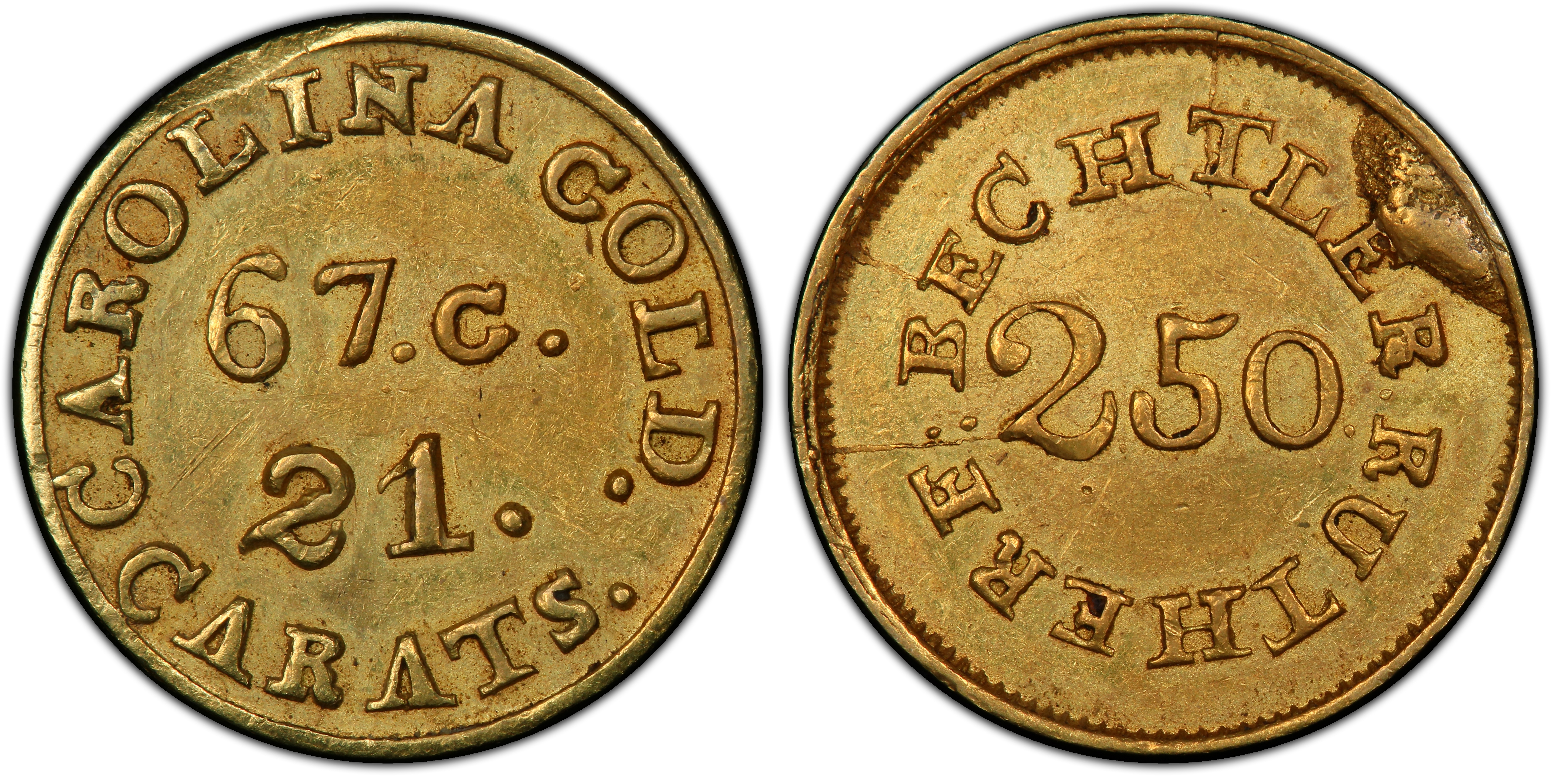
Obverse & Reverse
The Christopher Bechtler $2.50 gold piece is a tangible relic from America's first gold rush, an often-overlooked yet pivotal period in the nation's economic development that predates the more famous California discovery by decades. Beginning in the late 1790s and escalating through the 1820s, significant gold deposits were uncovered in the Piedmont region of North Carolina and Georgia. This influx of raw gold created a severe economic bottleneck. Miners and merchants were flush with gold dust and nuggets but lacked a practical medium of exchange. The only federal mint was in Philadelphia, a treacherous and time-consuming journey of hundreds of miles. Transporting gold to be coined was not only impractical but dangerous, effectively stifling local commerce. Into this monetary vacuum stepped Christopher Bechtler, a skilled German metallurgist, watchmaker, and gunsmith who had immigrated to the U.S. in 1829. After a brief stay in Philadelphia, he astutely relocated his family to the heart of the gold region, Rutherfordton, North Carolina, in 1830. Recognizing the local miners' plight, Bechtler established a private mint on his property in 1831. His operation was an immediate success, founded on a reputation for scrupulous honesty and accurate assays. For a modest fee, typically around 2.5%, he would convert raw gold into professionally struck coins of consistent weight and purity. This K-10 variety, struck between 1837 and 1842, reflects the maturity of his operation. By this time, the Bechtler mint was a cornerstone of the regional economy, so trusted that its coins circulated more freely than federal issues. Even after the U.S. government established branch mints in Charlotte (1838) and Dahlonega (1838) to serve the goldfields, Bechtler's operation continued to thrive, a testament to the quality and convenience he provided. These coins were not fiat currency but commodity money, their value derived directly from the gold they contained. They facilitated everything from daily commerce to large land transactions and were so well-regarded that some Confederate contracts during the Civil War were specified to be paid in Bechtler gold. The eventual decline of the Bechtler mint was tied to Christopher Sr.'s death in 1842 and the gradual petering out of the Carolina gold deposits, which was greatly accelerated by the mass exodus of miners to California after 1848. Today, the K-10 and other Bechtler issues are revered as foundational pieces of American private and territorial coinage, representing a crucial, entrepreneurial solution to a frontier economic crisis.
Associated EventCarolina Gold Rush
Reason For MintingTo convert locally mined raw gold into a standardized, convenient medium of exchange for commerce in a region distant from the federal mint.
Minter HistoryChristopher Bechtler, Sr. (1782-1842) was a German immigrant with extensive training as a goldsmith, watchmaker, and metallurgist. He arrived in Rutherford County, North Carolina, in 1830 and established his highly respected private mint in 1831. He produced over $2.2 million in gold coins across three denominations ($1, $2.50, $5) before his death in 1842. His operation was known for its integrity and the reliable purity of its coins, which became a trusted currency throughout the Southeast. After his death, the mint was continued by his son Augustus and later his nephew, also named Christopher, until the early 1850s.
Historical SignificanceBechtler's coinage was the most successful and prolific private minting operation east of the Mississippi. It solved a critical currency shortage during the nation's first gold rush, provided a vital service to miners, and established a trusted circulating medium that competed favorably with federal coinage, demonstrating the viability of private enterprise in currency production.
K-10
Denomination$2.50
Minting Periodca. 1837-1842
Assayer/MinterChristopher Bechtler, Sr.
Geographic OriginRutherfordton, North Carolina
Obverse DescriptionThe design is purely utilitarian, consisting entirely of inscriptions. The central device features the stated weight and purity, '67. G.' stacked above '21. CARATS'. The legend 'CAROLINA GOLD.' is arranged peripherally around the upper portion.
Obverse InscriptionCAROLINA GOLD. / 67. G. / 21. CARATS
Reverse DescriptionSimilar to the obverse, the reverse is functional and without imagery. The denomination '250' (for 250 cents, or $2.50) is prominently displayed in the center. The name of the minter and location, 'BECHTLER.', is inscribed above, with 'RUTHERF:' below.
Reverse InscriptionBECHTLER. / 250 / RUTHERF:
CompositionGold
Stated Fineness21 Carats (.875 fine)
Actual FinenessBechtler's coinage was known for its accuracy. Assays of surviving specimens confirm the fineness is generally very close to the stated 21 carats.
Weight4.31 grams
Diameter18.00 mm
EdgePlain
Unknown. No specific records were kept for individual varieties, but this is a scarcer type within the overall Bechtler coinage.
Survival EstimateFewer than 75 are believed to exist in all grades.
Rarity ScaleR-5 (Very Scarce)
This coin is highly prized for its direct connection to the pre-California Carolina Gold Rush, its status as one of the most successful private issues in U.S. history, and its charmingly crude, utilitarian design. It represents a pivotal moment in American economic and numismatic history.
Key VarietiesThe primary variety for K-10 is the regular strike as described. A notable characteristic sometimes seen on Bechtler coinage, including some $2.50 varieties, is the use of an inverted 'V' for the letter 'A' in the inscriptions, though this is more commonly associated with other K-numbers. No proof or presentation strikings are known from the original period of issue. Later restrikes by figures like Henry Chapman in the early 20th century exist for some August Bechtler issues, but not for this Christopher Bechtler K-10 variety.
Authentication TipsGenuine examples have a distinctively crude but sharp strike from hand-cut dies. The lettering often shows slight irregularities in placement and form. Surfaces should exhibit the soft, satiny luster of pioneer gold, not the hard, reflective fields of modern copies. Counterfeits often have a mushy or porous appearance from being cast, or incorrect details such as wrong lettering style, spacing, or weight. Specifically, look for a pebbly or granular surface on fakes. All Bechtler gold is non-magnetic. Weight is a critical diagnostic; the coin should be very close to its stated 67 grains (4.31 grams).
Shopping ConsiderationsA premium quality example for its grade is defined by a bold, well-centered strike, especially on the central denomination '250' and the weight '67. G.', which can often be weak. Original, uncleaned surfaces are paramount; look for a pleasing, often slightly reddish or orange-gold patina. Many surviving Bechtlers are found on irregular or slightly flawed planchets, which is typical and not necessarily a major detriment unless severe. Avoid examples that have been harshly cleaned, polished, or show evidence of tooling or repairs in the fields. A coin with minimal distracting marks and strong eye appeal will always command a significant premium.
A coin's grade is its condition, rated on a 1-70 scale. For rare coins, this is the most critical factor in determining value, as a tiny difference in preservation can mean a huge difference in price.
Relevant Grade TypesAll original Bechtler coins were struck as business strikes for circulation and are found in Circulated (1-58) and Mint State (MS, 60-70) grades. Due to their heavy use in commerce, most survivors are in circulated grades, with Mint State examples being exceptionally rare. No Proof (PR/PF) examples of this variety were struck during the original period of operation, and no later collector restrikes are known to exist.
Mint State CharacteristicsUncirculated examples are very rare. The strike is often somewhat soft in the centers, particularly on '250' and '67 G'. The luster is typically a soft, satiny texture rather than bright and flashy. The planchets were not always perfectly prepared, so minor natural flaws or adjustment marks may be present even on high-grade specimens. Contact marks are common due to the softness of the gold and the primitive handling practices of the era.
Circulated Wear PatternsWear first appears on the highest points of the coin, which are the numerals '250' on the reverse and '67. G.' on the obverse. As wear progresses, the peripheral lettering in 'CAROLINA GOLD' and 'BECHTLER' will begin to soften and merge with the fields. In lower grades (VG and below), the central numerals and letters may become faint and difficult to read, and the rims will show considerable wear.
Key Factors For ValueThe primary value driver is the grade, or state of preservation. Beyond the technical grade, surface quality is critical; an example with original, untouched skin and a pleasing reddish-gold color is far more desirable than a cleaned or polished coin of the same grade. Strike sharpness is also a major factor, with well-struck coins commanding significant premiums. Finally, certification by a top-tier grading service (PCGS or NGC) is standard, and a sticker from CAC (Certified Acceptance Corporation) indicating premium quality for the grade can add substantially to the coin's value.
PCGS Price Guide
| Grade | Price | Population |
|---|---|---|
| 8 | $5,500.00 | N/A |
| 10 | $6,000.00 | N/A |
| 12 | $6,500.00 | N/A |
| 15 | $7,000.00 | N/A |
| 20 | $8,250.00 | N/A |
| 25 | $9,000.00 | N/A |
| 30 | $10,000.00 | N/A |
| 35 | $11,000.00 | N/A |
| 40 | $14,000.00 | 3 |
| 45 | $15,500.00 | 1 |
| 45+ | $16,000.00 | N/A |
| 50 | $17,500.00 | 6 |
| 50+ | $18,500.00 | N/A |
| 53 | $20,000.00 | 1 |
| 53+ | $22,500.00 | N/A |
| 55 | $26,000.00 | 8 |
| 55+ | $28,500.00 | N/A |
| 58 | $30,000.00 | 2 |
| 58+ | $35,000.00 | N/A |
| 60 | $40,000.00 | 1 |
| 61 | $45,000.00 | 1 |
| 62 | $62,500.00 | 3 |
| 62+ | $70,000.00 | N/A |
| 63 | $85,000.00 | N/A |