(1834-37) $5 C. Bechtler, Carolina Gold (Regular Strike)
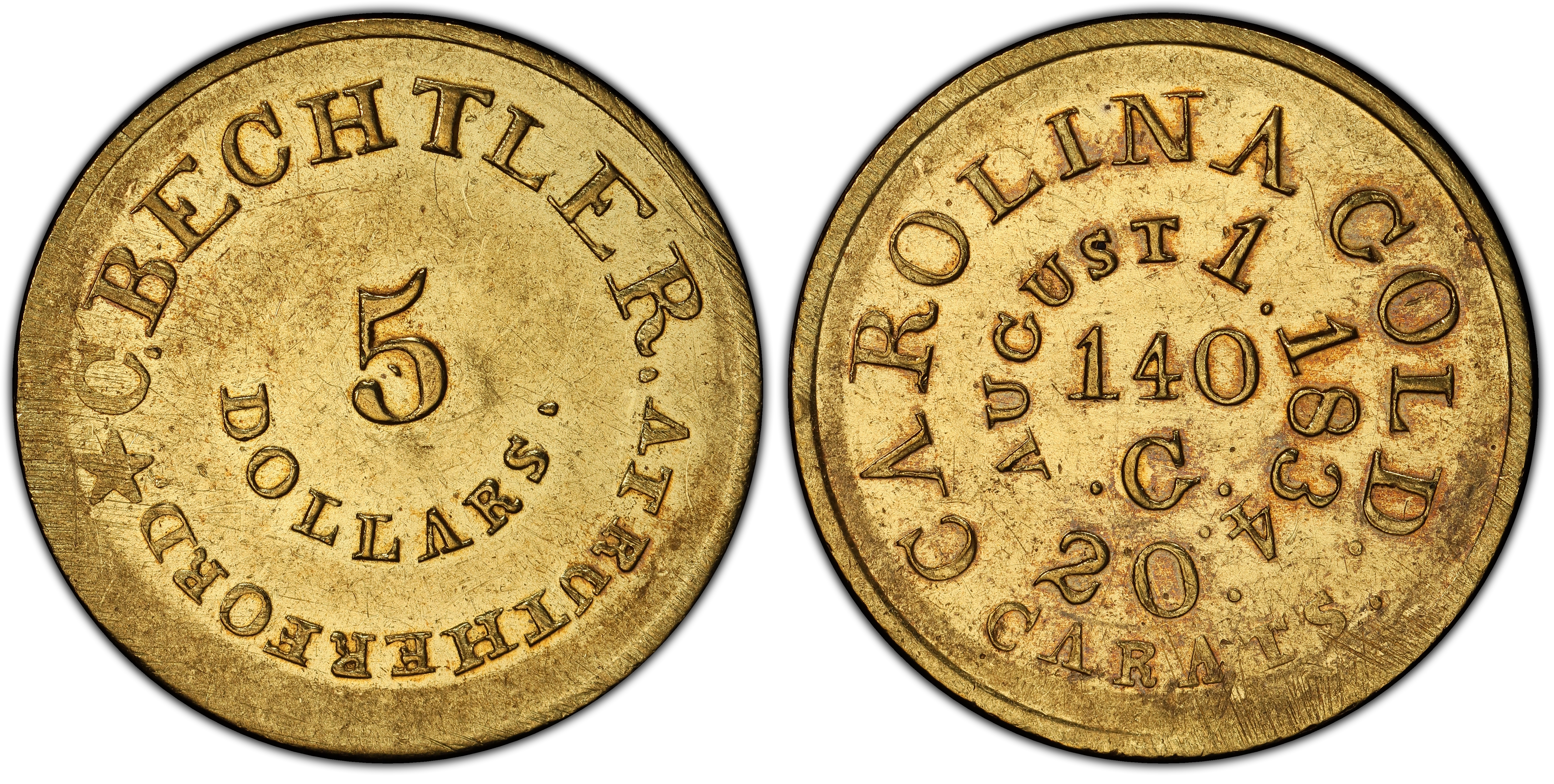
Obverse & Reverse
The Bechtler five-dollar gold piece of 1834-37 stands as a critical artifact of America's first gold rush and a testament to private enterprise solving a national monetary crisis. Following the discovery of gold in Cabarrus County, North Carolina, in 1799, the Piedmont region became the nation's primary source of gold for three decades. However, the gold dust and nuggets unearthed by thousands of miners created a paradox of wealth: despite an abundance of raw gold, there was a severe shortage of circulating specie. The only U.S. Mint was in distant Philadelphia, and the journey was long, dangerous, and costly for miners, who were forced to sell their gold at a discount to banks or use unreliable paper notes. Into this economic vacuum stepped Christopher Bechtler, a skilled German metallurgist, gunsmith, and watchmaker who had immigrated to the U.S. in 1829 and settled in the heart of the gold fields in Rutherfordton, North Carolina, by 1830. Recognizing the miners' plight, and after local petitions for a branch mint were denied, Bechtler established his own private mint in July 1831. His operation was an immediate success due to his well-earned reputation for honesty and accuracy; his fee was a modest 2.5%, significantly less than the costs associated with shipping to Philadelphia. The Bechtler mint produced gold dollars, quarter eagles, and half eagles that were of honest weight and fineness, quickly becoming the preferred medium of exchange throughout the Southeast. The U.S. government, initially wary, repeatedly tested his coins and found them to be of full, and sometimes superior, value. This specific series of five-dollar coins is particularly historic. On June 28, 1834, Congress passed a Coinage Act that reduced the weight of federal gold coins to combat their melting and export. To avoid any potential conflict with the federal government and to signify his coins' compliance with the new realities (though they were not bound by the law), Bechtler proactively stamped these coins with the date the act took effect: 'AUGUST 1, 1834.' This act of transparency further solidified public trust. The Bechtler mint continued to thrive even after the establishment of U.S. branch mints in Charlotte, NC, and Dahlonega, GA, in 1838, a remarkable feat demonstrating the high regard for his coinage. The family operation coined over $2.24 million in gold by 1840, a figure rivaling the federal mints. Today, these coins are numismatic icons, representing a pivotal period of American economic development and the ingenuity of a private citizen who created a trusted currency for an entire region.
Associated EventCarolina Gold Rush
Reason For MintingTo convert raw gold dust from the Carolina Gold Rush into a reliable, standardized circulating currency due to the prohibitive distance and cost of using the U.S. Mint in Philadelphia.
Minter HistoryChristopher Bechtler, Sr. (1782-1843) was a German-born watchmaker, jeweler, and metallurgist from the Grand Duchy of Baden. After immigrating to the United States in 1829, he settled in Rutherfordton, North Carolina, in 1830, drawn by the burgeoning gold rush. A man of exceptional skill and integrity, he established his private mint in 1831 at the request of local miners. He manufactured all his own equipment, including the dies and screw press. His operation was so successful and trusted that his coins circulated widely for decades, even after his death in 1842. The business was continued by his son, Augustus Bechtler, and later his nephew, Christopher Jr., until the early 1850s.
Historical SignificanceBechtler's coinage was the first significant and successful private currency in the United States, providing a vital medium of exchange for the entire Southeast during America's first gold rush and proving more trustworthy than many contemporary bank notes. The success and high quality of his mint directly spurred the U.S. government to establish branch mints in Charlotte and Dahlonega to reclaim control over the nation's gold coinage.
K-16 to K-19
Denomination$5
Minting Period1834-1837
Assayer/MinterChristopher Bechtler, Sr.
Geographic OriginRutherfordton, North Carolina
Obverse DescriptionThe central device consists of the date 'AUGUST 1, 1834.' surrounded by the weight '140. G.' and purity '20. CARATS.' The peripheral legend is 'CAROLINA GOLD.'
Obverse InscriptionCAROLINA GOLD. / AUGUST 1, 1834 / 140. G. / 20. CARATS
Reverse DescriptionThe central device is the denomination '5 / DOLLARS.'. The peripheral legend identifies the minter and location, 'C. BECHTLER. AT RUTHERFORD.', often with a star or other ornamentation.
Reverse InscriptionC. BECHTLER. AT RUTHERFORD. / 5 / DOLLARS
CompositionGold
Stated Fineness20 Carats
Actual FinenessApproximately 20 Carats (.833 fine). Bechtler's assays were known for their accuracy and honesty.
Weight9.07 grams
Diameter24.70 mm
EdgePlain or Reeded, depending on the variety.
Unknown for specific varieties, but the total Bechtler mintage was very large for the era. Massive melting occurred after the 1834 Coinage Act increased the value of gold, making all pre-act coins worth more than face value.
Survival EstimateFewer than 100 known for the key K-17 variety; other varieties are similarly rare. All are considered very scarce to rare.
Rarity ScaleR-5 (Very Scarce) to R-6 (Very Rare)
This coin is highly coveted as a tangible piece of America's first gold rush, a classic Territorial issue from a widely respected private minter, and a historically significant issue due to the 'AUGUST 1, 1834' date. It appeals to collectors of pioneer gold, Southern history, and early U.S. numismatics.
Key VarietiesThe primary varieties struck from 1834-1837 are distinguished by Kagin numbers: - K-16: Reeded Edge. Reverse legend ends with 'RUTHERFORD'. - K-17: Plain Edge. Reverse legend ends with 'RUTHERFORD.' (with period). Considered a key variety. - K-18: Plain Edge. Reverse legend ends with 'RUTHERF:'. - K-19: Plain Edge. Similar to K-18, but the '20' on the obverse is positioned farther from 'CARATS'. No original Proofs are known. However, famed coin dealer Henry Chapman acquired original August Bechtler dies and produced a small number of Proof restrikes around 1920. These are extremely rare, numismatically distinct from the original circulation strikes, and highly valuable.
Authentication TipsAuthentic Bechtler coins have a characteristic 'homemade' but precise look. The lettering is often simple and not perfectly aligned. Surfaces frequently show planchet adjustment marks, which are parallel lines made before striking to correct the weight. Be wary of coins with a mushy or cast-like appearance. Modern fakes may have incorrect lettering styles or a soapy luster. Counterfeits from the era were often gold-plated brass. Authentication by a major grading service (PCGS or NGC) is highly recommended.
Shopping ConsiderationsA premium quality example for its grade will possess original, uncleaned surfaces, often with a distinctive greenish-gold or reddish-gold hue. Strike quality varies; look for sharpness in the central inscriptions (date and denomination) and clear peripheral legends. Many examples are weakly struck in areas. Planchet quality can be crude, but examples without major, distracting fissures or laminations are preferred. Avoid coins that have been tooled, harshly cleaned, or show evidence of 'engraving' where someone has traced the letters with a sharp tool to 'improve' their appearance. Eye appeal is paramount for this series.
A coin's grade is its condition, rated on a 1-70 scale. For rare coins, this is the most critical factor in determining value, as a tiny difference in preservation can mean a huge difference in price.
Relevant Grade TypesAll original Bechtler coins were business strikes intended for commerce and are found in Circulated (1-58) and Mint State (MS, 60-70) grades. No Proofs were struck during the original period of issue. Later-date Proof restrikes, such as the Chapman issues made circa 1920 from original dies, exist but are entirely separate numismatic items valued for their unique history and rarity.
Mint State CharacteristicsUncirculated examples are very rare. A typical Mint State Bechtler $5 exhibits a soft, satiny luster rather than a hard, frosty one. The strike is often somewhat soft, particularly in the center of the obverse and reverse. Small, scattered contact marks are common due to the softness of the gold and rudimentary handling at the mint. Original planchet adjustment marks are not considered defects but are part of the coin's character. The finest known examples possess exceptional luster and a bold strike for the issue.
Circulated Wear PatternsWear first appears on the highest points of the lettering and numbers. On the obverse, friction will first dull the '1834' in the date and the number '20'. On the reverse, the number '5' and the letters in 'BECHTLER' will show the first signs of flattening. In lower grades (VG and below), the peripheral legends become weak and parts of the date may be illegible.
Key Factors For ValueThe primary value driver is surface preservation. An example with original, undisturbed skin and attractive color will command a significant premium over one that has been cleaned or polished, even if in the same technical grade. Secondly, strike sharpness is important; well-struck coins with full legends are highly desirable. Thirdly, problem-free surfaces without distracting damage (rim bumps, harsh scratches, or tooling) are essential. Finally, for this specific issue, a CAC sticker adds a considerable premium, confirming the quality and eye appeal for the assigned grade.
PCGS Price Guide
| Grade | Price | Population |
|---|---|---|
| 8 | $3,500.00 | N/A |
| 10 | $4,000.00 | N/A |
| 12 | $4,500.00 | N/A |
| 15 | $5,000.00 | N/A |
| 20 | $6,000.00 | N/A |
| 25 | $6,750.00 | 1 |
| 30 | $7,250.00 | 1 |
| 35 | $8,500.00 | 3 |
| 40 | $10,500.00 | 7 |
| 45 | $13,500.00 | 4 |
| 45+ | $14,000.00 | N/A |
| 50 | $14,500.00 | 12 |
| 50+ | $15,000.00 | N/A |
| 53 | $15,500.00 | 10 |
| 53+ | $17,500.00 | N/A |
| 55 | $20,000.00 | 10 |
| 55+ | $22,500.00 | N/A |
| 58 | $25,000.00 | 7 |
| 58+ | $30,000.00 | N/A |
| 60 | $35,000.00 | N/A |
| 61 | $45,000.00 | 7 |
| 61+ | N/A | N/A |
| 62 | $55,000.00 | 3 |
| 62+ | $62,500.00 | N/A |
| 63 | $80,000.00 | N/A |
| 65 | N/A | N/A |