(1842-52) $5 A. Bechtler 128 Grains, 22 Carats (Regular Strike)
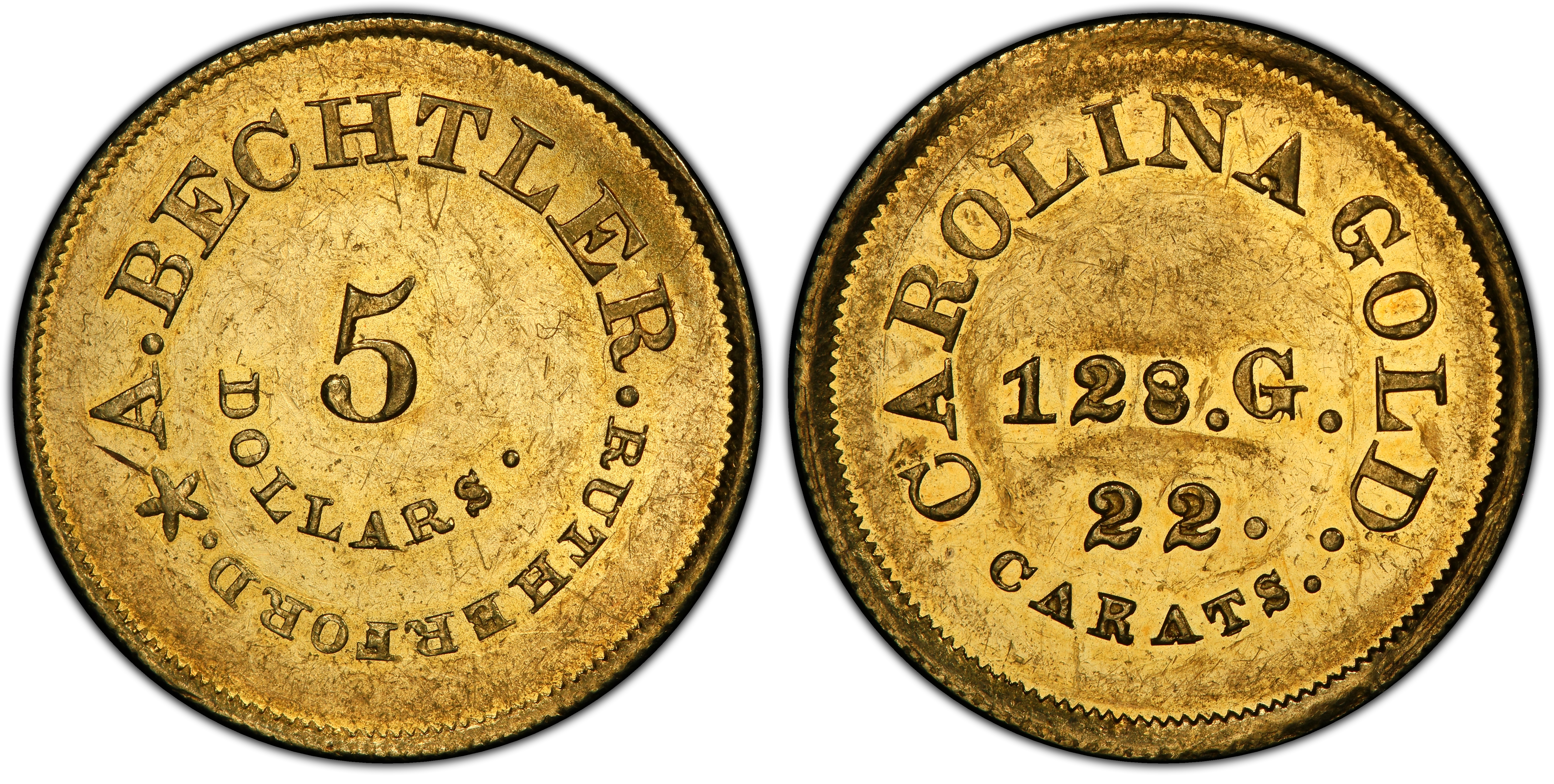
Obverse & Reverse
The Augustus Bechtler $5 gold piece is a tangible relic of America's first gold rush, a period of intense economic activity in the Appalachian foothills of North Carolina and Georgia that predated the more famous California rush by two decades. From the late 1820s, miners extracted significant quantities of gold, but the region suffered from a chronic shortage of reliable currency. Transporting raw gold dust and nuggets over 500 miles to the U.S. Mint in Philadelphia was a perilous and impractical journey. Into this economic vacuum stepped Christopher Bechtler, Sr., a skilled German metallurgist who immigrated to Rutherfordton, North Carolina, in 1830. Recognizing the miners' plight, he established a private mint in 1831, offering to convert their gold into coins for a small fee. The Bechtler mint was a model of efficiency and, crucially, integrity. U.S. government assays repeatedly confirmed that Bechtler's coins met or exceeded their stated weight and fineness, fostering immense public confidence. Their coinage became the de facto currency of the Southeast, so trusted that it circulated widely even after the establishment of U.S. Branch Mints in Charlotte (1838) and Dahlonega (1838). In 1842, following his father's death, Augustus Bechtler took control of the family enterprise. He continued the tradition of minting high-quality coinage, introducing his own 'A. BECHTLER' dies. The K-28 variety, with its explicit declaration of '128.G.' (Grains) and '22. CARATS.', represents this later period of the mint's operation. These coins were workhorses of commerce, struck not for numismatic posterity but to facilitate trade in a gold-rich but cash-poor economy. Their simple, utilitarian design belies their profound historical importance. The Bechtler operation as a whole coined over $2.24 million in gold between 1831 and 1840 alone, a staggering sum that fueled the region's economy and proved the viability of private coinage in the young republic, setting a precedent for the territorial issues that would follow during the western expansion.
Associated EventAppalachian Gold Rush (North Carolina/Georgia)
Reason For MintingTo provide a reliable and convenient medium of exchange for miners and merchants during the Appalachian gold rush, alleviating a severe currency shortage.
Minter HistoryAugustus Bechtler was the son of Christopher Bechtler, Sr., founder of the most successful private mint in U.S. history. Trained as a metallurgist and watchmaker by his father, Augustus took over the family's lucrative coining business in Rutherfordton, North Carolina, upon his father's death in 1842. He continued minting $1, $2.50, and $5 gold pieces, updating the dies to bear his initial, 'A.'. While his father's reputation was unimpeachable, some contemporary accounts and modern analysis suggest that the quality control under Augustus, and later his cousin Christopher Jr., may have occasionally lapsed, though his coinage was still widely accepted. He operated the mint until the early 1850s, by which time the California gold rush had eclipsed the Carolina gold fields in production and national importance.
Historical SignificanceThis coin is a direct link to the second generation of America's most respected and prolific private mint. It represents the continuation of a trusted currency system that was vital to the economy of the southeastern United States, demonstrating the critical role private enterprise played in filling monetary gaps left by the federal government during a period of rapid growth and resource discovery.
K-28
Denomination$5
Minting Period1842-1852
Assayer/MinterAugustus Bechtler
Geographic OriginRutherfordton, North Carolina
Obverse DescriptionThe obverse design is purely informational. In the center are the inscriptions '128.G.' and '22. CARATS.' arranged in two lines. The legend 'CAROLINA GOLD' is inscribed around the upper periphery, with the word 'CARATS' completing the lower periphery.
Obverse InscriptionCAROLINA GOLD / 128.G. / 22. / CARATS
Reverse DescriptionThe reverse is similarly utilitarian. In the center, the denomination '5' is prominent, with the word 'DOLLARS' curving beneath it. The minter's name and location, 'A. BECHTLER' and 'RUTHERFORD', encircle the central design, separated by a star on some varieties.
Reverse InscriptionA. BECHTLER. / RUTHERFORD / 5 / DOLLARS
CompositionGold
Stated Fineness22 Carats (0.9167 fine)
Actual FinenessGenerally found to be very close to the stated fineness, maintaining the family's reputation for honesty.
Weight8.29 grams
Diameter24.50 mm
EdgeReeded
Unknown for this specific variety; part of the mint's total output.
Survival Estimate31-75 coins known
Rarity ScaleR-6 (Very Rare)
Sought for its direct connection to the pre-California Appalachian gold rush and the famed Bechtler family. As a product of the most successful private mint in U.S. history, it holds a key place in the territorial gold series. Its rarity as an R-6 variety adds significant allure.
Key VarietiesThe primary variety is the K-28 business strike. Augustus Bechtler also produced other $5 varieties with different weights and fineness, such as the K-27 (134 Grains, 21 Carats) and K-29 (141 Grains, 20 Carats). While not specifically of this K-28 variety, collectors should be aware of the famous 'Chapman Restrikes'. Around 1920, Philadelphia coin dealer Henry Chapman acquired original Bechtler dies and produced a small number of Proof restrikes of other Bechtler types. These are distinct collector items, struck on planchets with plain edges and sharp proof surfaces, and are extremely rare.
Authentication TipsGenuine examples possess a distinctive, somewhat crude but sharp quality from a hand-operated screw press. Check for a properly formed reeded edge. Counterfeits often exhibit a soft, mushy appearance on the lettering or may have incorrect weight or specific gravity. The planchet may show parallel striations from the drawing process. Look for known die characteristics of the K-28 variety; some specimens are noted to have a slightly 'pinched' look on the rim at the 3 and 9 o'clock positions, a useful diagnostic.
Shopping ConsiderationsA premium quality example for its grade will exhibit a bold strike on the central elements (128.G, 22, 5 DOLLARS). The peripheral legends, particularly 'A. BECHTLER' and 'RUTHERFORD', are often softly struck, which is characteristic of the issue and not necessarily a flaw. Look for lustrous, original surfaces; many survivors are heavily circulated or have been cleaned. Attractive examples often display a pleasing reddish or greenish-gold patina resulting from the natural copper alloy. Avoid specimens with significant, distracting marks, edge bumps, or evidence of tooling or repairs.
A coin's grade is its condition, rated on a 1-70 scale. For rare coins, this is the most critical factor in determining value, as a tiny difference in preservation can mean a huge difference in price.
Relevant Grade TypesOriginal period issues were business strikes intended for circulation, and are found in Circulated (1-58) and Mint State (MS, 60-70) grades. No Proofs were struck by Augustus Bechtler during the original period of issue. Any Bechtler coin in Proof is a later-date restrike (like the Chapman issues) and should be understood as a separate and distinct numismatic item.
Mint State CharacteristicsAn uncirculated K-28 typically displays a bright, satiny luster, sometimes with semi-prooflike fields. The strike can be inconsistent; the central denominations and weights are usually bold, but the lettering around the circumference is often weaker. The planchets were not always perfectly prepared, so minor natural striations or imperfections may be present and are acceptable. Contact marks from handling are common due to the softness of the high-karat gold.
Circulated Wear PatternsWear first appears on the highest points of the numbers and letters on both sides. On the obverse, the numbers '128' and '22' will show friction. On the reverse, the '5' and the word 'DOLLARS' are the high points. As wear progresses, the legends begin to weaken and the fields will lose their luster, becoming dull and showing fine scratches.
Key Factors For ValueThe primary drivers of value are grade and surface originality. A coin with its original 'skin' and luster, free from harsh cleaning or polishing, will command a significant premium. The sharpness of the strike is a major factor; a well-struck example with full peripheral legends is highly desirable. Eye appeal, including attractive natural toning, adds to the value. For this issue, a CAC sticker confirming quality for the grade provides a substantial boost in collector confidence and market price.
PCGS Price Guide
| Grade | Price | Population |
|---|---|---|
| 8 | $6,750.00 | N/A |
| 10 | $7,500.00 | N/A |
| 12 | $8,750.00 | N/A |
| 15 | $9,500.00 | N/A |
| 20 | $10,500.00 | 1 |
| 25 | $12,000.00 | 1 |
| 30 | $13,500.00 | N/A |
| 35 | $16,000.00 | N/A |
| 40 | $20,000.00 | N/A |
| 45 | $25,000.00 | 6 |
| 45+ | $27,500.00 | N/A |
| 50 | $30,000.00 | 3 |
| 50+ | $32,500.00 | N/A |
| 53 | $37,500.00 | 4 |
| 53+ | $42,500.00 | N/A |
| 55 | $47,500.00 | 1 |
| 55+ | $52,500.00 | N/A |
| 58 | $57,500.00 | 1 |
| 58+ | $65,000.00 | N/A |
| 60 | $77,500.00 | N/A |
| 61 | $85,000.00 | 1 |