(1834-37) $5 "C:" Bechtler, Carolina Gold Plain Edge (Regular Strike)
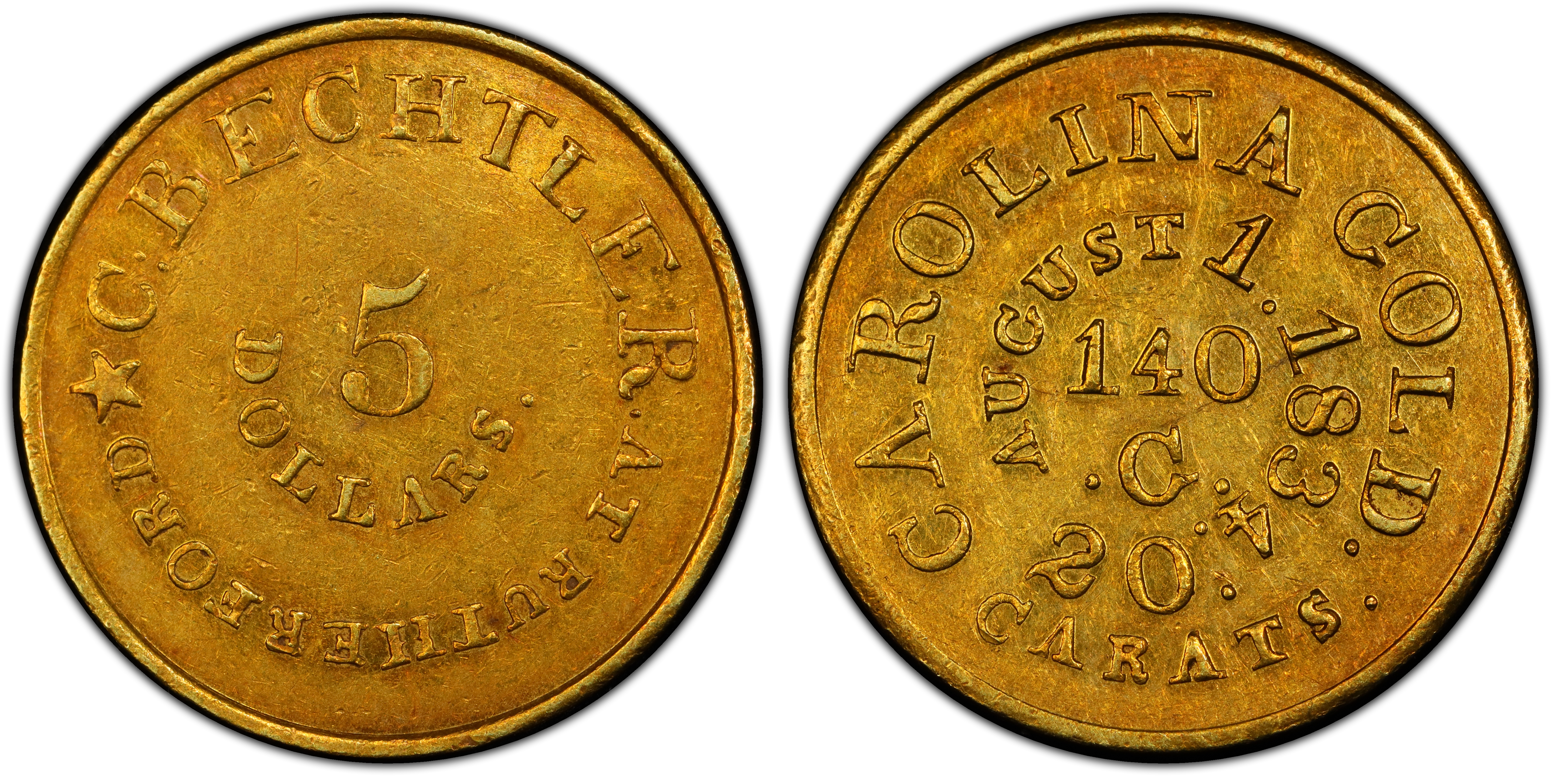
Obverse & Reverse
The Bechtler five-dollar gold piece stands as a tangible monument to America's first gold rush, an era centered not in California, but in the Piedmont region of North Carolina and Georgia. Beginning in 1799, discoveries of gold created a burgeoning mining industry, but the region suffered from a severe shortage of circulating specie. Miners and merchants were forced to transact business with raw gold dust, an inefficient and insecure medium of exchange. The only federal mint was in Philadelphia, a treacherous and costly journey for Southern gold producers. Recognizing this critical economic need, Christopher Bechtler, Sr., a highly skilled German immigrant watchmaker and metallurgist, established a private mint on his property in Rutherfordton, North Carolina, in July 1831. His reputation for honesty and the accuracy of his coinage quickly won the public's trust, a stark contrast to the failed private minting attempt by Templeton Reid in Georgia a year earlier. Bechtler's integrity was so renowned that his coins were preferred over federal issues in the region and even traded at a premium during the Civil War. The variety known as Kagin-17 was struck following the U.S. Coinage Act of June 28, 1834, which reduced the weight of federal gold coins. To maintain public confidence and align with the new federal standard, Bechtler ingeniously inscribed the obverse with 'AUGUST 1, 1834,' the date the act took effect, thereby signaling that his coins conformed to the new, lighter weight standards. This transparent approach cemented his status as a reliable minter. For a modest fee of around 2.5%, Bechtler would convert raw gold into well-struck coins, a service that proved indispensable to the regional economy. His mint processed over $2.24 million in gold between 1831 and 1840, producing the nation's first-ever gold dollars in 1832, a full 17 years before the U.S. Mint. The Bechtler mint continued operations under his son, August, and later his nephew, Christopher Jr., until the early 1850s, but the coins of Christopher Sr. are the most highly regarded for their consistent weight and purity.
Associated EventCarolina Gold Rush
Reason For MintingTo convert raw gold dust from the Carolina Gold Rush into a reliable, standardized medium of exchange for local commerce due to the distance and difficulty of reaching the U.S. Mint in Philadelphia.
Minter HistoryChristopher Bechtler, Sr. (1782-1842) was a German watchmaker, gunsmith, and metallurgist from the Grand Duchy of Baden. He immigrated to the United States in 1829 with his family, initially settling in Philadelphia before moving to Rutherfordton, North Carolina, in 1830, drawn by the burgeoning gold rush. A craftsman of immense skill and unimpeachable integrity, he established his private mint in 1831 at the request of local miners and merchants. He manufactured his own dies and coining press. His coinage was known for its consistent weight and fineness, earning widespread public trust and acceptance. He operated the mint until his death in 1842, after which his son Augustus and nephew Christopher Jr. continued the business.
Historical SignificanceBechtler's coinage was the most successful and trusted private currency of the pre-Civil War era, providing a vital economic service during America's first gold rush and setting a standard for private minting integrity. His operation also produced the first gold dollar in American history, predating the federal version by nearly two decades.
K-17
Denomination$5
Minting Period1834-1837
Assayer/MinterChristopher Bechtler, Sr.
Geographic OriginRutherfordton, North Carolina
Obverse DescriptionThe obverse is purely informational, lacking any pictorial device. The central inscription is arranged in four lines, stating the date the new federal weight standard took effect, the coin's weight, and its purity. The periphery is inscribed with the origin of the gold and the carat value.
Obverse InscriptionCAROLINA GOLD / AUGUST 1, 1834 / 140. G. / 20. CARATS.
Reverse DescriptionThe reverse features the denomination '5 / DOLLARS' in the center, encircled by the minter's name and location. A single five-pointed star is often present in the legend.
Reverse InscriptionC. BECHTLER . AT RUTHERFORD . / 5 / DOLLARS
CompositionGold
Stated Fineness20 Carats
Actual FinenessApproximately 20 Carats (.833 fine); Bechtler's coins were known for their accurate, if not slightly generous, gold content relative to their stated value.
Weight9.07 grams
Diameter24.70 mm
EdgePlain
Unknown
Survival EstimateFewer than 100 known in all grades.
Rarity ScaleR-5
This coin is highly prized as a key artifact from America's first gold rush, representing the most respected private minter of the era. Its simple, utilitarian design, historical connection to the pre-Charlotte Mint South, and tangible link to Christopher Bechtler's legendary honesty make it a cornerstone of any Territorial gold collection.
Key VarietiesThe primary varieties of the C. Bechtler $5 coinage are defined by the inscriptions (CAROLINA, NORTH CAROLINA, or GEORGIA GOLD), the stated weight and carats, and the edge type (plain or reeded). The K-17 is the plain edge 'CAROLINA GOLD' 140 grains, 20 carats variety. Other varieties from the same period include K-18 (abbreviated 'RUTHERF:') and K-19 (wider spacing in '20 CARATS'). No patterns or trial pieces from the original period are confirmed. However, collectors should be aware of the Chapman restrikes, produced in 1908 by Philadelphia coin dealer S.H. Chapman using discarded, heavily rusted dies he had acquired. These pieces, including K-31 (a restrike of a C. Bechtler $5), are numismatically significant but are fantasy pieces, not original issues, and are identifiable by their pitted, rusty surfaces and often weak strikes.
Authentication TipsGenuine Bechtler coins possess a distinctive, somewhat crude but sharp style of lettering from hand-cut dies. The 'A' punch used by Bechtler is often an inverted 'V', sometimes with a faint crossbar. The planchets are often imperfect, with minor, natural flaws. Counterfeits may appear too perfect, have incorrect lettering fonts, or show casting bubbles. Weight is a critical diagnostic; genuine pieces should be very close to the stated 140 grains (9.07 grams). Any significant deviation is a major red flag. Surface characteristics are also key; look for original, non-prooflike surfaces, as many pieces exhibit a soft, satiny luster from the coining process.
Shopping ConsiderationsA premium quality example for its grade will exhibit a bold, well-centered strike, especially on the central inscriptions which can sometimes be weak. Look for original, uncleaned surfaces with a pleasing reddish or greenish-gold patina. Many surviving examples are plagued by adjustment marks, scratches, or other circulation damage; a coin with minimal distracting marks commands a significant premium. Planchet quality varies, and some minor natural flaws are expected and accepted. Avoid examples that have been harshly cleaned, polished, or show signs of tooling or edge damage. Eye appeal is paramount for this issue; a circulated coin with honest wear and attractive original color is far more desirable than a higher-graded but lifeless, cleaned specimen.
A coin's grade is its condition, rated on a 1-70 scale. For rare coins, this is the most critical factor in determining value, as a tiny difference in preservation can mean a huge difference in price.
Relevant Grade TypesAll original Bechtler issues were business strikes intended for commerce and are found in Circulated (1-58) and Mint State (MS, 60-70) grades. No Proofs were struck during the original minting period. The aforementioned Chapman issues are later-date fantasy restrikes and are collected as separate numismatic items, not as original Proofs.
Mint State CharacteristicsUncirculated examples are exceptionally rare. A true Mint State Bechtler $5 will exhibit a soft, satiny luster that is sometimes semi-reflective but not fully prooflike. The strike is a key consideration; many were not perfectly struck, so a coin with sharp, clear lettering across the entire face is rare and desirable. Due to the softness of the high-purity gold and the primitive minting environment, small, scattered planchet flaws or contact marks are common and should be expected, even on high-grade specimens. The overall eye appeal, combining luster, strike, and color, is the ultimate determinant of quality.
Circulated Wear PatternsWear first becomes evident on the highest points of the letters and numbers on both the obverse and reverse. The central inscriptions, 'AUGUST 1, 1834' and '5 DOLLARS', will show initial flattening. As wear progresses, the peripheral legends 'CAROLINA GOLD' and 'C. BECHTLER AT RUTHERFORD' will begin to soften. On lower grade examples, the digits of the date and the grains/carats become difficult to read, and the entire coin takes on a smooth, worn appearance.
Key Factors For ValueFor the Bechtler K-17, value is driven by four primary factors: 1) Grade and surface preservation – original, uncleaned surfaces are critical and command huge premiums. 2) Strike quality – a sharp, well-defined strike is rare and highly sought after. 3) Eye appeal – coins with attractive, original reddish-gold or greenish-gold toning are prized by advanced collectors. 4) Provenance – specimens with a pedigree to famous collections like the Eric P. Newman collection carry additional prestige and value. A CAC sticker is particularly valuable for this series, as it confirms both the grade and the quality of the surfaces for the assigned grade.
PCGS Price Guide
| Grade | Price | Population |
|---|---|---|
| 55 | $120,000.00 | 1 |