(1834-37) G$1 C. Bechtler, 28.G High Reeded Edge (Regular Strike)
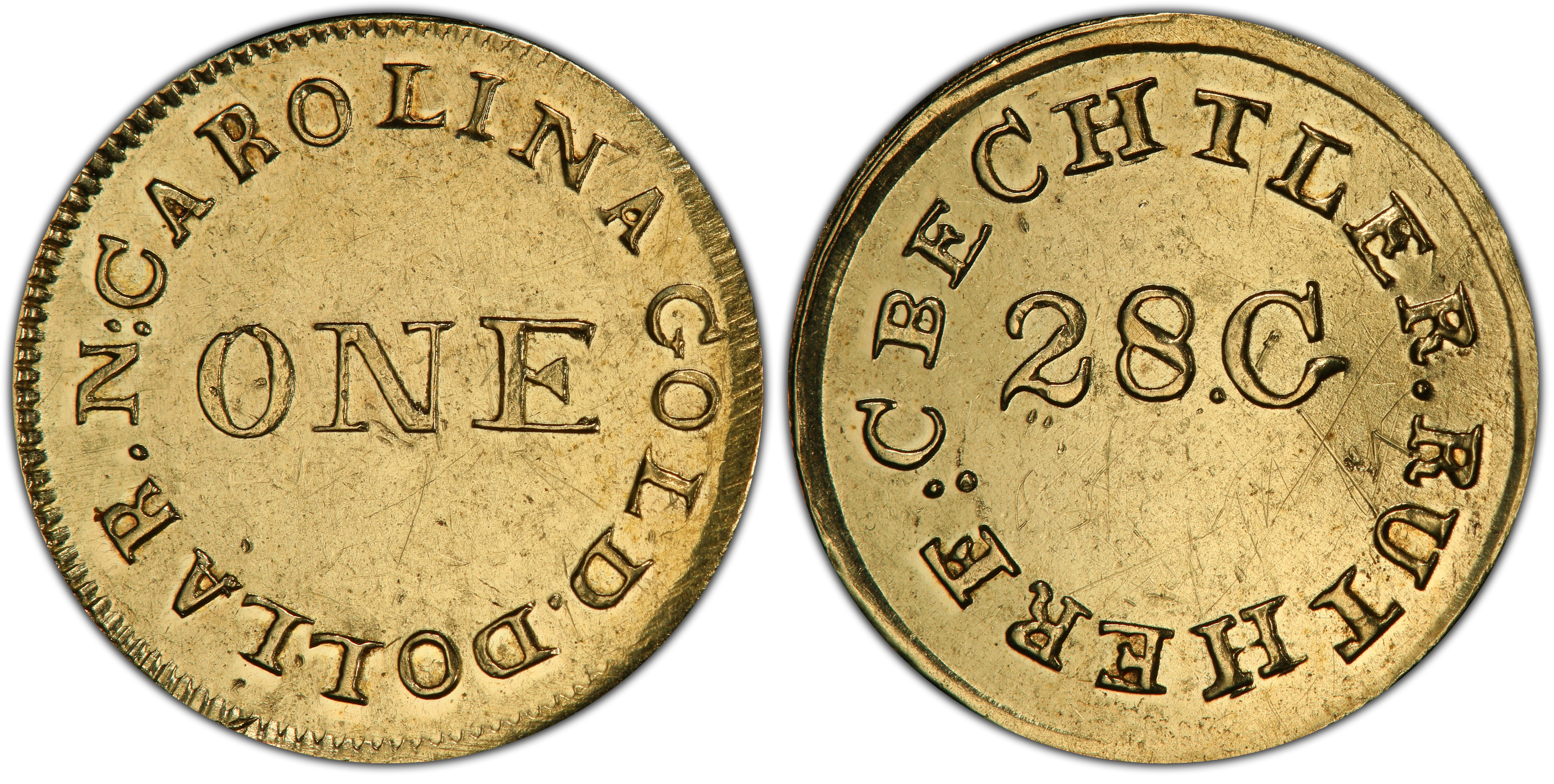
Obverse & Reverse
The Bechtler gold dollar, Kagin-2, stands as a pivotal artifact from America's first gold rush, a period when the nation's monetary system was in flux and private enterprise filled a crucial void. Following the discovery of gold in North Carolina in 1799, the Piedmont region became the epicenter of domestic gold production. However, miners and merchants faced a significant dilemma: the only Federal Mint was in Philadelphia, a perilous and costly journey away. The local economy was starved for circulating specie, forced to transact in unreliable paper bank notes or cumbersome gold dust. This economic friction created a ripe opportunity for Christopher Bechtler, a German immigrant and master metallurgist who had settled in Rutherfordton, North Carolina, in 1830. Recognizing the community's need, and at the urging of local miners, Bechtler established a private mint in 1831. His reputation for honesty and the consistent purity of his coins quickly made them the preferred currency in the region. The K-2 variety, struck in 1834, represents a direct response to the U.S. Coinage Act of June 28, 1834. This act altered the official weight standard for federal gold coins. Bechtler, ever astute, promptly adjusted his own coinage, reducing the weight of his gold dollar from 30 grains to 28 grains to align with the new federal standard of 20-carat purity. This particular variety is distinguished by the high placement of '28.G.' on the obverse, suggesting it was an early die pairing of this new standard. The reeded edge, a feature intended to prevent clipping and enhance the coin's appearance, was meticulously applied by Bechtler's custom-made machinery. Despite competition from the newly established U.S. Branch Mints in Charlotte (1838) and Dahlonega (1838), Bechtler's coinage remained so trusted that it circulated on par with federal issues for decades, a testament to the integrity of his private enterprise in an era of national expansion.
Associated EventNorth Carolina Gold Rush
Reason For MintingTo convert locally mined raw gold into a standardized, reliable circulating medium for commerce due to the great distance and danger of shipping gold to the U.S. Mint in Philadelphia.
Minter HistoryChristopher Bechtler, Sr. (1782-1842) was a German-born watchmaker, jeweler, and metallurgist from the Grand Duchy of Baden. He immigrated to the United States in 1829 with his sons, Augustus and Charles, and a nephew, also named Christopher. After a brief stay in Philadelphia, the family was drawn to the heart of America's first gold rush in Rutherfordton, North Carolina, in 1830. A skilled artisan with an impeccable reputation for integrity, Bechtler began coining gold in 1831. He manufactured his own dies and screw press, producing coins of such consistent weight and purity that they were universally accepted in commerce, often preferred over bank notes. His operation was the most successful and prolific private mint in the eastern United States, producing over $2.24 million in gold coins by 1840. He created the nation's first gold dollar in 1832, seventeen years before the U.S. government. After his death in 1842, the mint was continued by his son Augustus and later his nephew until the early 1850s.
Historical SignificanceThis coin is the earliest gold dollar struck to the 20-carat, 28-grain standard adopted by Christopher Bechtler following the U.S. Coinage Act of 1834, representing a key transition in his highly successful private minting operation. It is a tangible link to America's first gold rush and the critical role of private coinage in the economic development of the antebellum South.
K-2
Denomination$1
Minting Period1834
Assayer/MinterChristopher Bechtler, Sr.
Geographic OriginRutherfordton, North Carolina
Obverse DescriptionThe central design element is the name of the minter, 'C. BECHTLER.', arranged in an arc. Below this is the location, 'RUTHERF:'. The denomination is expressed by the weight '28.G.', placed high in the field above the minter's name.
Obverse InscriptionC.BECHTLER. / RUTHERF: / 28.G.
Reverse DescriptionThe central inscription 'ONE' is surrounded by 'N:CAROLINA GOLD' in an arc above and 'DOLLAR' in an arc below, with dots separating the legends.
Reverse InscriptionN:CAROLINA GOLD / ONE / DOLLAR
CompositionGold
Stated Fineness20 Carats
Actual FinenessApproximately 20 Carats (.833)
Weight1.81 grams
Diameter18.00 mm
EdgeReeded
Unknown, but very small; struck for less than a year.
Survival EstimateApproximately 20 examples known.
Rarity ScaleR-6
The K-2 is highly coveted as a landmark issue in the territorial gold series. It represents the first Bechtler dollar struck on the new 28-grain standard and is significantly rarer than its 30-grain predecessor. Its crude, handmade charm and direct connection to the Appalachian gold rush make it a centerpiece for advanced collectors.
Key VarietiesThe primary variety is the Reeded Edge (K-2). An extremely rare Plain Edge variety (K-2a) also exists, with only a few known specimens. No patterns, trial pieces, or later-date restrikes are known for this specific variety.
Authentication TipsAuthentic examples exhibit a distinctive, somewhat crude but sharp strike from hand-engraved dies. The lettering has a unique, slightly irregular character. Planchets are often slightly uneven. Counterfeits are typically identified by a soft, cast-like appearance, incorrect weight, improper lettering font, and unnatural surface color. Many contemporary counterfeits were gold-plated brass. Genuine pieces will have the density and ring of true gold. Diagnostics include the specific letter placement and the distinctive colon after 'RUTHERF:'.
Shopping ConsiderationsA premium quality example for its grade will show a bold strike, particularly on the central inscriptions 'C.BECHTLER.' and 'ONE'. Look for original, uncleaned surfaces that exhibit the characteristic reddish-gold or greenish-gold hue of Appalachian gold. While some light adjustment marks are common and acceptable, avoid coins with heavy scratches, rim damage, or signs of tooling. The reeding should be distinct, though it may not be perfectly uniform. Luster on Mint State examples is typically soft and satiny rather than deeply prooflike. Eye appeal is paramount; a choice, original coin will always command a significant premium over a cleaned or damaged specimen of the same grade.
A coin's grade is its condition, rated on a 1-70 scale. For rare coins, this is the most critical factor in determining value, as a tiny difference in preservation can mean a huge difference in price.
Relevant Grade TypesAll original Bechtler issues were business strikes intended for circulation and are found in Circulated (1-58) and Mint State (MS, 60-70) grades. No Proofs were struck during the original period of issue, and no later-date Proof restrikes of this variety are known to exist. Any coin claiming to be a 'Proof' would be highly suspect.
Mint State CharacteristicsUncirculated examples are exceptionally rare. A typical Mint State K-2 will exhibit a soft, satiny luster, often with a slightly granular texture resulting from the unrefined nature of the gold. The strike is almost never perfectly centered or fully struck-up; weakness on the peripheral letters and the reeding is common. Planchets are characteristically irregular. Small, inherent planchet flaws or light adjustment marks made at the mint to correct weight are not uncommon and should be distinguished from post-minting damage. The natural toning of the unalloyed gold is a key indicator of originality.
Circulated Wear PatternsWear first appears on the highest points of the letters in 'BECHTLER' and 'ONE'. As wear progresses, the finer details of the peripheral lettering will begin to soften. On the obverse, the minter's name and location will show flattening, and on the reverse, the word 'ONE' and the surrounding legend will lose their sharp edges. In lower grades (VG and below), the inscriptions may become partially illegible, though the coin's fundamental design remains bold.
Key Factors For ValueFor the Bechtler K-2, value is driven primarily by rarity and grade. Surface quality is paramount; an example with original 'skin' and minimal distracting marks is far more desirable than a harshly cleaned or polished piece. The quality of the strike is also a major factor; coins with unusually sharp and well-centered impressions command strong premiums. Eye appeal, defined by attractive original color and problem-free surfaces, is critical. Given the coin's rarity, any certified example is significant, but a coin verified for quality by CAC (Certified Acceptance Corporation) will often realize a substantial premium, as it confirms the piece is superior for its assigned grade.
PCGS Price Guide
| Grade | Price | Population |
|---|---|---|
| 8 | $7,500.00 | N/A |
| 10 | $8,000.00 | N/A |
| 12 | $9,000.00 | N/A |
| 15 | $10,000.00 | 1 |
| 20 | $11,500.00 | N/A |
| 25 | $12,500.00 | 1 |
| 30 | $14,000.00 | 1 |
| 35 | $15,000.00 | N/A |
| 40 | $17,000.00 | N/A |
| 45 | $18,000.00 | 1 |
| 45+ | $18,500.00 | N/A |
| 50 | $20,000.00 | N/A |
| 50+ | $21,000.00 | N/A |
| 53 | $22,500.00 | 1 |
| 53+ | $23,500.00 | N/A |
| 55 | $25,000.00 | N/A |
| 55+ | $26,500.00 | N/A |
| 58 | $33,500.00 | 2 |
| 58+ | $35,000.00 | N/A |
| 60 | $37,500.00 | N/A |
| 61 | $40,000.00 | 3 |
| 62 | $47,500.00 | N/A |
| 62+ | $50,000.00 | N/A |
| 63 | $57,500.00 | N/A |
| 63+ | $67,500.00 | N/A |
| 64 | $85,000.00 | N/A |
Graysheet Price Guide
| Coin | Price Range |
|---|---|
| (1834) G$1 C. Bechtler, 28 GR, High, Plain Edge, K-2a MS | $5,250 - $30,000 |
| (1834-37) G$5 C. Bechtler, RUTHERFORD, 140 GR, 20C, Reeded Edge, K-17a MS | $12,000 - $32,500 |