(1837-42) $2.50 C. Bechtler, 64 Grains, Even '22' (Regular Strike)
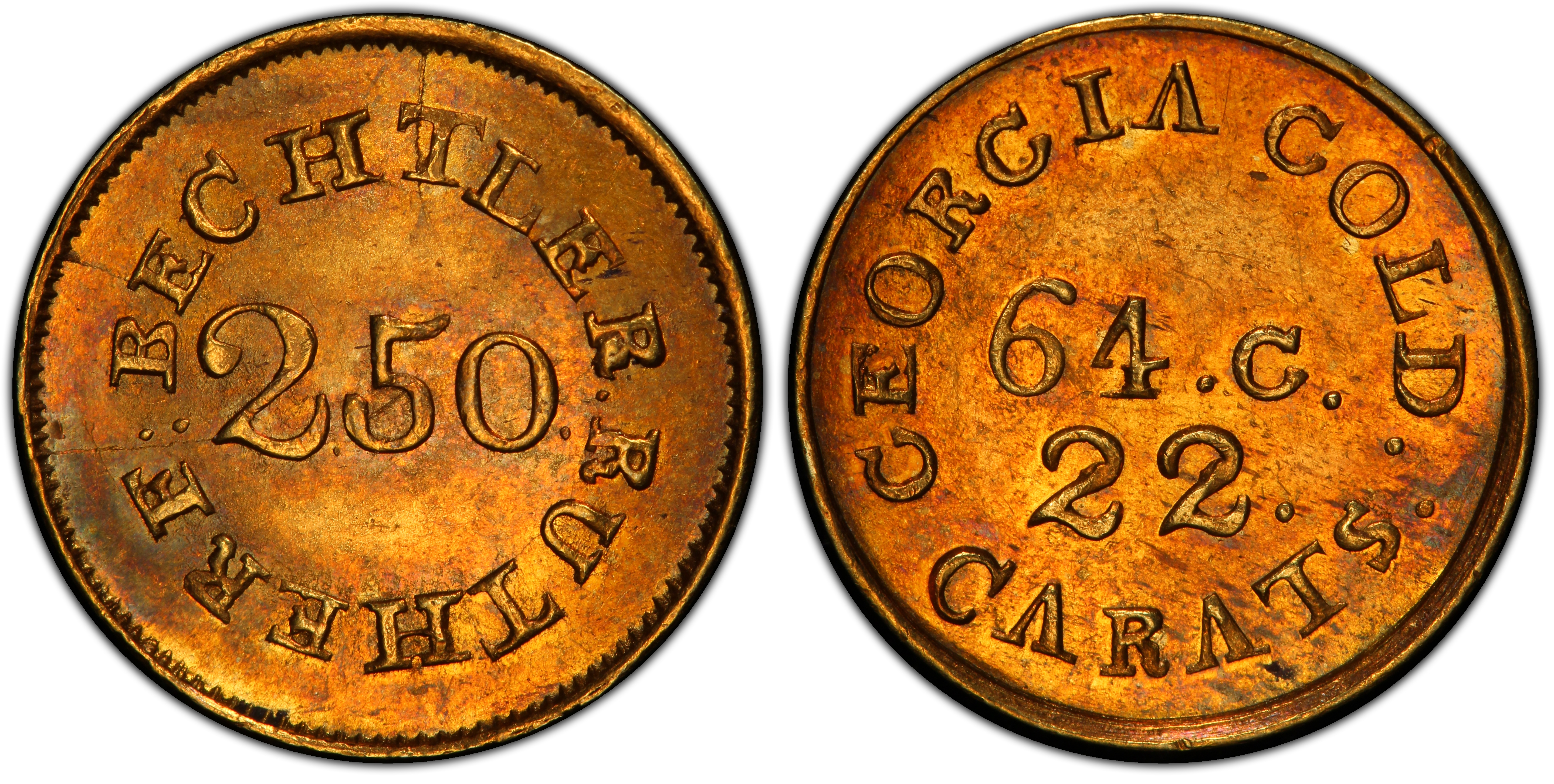
Obverse & Reverse
The C. Bechtler $2.50 gold coin stands as a critical artifact from America's first gold rush, an economic boom centered not in California, but in the foothills of the Appalachian Mountains of North Carolina and Georgia. Prior to the federal government establishing branch mints in Dahlonega, Georgia, and Charlotte, North Carolina, in 1838, the region's miners faced a severe dilemma: what to do with their gold dust and nuggets. Transporting raw gold to the sole U.S. Mint in Philadelphia was a perilous and costly journey, fraught with the risk of robbery. This economic vacuum created a perfect opportunity for a skilled and trusted entrepreneur. Christopher Bechtler, Sr., a German metallurgist and gunsmith who immigrated to the U.S. in 1829 and settled in Rutherfordton, NC, in 1830, was that man. He established a private mint on his property, offering to convert raw gold into coins for a modest fee (around 2.5%). His reputation for honesty and the accuracy of his coinage's stated weight and fineness were impeccable, making his coins a trusted medium of exchange throughout the Southeast. Unlike the disastrously debased coins of Templeton Reid in Georgia, Bechtler's gold was widely accepted and even preferred locally, circulating for decades. This specific variety, the K-12, was struck from gold sourced from the Georgia gold fields, as proclaimed by its inscription. It was produced during the latter period of Christopher Sr.'s operation, a time of great success even as the new federal mints began their own coining operations. The Bechtler mint ultimately produced over $2.2 million in gold coinage, a staggering sum for a private enterprise, and its output provided essential liquidity to the regional economy, facilitating commerce and helping to build the communities of the southern gold fields.
Associated EventAppalachian Gold Rush (North Carolina/Georgia)
Reason For MintingTo provide a reliable and convenient medium of exchange for miners and merchants by converting locally mined raw gold into standardized coins.
Minter HistoryChristopher Bechtler, Sr. (1782-1842) was a German immigrant with extensive experience as a metallurgist, jeweler, and watchmaker. After arriving in Rutherfordton, North Carolina, in 1830, he quickly recognized the local miners' need for a trustworthy assaying and coining facility. Starting in 1831, he, along with his son Augustus and nephew Christopher Jr., operated a highly successful private mint. He manufactured his own presses and dies. His integrity was legendary, and his coins were known for their honest weight and purity, becoming a staple of the Southern economy. After his death in 1842, the mint was operated by his son Augustus until the early 1850s, though the quality and reputation of the later issues were considered somewhat inferior to those of the patriarch.
Historical SignificanceThe Bechtler coinage represents the most successful and prolific of all U.S. private or territorial gold issues. It solved a critical economic problem during America's first gold rush, established a trusted circulating currency where federal coinage was scarce, and includes the first gold dollar ever struck in the United States (1832), predating the federal version by 17 years. The longevity and widespread acceptance of Bechtler's money are a testament to his personal integrity and skill.
K-12
Denomination$2.50
Minting Periodca. 1837-1842
Assayer/MinterChristopher Bechtler, Sr.
Geographic OriginRutherfordton, North Carolina
Obverse DescriptionThe design is purely typographic and functional. Centered in the field is the statement of weight and fineness: '64. G.' (Grains) positioned above '22. CARATS'. The numeral '22' is level and evenly punched, the key diagnostic for the K-12 variety. Encircling this central text, near the plain border, is the inscription 'GEORGIA GOLD.'
Obverse InscriptionGEORGIA GOLD. / 64. G. / 22. CARATS
Reverse DescriptionThe reverse identifies the minter and denomination. The name 'BECHTLER.' is at the top, followed by the location 'RUTHERF:' below it. A horizontal line separates the minter's identification from the denomination, which is stated as '$2.50' in the lower portion of the coin.
Reverse InscriptionBECHTLER. / RUTHERF: / $2.50
CompositionGold
Stated Fineness22 Karats
Actual FinenessGenerally close to the stated fineness; Bechtler's assays were highly regarded for their accuracy.
Weight4.12 grams
Diameter18.00 mm
EdgePlain
Unknown; specific mintage figures for individual Bechtler varieties were not recorded.
Survival EstimateFewer than 35 known. It is slightly rarer than its K-11 counterpart.
Rarity ScaleR-6 (Very Rare)
This coin is highly sought after as a key piece of American history from the nation's first gold rush. Its appeal lies in its direct connection to the Appalachian gold fields, the sterling reputation of its minter, and its status as a tangible link to the pre-federal mint era in the South. The simple, utilitarian design is prized for its historical honesty.
Key VarietiesThe primary variety is the K-11, which is nearly identical but features an 'Uneven 22' on the obverse, with the first '2' punched lower than the second. The K-12, with its 'Even 22', is the scarcer of the two Georgia Gold quarter eagle types. No proof or special collector strikings were produced during the original minting period.
Authentication TipsGenuine Bechtler coins possess a characteristic crude but sharp quality from hand-cut dies. Look for a slightly irregular planchet shape and soft, somewhat uneven lettering. The surfaces should have a consistent, original texture. Counterfeits often have a mushy or porous appearance from being cast, or incorrect lettering styles. On the K-12, the numbers in '22' should be perfectly level. Weight and specific gravity tests are crucial, as many contemporary counterfeits were made of gold-plated base metals.
Shopping ConsiderationsA premium quality example for its grade will exhibit a bold strike, especially on the central weight and purity figures and the denomination on the reverse. Many examples are weakly struck, particularly around the peripheries. Look for original, uncleaned surfaces, which often display a rich, reddish-gold or deep orange patina. Avoid examples with excessive planchet flaws, harsh cleaning, scratches, or rim damage, as these are common. Eye appeal is paramount; a coin with honest, even wear and attractive original surfaces is far more desirable than a higher-grade but cleaned or damaged specimen.
A coin's grade is its condition, rated on a 1-70 scale. For rare coins, this is the most critical factor in determining value, as a tiny difference in preservation can mean a huge difference in price.
Relevant Grade TypesAll original Bechtler coins were business strikes intended for commerce and are found in Circulated (1-58) and Mint State (MS, 60-70) grades. No Proofs were struck during the original period of issue, and no later-date restrikes are known to exist.
Mint State CharacteristicsUncirculated examples are exceptionally rare. A true Mint State specimen would exhibit full, satiny mint luster, though this luster may be somewhat subdued compared to federal issues due to the minting process. The strike is a key factor; many Bechtler coins are not fully struck up. A high-end MS example would show unusual sharpness in the legends. Small, inherent planchet irregularities or adjustment marks are common and often acceptable, but significant, distracting contact marks in prime focal areas will lower the grade.
Circulated Wear PatternsWear first appears on the highest, flattest parts of the coin's fields, as the design is mostly typographic. The lettering and numbers, being the raised elements, will show friction first. On the obverse, the numbers '64' and '22' will begin to flatten. On the reverse, the numerals in '$2.50' and the letters in 'BECHTLER' are the first to show wear. In lower grades (VG and below), the peripheral legends become weak and parts of the central inscriptions may start to merge with the fields.
Key Factors For ValueFor the K-12 Bechtler $2.50, value is driven by rarity, grade, and surface quality. A sharp, well-centered strike commands a significant premium, as many are off-center or weak. The most prized examples possess untouched original 'skin' with a pleasing luster and deep, attractive toning. Cleaned, polished, or damaged coins are heavily penalized by the market. Given the prevalence of counterfeits and the subtlety of high-grade wear, certification by a top-tier grading service (PCGS or NGC) is essential for market acceptance. A CAC sticker on an already-graded coin provides an additional layer of verification for quality and originality, often resulting in a substantial price premium.
PCGS Price Guide
| Grade | Price | Population |
|---|---|---|
| 8 | $6,250.00 | N/A |
| 10 | $7,000.00 | N/A |
| 12 | $8,250.00 | N/A |
| 15 | $9,500.00 | N/A |
| 20 | $10,500.00 | N/A |
| 25 | $11,750.00 | N/A |
| 30 | $13,500.00 | N/A |
| 35 | $15,000.00 | N/A |
| 40 | $17,500.00 | N/A |
| 45 | $20,000.00 | N/A |
| 45+ | $21,000.00 | N/A |
| 50 | $22,500.00 | N/A |
| 50+ | $23,500.00 | N/A |
| 53 | $25,000.00 | N/A |
| 53+ | $26,500.00 | N/A |
| 55 | $28,500.00 | 4 |
| 55+ | $31,500.00 | N/A |
| 58 | $35,000.00 | 1 |
| 58+ | $40,000.00 | N/A |
| 60 | $45,000.00 | N/A |
| 61 | $55,000.00 | 1 |
| 62 | $60,000.00 | N/A |
| 62+ | $75,000.00 | N/A |
| 63 | $110,000.00 | 1 |