(1837-42) $2.50 C. Bechtler, 250. / 20.C. / 75.G. (Regular Strike)
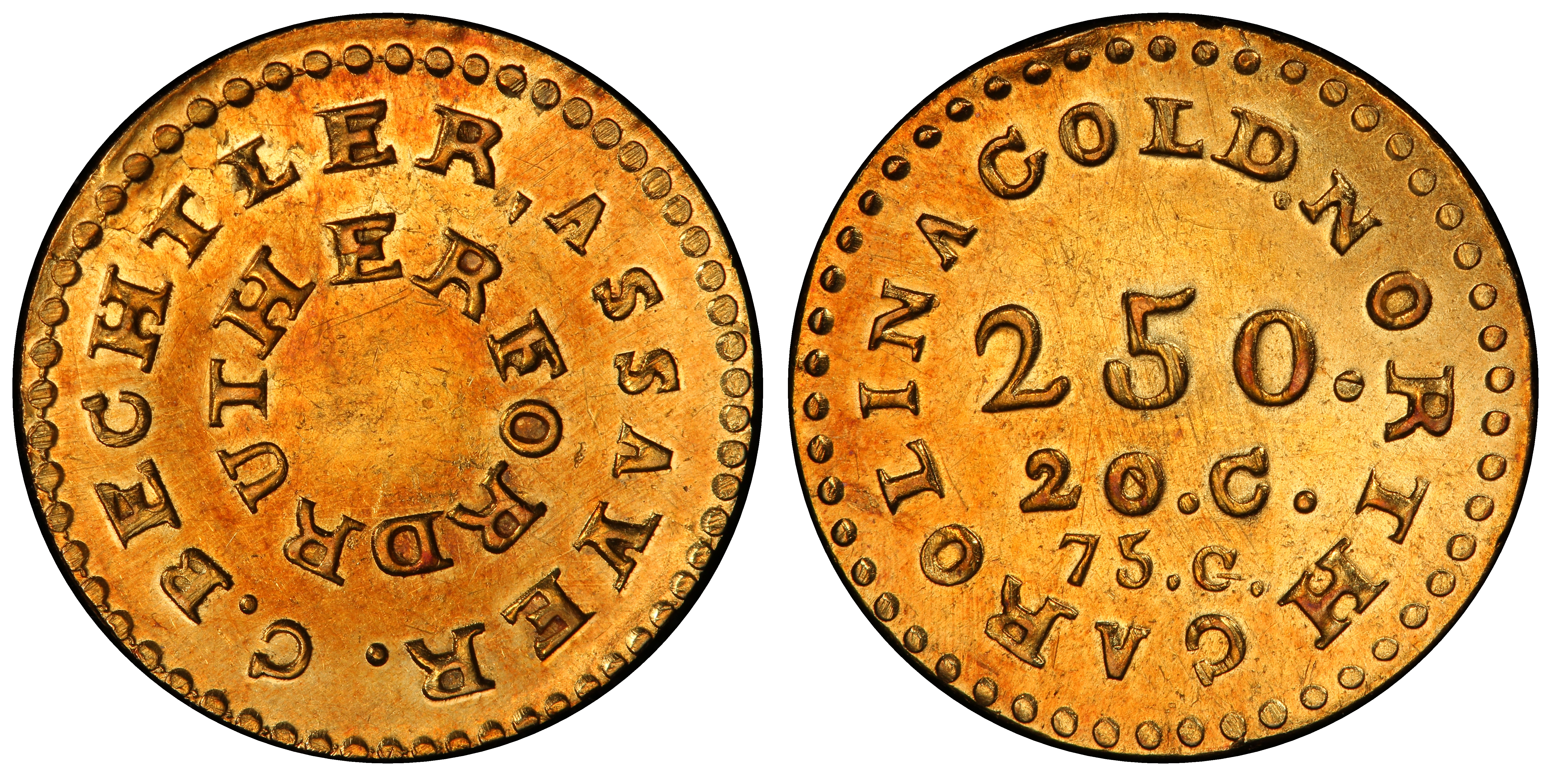
Obverse & Reverse
The C. Bechtler $2.50 gold piece, Kagin-8, stands as a critical monetary instrument from America's first gold rush. Prior to the California frenzy of 1849, the foothills of the southern Appalachian Mountains, particularly in North Carolina and Georgia, were the nation's primary source of gold. However, a severe lack of circulating specie plagued the region. Miners who toiled to extract gold dust and nuggets were left with a commodity that was difficult to use in daily commerce. The only federal mint was in Philadelphia, a treacherous and expensive journey away, discouraging deposits and stifling the local economy. Into this void stepped Christopher Bechtler, a German immigrant and skilled metallurgist who had settled in Rutherfordton, North Carolina, in 1830. Responding to pleas from local miners and merchants, he established a private mint on his property in 1831. His operation was a model of efficiency and, crucially, integrity. Unlike the ill-fated venture of Templeton Reid in Georgia, Bechtler's coinage was trusted implicitly for its honest weight and fineness. The K-8 variety represents a key evolution in his early coinage. Struck from late 1831 through 1834, it utilized the dies of the earlier K-6 variety but with the crucial addition of the weight, '75.G.', punched into the obverse die below '20.C.'. This public declaration of weight and purity (75 grains, 20 carats) reinforced public confidence and made the coins a pillar of the Southeastern economy. These coins circulated widely, serving as the primary hard currency for years, even after the establishment of the Charlotte and Dahlonega branch mints in 1838. Their success was a testament to Bechtler's reputation and the pressing economic need they filled. Most Bechtler coins, including the K-8, saw heavy circulation, and the implementation of the federal Coinage Act of June 28, 1834, which raised the value of gold, led to the widespread melting of these earlier, heavier issues. This act, combined with decades of commercial use, is the primary reason for their immense rarity today.
Associated EventCarolina Gold Rush
Reason For MintingTo convert raw gold dust from the Carolina gold rush into a standardized, spendable coinage for regional commerce due to the lack of federal minting facilities.
Minter HistoryChristopher Bechtler, Sr. (1782-1842) was a German goldsmith, watchmaker, and metallurgist from the Grand Duchy of Baden. He immigrated to the United States in 1829 with his sons, Augustus and Charles, and a nephew, also named Christopher. After a brief period in Philadelphia, the family was drawn to the gold-producing region of North Carolina, settling in Rutherford County in 1830. Recognizing the local economy's desperate need for specie, he established his private mint in 1831. His operation was highly successful and prolific, minting over $2.24 million in gold coins between 1831 and 1840. He is noted for producing the first gold dollar in American history in 1832. Bechtler's reputation for honesty was impeccable, making his coins the most trusted and widely circulated private currency of the era. He died in 1842, after which the family continued the minting operation with diminishing success until about 1850.
Historical SignificanceThe Bechtler coinage was the most successful and longest-lived private minting operation in U.S. history, providing a stable and trusted medium of exchange that was vital to the economy of the antebellum South. It legitimized private coinage through its honest standards and demonstrated the clear need for federal branch mints in gold-producing regions, directly leading to their establishment in Charlotte and Dahlonega.
K-8
Denomination$2.50
Minting Period1831-1834
Assayer/MinterChristopher Bechtler, Sr.
Geographic OriginRutherfordton, North Carolina
Obverse DescriptionThe central design is dominated by the inscriptions '20.C.' and, directly below it, '75.G.', indicating 20 carats and 75 grains. The value '250' for $2.50 is above. Encircling the central inscriptions is the legend 'NORTH CAROLINA GOLD'. The entire design is enclosed by a beaded border.
Obverse InscriptionNORTH CAROLINA GOLD / 250. / 20.C. / 75.G.
Reverse DescriptionWithin a central circle is the name 'RUTHERFORD'. Encircling this is the legend 'C. BECHTLER, ASSAYER', with a star separating the beginning and end of the legend. The entire design is enclosed within a beaded border matching the obverse.
Reverse InscriptionC. BECHTLER, ASSAYER / RUTHERFORD
CompositionGold
Stated Fineness20 Carats (.833 fine)
Actual FinenessApproximately .833, known for being consistently close to the stated purity.
Weight4.85 grams
Diameter20.00 mm
EdgeReeded
Unknown
Survival EstimateFewer than 20 known
Rarity ScaleR-6+
This coin is a landmark of American ingenuity and a tangible link to the nation's first gold rush. As one of the earliest Bechtler issues with full weight and purity declarations, its historical importance is immense. Its extreme rarity and the romantic history of its private minter make it a cornerstone piece for advanced collectors of territorial gold and U.S. numismatics.
Key VarietiesThe K-8 is a distinct variety, defined by the addition of '75.G.' to the dies of the earlier K-6 issue. The primary diagnostic for die states is the reverse, where later strikings exhibit a pronounced central bulge around the 'RUTHERFORD' inscription. No proof restrikes or patterns of this specific variety are known to exist.
Authentication TipsGenuine examples have a characteristic crude but sharp strike from a screw press. The lettering and numbers are hand-punched and show slight irregularities in alignment and spacing. The gold often has a slightly greenish or reddish tint from natural alloys. Planchets can be irregular. Counterfeits are typically cast, showing a soft, porous surface and often a seam on the edge. Modern fakes may be struck but will lack the precise die characteristics and surface texture of originals. Weight is a key diagnostic; genuine examples should be very close to the 4.85 gram (75 grain) standard.
Shopping ConsiderationsFor a 'premium quality' example, look for a bold strike, particularly on the central inscriptions and the reverse legend, which can be weak. Original, uncleaned surfaces are paramount; many surviving examples have been harshly cleaned, which drastically reduces value. Seek out coins with minimal marks and evidence of original mint luster, often seen as a subtle satiny glow in protected areas. Planchet quality varies, but examples on smooth, problem-free planchets command a significant premium. A CAC sticker is highly desirable for this issue, as it confirms both grade and originality for a series where surface quality is often a major issue.
A coin's grade is its condition, rated on a 1-70 scale. For rare coins, this is the most critical factor in determining value, as a tiny difference in preservation can mean a huge difference in price.
Relevant Grade TypesAll original Bechtler coins were business strikes intended for commerce, so they are found in Circulated (1-58) and, very rarely, Mint State (MS, 60-70) grades. No Proof examples were struck during the original minting period, and no later-date collector restrikes of the K-8 variety are known to exist. Any coin described as a 'Proof' is highly suspect.
Mint State CharacteristicsAn uncirculated K-8 will exhibit a soft, satiny luster, often with a slightly prooflike or reflective quality in the fields. The strike is typically somewhat weak in the center, so a coin with a sharp '20.C. / 75.G.' and bold 'RUTHERFORD' is highly desirable. Due to the soft, high-purity gold, even Mint State examples will typically show some light handling marks or 'chatter' from brief contact with other coins. The beaded borders should be well-defined.
Circulated Wear PatternsWear first appears on the highest points of the letters and numbers, particularly the '250', '20.C.', and '75.G.' on the obverse. On the reverse, the letters of 'ASSAYER' and the border of the central circle are the first elements to show flatness. On lower grade examples (Fine and below), the legends become soft and can merge with the fields, and the reeded edge will show significant smoothing.
Key Factors For ValueOriginality of the surfaces is the most important factor; a coin with its original 'skin', even if circulated, is far more valuable than a cleaned, brighter-looking one. Strike quality is second; a sharply struck coin can command a 50% or greater premium over a softly struck example in the same grade. Eye appeal, driven by attractive original color (often a reddish-gold or greenish-gold patina) and a lack of distracting marks, is critical. A CAC sticker confirming premium quality for the grade provides a significant boost in market value and liquidity.
PCGS Price Guide
| Grade | Price | Population |
|---|---|---|
| 8 | $11,000.00 | N/A |
| 10 | $12,500.00 | N/A |
| 12 | $15,000.00 | N/A |
| 15 | $17,500.00 | N/A |
| 20 | $20,000.00 | N/A |
| 25 | $21,500.00 | N/A |
| 30 | $23,500.00 | N/A |
| 35 | $26,000.00 | N/A |
| 40 | $28,500.00 | N/A |
| 45 | $32,500.00 | 1 |
| 45+ | $35,000.00 | N/A |
| 50 | $42,500.00 | 3 |
| 50+ | $45,000.00 | N/A |
| 53 | $47,500.00 | N/A |
| 53+ | $50,000.00 | N/A |
| 55 | $52,500.00 | 2 |
| 55+ | $55,000.00 | N/A |
| 58 | $57,500.00 | 1 |
| 58+ | $60,000.00 | N/A |
| 60 | $70,000.00 | 1 |
| 61 | $75,000.00 | N/A |
| 62 | $82,500.00 | N/A |
| 62+ | $105,000.00 | 1 |
| 63 | $185,000.00 | 1 |