(1831-34) $2.50 C. Bechtler, 75G and Star (Regular Strike)
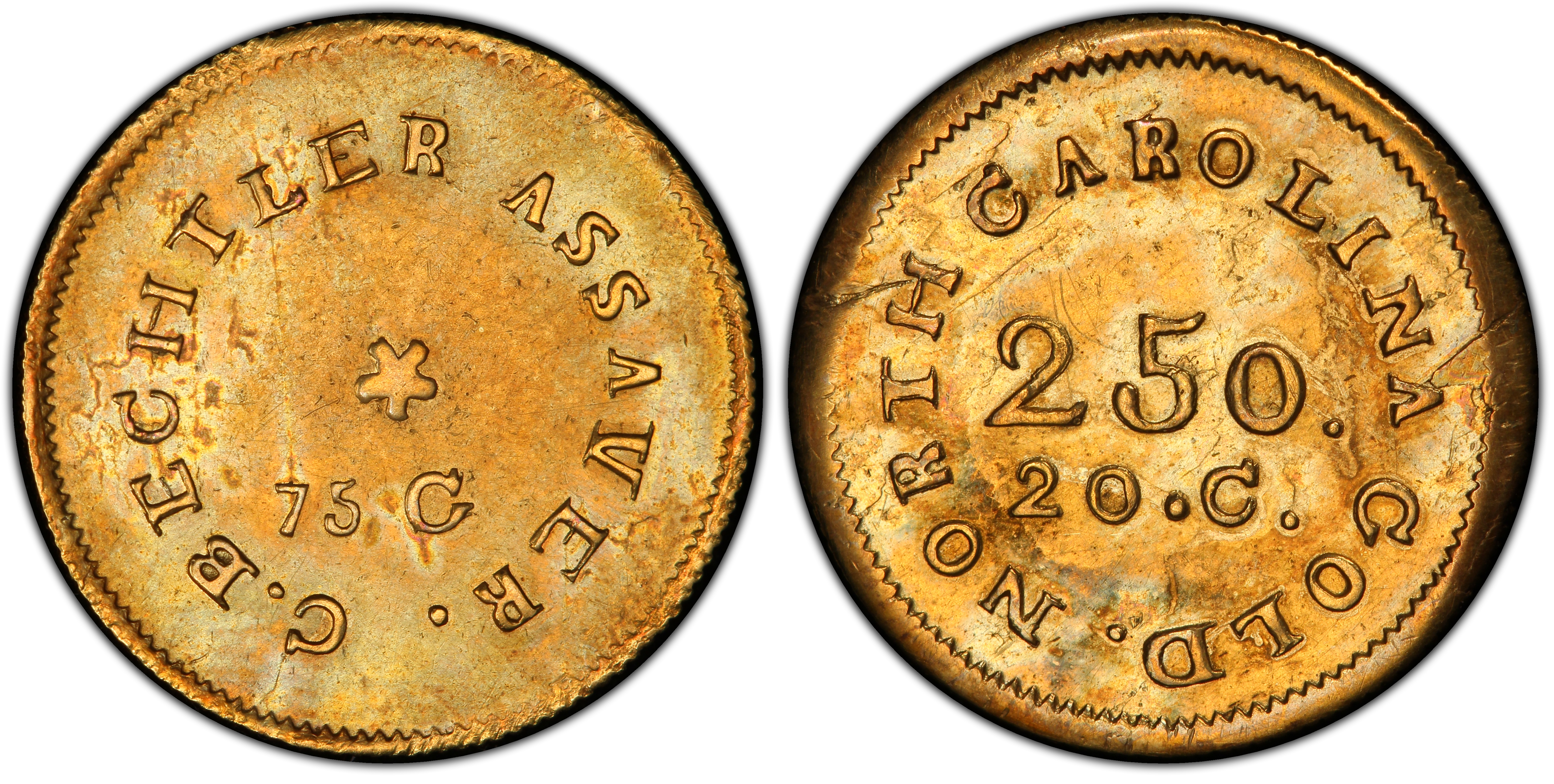
Obverse & Reverse
The Christopher Bechtler $2.50 gold piece, specifically the Kagin-9 variety, stands as a critical artifact from America's first gold rush. Prior to the major discoveries in California in 1848, the foothills of the Appalachian Mountains in North Carolina and Georgia were the epicenter of the nation's gold production. This created a severe economic paradox: the region was rich in gold dust and nuggets, but impoverished of a standardized, reliable medium of exchange. Transporting raw gold to the sole U.S. Mint in Philadelphia was a long, perilous, and expensive journey that miners and merchants were loath to undertake. This void in commerce was brilliantly filled by Christopher Bechtler, a German immigrant metallurgist, gunsmith, and watchmaker who settled in Rutherfordton, North Carolina, in 1830. Recognizing the local economy's plight, and with the encouragement of prominent citizens, Bechtler established a private minting operation on his property in 1831. His reputation for scrupulous honesty and metallurgical skill quickly made his coins the preferred currency throughout the southeastern United States. Unlike his contemporary, Templeton Reid in Georgia, whose coins were quickly found to be underweight, Bechtler's issues were known to contain the full stated weight and value, and often slightly more, than their federal counterparts. He charged a modest 2.5% seigniorage fee, which was far more economical than the costs associated with shipping gold to Philadelphia. The K-9 variety, struck between 1831 and 1834, is a product of this initial period of high trust and demand. Its simple, utilitarian design, stamped with the weight (75 Grains) and fineness (20 Carats), was a direct testament to its intrinsic value. These coins circulated vigorously, facilitating everything from land purchases to daily commerce. The Bechtler mint was so successful and trusted that it continued to operate for years even after the U.S. government established branch mints in Charlotte (1838) and Dahlonega (1838) to serve the gold region. Bechtler and his son Augustus would ultimately coin over $2.24 million in gold, a staggering sum for a private enterprise of the era. The K-9 is a tangible link to this unique period of private enterprise successfully solving a government failure, underpinning the economy of an entire region through sheer integrity and skill.
Associated EventCarolina Gold Rush
Reason For MintingTo convert locally mined raw gold dust and nuggets into a standardized, trusted medium of exchange for regional commerce due to the extreme distance and danger of transporting gold to the U.S. Mint in Philadelphia.
Minter HistoryChristopher Bechtler, Sr. (1782-1842) was a German-born metallurgist, watchmaker, and gunsmith who immigrated to the United States in 1829. After a brief period in Philadelphia, he moved his family to Rutherfordton, North Carolina, in 1830, placing himself in the heart of the Carolina gold fields. A skilled and honest craftsman, he identified the region's critical need for coinage. He manufactured his own press and dies, beginning his private coining operation in July 1831. His issues were so reliable—often containing slightly more gold than their stated value—that they became the dominant currency in the Southeast, trusted over bank notes and even circulated alongside federal issues. His mint produced the first $1 gold coin in American history in 1832. After his death in 1842, the business was continued by his son, Augustus Bechtler, and later his nephew.
Historical SignificanceThe Bechtler coinage was the most successful and prolific private currency in U.S. history, providing a stable monetary system for the southeastern gold regions for two decades. The K-9 variety is a high-rarity example from the initial period of Christopher Bechtler's operation, symbolizing the peak of trusted private minting in America and representing a direct solution to a major economic challenge on the nation's early frontier.
K-9
Denomination$2.50
Minting Period1831-1834
Assayer/MinterChristopher Bechtler, Sr.
Geographic OriginRutherfordton, North Carolina
Obverse DescriptionThe central design consists of the denomination '250.' above '20.' and 'C.' within a circle of text. The legend reads 'NORTH CAROLINA GOLD.'
Obverse InscriptionNORTH CAROLINA GOLD. 250. 20. C.
Reverse DescriptionThe central design consists of a five-pointed star above the weight '75.G'. The legend around the periphery reads 'C.BECHTLER. ASSAYER.'
Reverse InscriptionC.BECHTLER. ASSAYER. ★ 75.G
CompositionGold
Stated Fineness20 Carats (.833 Fine)
Actual FinenessGenerally found to be at or slightly above the stated fineness.
Weight4.86 grams
Diameter18.00 mm
EdgeReeded
Unknown
Survival EstimateFewer than 10 known
Rarity ScaleR-7
As one of the rarest Christopher Bechtler quarter eagles, the K-9 is a trophy coin for advanced specialists in territorial gold. Its appeal lies in its extreme rarity, its direct connection to the first U.S. gold rush, and the legendary integrity of the Bechtler name. It represents a pinnacle of private coinage.
Key VarietiesThe K-9 is a key variety itself, distinguished by the star on the reverse. There are no known major sub-varieties from the original minting period. Unlike some federal issues, there are no known patterns, trial pieces, or later-date restrikes of Bechtler coinage. All known examples are original business strikes.
Authentication TipsGenuine examples exhibit characteristic crude but sharp die work. The lettering, while not perfectly uniform, should have a hand-punched, confident appearance. The surfaces often have a slightly wavy or uneven quality from the manual screw press. Counterfeits are often identified by a soft, cast-like appearance, incorrect weight, or lettering that appears too modern or 'perfect.' The specific gravity test is crucial, as Bechtler's coins are of honest weight and fineness. Examine the style of the numerals and letters closely and compare them to high-resolution images of certified examples.
Shopping ConsiderationsFor a coin of this rarity, any example offered is a major event. A 'premium quality' specimen is one that has avoided major impairments like cleaning, tooling, or significant edge damage. Look for honest, even wear and original, unmolested surfaces, which may exhibit a deep, old reddish-gold patina. Strike weakness is common on Bechtler issues, but a K-9 with a relatively bold strike on the central devices ('250', star, '75.G') and clear legends would command a significant premium. Given the high value and prevalence of counterfeits, third-party authentication and grading by PCGS or NGC is an absolute necessity for any transaction.
A coin's grade is its condition, rated on a 1-70 scale. For rare coins, this is the most critical factor in determining value, as a tiny difference in preservation can mean a huge difference in price.
Relevant Grade TypesAll original Bechtler coins were produced as business strikes intended for circulation and are found in Circulated (1-58) and, very rarely, Mint State (MS, 60-70) grades. No Proof (PR/PF) examples of this issue were ever struck by the Bechtler mint, and no later-date restrikes or collector issues exist. Any coin purporting to be a 'Proof' Bechtler is fraudulent.
Mint State CharacteristicsA true Mint State K-9 is a phenomenal rarity. Quality is defined by the preservation of its original, slightly matte-like luster, which is often subdued compared to federal issues. The strike is a key factor; many were softly struck, so an example with sharp central details and bold legends is highly desirable. Due to the softness of the 20-carat gold, even uncirculated examples are expected to have some light contact marks or 'chatter' from brief handling and storage with other coins.
Circulated Wear PatternsWear first appears on the highest points of the coin, which due to the simple design are the numerals and letters of the legends. On the obverse, the tops of '250' and the letters in 'CAROLINA' will show flattening. On the reverse, the points of the star and the letters in 'BECHTLER' will begin to lose their sharpness. In lower grades (VG and below), the inscriptions will become faint and parts may merge with the fields.
Key Factors For ValueFor the K-9, rarity is the primary value driver, but condition is paramount. The most valuable examples will possess completely original surfaces, free from harsh cleaning, polishing, or tooling. Eye appeal is critical; an example with a pleasing, honest appearance and perhaps a hint of original luster will always be prized over a brighter, cleaned coin. Sharpness of strike is a major differentiating factor. Finally, given the coin's rarity and value, certification by PCGS or NGC with a CAC sticker indicating premium quality for the grade would add a substantial premium.
PCGS Price Guide
| Grade | Price | Population |
|---|---|---|
| 30 | $80,000.00 | 1 |
| 35 | $90,000.00 | N/A |
| 40 | $100,000.00 | 3 |
| 45 | $120,000.00 | 1 |
| 45+ | $125,000.00 | N/A |
| 50 | $145,000.00 | N/A |
| 50+ | $155,000.00 | N/A |
| 53 | $170,000.00 | 1 |