(1834-37) $5 C. Bechtler, No C, No Star (Regular Strike)
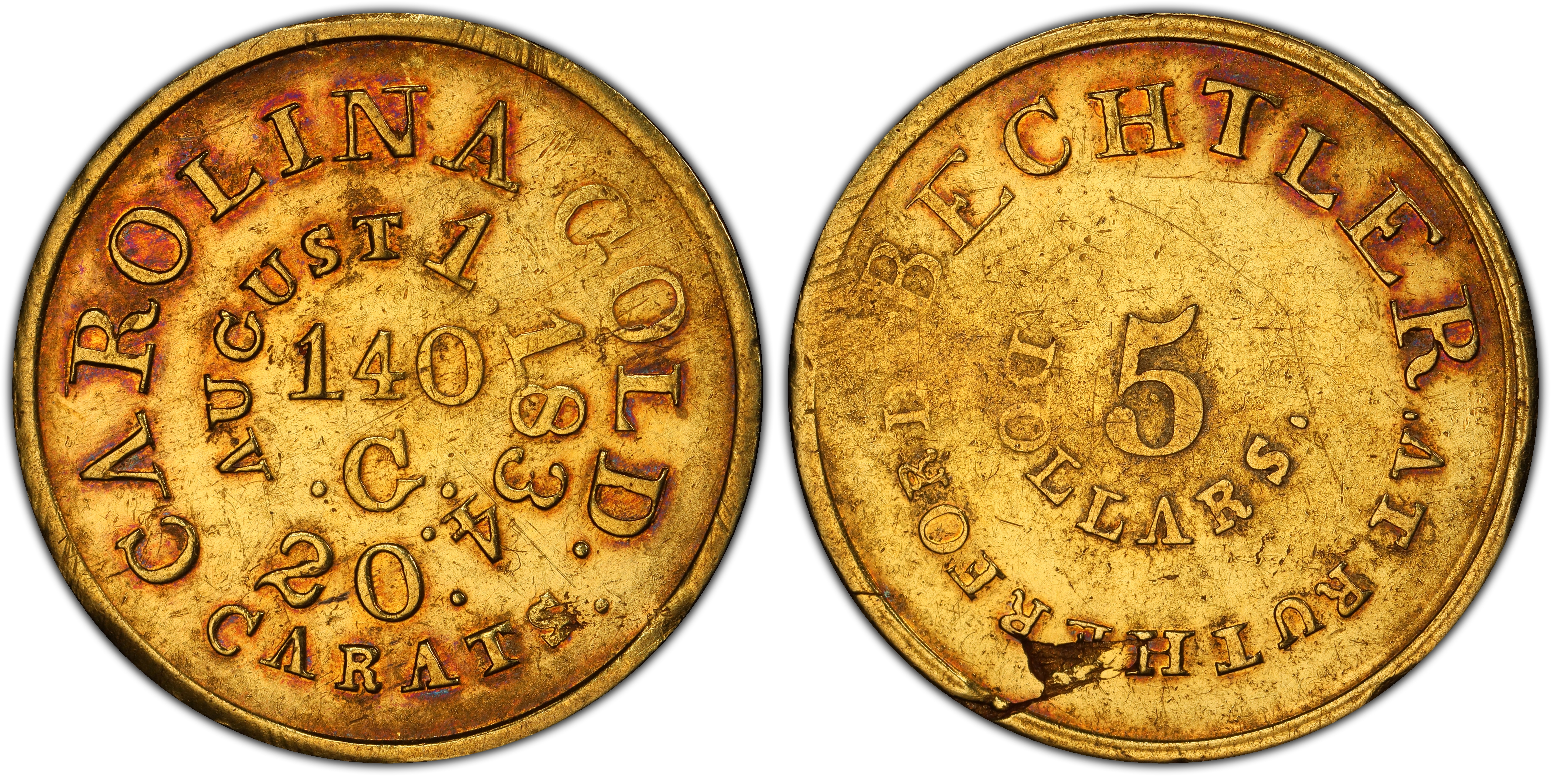
Obverse & Reverse
The Christopher Bechtler five-dollar gold piece represents a fascinating and critical chapter in American economic history, born from the nation's first major gold rush in the Appalachian mountains of North Carolina and Georgia. Prior to the California Gold Rush of 1849, this region was the primary source of domestic gold. However, miners faced a significant logistical and economic dilemma: the only United States Mint was in Philadelphia, a distant and perilous journey away. Transporting raw gold dust was fraught with danger from thieves, and the only other option was to sell it locally at a significant discount to banks or merchants who would accept it. This scarcity of a reliable medium of exchange severely hampered the regional economy. Into this void stepped Christopher Bechtler, a skilled German metallurgist and watchmaker who immigrated to the United States and settled in Rutherford County, North Carolina, in 1830. Recognizing the local miners' plight, he established a private mint on his property in 1831. For a small fee, Bechtler would assay and convert raw gold into professionally struck coins of consistent weight and purity. His reputation for honesty was impeccable; the U.S. Mint repeatedly tested his coins and found their gold content to be reliable, often exceeding that of federal issues. This integrity made Bechtler's coinage immensely popular and trusted throughout the Southeast, where his coins became the dominant circulating medium for years. The Bechtler mint ultimately coined over $2.24 million in gold between 1831 and 1840, a staggering sum for a private enterprise. The specific variety struck between 1834 and 1837 is historically significant as it reflects a direct response to federal monetary policy. The U.S. Coinage Act of 1834 reduced the weight of federal gold coins, effectively increasing the value of gold and making older, heavier coins (both federal and Bechtler's earlier issues) worth more than their face value. To prevent his coins from being melted down, Bechtler promptly adjusted his own standards. He began striking his $5 pieces at a new weight of 140 grains and, on some varieties, included the date 'AUGUST 1, 1834'—the very day the federal act took effect—to signify their compliance with the new national standard. The 'No C' and 'No Star' variety represents a simplified design within this period, focusing on the core elements of trust: his name, the location, the weight, and the fineness. The success of Bechtler's operation highlighted the desperate need for minting services in the gold regions and directly led to the establishment of U.S. Branch Mints in Charlotte, North Carolina (1838) and Dahlonega, Georgia (1838), which eventually rendered his private mint obsolete.
Associated EventAppalachian Gold Rush (North Carolina/Georgia)
Reason For MintingTo convert locally mined gold dust into a reliable, standardized, and trusted medium of exchange due to the great distance to the only U.S. Mint in Philadelphia.
Minter HistoryChristopher Bechtler, Sr. (1782-1842) was a German goldsmith, watchmaker, and metallurgist from the Grand Duchy of Baden. After immigrating to the U.S. in 1829 and a brief stay in Philadelphia, he moved to Rutherford County, North Carolina, in 1830, drawn by the ongoing gold rush. A man of exceptional skill and integrity, he established his private mint in 1831. He designed and built his own screw press and roller dies, producing coins of remarkable quality for a private venture. He struck the first U.S. gold dollar in 1832, seventeen years before the federal government. After his death in 1842, the minting operation was continued less successfully by his son Augustus and nephew, also named Christopher, until around 1850.
Historical SignificanceBechtler's coinage was the most successful private currency in U.S. history, providing a vital and trusted money supply for the southeastern gold regions. It legitimized private minting through its honesty and quality, directly prompting the U.S. government to establish branch mints in Charlotte and Dahlonega to serve the needs of gold miners and regulate the nation's currency.
K-18
Denomination$5
Minting Period1834-1837
Assayer/MinterChristopher Bechtler, Sr.
Geographic OriginRutherfordton, North Carolina
Obverse DescriptionThe central design element is a simple, text-based declaration of the coin's origin, date, weight, and fineness. The words are arranged in five lines within a plain, non-beaded border.
Obverse InscriptionCAROLINA GOLD / AUGUST 1, 1834 / 140. G. / 20 / CARATS
Reverse DescriptionThe central design element is the denomination '5' with 'DOLLARS' below it. The minter's name and location encircle the denomination along the periphery, inside a plain border.
Reverse InscriptionC. BECHTLER. / 5 / DOLLARS / AT RUTHERFORD.
CompositionGold
Stated Fineness20 CARATS
Actual FinenessApproximately 20 carats (.833 fine)
Weight9.07 grams
Diameter24.70 mm
EdgePlain
Unknown
Survival EstimateFewer than 100 known in all grades.
Rarity ScaleR-5 (Very Scarce)
This coin is highly prized as a tangible link to America's first gold rush and the most successful private coinage in U.S. history. Its crude but honest design, direct connection to Christopher Bechtler's unimpeachable integrity, and historical importance make it a cornerstone of any collection of territorial or private gold.
Key VarietiesBechtler's coinage is rich with varieties. For the 1834-37 $5 pieces, key variations include: 'CAROLINA GOLD' vs. 'GEORGIA GOLD' obverses; weights of 150 Grains (pre-1834) vs. 140 Grains; fineness of 20, 21, or 22 carats; and reverse legends spelling 'RUTHERFORD' fully, abbreviated to 'RUTHERF:', or with 'AT RUTHERFORD'. Some reverse dies feature a star. No known patterns, restrikes, or proof strikings from the period of issue exist for this specific variety. All known examples are business strikes.
Authentication TipsAuthentic Bechtler coins have a characteristic crude but sharp strike from a hand-operated screw press. The lettering is often imperfectly aligned and spaced. The surfaces should exhibit a soft, slightly greasy luster typical of high-purity, unalloyed gold. Counterfeits are common and are often cast, showing pitting and a soapy appearance. Others are electrotypes, identified by a seam on the edge. Weight is a critical diagnostic; genuine 140-grain examples should weigh very close to 9.07 grams. Many fakes are made of brass with a thin gold plating and will be significantly underweight.
Shopping ConsiderationsA premium quality example for its grade will possess superior surface preservation with minimal distracting marks. Look for a bold strike, as weakness is common, particularly on the '140. G.' on the obverse and the central '5' on the reverse. Original, uncleaned surfaces displaying a rich, reddish-gold or greenish-gold patina are highly desirable and command significant premiums. Avoid examples that have been harshly cleaned, polished, or show evidence of tooling or repairs in the fields. Edge bumps and rim bruises are common due to the coin's soft nature and should be carefully evaluated.
A coin's grade is its condition, rated on a 1-70 scale. For rare coins, this is the most critical factor in determining value, as a tiny difference in preservation can mean a huge difference in price.
Relevant Grade TypesAll original Bechtler coins were struck as business strikes, intended for everyday commerce. They are found in Circulated grades (AG-3 to AU-58) and, very rarely, in Mint State grades (MS-60 to MS-70). No proof (PR/PF) examples were struck by Christopher Bechtler during the original minting period, and there are no known later-date restrikes or special collector issues.
Mint State CharacteristicsAn uncirculated Bechtler $5 is exceptionally rare. Quality is defined by originality of surface and strength of strike. Luster is typically soft and satiny rather than bright and flashy. Even on high-grade pieces, some weakness in the strike is expected due to the manual press. The fields are prone to mint-made planchet adjustment marks and minor striations. Contact marks are common and, due to the softness of the gold, can be deep; a coin with minimal, well-placed marks will command a significant premium.
Circulated Wear PatternsWear first appears on the highest points of the design. On the obverse, friction will first dull the luster and show on the numerals '140' and the word 'CAROLINA'. On the reverse, the numeral '5' and the letters in 'BECHTLER' are the highest points and will show the first signs of smoothing. On lower-grade examples, the inscriptions, particularly the date and fineness, will become faint and merge with the fields.
Key Factors For ValueThe primary drivers of value are grade (condition) and surface quality. An example with original, uncleaned 'skin' is vastly more desirable than a cleaned or polished coin of the same grade. Strike is also critical; a coin with a sharp, well-centered impression is much preferred over a weakly struck or off-center example. Eye appeal, driven by attractive original color and minimal distracting marks, plays a major role. For this series, a CAC sticker carries significant weight, confirming both the grade and the quality of the surfaces for the assigned grade.
PCGS Price Guide
| Grade | Price | Population |
|---|---|---|
| 40 | $90,000.00 | N/A |
| 45 | $105,000.00 | 1 |
| 45+ | $120,000.00 | N/A |
| 50 | $135,000.00 | N/A |
| 50+ | $155,000.00 | N/A |
| 53 | $170,000.00 | N/A |
| 55 | N/A | N/A |