(1842-50) G$1 A. Bechtler 27 Grains, 21 Carat, Plain Edge (Regular Strike)
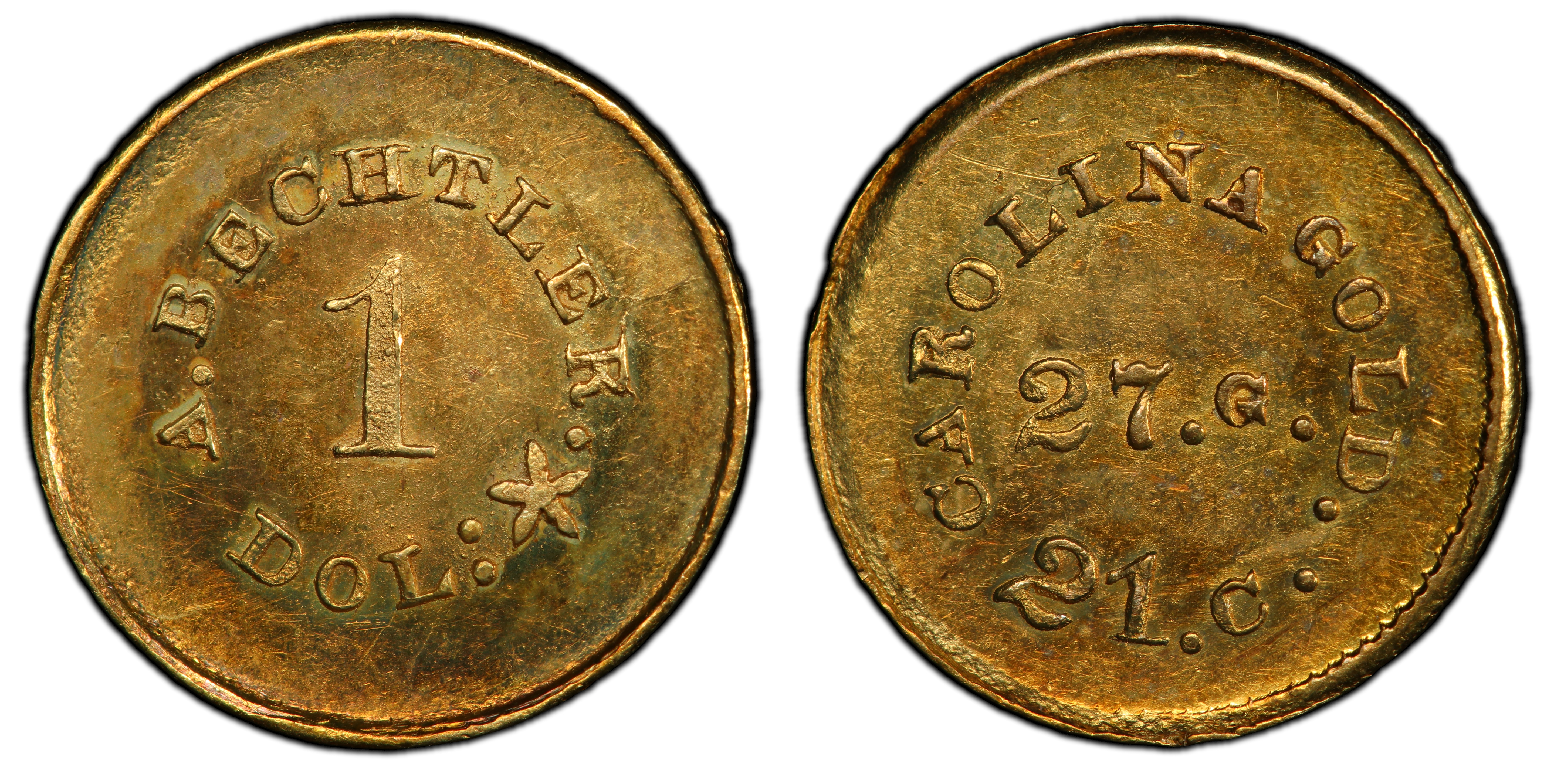
Obverse & Reverse
The Augustus Bechtler one-dollar gold coin stands as a pivotal artifact from America's first gold rush, a period centered not in California, but in the Piedmont region of North Carolina and Georgia. Prior to the federal government establishing branch mints in Charlotte and Dahlonega in 1838, the regional economy was severely hampered by a lack of circulating specie. Gold dust and nuggets were cumbersome for daily transactions. Into this void stepped Christopher Bechtler, a skilled German metallurgist who immigrated in 1829 and established a private mint in Rutherfordton, North Carolina, around 1831. His operation was so successful and trusted that his coins became the de facto currency of the region, their acceptance often preferred over federal issues even after the branch mints opened. Upon Christopher Sr.'s death in 1842, the minting operation passed to his son, Augustus. Augustus continued the family's legacy of honest weight and fair value, moving the physical mint from the family homestead to the town of Rutherfordton itself. It was during this period, from 1842 until the operation ceased around 1850, that the K-24 gold dollar was produced. These coins were not only a continuation of his father's work but also a direct response to the persistent need for a small-denomination circulating coin. The Bechtler operation provided an essential service, allowing miners to convert their raw gold into a usable medium of exchange with a seigniorage fee (around 2.5%) that was more favorable than the cost and danger of transporting gold hundreds of miles to the U.S. Mint in Philadelphia. The Bechtlers' reputation for integrity was paramount; assays of their coins by the Philadelphia Mint consistently found them to be of honest weight and value. The cessation of the Bechtler mint around 1850 coincided with the wane of the Carolina gold rush, as miners were lured west by the California discoveries, and the U.S. government's official introduction of a federal gold dollar in 1849, which finally filled the economic niche the Bechtlers had so expertly served for two decades. The A. Bechtler dollar is thus not just a coin, but a tangible link to a period of vibrant, localized economic independence and innovation in American history.
Associated EventAppalachian Gold Rush (Georgia/North Carolina)
Reason For MintingTo convert raw gold dust from the Appalachian gold rush into a reliable, small-denomination circulating currency for the regional economy, which lacked sufficient federal coinage.
Minter HistoryAugustus Bechtler was the son of Christopher Bechtler, a German immigrant and gifted metallurgist who founded the Bechtler Mint in 1831. Trained by his father, Augustus inherited the coining business upon Christopher's death in 1842. He continued the family tradition of producing reliable gold coins in $1, $2.50, and $5 denominations, which were highly trusted and essential to the regional economy of the American Southeast. Augustus moved the minting operation into the town of Rutherfordton, where he produced a large quantity of the gold dollars bearing his initial. While the coins struck by his father are generally considered the most pure, those of Augustus from the middle years are also held in high regard for their honest weight and value. The Bechtler operation, under both father and son, was remarkably successful, minting over $2.24 million in gold by the mid-1840s, a testament to their integrity and the region's need for their service.
Historical SignificanceThe A. Bechtler gold dollar represents the successful culmination of America's most significant private minting enterprise, providing a stable and trusted currency that fueled the economy of the Southeastern gold regions for nearly a decade before the U.S. government issued its own gold dollar.
K-24
Denomination$1.00
Minting Periodc. 1842-1850
Assayer/MinterAugustus Bechtler
Geographic OriginRutherfordton, North Carolina
Obverse DescriptionThe design is purely utilitarian. The upper periphery is inscribed 'CAROLINA GOLD'. The center contains the weight '27 . G .', and the lower periphery states the fineness, '21 . C .'. The fields are plain without ornamentation.
Obverse InscriptionCAROLINA GOLD . 27 . G . 21 . C .
Reverse DescriptionA simple design featuring the denomination '1' in the center, with 'DOL:' directly below it. The minter's name, 'A. BECHTLER.', is inscribed around the upper periphery, separated by a small star or dot ornament at the bottom.
Reverse InscriptionA. BECHTLER . 1 DOL:
CompositionGold
Stated Fineness21 Carats (.875 fine)
Actual FinenessGenerally close to stated fineness, though minor variations existed.
Weight1.75 grams
Diameter13.00 mm
EdgePlain
Unknown, but was the most heavily produced of all Bechtler issues.
Survival EstimateApproximately 300-400
Rarity ScaleR-3
This is the most common and affordable of all U.S. privately issued territorial gold coins, making it a cornerstone piece for collectors. It serves as an accessible entry point into the fascinating history of the Appalachian gold rush and private coinage.
Key VarietiesThe primary variety is the Kagin-24 with a Plain Edge. A major, nearly uncollectible variety is the K-25, which features a Reeded Edge and is considered a great rarity. No proof restrikes or special collector issues are known from this period or later.
Authentication TipsGenuine examples often exhibit a slightly wavy or uneven planchet, a byproduct of the private minting process. The lettering is typically crude but consistently styled. Look for sharp, well-defined letters rather than the soft, mushy details seen on cast counterfeits. The weight should be very close to 27 grains (1.75g). Counterfeits may be made of brass or other base metals, which can be detected with a magnet (gold is not magnetic) or by their incorrect weight. The luster on genuine, high-grade examples is often satiny or sometimes semi-prooflike.
Shopping ConsiderationsA premium quality example for its grade will possess sharp details, particularly on the numbers and letters. Seek out coins with minimal distracting marks and original, uncleaned surfaces, which often display a pleasing reddish-gold or deep orange toning. Many surviving examples were cleaned in the past, so coins with original 'skin' command a significant premium. Avoid examples with harsh cleaning, rim damage, or evidence of having been mounted in jewelry. Due to the primitive striking process, a perfectly flat, round planchet is unusual; a slight waviness is characteristic of the issue and not necessarily a detriment.
A coin's grade is its condition, rated on a 1-70 scale. For rare coins, this is the most critical factor in determining value, as a tiny difference in preservation can mean a huge difference in price.
Relevant Grade TypesAll original A. Bechtler gold dollars were struck as business strikes intended for circulation and are found in Circulated (1-58) and Mint State (MS, 60-70) grades. No Proofs were struck during the original minting period, and no later-date Proof restrikes or special collector strikings are known to exist for this specific issue.
Mint State CharacteristicsUncirculated examples are scarce but available. The quality of the strike can vary, but a choice MS example should have sharp, clear legends and numbers. The luster is typically soft and satiny, though some semi-prooflike examples with reflective fields are known and highly prized. Due to the softness of the 21-carat gold, even uncirculated coins will typically show some light contact marks from handling and storage over the years. Planchet quality is a factor; some coins are found on dished or uneven planchets, which may indicate issues with the press during production.
Circulated Wear PatternsWear first appears on the highest points of the design, which are the numerals '27' and '21' on the obverse and the '1' and the letters of 'BECHTLER' on the reverse. As wear progresses, these central design elements will become flat and the peripheral lettering will begin to weaken, particularly at their highest points. In lower grades (VG and below), the inscriptions may become partially illegible.
Key Factors For ValueSurface preservation is paramount. An example with original, uncleaned surfaces and attractive reddish-gold toning will always be worth more than a harshly cleaned coin of the same technical grade. Strike quality is also key; coins with a sharp, well-defined strike are more desirable than those with weak or mushy details. Eye appeal, a subjective but critical factor, encompasses the overall look of the coin, including its color and luster. For this specific issue, the presence of a CAC sticker, indicating premium quality for the grade, adds a significant price premium.
PCGS Price Guide
| Grade | Price | Population |
|---|---|---|
| 25 | $2,350.00 | 1 |
| 30 | $2,550.00 | 4 |
| 35 | $2,850.00 | 5 |
| 40 | $3,250.00 | 17 |
| 45 | $3,650.00 | 44 |
| 45+ | $4,000.00 | 1 |
| 50 | $4,350.00 | 92 |
| 50+ | $4,650.00 | N/A |
| 53 | $5,000.00 | 58 |
| 53+ | $5,500.00 | N/A |
| 55 | $6,250.00 | 111 |
| 55+ | $7,000.00 | 1 |
| 58 | $8,000.00 | 57 |
| 58+ | $8,500.00 | 1 |
| 60 | $9,000.00 | 2 |
| 61 | $9,500.00 | 15 |
| 62 | $10,000.00 | 13 |
| 62+ | $11,500.00 | 1 |
| 63 | $15,000.00 | 7 |
| 63+ | $25,000.00 | 1 |
| 64 | $32,500.00 | 2 |
Graysheet Price Guide
| Coin | Price Range |
|---|---|
| (1842-52) G$1 A.Bechtler, 27 GR, 21C, PE, K-24 MS | $2,000 - $19,500 |
| (1842-52) G$1 A.Bechtler, 27 GR, 21C, RE, K-25 MS | $10,500 - $57,500 |