1901 Lesher$ HK-796a Boyd Park w/o # Boyd Park without No., PL (Regular Strike)
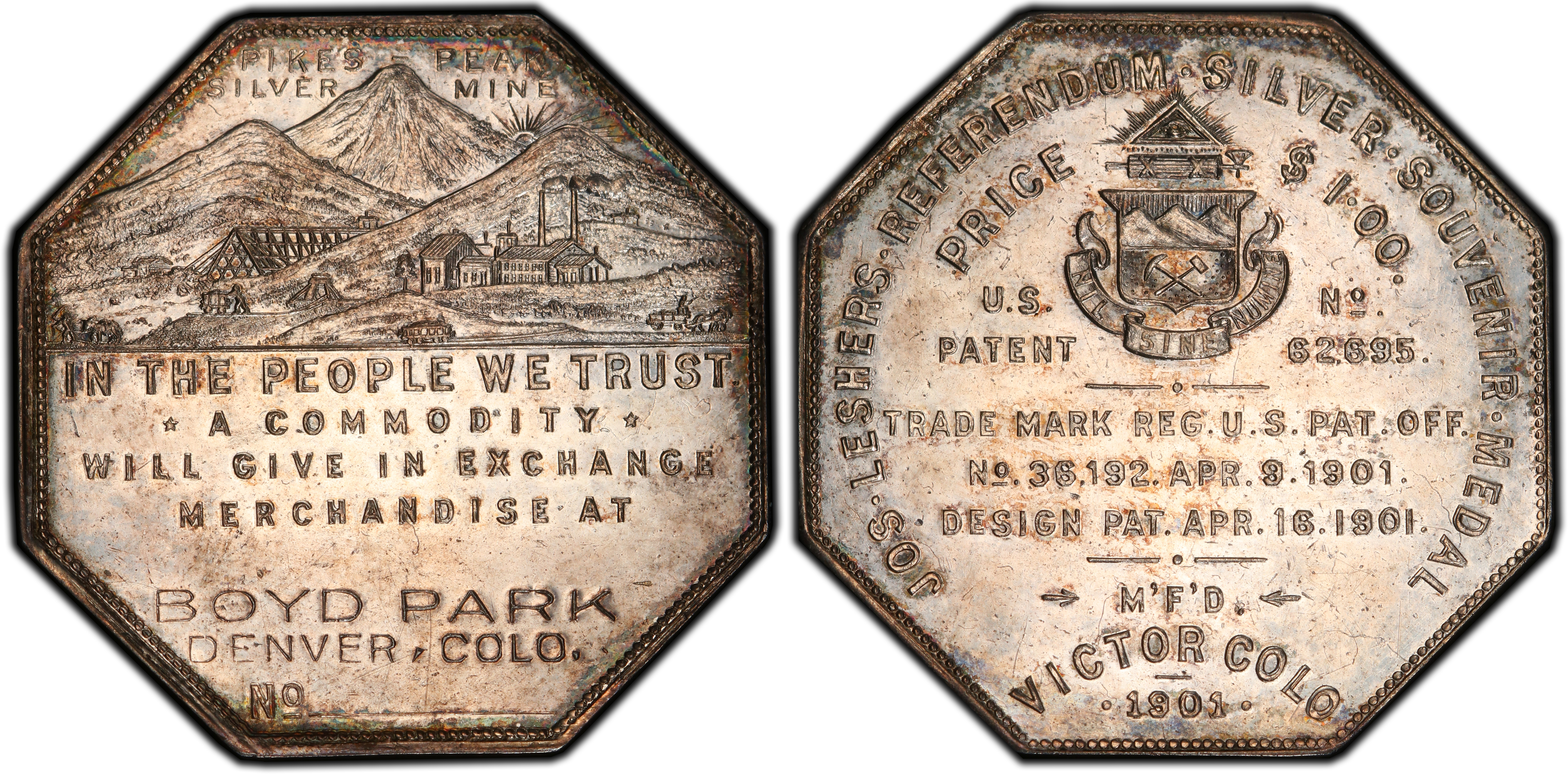
Obverse & Reverse
The Lesher 'Referendum' Dollars of 1900-1901 represent a fascinating and uniquely American chapter in the history of private coinage, born from the fiery 'Free Silver' political movement of the late 19th century. Their creator, Joseph Lesher, a silver mine owner and staunch silver advocate from Victor, Colorado, was deeply affected by the economic downturn that crippled the silver mining industry following the nation's official adoption of the gold standard. A supporter of William Jennings Bryan, Lesher believed fervently that the unlimited coinage of silver would restore prosperity. After Bryan's second defeat in 1900, Lesher took matters into his own hands. He devised a plan to privately issue silver 'coins' to prove their utility and public acceptance, thereby stimulating local commerce and, he hoped, demand for his own mine's silver. He called them 'Referendum' pieces because their acceptance was purely voluntary, referred to the people for approval. To avoid federal counterfeiting laws, Lesher cleverly designed his pieces to be octagonal and initially called them 'souvenirs.' The first issues of 1900 were valued at $1.25 and contained a full ounce of silver. In 1901, he modified the design, reducing the size and weight to match that of a standard U.S. Silver Dollar (412.5 grains) and lowering the face value to $1.00. Lesher patented his 1901 design to prevent others from copying it. The business model involved selling the pieces at a discount to merchants, who would then circulate them as change. The public could use them for purchases or redeem them with the participating merchant. The HK-796a is an example of this later type, distributed by Boyd Park, a prominent jeweler in Denver. Park was appointed Lesher's exclusive agent in the city and displayed the pieces prominently in his shop window. This variety is distinguished by the absence of a hand-punched serial number, making it significantly rarer than its numbered counterpart (HK-796). These 'no number' varieties may have been early samples, presentation pieces, or simply part of a batch where the tedious numbering process was omitted. Despite Lesher's efforts and the tokens' local popularity, the project was short-lived and ultimately failed to shift national monetary policy, ending in late 1901. Today, Lesher Dollars are prized as historical artifacts of the Populist Era, tangible links to the intense economic debates that defined the turn of the 20th century.
Associated EventFree Silver Movement
Reason For MintingTo promote the use and acceptance of silver as a circulating medium of exchange during a period of economic hardship for Colorado's silver mining industry.
Minter HistoryJoseph W. Lesher (1838-1918) was an Ohio native who served in the Union Army during the Civil War before heading west to Colorado. He became deeply involved in the mining industry, working his way up from a miner to a mine owner and real estate investor in camps like Leadville and Central City before settling in the Cripple Creek-Victor district. A passionate advocate for the free coinage of silver, he channeled his political and economic beliefs into the creation of his private 'Referendum' coinage in 1900-1901. He personally designed the pieces, secured dies from Denver craftsmen Herman Otto and Frank Hurd, and managed the distribution through local merchants. Lesher died in Victor in 1918, leaving behind one of the most famous and intriguing legacies in the field of private and territorial coinage.
Historical SignificanceThe Lesher Dollars are a physical embodiment of the Populist 'Free Silver' movement. They stand as a bold, albeit unsuccessful, private challenge to national monetary policy and a testament to the frontier spirit of enterprise and protest. Numismatically, they are among the most popular and collectible 'So-Called Dollars'.
HK-796a
Denomination$1.00
Minting Period1901
Assayer/MinterJoseph Lesher
Geographic OriginVictor, Colorado
Obverse DescriptionThe central motif features a detailed vignette of the Pikes Peak silver mine and its surrounding buildings, with smoke rising from a smokestack set against a mountain backdrop. Above the scene is the inscription 'PIKES-PEAK SILVER MINE'. Below the vignette, the motto 'IN THE PEOPLE WE TRUST' is inscribed, followed by 'A COMMODITY / WILL GIVE / IN EXCHANGE / MERCHANDISE AT'. At the bottom is a blank panel where the merchant's name, in this case 'BOYD PARK / DENVER, COLO.', is stamped.
Obverse InscriptionPIKES-PEAK SILVER MINE / IN THE PEOPLE WE TRUST / A COMMODITY / WILL GIVE / IN EXCHANGE / MERCHANDISE AT / BOYD PARK / DENVER, COLO.
Reverse DescriptionThe central device is the Colorado State Seal, featuring a miner's pick and sledge, a shield, and the 'Eye of Providence'. Below is a banner with the state motto, 'NIL SINE NUMINE' (Nothing without Providence). The surrounding inscriptions detail the coin's identity, face value, and Lesher's patent information in multiple lines.
Reverse InscriptionJOS. LESHERS REFERENDUM SOUVENIR MEDAL / PRICE $1.00 / U.S. PATENT NO. 62695 / TRADE MARK REG. U.S. PAT. OFF. NO. 36192, APR. 9, 1901. / DESIGN PAT. APR. 16, 1901 / M'F'D VICTOR, COLO. / 1901
CompositionSilver
Stated Fineness.950 Silver, .050 Copper
Actual Fineness.950 Silver, .050 Copper
Weight26.73 grams
Diameter32.00 mm
EdgePlain
Unknown, but significantly less than the numbered HK-796 version. Total Boyd Park issuance (numbered and unnumbered) is estimated around 150-200 pieces.
Survival EstimateVery few; likely less than 20-25 pieces are known.
Rarity ScaleR-7 (Very Rare, 4-12 known)
These octagonal pieces are highly sought after for their unique shape, direct connection to the 'Free Silver' movement, and Western pioneer history. The specific Boyd Park variety appeals to collectors of Colorado material and those who appreciate the rarity of the unnumbered type.
Key VarietiesThe primary variety is the far more common numbered version, HK-796. This variety, HK-796a, is defined by the absence of a serial number. Some examples of both types are known with Prooflike (PL) surfaces, representing exceptionally sharp, early strikes from polished dies, and they command a significant premium. There are no later-date restrikes or patterns associated with the Boyd Park issue.
Authentication TipsAuthentic examples have a precise weight of 412.5 grains (26.73g) and a 32mm diameter. The Boyd Park merchant stamp was applied after striking and should show evidence of displacing the metal, with a corresponding flatness on the reverse. The overall strike details, particularly in the mining scene and state seal, should be consistent with known genuine specimens. Counterfeits are often cast, showing a soapy appearance and lacking sharp detail, or may be struck with incorrect weight and dimensions.
Shopping ConsiderationsFor a premium quality example, look for a sharp, well-defined strike on both the primary design and the Boyd Park counterstamp. On many specimens, either the main design or the stamp is weak; a balanced strike is desirable. Original, lustrous surfaces are key. Many have been cleaned over the years; an example with original 'skin' and minimal distracting marks is highly prized. For a PL-designated coin, seek brilliant, reflective fields with strong cameo contrast on the devices. Check carefully for tooling or repairs, especially around the merchant stamp, where damage could have been smoothed over.
A coin's grade is its condition, rated on a 1-70 scale. For rare coins, this is the most critical factor in determining value, as a tiny difference in preservation can mean a huge difference in price.
Relevant Grade TypesAll original Lesher Dollars were business strikes intended for circulation and are found in Circulated (1-58) and Mint State (MS, 60-70) grades. No true Proofs were struck during the original period of issue. However, some early strikes were produced using highly polished dies, resulting in coins with deeply mirrored fields and sometimes frosted devices. These are designated as 'Prooflike' (PL) by grading services and are considered a special category of business strike, not separate Proof issues. They are highly coveted and valued well above standard Mint State examples.
Mint State CharacteristicsAn uncirculated HK-796a is typically characterized by a soft, satiny silver luster. The quality of the strike can vary; many show some softness in the center of the obverse or reverse. High-grade examples, especially those designated PL, will exhibit exceptionally sharp details in the mining camp buildings and the finer elements of the state seal. Due to their handling by merchants and the public, even Mint State examples can show light contact marks or 'scuffiness' on the open fields.
Circulated Wear PatternsWear first appears on the highest points of the design. On the obverse, this includes the rooflines of the mining buildings and the letters of the 'IN THE PEOPLE WE TRUST' motto. On the reverse, the high points of the shield in the state seal and the eagle's head above it will show initial friction and flattening. In lower grades (VF and below), the finer text of the patent information begins to weaken and merge.
Key Factors For ValueThe primary value driver is the grade and surface quality. An example with original, undisturbed luster will always be worth more than a cleaned or polished one of the same grade. Strike sharpness is critical; a fully struck piece with all details clear is a major premium factor. The Prooflike (PL) designation adds a significant multiplier to the value. Finally, eye appeal—encompassing attractive toning and a lack of distracting marks—plays a huge role, and a sticker from CAC confirming quality for the grade will add a further premium.
PCGS Price Guide
| Grade | Price | Population |
|---|---|---|
| 63 | $18,500.00 | 1 |