1901 Lesher$ HK-796a Boyd Park w/o # Boyd Park without No. (Regular Strike)
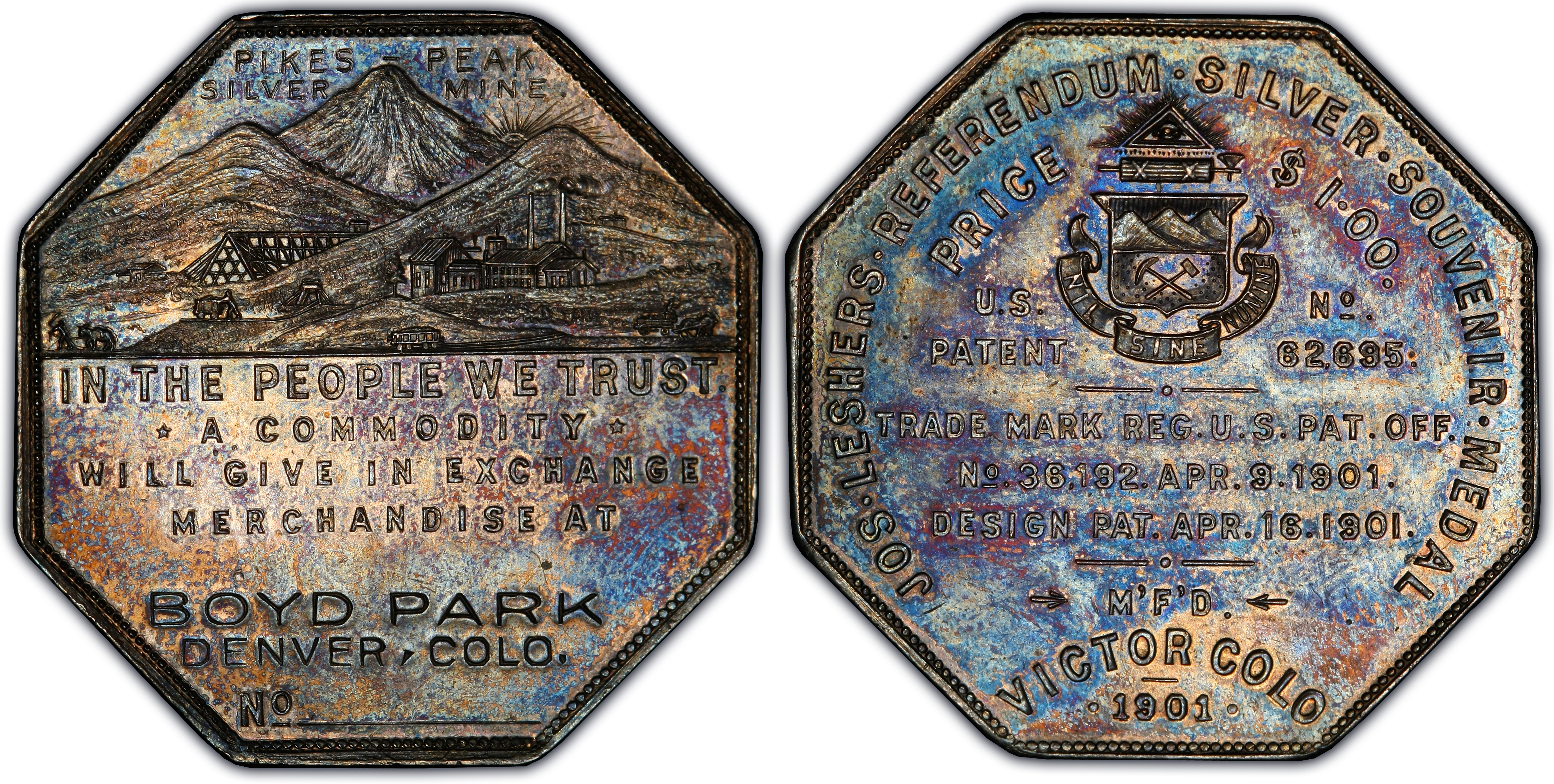
Obverse & Reverse
The Lesher Referendum Dollars are a fascinating and historically significant series of private coinage born from the turbulent economic landscape of turn-of-the-century Colorado. At the heart of this story is Joseph Lesher, a Civil War veteran, silver miner, and real estate investor who settled in Victor, Colorado, the 'City of Mines,' during the Cripple Creek Gold Rush. Lesher was a staunch advocate for the free coinage of silver, a populist movement that believed an expanded money supply based on silver would counteract the deflationary pressures of the gold standard and alleviate the economic hardships faced by farmers and miners. Despite the political defeat of the 'Free Silver' movement in the presidential elections of 1896 and 1900, Lesher remained convinced of its merits and took the extraordinary step of creating his own silver currency. In November 1900, he began issuing octagonal silver 'dollars,' which he cleverly termed 'Referendum Souvenirs'—so named because they were referred to the people for acceptance or rejection, a voluntary currency not forced upon anyone. The initial 1900 issue, valued at $1.25, was struck on one-ounce planchets of .950 fine silver. However, after a run-in with the Secret Service over concerns they too closely resembled federal coinage, Lesher consulted with legal authorities and modified his design for the 1901 issues. These were smaller (32mm), lighter (412.5 grains, matching a standard silver dollar), valued at $1.00, and featured a blank space for counterstamping by local merchants who agreed to accept and redeem them. This transformed the pieces into a form of trade token or scrip, backed by Lesher's promise to redeem them. This specific variety, HK-796a, was issued for Boyd Park, a jeweler located at 16th and Curtis in Denver. The Boyd Park pieces, like others in the series, were intended to facilitate local commerce and promote the use of Colorado's abundant silver. The variety without a serial number (HK-796a) is considered scarcer than its numbered counterpart (HK-796). These 'Referendum Dollars' are a tangible link to the Colorado Labor Wars, the populist political movements of the era, and one man's determined, if ultimately short-lived, experiment in private currency.
Associated EventCripple Creek Gold Rush & 'Free Silver' Movement
Reason For MintingTo promote the use of silver as a currency and provide a medium of exchange during a period of economic uncertainty in mining regions.
Minter HistoryJoseph Lesher (1838-1918) was an Ohio native and Union Army veteran who, after the Civil War, became deeply involved in Colorado's mining industry. He worked in various silver camps, including Leadville and Georgetown, before settling in Victor. An ardent populist and silverite, Lesher was frustrated by the federal government's adherence to the gold standard, which he believed suppressed the value of silver and harmed the local economy. His decision to mint the 'Referendum Dollars' in 1900 and 1901 was a personal crusade to prove the viability and public acceptance of silver-based currency. He patented his octagonal design to prevent counterfeiting and arranged with various merchants across Colorado to distribute his pieces. After producing around 1,800 pieces across all varieties, Lesher ceased production in 1901. He passed away in Victor in 1918, leaving behind one of the most storied and collectible series of private tokens in American history.
Historical SignificanceThe Lesher Dollars are a unique physical embodiment of the American 'Free Silver' political movement. They represent a private citizen's direct challenge to monetary policy and an innovative attempt to create a local, commodity-backed currency. They are among the most famous and well-documented of all 'So-Called Dollars,' bridging the gap between pioneer gold coinage and later trade tokens.
N/A
Denomination$1.00
Minting Period1901
Assayer/MinterJoseph Lesher
Geographic OriginVictor, Colorado
Obverse DescriptionThe central design features a depiction of the Pike's Peak silver mine, with buildings and mining equipment surrounded by mountains. The legend is arranged around the periphery.
Obverse InscriptionJOS. LESHERS REFERENDUM SOUVENIR / PRICE $1.00 / A COMMODITY. / WILL GIVE IN EXCHANGE / MERCHANDISE OR CASH.
Reverse DescriptionThe reverse features a central shield with stars and stripes, surmounted by a fasces (a bundle of rods with a projecting axe blade) and a wreath. The bottom has a blank, recessed panel where merchants would stamp their names.
Reverse InscriptionIN THE PEOPLE WE TRUST. / A GOVERNMENT THAT ISSUES THIS, COIN IS A WRONG TO THE PEOPLE, PERPETUATED. / NO. / PICE'S PEAK SILVER MINE / VICTOR, COLO. / 1901. / (Counterstamp in panel: BOYD PARK / DENVER, COLO.)
CompositionSilver, alloyed with Copper
Stated Fineness.950 Fine Silver
Actual Fineness0.95
Weight26.73 grams
Diameter32.00 mm
EdgePlain
Approximately 150 were struck for Boyd Park in total (both numbered and unnumbered varieties).
Survival EstimateVery few; likely less than 50 of the unnumbered HK-796a variety survive.
Rarity ScaleR-7 (Very Rare: 4-12 known)
This piece is highly sought after for its unique octagonal shape, direct connection to the 'Free Silver' movement, and its status as a classic 'So-Called Dollar.' The specific merchant counterstamp ties it to the history of Denver, while the unnumbered variety's scarcity adds a layer of rarity that is irresistible to advanced specialists.
Key VarietiesThe primary varieties for the Boyd Park Lesher Dollar are the numbered (HK-796, Zerbe-10) and the unnumbered (HK-796a). The unnumbered variety is significantly scarcer. No proof restrikes or special collector issues were made from the original dies.
Authentication TipsAuthentic examples have a distinct style of engraving and die work by Herman Otto of Denver. The Boyd Park counterstamp should be examined for correct font, size, and placement; it was struck into the piece after the coin was minted, not engraved into the die. The octagonal shape should be precise and the edge plain. Be wary of cast counterfeits, which will have a porous or soapy appearance and lack the sharp detail of a genuine struck piece.
Shopping ConsiderationsA premium quality example for its grade will possess a sharp, well-defined strike, particularly on the fine details of the Pike's Peak mine scene and the central shield on the reverse. The Boyd Park counterstamp should be bold and fully readable. Original, undisturbed surfaces with attractive grey or golden toning command significant premiums. These pieces are often found cleaned or polished; examples with original 'skin' are far more desirable. Check carefully for scratches, rim bumps, or tooling in the fields, which are common issues that detract from both the appearance and value.
A coin's grade is its condition, rated on a 1-70 scale. For rare coins, this is the most critical factor in determining value, as a tiny difference in preservation can mean a huge difference in price.
Relevant Grade TypesOriginal period issues were business strikes intended for circulation and are found in Circulated (1-58) and Mint State (MS, 60-70) grades. No proofs were struck during the original period of issue, and no later-date restrikes are known to exist.
Mint State CharacteristicsUncirculated examples of Lesher Dollars are rare. A true Mint State specimen will exhibit full, unbroken mint luster, which is typically soft and satiny rather than frosty. The strike is often somewhat soft in the absolute centers, but a high-quality piece will show sharp details on the mountain range and the lettering. Because they were handled as curiosities, even MS examples can have minor contact marks or 'cabinet friction' on the highest points.
Circulated Wear PatternsWear first appears on the highest points of the design. On the obverse, look for flattening on the rooflines of the mine buildings and the tops of the mountains. On the reverse, the highest points of the shield and the top of the fasces will show the first signs of friction and metal loss. In lower grades (VF and below), the finer text in the inscriptions will begin to weaken and merge with the fields.
Key Factors For ValueThe primary value drivers for this coin are rarity and grade. Surface quality is paramount; an example with original, attractive toning and minimal marks will always sell for more than a harshly cleaned or damaged piece in the same numerical grade. The boldness of the Boyd Park counterstamp is also a key factor, with clear, well-centered stamps being the most desirable. Eye appeal—the overall visual impact of the coin—plays a major role. A CAC sticker, indicating premium quality for the grade, adds a significant premium for this series.
PCGS Price Guide
| Grade | Price | Population |
|---|---|---|
| 8 | $2,250.00 | 1 |
| 10 | $2,350.00 | N/A |
| 12 | $2,500.00 | N/A |
| 15 | $2,650.00 | N/A |
| 20 | $2,750.00 | N/A |
| 25 | $3,000.00 | N/A |
| 30 | $3,250.00 | 1 |
| 35 | $3,500.00 | N/A |
| 40 | $3,750.00 | N/A |
| 45 | $4,000.00 | 2 |
| 45+ | $4,250.00 | N/A |
| 50 | $4,500.00 | 1 |
| 50+ | $4,750.00 | N/A |
| 53 | $5,000.00 | 1 |
| 53+ | $5,150.00 | N/A |
| 55 | $5,500.00 | 1 |
| 55+ | $5,750.00 | N/A |
| 58 | $6,000.00 | N/A |
| 58+ | $6,500.00 | N/A |
| 60 | $7,000.00 | N/A |
| 61 | $8,000.00 | N/A |
| 62 | $8,500.00 | N/A |
| 62+ | $9,500.00 | N/A |
| 63 | $11,000.00 | N/A |
| 63+ | $12,000.00 | N/A |
| 64 | $13,500.00 | 1 |