1901 Lesher $ HK-797 W.C. Alexander (Regular Strike)
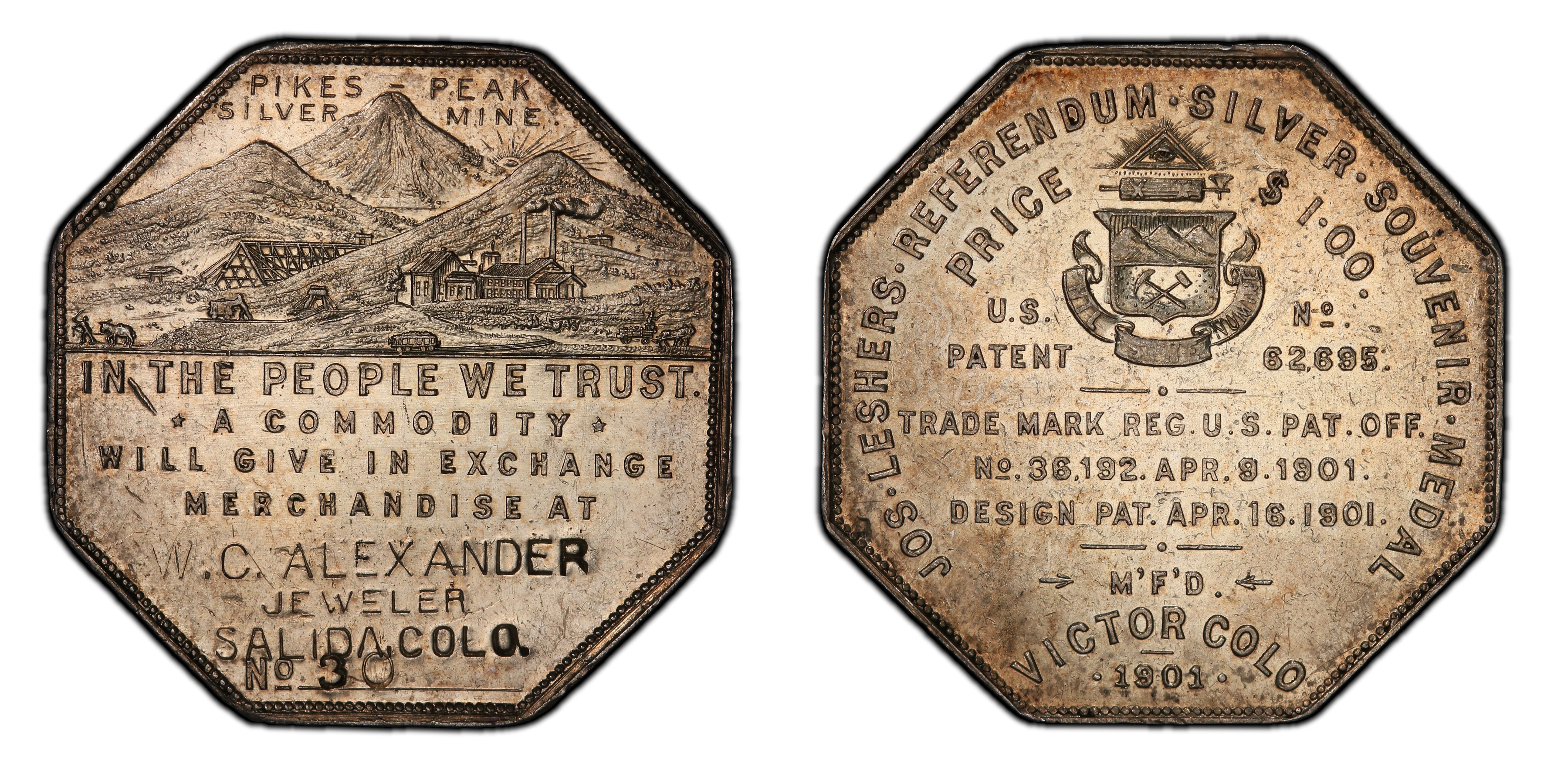
Obverse & Reverse
The Lesher 'Referendum' Dollars of 1900-1901 are a quintessential product of the 'Free Silver' movement, a fiery political issue that dominated late 19th-century American politics. Following the defeat of silver advocate William Jennings Bryan in the 1896 and 1900 presidential elections, the economic future of silver mining regions like Victor, Colorado, in the Cripple Creek Mining District, appeared bleak. Joseph Lesher, a silver mine owner and ardent believer in bimetallism, conceived a radical plan to demonstrate silver's utility and fight back against the gold standard. He decided to mint his own octagonal 'coins' from locally mined silver, calling them 'Referendum Souvenirs' because their acceptance in commerce was left as a referendum to the people. He shrewdly designed them to be octagonal with the word 'Souvenir' to avoid federal counterfeiting laws. The 1901 issues, smaller than their 1900 predecessors, were specifically designed to facilitate local trade. Lesher struck 'blank' or 'imprint' dollars and wholesaled them to area merchants for around 80-85 cents each. These merchants would then have their own names and towns stamped into a reserved space on the obverse, creating a localized currency they could use for change and payroll, effectively guaranteeing their value in trade at their stores. This HK-797 variety was distributed by William Calvin Alexander, a prominent jeweler, optician, and eventual three-term mayor of Salida, Colorado. Alexander purchased a small batch of approximately 50 of these pieces to distribute through his business, forever linking his name to Lesher's populist monetary experiment. These pieces circulated briefly as a form of trade token, a tangible representation of a defiant, community-level monetary policy in the face of national economic shifts. Their story encapsulates the economic anxieties and creative solutions born from the ashes of the Free Silver movement.
Associated EventFree Silver Movement
Reason For MintingTo create a privately issued silver currency to promote the use of silver and facilitate local commerce following the political defeat of the Free Silver movement.
Minter HistoryJoseph W. Lesher (1838-1918) was an Ohio native who, after serving in the Civil War, moved to Colorado and became deeply involved in the silver industry. Over several decades, he transitioned from a common miner to a successful mine owner and real estate investor in camps like Leadville and Georgetown before settling in Victor. A staunch supporter of William Jennings Bryan and the free coinage of silver, Lesher's minting experiment was born from both ideological conviction and economic self-interest. He personally designed the pieces and contracted a Denver firm for the striking. His enterprise lasted only from 1900 to 1901, but his unique octagonal 'dollars' became a lasting numismatic legacy of the era's fierce monetary debates.
Historical SignificanceThe Lesher Dollars are one of the most famous and historically significant series within the 'So-Called Dollar' category, representing a grassroots monetary rebellion against federal policy. The W.C. Alexander variety is a prime example of the merchant-based distribution system Lesher devised in 1901, illustrating how these tokens were integrated into local economies. They serve as a physical link to the intense socio-economic struggles of Western mining towns at the turn of the 20th century.
HK-797 / Zerbe-11
Denomination$1.00
Minting Period1901
Assayer/MinterJoseph Lesher
Geographic OriginVictor, Colorado
Obverse DescriptionAn octagonal planchet. The center field is dominated by a detailed depiction of a mining scene, featuring a mine entrance, ore cart on tracks, and mountains in the background, with 'PIKES PEAK / SILVER MINE' split by the central peak. Below this scene is a blank rectangular space intended for a merchant's counterstamp. The legend 'JOS. LESHERS REFERENDUM SOUVENIR' is in the upper periphery, and 'PRICE $1.00' is in the lower periphery. A small Colorado state seal device is at the bottom, flanked by 'VICTOR.' and 'COLO.', all dated 1901.
Obverse InscriptionJOS. LESHERS REFERENDUM SOUVENIR / PIKES PEAK / SILVER MINE / PRICE $1.00 / VICTOR. / COLO. / 1901 / [Merchant Stamp: W.C. ALEXANDER / JEWELER / SALIDA, COLO.]
Reverse DescriptionThe reverse text is arranged in several lines within the octagonal border, with a space at the bottom for a serial number. The legend makes clear the piece's function as a trade token.
Reverse InscriptionA COMMODITY / WILL GIVE / IN EXCHANGE / MERCHANDISE / OR CASH / AT FACE VALUE / No. [Hand-punched serial number]
CompositionSilver, alloyed with Copper
Stated Fineness.950 Silver
Actual Fineness.950 Silver
Weight26.73 grams
Diameter32.00 mm
EdgePlain
Approximately 50
Survival Estimate13-15
Rarity ScaleR-6 (Very Rare)
The W.C. Alexander Lesher Dollar is highly prized for its extreme rarity, historical connection to the Free Silver movement, and its status as a definitive 'merchant' piece from a known Colorado figure. The octagonal shape and intricate mining scene make it visually distinctive and a cornerstone of any advanced So-Called Dollar or Territorial collection.
Key VarietiesThe primary variety for HK-797 is the W.C. Alexander stamp itself. Within the broader Lesher series, key varieties are defined by the different merchant stamps (e.g., Geo. Mullen, Boyd Park, Sam Cohen), the earlier 1900 A.B. Bumstead types (HK-788, HK-789), and the initial Lesher-redeemed type (HK-787). No proof or specimen strikings of the W.C. Alexander type are known to exist; all were business strikes intended for commerce. No official restrikes were ever made, though modern copies and tribute pieces exist and should not be confused with original issues.
Authentication TipsAuthenticity hinges on several key points. The underlying Lesher dollar must be genuine, exhibiting the correct die characteristics. The W.C. Alexander counterstamp is the crucial diagnostic: it is typically well-impressed, and a known characteristic is that the second 'A' in 'SALIDA' is an inverted 'V'. The serial number on the reverse should be hand-punched, resulting in numerals that are imperfectly aligned and spaced, a hallmark of originality. Modern forgeries often have laser-etched or perfectly aligned stamps and serial numbers. The weight and silver composition should also match specifications precisely.
Shopping ConsiderationsA premium quality example for its grade will possess undisturbed, original surfaces with attractive natural toning, often in shades of gray, blue, or gold. The strike of the host token should be sharp, with clear details on the mining cart and mountain range. Crucially, the merchant stamp and serial number should be bold and fully legible. Avoid examples that have been harshly cleaned, which will appear unnaturally bright and may have fine hairline scratches. Also, check the rims carefully for damage, as the octagonal shape is prone to bumps and subsequent tooling or filing to hide imperfections. A CAC sticker on a certified holder provides strong third-party confirmation of quality for the assigned grade.
A coin's grade is its condition, rated on a 1-70 scale. For rare coins, this is the most critical factor in determining value, as a tiny difference in preservation can mean a huge difference in price.
Relevant Grade TypesAll original Lesher Dollars were business strikes intended for circulation and are graded on the Circulated (1-58) and Mint State (MS, 60-70) scales. The vast majority of surviving examples are circulated, typically found in grades from Very Fine to About Uncirculated. True Mint State specimens are exceedingly rare. No Proof (PR/PF) examples of this issue were ever struck by Lesher, and no later-date proof restrikes are known.
Mint State CharacteristicsAn uncirculated (MS) W.C. Alexander dollar is a significant rarity. Quality is defined by full, unbroken mint luster, which is typically soft and satiny rather than deeply prooflike. The strike can be variable; a premium piece will show sharp detail on the ore cart and the fine lines of the mine building. Due to the nature of their production and distribution in bags, even high-grade examples may show light contact marks. The quality and sharpness of the hand-punched serial number and the merchant stamp are also critical factors for eye appeal.
Circulated Wear PatternsWear first appears on the highest points of the design. On the obverse, look for friction on the roof and front face of the mine building, the top of the ore cart, and the lettering in the legends. On the reverse, the highest points of the letters in 'COMMODITY' and 'EXCHANGE' will show the first signs of smoothing. In lower grades (below VF), the finer details of the mountain range will begin to merge, and the legends will soften into the fields.
Key Factors For ValueFor the HK-797, value is driven by three main factors beyond the numerical grade. First is rarity; with only a handful known, any example is valuable. Second is surface quality; pieces with original, uncleaned surfaces and attractive toning command significant premiums. Third is the quality of the counterstamp and serial number; a bold, clear, and well-centered stamp is far more desirable than a weak or uneven one. A CAC sticker indicating premium quality for the grade will add a substantial premium due to the scarcity and demand for this iconic So-Called Dollar.
PCGS Price Guide
| Grade | Price | Population |
|---|---|---|
| 35 | $10,000.00 | 1 |
| 40 | $10,750.00 | 1 |
| 45 | $11,500.00 | N/A |
| 45+ | $12,000.00 | N/A |
| 50 | $13,000.00 | 4 |
| 50+ | $13,500.00 | N/A |
| 53 | $15,000.00 | 2 |
| 53+ | $16,000.00 | N/A |
| 55 | $16,500.00 | 3 |
| 55+ | $17,000.00 | N/A |
| 58 | $17,500.00 | N/A |
| 58+ | $18,500.00 | N/A |
| 60 | $20,000.00 | N/A |
| 61 | $21,500.00 | 1 |
| 62 | $23,500.00 | N/A |