1901 Lesher $ HK-1020 H Stein (Regular Strike)
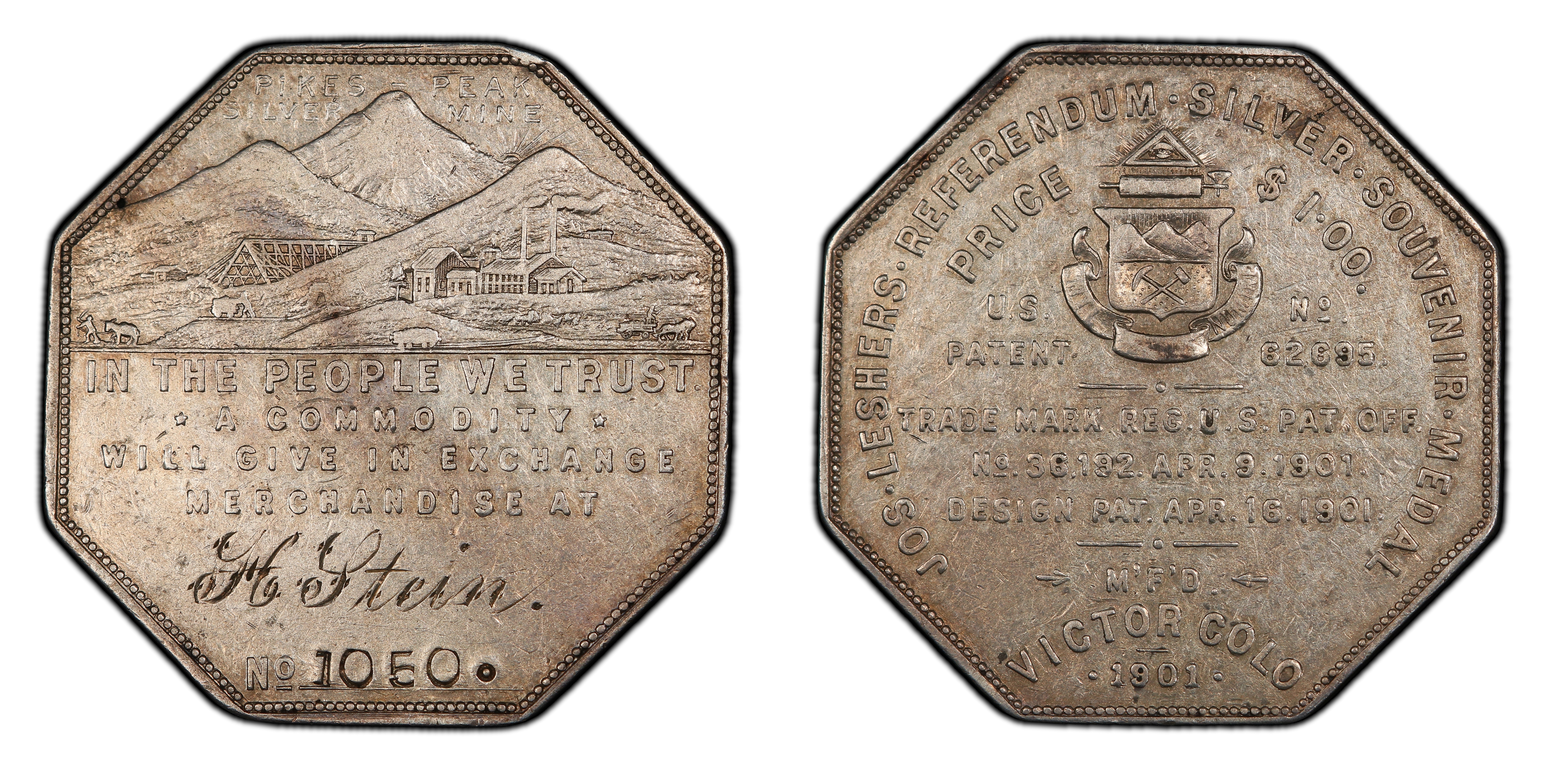
Obverse & Reverse
The Lesher Referendum Dollars of 1900-1901 represent a fascinating and defiant chapter in American monetary history, born from the ashes of the 'Free Silver' movement. By the turn of the 20th century, the United States had firmly committed to the gold standard, a decision that devastated silver mining economies in the West, particularly in Colorado. The Panic of 1893, largely blamed on the Sherman Silver Purchase Act, led to its repeal and the subsequent collapse of silver prices. This left mining towns like Victor, in the Cripple Creek district, reeling from mine closures and economic depression. Into this environment stepped Joseph Lesher, a Civil War veteran, silver mine owner, and staunch 'Silverite'. A passionate believer that the unlimited coinage of silver was the key to national prosperity, Lesher decided to take matters into his own hands after the political defeat of William Jennings Bryan, the movement's champion, in the 1900 presidential election. Lesher conceived of a private coinage, octagonal in shape to avoid conflict with federal anti-counterfeiting laws, which he called 'Referendum Souvenirs'. The name signified his core principle: the pieces were 'referred' to the people for acceptance or rejection, a grassroots vote on the utility of silver. The 1901 issue, to which the H. Stein variety belongs, was a modification of his initial 1900 experiment. The weight was reduced from one troy ounce to 412.5 grains (the same as a standard U.S. silver dollar), and the face value was lowered from $1.25 to $1.00. The new design left a blank space on the obverse for merchants to stamp or engrave their names, effectively turning the pieces into a privately issued trade dollar redeemable for goods or services. Lesher sold these planchets to merchants for about 80-85 cents each. The 'H. Stein' variety is one of the rarest of these merchant-sponsored issues. Unlike most other varieties which were counterstamped, the H. Stein pieces are hand-engraved, adding a unique, artisanal quality. It is believed that H. Stein was a clothier, possibly from Canon City, Colorado, though historical records are scarce. The existence of engraved varieties like the H. Stein suggests that some merchants may have participated on a very small, perhaps experimental, scale. These pieces circulated locally, a testament to the community's support for silver and their trust in Lesher's guarantee to redeem them. However, the project was short-lived. The ever-watchful U.S. Secret Service, tasked with policing the nation's currency, inevitably took an interest in Lesher's activities, and production ceased. Today, the Lesher Dollars, and particularly the rare merchant varieties like the H. Stein, are prized as tangible relics of the Populist-era struggle between Western debtors and miners and Eastern financial interests.
Associated EventFree Silver Movement
Reason For MintingTo promote the use of silver as a circulating medium of exchange following its demonetization and to protest the gold standard.
Minter HistoryJoseph W. Lesher (1838-1918) was a native of Ohio and a Union Army veteran of the Civil War. After the war, he moved to Colorado and became deeply involved in the silver industry as a miner and eventually a mine owner and real estate investor in the booming mining camps of Leadville, Georgetown, and finally Victor. A fervent believer in bimetallism, Lesher was dismayed by the economic hardship caused by the demonetization of silver. An entrepreneur at heart, he devised the 'Referendum Dollar' as a practical demonstration of his monetary theories. He consulted with legal minds, including Senator Henry Teller, to ensure his octagonal 'souvenirs' did not violate federal law. He personally designed the medals and commissioned dies from Denver die-sinkers Frank Hurd and Herman Otto. Lesher's experiment, though ultimately small-scale and brief, secured his place in numismatic history as a bold advocate for the 'People's Money'.
Historical SignificanceThe Lesher Dollars are a tangible link to the Populist movement and the contentious 'Battle of the Standards' between gold and silver. They are a rare example of privately issued currency that achieved limited, regional circulation, reflecting local defiance of national monetary policy. The series demonstrates the economic anxieties and proposed solutions of the era, making them important historical documents as much as numismatic items.
N/A
Denomination$1.00
Minting Period1901
Assayer/MinterJoseph Lesher
Geographic OriginVictor, Colorado
Obverse DescriptionAn octagonal medal. The center features a depiction of a mining complex on a mountainside, identified as the PIKES PEAK SILVER MINE. Below this is a blank space where the merchant's name is engraved. At the bottom is a serial number, which was individually hand-punched.
Obverse InscriptionPIKES PEAK / SILVER MINE / [Engraved: H. Stein] / [Hand-punched serial number, e.g., '1020']
Reverse DescriptionThe reverse is dominated by text arranged in multiple lines within the octagonal border, asserting the piece's purpose and Lesher's patent and trademark information.
Reverse InscriptionJOS. LESHERS • REFERENDUM • SOUVENIR / PRICE $1.00 / U.S. PAT. / NO. 62695 / TRADE MARK REG. / U.S. PAT. OFF. / NO. 36192 APR. 9. 1901 / DESIGN PAT. / APR. 16. 1901. / M'F'D / VICTOR. COLO. / • 1901 •
CompositionSilver, alloyed with copper
Stated Fineness.950 Silver
Actual Fineness.950 Silver
Weight26.73 grams
Diameter32.00 mm
EdgePlain
Extremely low; likely fewer than 25.
Survival EstimateFewer than 10 known
Rarity ScaleR-7 (4 to 12 known)
The HK-1020 is a classic rarity within an already popular series. Its appeal lies in its extreme scarcity, its connection to the romanticized 'Free Silver' era of the American West, and the unique, hand-engraved merchant name, which distinguishes it from the more common stamped varieties.
Key VarietiesThe Lesher series is rich with varieties, primarily differentiated by the merchant counterstamp. The 1901 'Imprint' type (HK-791) served as the host piece for numerous merchant issues, including J.M. Slusher (HK-792), Sam Cohen (HK-793), Boyd Park (HK-796), and others. The H. Stein (HK-1020) and H.H. Rosser (HK-1021) are notable for being hand-engraved rather than stamped. No proof or special collector issues were created during the original period of issue. In the 1980s, restrikes were produced to raise funds for the restoration of the Lesher House, using the original reverse design but a new obverse; these are modern collectibles and distinct from the original pieces.
Authentication TipsAuthentic examples exhibit crisp details on the mining scene and reverse lettering, consistent with a die-struck piece. The hand-engraving of 'H. Stein' should show characteristics of period craftsmanship, with variable depth and a natural, flowing script, unlike modern laser or machine engraving. The hand-punched serial numbers are characteristically irregular in depth and alignment. Counterfeits may be cast, showing a softer overall appearance and possibly a seam on the edge. Be wary of genuine 'Imprint' type Lesher dollars (HK-791) to which a spurious 'H. Stein' engraving has been added; comparing the engraving style to known genuine examples is critical.
Shopping ConsiderationsA premium quality example for its grade will possess original, undisturbed surfaces with attractive, often gray-blue toning. Look for a bold strike, particularly on the fine details of the mining complex and the patent information on the reverse. The quality and aesthetic appeal of the hand-engraving can also impact value. Check the octagonal edges and corners for bumps, bruises, or filing, which are common and should be noted. As with many rare territorial issues, cleaning is a frequent problem; pieces with original 'skin' and some remaining luster command significant premiums. Avoid examples with harsh cleaning, significant rim damage, or scratches that detract from the engraving.
A coin's grade is its condition, rated on a 1-70 scale. For rare coins, this is the most critical factor in determining value, as a tiny difference in preservation can mean a huge difference in price.
Relevant Grade TypesAll original Lesher Dollars, including the H. Stein variety, were struck as business strikes intended for local commerce. They are found in Circulated grades (AG-3 to AU-58) and, very rarely, in Mint State grades (MS-60 to 70). No proofs were struck during the original period of issue, and there are no known later-date proof restrikes of this specific variety.
Mint State CharacteristicsA true Mint State HK-1020 is exceptionally rare. Such a piece would exhibit full, unbroken mint luster, likely with a soft, satiny texture. The strike can be variable; some areas, like the center of the mining scene or parts of the reverse legend, may show slight weakness even on the best-struck examples. Due to the handling and application of the engraving and serial number, small ticks or marks around the merchant name or number are not uncommon and may not preclude a Mint State grade if they are contemporaneous to manufacture.
Circulated Wear PatternsWear first appears on the highest points of the design: the roof of the main mining building on the obverse and the central portion of the reverse legends, particularly the patent dates. As wear progresses, the finer details of the mountainside and the smaller buildings will soften. On the reverse, the peripheral inscriptions will begin to fade. The engraved 'H. Stein' is relatively protected and usually remains sharp even on moderately circulated examples.
Key Factors For ValueFor the H. Stein Lesher Dollar, rarity is the paramount value driver. After that, surface quality is key. An example with original, uncleaned surfaces and attractive toning is vastly superior to a harshly cleaned or polished piece of the same technical grade. The sharpness of the strike, the clarity of the engraving, and overall eye appeal contribute significantly to value. Given the piece's rarity and historical importance, any example, even those with problems, is highly coveted. A CAC sticker would provide a strong endorsement of surface quality and strike for the assigned grade.
PCGS Price Guide
| Grade | Price | Population |
|---|---|---|
| 50 | $25,000.00 | 1 |
| 53 | N/A | N/A |