1901 Lesher $ HK-794 D.W. Klein & Co. (Regular Strike)
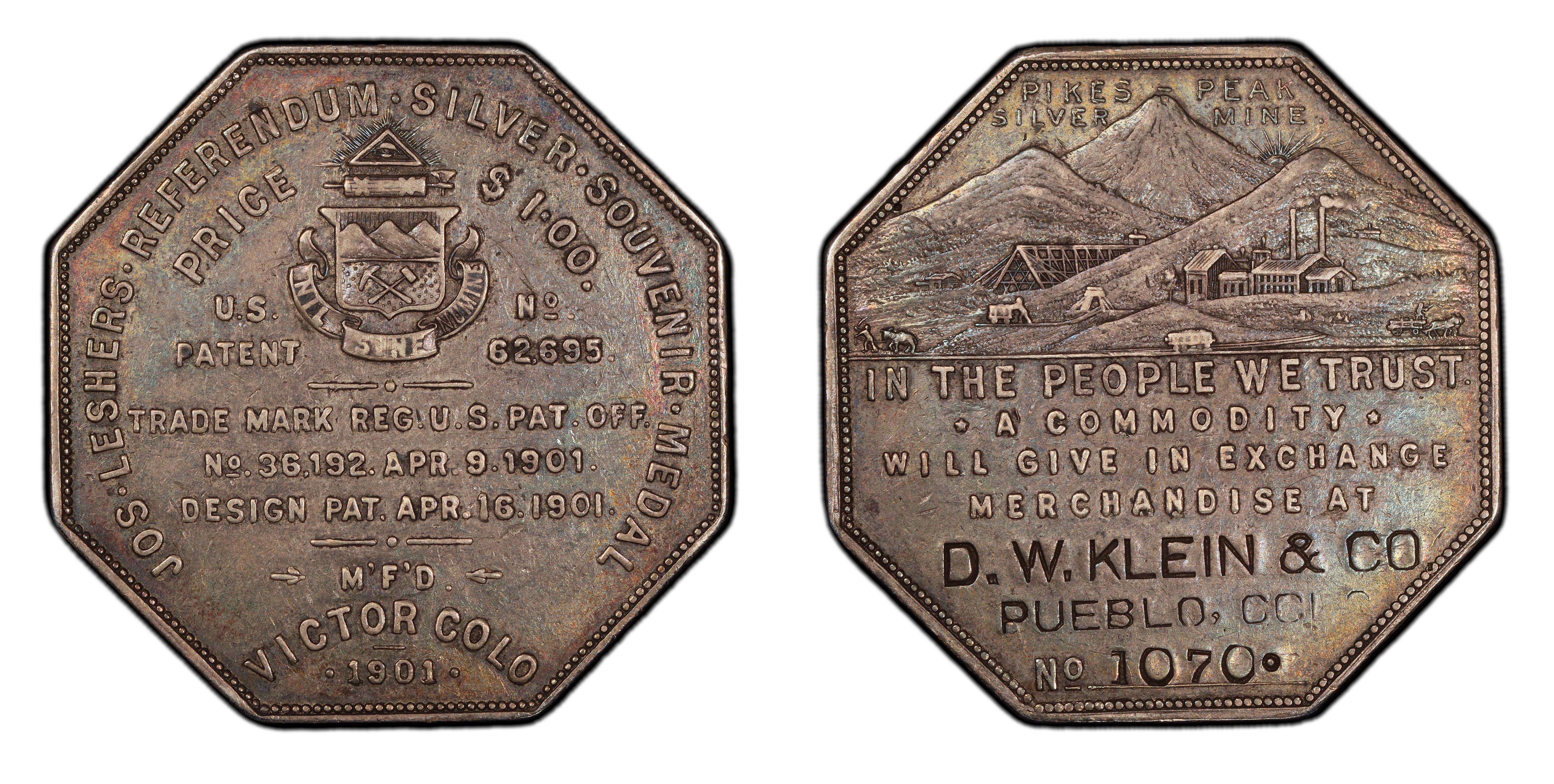
Obverse & Reverse
The Lesher 'Referendum' Dollars represent a fascinating and uniquely American chapter in the history of private coinage, born from the fiery 'Free Silver' movement of the late 19th century. Following the Panic of 1893 and the repeal of the Sherman Silver Purchase Act, the price of silver plummeted, devastating mining-dependent economies like Colorado's. Joseph Lesher, a Civil War veteran and silver mine owner from Victor, Colorado, was a fervent believer in bimetallism. He watched as his own mine became unprofitable and his community in the Cripple Creek Mining District suffered from economic stagnation. Convinced that increasing the circulation and demand for silver was the key to prosperity, Lesher embarked on a bold experiment. In 1900, he began issuing octagonal silver 'coins,' which he ingeniously called 'Referendum Souvenirs.' The name was a clever legal maneuver; he argued they were not illegal private coinage because they were 'referred' to the people for acceptance or rejection. No one was forced to take them. The 1901 issues, including the D.W. Klein & Co. variety, were struck to the same weight as a standard U.S. silver dollar (412.5 grains) and valued at $1.00, despite the silver content being worth significantly less at the time. To guarantee their value, Lesher partnered with local merchants who agreed to accept them for goods and services. D.W. Klein, a retail liquor store owner on South Union Avenue in Pueblo, Colorado, was one such merchant and an old friend of Lesher's. Klein became the exclusive agent for the pieces in Pueblo, purchasing a reported 300 pieces at a discount (85 cents each) to distribute. The pieces were a success in the local mining camps, circulating freely and rarely being returned for redemption, proving Lesher's concept that a locally backed currency could thrive. The enterprise was short-lived, however, as pressure from the U.S. Treasury Department, which viewed the pieces as a violation of federal law, eventually forced Lesher to cease production. Today, these 'so-called dollars' are prized numismatic relics, tangible symbols of a populist monetary movement and a testament to one man's defiant effort to solve a national economic crisis at a local level.
Associated EventFree Silver Movement / Cripple Creek Gold Rush
Reason For MintingTo create a local currency that would increase the circulation and demand for silver, thereby stimulating the depressed mining economy of Colorado.
Minter HistoryJoseph W. Lesher (1838-1918) was a Civil War veteran from Ohio who moved to Colorado and became involved in mining and real estate. A staunch advocate for the free coinage of silver, he owned a silver mine near Central City that became unprofitable after the silver price crash of 1893. Residing in the bustling gold camp of Victor, he conceived the 'Referendum Dollar' idea as a practical application of his 'Free Silver' beliefs. He designed the pieces, contracted Denver die-sinkers Frank Hurd and Herman Otto to create the dies, and had them struck. His experiment, while ultimately halted by the government, made him a notable figure in the history of American private and territorial coinage.
Historical SignificanceLesher Dollars are a tangible link to the Populist-era 'Free Silver' debate. They are one of the most famous and widely collected series of 'so-called dollars' and represent a bold, grassroots attempt to defy federal monetary policy and address a local economic crisis through private minting, bridging the gap between tokens and circulating currency.
K-12 (similar type)
Denomination$1.00
Minting Period1901
Assayer/MinterJoseph Lesher
Geographic OriginVictor, Colorado
Obverse DescriptionThe octagonal piece features a central vignette of the Pikes Peak mountain range with 'PIKES-PEAK SILVER MINE' inscribed above. Below the mountains is the inscription 'IN THE PEOPLE WE TRUST / A COMMODITY / WILL GIVE / IN EXCHANGE / MERCHANDISE AT'. In a recessed panel at the bottom, the merchant's name and location are hand-stamped or engraved, 'D.W. KLEIN & CO. / PUEBLO, COLO.'. A unique serial number is also hand-punched into the field.
Obverse InscriptionPIKES-PEAK SILVER MINE / IN THE PEOPLE WE TRUST / A COMMODITY / WILL GIVE / IN EXCHANGE / MERCHANDISE AT / D.W. KLEIN & CO. / PUEBLO, COLO.
Reverse DescriptionThe reverse is dominated by text. The periphery reads 'JOS. LESHERS REFERENDUM SOUVENIR MEDAL'. Below this is the denomination 'PRICE $1.00', separated by a shield device. To the left and right of the shield is 'U.S. / PATENT' and 'NO. / 62,695'. Below this is a multi-line inscription detailing patent and trademark information, ending with the manufacturing location and date: 'TRADE MARK REG. U.S. PAT. OFF. / NO. 36,192. APR. 9, 1901. / DESIGN PAT. APR. 16, 1901. / M'F'D / VICTOR COLO / 1901'.
Reverse InscriptionJOS. LESHERS REFERENDUM SOUVENIR MEDAL / PRICE $1.00 / U.S. PATENT NO. 62,695 / TRADE MARK REG. U.S. PAT. OFF. NO. 36,192. APR. 9, 1901. DESIGN PAT. APR. 16, 1901. M'F'D VICTOR COLO 1901
CompositionSilver
Stated Fineness.950 Silver, alloyed with Copper
Actual Fineness.950 Silver, alloyed with Copper
Weight26.73 grams
Diameter32.00 mm
EdgePlain
Fewer than 150; Wilde estimated 100
Survival Estimate12-15 known
Rarity ScaleR-7 (Very Rare)
This variety is highly sought after for its extreme rarity, its direct connection to a specific Colorado merchant, and its compelling backstory rooted in the 'Free Silver' movement. The unique octagonal shape, individual serial numbers, and hand-stamped merchant name ensure that no two pieces are exactly alike, adding to the collector appeal.
Key VarietiesThe primary variety within the D.W. Klein & Co. issue is the method of applying the merchant's name; some are neatly hand-stamped, while at least one early serial number example is known with the name expertly hand-engraved, suggesting it was issued before a punch was prepared. There are no known patterns, proofs, or restrikes of Lesher dollars; all were originally produced as business strikes intended for circulation.
Authentication TipsAuthentic examples have a distinct 'feel' and strike characteristic. Look for sharp details on the reverse legends and the mountain range, which are often softer on cast counterfeits. The merchant stamp and serial number should be examined closely; the punches should show character consistent with early 20th-century tools, not modern laser engraving. The weight (412.5 grains / 26.73g) and specific gravity should be correct. Fakes may have a soapy or greasy luster, porous surfaces, or tooling marks around the lettering or merchant stamp.
Shopping ConsiderationsA premium quality example for its grade will possess a bold, well-centered strike on both sides, with a particularly sharp and fully legible merchant stamp and serial number. Originality of surface is paramount; look for attractive, undisturbed 'cabinet' toning, which often ranges from steel-gray to deep blue and gold. Avoid examples that have been harshly cleaned, polished, or show evidence of tooling or repairs, as these significantly impair value. Check for edge bumps and rim bruises, as the octagonal shape made them susceptible to damage. An even, honest amount of circulation wear can be very attractive on these pieces, but severe scratches or planchet flaws will detract from the eye appeal.
A coin's grade is its condition, rated on a 1-70 scale. For rare coins, this is the most critical factor in determining value, as a tiny difference in preservation can mean a huge difference in price.
Relevant Grade TypesAll original Lesher Dollars were business strikes intended for local commerce and are graded on the standard 1-70 scale. They are found in Circulated grades (AG-3 to AU-58) and, very rarely, in Mint State (MS, 60-70). No proofs were struck during the original period of issue, and no later-date restrikes or special collector strikings are known to exist.
Mint State CharacteristicsUncirculated examples are exceptionally rare. A true Mint State specimen would exhibit full, frosty mint luster, often with a slightly prooflike or reflective quality in the protected areas. Strike is a key factor; many Leshers are not perfectly struck, so a piece with sharp detail on the mountain peaks and the fine text of the reverse patent information is highly desirable. Minor, scattered contact marks are to be expected due to the large size and handling at the time of issue, but large, distracting marks will lower the grade.
Circulated Wear PatternsWear first appears on the highest points of the design. On the obverse, this includes the peaks of the mountain range and the raised horizontal lines of the central text block. On the reverse, the high points are the shield device and the letters in 'LESHERS' and 'PRICE $1.00'. As wear progresses, the finer details of the mountains will soften, and the reverse legends will start to weaken. The hand-stamped merchant mark is often a point of weakness and may fade on heavily worn examples.
Key Factors For ValueRarity is the primary driver, but for a given example, the most important factors are surface preservation and strike quality. A specimen with original, uncleaned surfaces and attractive toning will command a significant premium over a cleaned or lackluster piece of the same grade. The boldness and clarity of the D.W. Klein & Co. merchant stamp and the serial number are critical; weak or uneven stamps are less desirable. Finally, because of the rarity and value, certification by a top-tier grading service (PCGS or NGC) is essential for market acceptance, with a CAC sticker adding a further premium for exceptional eye appeal and quality.
PCGS Price Guide
| Grade | Price | Population |
|---|---|---|
| 3 | $8,000.00 | 1 |
| 45 | $15,000.00 | 3 |
| 45+ | $17,000.00 | N/A |
| 50 | $22,500.00 | 1 |
| 61 | N/A | N/A |