1901 Lesher $ HK-1021a AW Clark (Regular Strike)
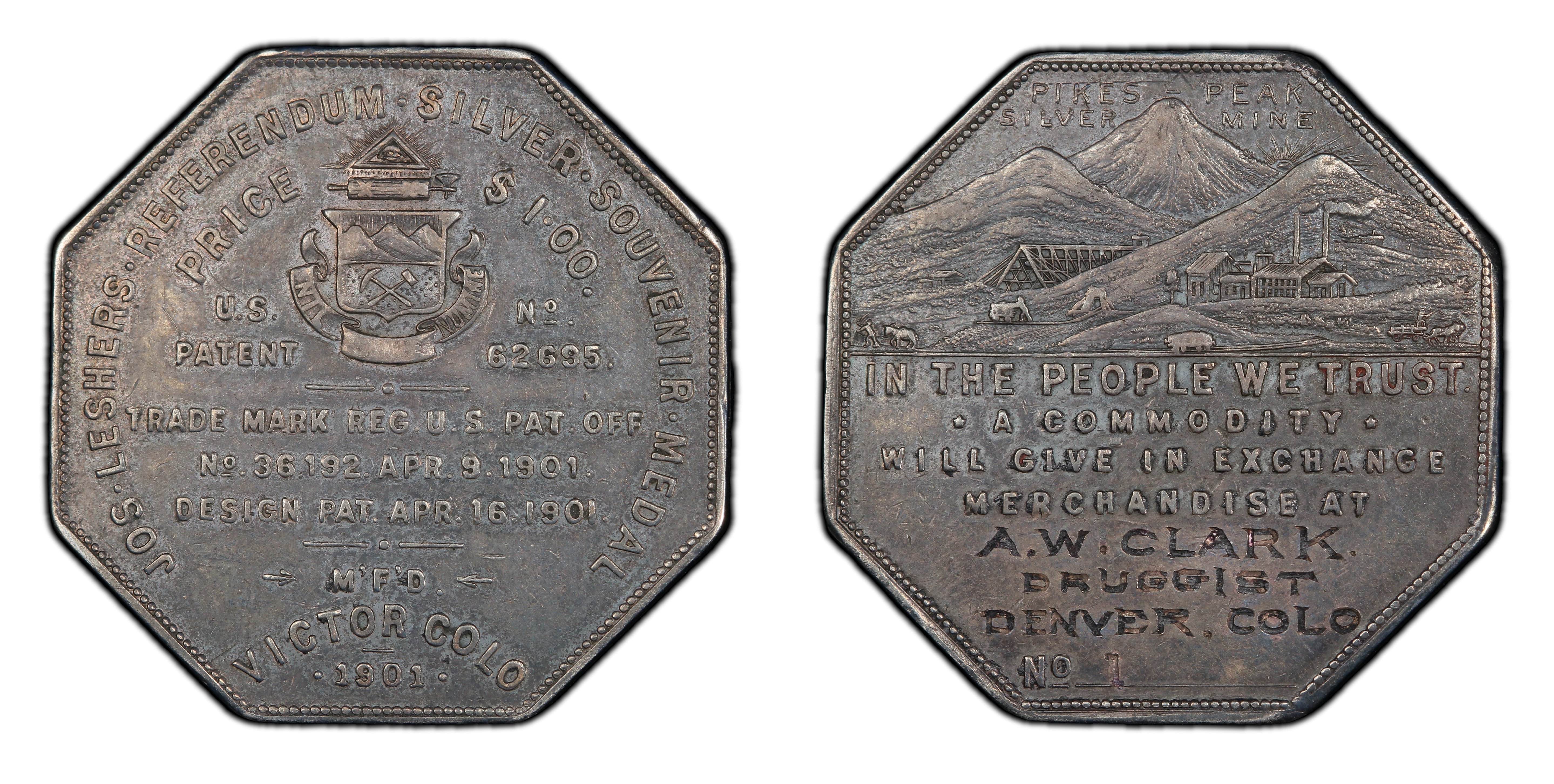
Obverse & Reverse
The 1901 Lesher 'Referendum' Dollar is a fascinating artifact born from the fiery 'Free Silver' debate that dominated American politics in the late 19th century. Its creator, Joseph Lesher, a silver mine owner and staunch populist from Victor, Colorado, was a fervent believer in bimetallism. Following the second defeat of presidential candidate William Jennings Bryan in 1900—a major blow to the Free Silver movement—Lesher took matters into his own hands. He devised a plan to privately mint octagonal 'dollars' to demonstrate silver's utility and challenge the gold standard's grip on the economy. He called them 'Referendum' pieces because their acceptance in commerce was a voluntary choice by the people, a referendum on the value of silver itself. Lesher began his experiment in 1900 with a larger, heavier piece valued at $1.25. In 1901, he modified the planchets to match the weight of a standard U.S. Silver Dollar (412.5 grains) and lowered the face value to $1.00. To avoid conflict with federal anti-counterfeiting laws, he made the pieces octagonal, called them 'souvenirs,' and obtained U.S. patents for his designs. The 1901 series featured a blank space on the obverse, designed to be stamped with the name of a participating merchant. This legally transformed them into trade tokens, redeemable in goods or services from that specific business. Lesher sold the blank pieces to merchants for about 80-85 cents each. Merchants, in turn, would stamp their name and location, creating dozens of distinct varieties. The A.W. Clark pieces are one such variety, commissioned by a druggist in Denver. These dollars circulated with some success in the Cripple Creek mining district and other Colorado towns, readily accepted by a population sympathetic to the silver cause. However, the project was short-lived, ending in 1901, likely due to a combination of limited commercial reach and potential pressure from federal authorities. Today, Lesher Dollars are highly prized as a tangible link to the populist movement and the economic struggles of the American West.
Associated EventFree Silver Movement
Reason For MintingTo promote the use and value of silver as a monetary metal in defiance of the prevailing gold standard.
Minter HistoryJoseph W. Lesher (1838-1918) was an Ohio native who moved to Colorado after the Civil War. He became deeply involved in the silver mining industry, eventually owning his own mine near Central City. A passionate advocate for the populist cause and the free coinage of silver, he was frustrated by the political defeats of the movement. This frustration spurred him to create the 'Referendum Dollar' series as a practical demonstration of his economic beliefs. He personally designed the pieces, commissioned dies from Denver engraver Herman Otto, and had them struck at a private firm. Lesher's project was a bold, if ultimately unsuccessful, act of monetary protest and local entrepreneurship.
Historical SignificanceLesher Dollars are the most famous examples of privately issued 'So-Called Dollars' from the era. They represent a unique intersection of economic theory, political protest, and numismatics, embodying the fierce debate over monetary policy that defined the Gilded Age. The merchant-stamped varieties like A.W. Clark's piece provide a direct connection to the local economies and businesses that embraced Lesher's vision.
N/A
Denomination$1.00
Minting Period1901
Assayer/MinterJoseph Lesher
Geographic OriginVictor, Colorado
Obverse DescriptionAn octagonal medal featuring a detailed mining scene of the Pikes Peak Mining District, with mountains in the background and mine buildings with smokestacks in the foreground. The legend 'PIKES-PEAK' is split by the main peak. Above the scene is the motto 'IN THE PEOPLE WE TRUST'. Below the scene is the text 'A COMMODITY / WILL GIVE / IN EXCHANGE / MERCHANDISE AT', followed by a stamped cartouche reading 'A.W. CLARK / DRUGGIST / DENVER, COLO.'. Below the cartouche is a space for a serial number, which was hand-punched on each piece.
Obverse InscriptionPIKES-PEAK / IN THE PEOPLE WE TRUST / A COMMODITY / WILL GIVE / IN EXCHANGE / MERCHANDISE AT / A.W. CLARK / DRUGGIST / DENVER, COLO. / No. [Hand-punched serial number]
Reverse DescriptionIn the center is the Seal of Colorado. The surrounding inscriptions detail the coin's status and legal protections.
Reverse InscriptionJOS. LESHERS REFERENDUM SOUVENIR / PRICE $1.00 / U.S. PATENT No 62695 / TRADE MARK REG. U.S. PAT. OFF. No 36192 APR. 9. 1901 / DESIGN PAT. APR. 16. 1901 / M'F'D VICTOR, COLO. 1901
CompositionSilver and Copper Alloy
Stated Fineness~.950 Silver
Actual Fineness~.950 Silver
Weight26.73 grams
Diameter32.00 mm
EdgePlain
Unknown for this specific merchant; Total 1901 Lesher Dollar mintage estimated by Farran Zerbe at 3,000-3,500, modern estimates by Adna Wilde suggest ~1,870 across all varieties.
Survival EstimateVery Low. Likely fewer than 20-30 known for the A.W. Clark variety.
Rarity ScaleR-6 (31-75 Known)
This piece appeals to collectors of territorial gold and silver, So-Called Dollars, and historical tokens. Its unique octagonal shape, direct link to the Free Silver movement, and the specific merchant imprint make it a highly desirable and historically rich numismatic item.
Key VarietiesThe primary varieties within the Lesher series are defined by the different merchant imprints on the 1901 issues. The 'A.W. Clark' (HK-1021a) is one such variety. Another key variety is the HK-791, which is the 1901 type piece left blank without a merchant stamp. No proof or special collector issues were created during the period of issuance.
Authentication TipsAuthentic examples have a distinctive, somewhat crude strike. The serial numbers are always hand-punched, resulting in imperfect alignment and depth. The A.W. Clark stamp should be examined for consistency with known genuine examples; the font and spacing are key diagnostics. The overall wear should be consistent between the underlying token and the merchant stamp. Modern counterfeits often have a cast-like or unusually sharp, modern appearance, and the lettering can be misshapen.
Shopping ConsiderationsA premium quality example for its grade will have a bold, even strike on both the main design and the A.W. Clark counterstamp. Original, uncleaned surfaces with attractive grey or bluish toning command a significant premium. Check for rim bumps and bruises, as the octagonal shape makes the corners susceptible to damage. Also inspect the fields for scratches or tooling, particularly around the merchant stamp, as this was sometimes a target for alteration. The clarity and completeness of the serial number are also important factors.
A coin's grade is its condition, rated on a 1-70 scale. For rare coins, this is the most critical factor in determining value, as a tiny difference in preservation can mean a huge difference in price.
Relevant Grade TypesAll original Lesher Dollars are business strikes intended for circulation. They are found in Circulated grades (AG-3 to AU-58) and, more rarely, in Mint State (MS, 60-70). No Proof (PR/PF) examples were struck during the original period of issue, and no later-date restrikes are known to exist.
Mint State CharacteristicsUncirculated examples are scarce. A typical Mint State piece will exhibit soft, satiny luster. The strike is often somewhat weak in the center of the mining scene and on the higher points of the state seal on the reverse. Small, scattered contact marks are common and expected due to the soft silver composition and handling at the time of issue. The quality of the merchant stamp and the hand-punched serial number does not affect the numerical grade but is a key component of eye appeal.
Circulated Wear PatternsWear first appears on the high points of the design. On the obverse, check the central mountain peaks and the roofs of the mine buildings. On the reverse, the eagle's head and the shield within the Colorado State Seal are the first areas to show friction and lose detail. In lower grades (VG and below), the finer lines of the inscriptions and the details of the mining camp will become faint.
Key Factors For ValueFor the A.W. Clark Lesher Dollar, value is driven primarily by grade and surface quality. An example with original, undisturbed surfaces is far more valuable than a cleaned or polished one. The boldness of the strike, particularly on the merchant stamp, is critical; a full, clear 'A.W. CLARK' stamp is highly desirable. Eye appeal, manifested as attractive, original toning, adds a significant premium. The presence of a CAC sticker, verifying quality for the grade, is highly sought after by discerning collectors and typically results in a higher market price.
PCGS Price Guide
| Grade | Price | Population |
|---|---|---|
| 55 | $55,000.00 | 1 |