1901 Lesher $ HK-793 Sam Cohen (Regular Strike)
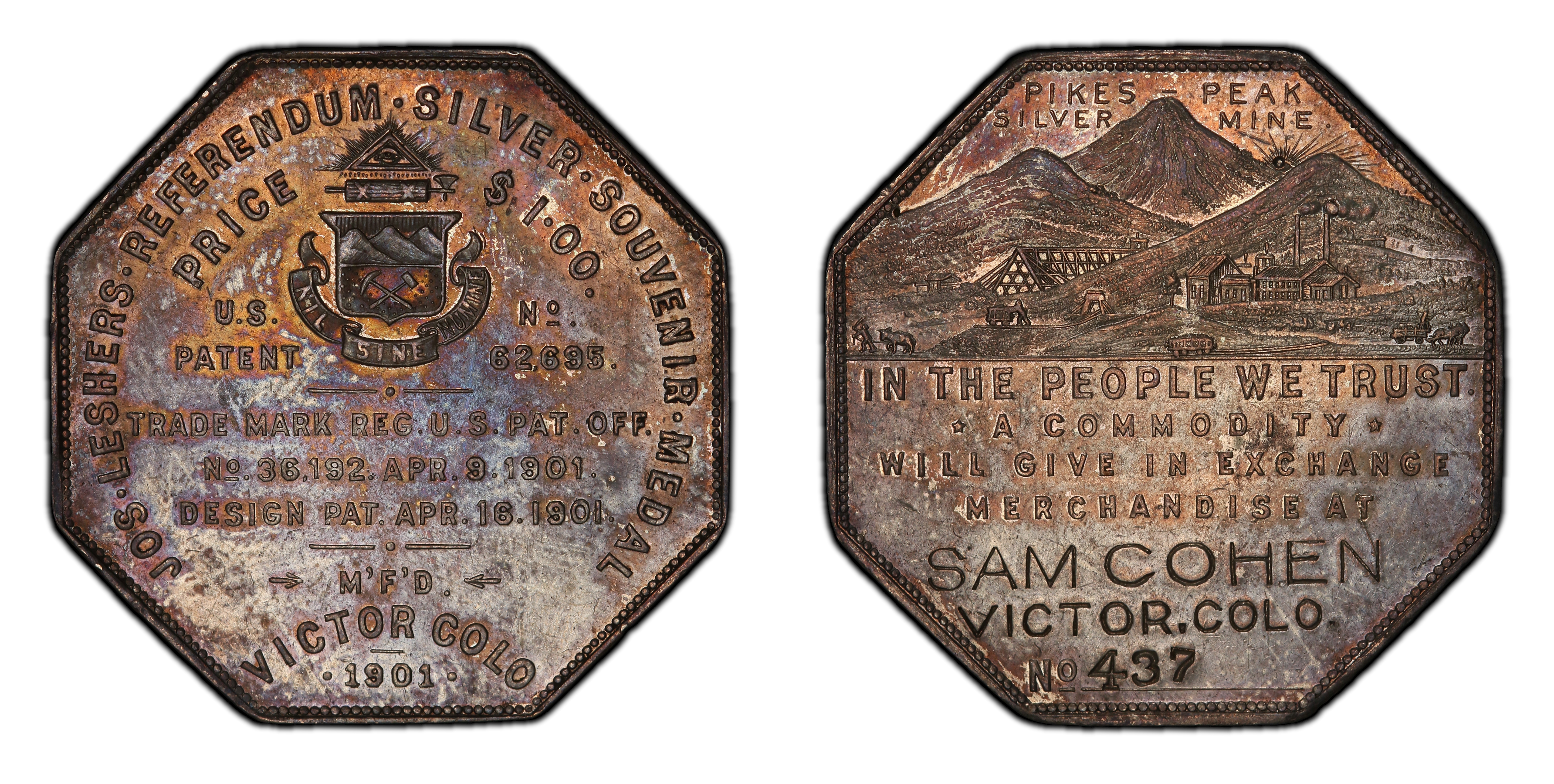
Obverse & Reverse
The Lesher Referendum Dollars are a tangible link to the fiery 'Free Silver' debate that defined late 19th and early 20th-century American politics. Following the 'Crime of '73,' which demonetized silver, and the subsequent economic depressions, silver-producing states like Colorado were devastated. The market price of silver plummeted, forcing mines to close and leaving thousands unemployed. Joseph Lesher, a Civil War veteran, silver miner, and real estate investor in the booming Cripple Creek Mining District, was a fervent believer in bimetallism. He was convinced that the intrinsic value of silver was far higher than its market price and that a greater circulation of silver coinage would restore prosperity. After the defeat of pro-silver presidential candidate William Jennings Bryan in 1900, Lesher took matters into his own hands. On November 13, 1900, he began issuing his own octagonal 'Referendum Souvenirs.' He called them 'Referendum' because they were offered to the public for voluntary acceptance or rejection, a direct appeal to the people's trust. To avoid conflict with federal anti-counterfeiting laws, the pieces were made octagonal and did not imitate U.S. coinage designs. The 1901 issues, including the Sam Cohen variety, were smaller and lighter than the 1900 pieces, matching the weight of a standard U.S. Silver Dollar. Lesher created a master die with a blank space for merchants to stamp their own names, creating a localized, privately backed currency. Sam Cohen, a jeweler at 305 Victor Avenue, became Lesher's 'exclusive agent' in Victor and embraced the project, stamping his name and location on a small batch of these silver pieces. He later chronicled his experiences in the Cripple Creek district, including his association with Lesher, in a 1940 book titled 'Gold Rush De Luxe.' These pieces circulated briefly as a form of trade token, redeemable for merchandise or cash at the participating merchant's establishment. Though Lesher's monetary experiment was short-lived and small in scale, his 'dollars' are now treasured as a fascinating and historically significant series of private issues, embodying the populist spirit and economic turmoil of the era.
Associated EventFree Silver Movement
Reason For MintingTo promote the use and acceptance of silver as a medium of exchange during a period of low silver prices and advocate for bimetallism.
Minter HistoryJoseph W. Lesher (1838-1918) was born in Fremont, Ohio, and served in the Union Army during the Civil War. Afterward, he moved west to Colorado, becoming a pioneer in the state's silver camps, including Georgetown, Leadville, and Central City, where he owned a silver mine. When the price of silver collapsed, he relocated to the booming gold camp of Victor, Colorado, and found success in mining and real estate. A passionate advocate for the free coinage of silver, he conceived of the 'Referendum Dollar' as a private, practical demonstration of his economic theories, hoping to stimulate the local economy and increase silver's circulation. He patented his design in 1901 to prevent counterfeiting, a testament to his commitment to redeem each piece at its face value.
Historical SignificanceThe Lesher Dollars are one of the most famous and widely collected series of 'So-Called Dollars.' They represent a unique and defiant private response to national monetary policy, embodying the populist frustrations of the Free Silver movement. The participation of local merchants like Sam Cohen illustrates a grassroots attempt to create a functional, localized currency based on the region's primary commodity, silver.
N/A
Denomination$1.00
Minting Period1901
Assayer/MinterJoseph Lesher
Geographic OriginVictor, Colorado
Obverse DescriptionA detailed mining scene featuring Pikes Peak in the background with a mine and mill building in the foreground, smoke rising from a smokestack. Below the scene are the inscriptions, and a blank area at the bottom where 'Sam Cohen / Victor, Colo.' is stamped. A unique serial number is hand-punched, typically to the right of the merchant's stamp.
Obverse InscriptionPIKES-PEAK SILVER MINE / IN THE PEOPLE WE TRUST. / A COMMODITY / WILL GIVE IN EXCHANGE / MERCHANDISE AT / [Stamped: Sam Cohen / Victor, Colo.] / No. [Hand-punched number]
Reverse DescriptionThe Colorado State Seal is depicted in the center, featuring a miner's tools (pick and sledgehammer) on a shield, a fasces, and the 'All-Seeing Eye' of Providence above. A banner below the shield contains the state motto.
Reverse InscriptionJOS. LESHERS REFERENDUM SOUVENIR / PRICE $1.00 / M'F'D. VICTOR, COLO. 1901. / U.S. PATENT No. 62695 / TRADE MARK REG. U.S. PAT. OFF. No. 36192 APR. 9. 1901 / DESIGN PAT. APR. 16. 1901. / [Motto on banner: NIL SINE NUMINE]
CompositionSilver, with a copper alloy.
Stated Fineness.950 fine silver
Actual Fineness.950 fine silver
Weight26.73 grams
Diameter32.00 mm
EdgePlain
Approximately 50.
Survival EstimateFewer than 20 known. As of early 2020, 17 distinct examples had been documented.
Rarity ScaleR-7 (Extremely Rare)
The HK-793 is highly sought after for its extreme rarity, direct connection to a specific merchant in the famous Victor mining camp, and its central role in the popular Lesher Dollar series. As a key 'imprint' variety, it is essential for specialists attempting to complete a collection of these fascinating historical tokens.
Key VarietiesThe primary variety within the HK-793 designation is the individually hand-punched serial number; each piece is unique in this regard. The merchant stamp itself can show minor variations in placement and depth. The Lesher series itself contains no later-date restrikes or proof issues; all known examples are original business strikes from the 1900-1901 period.
Authentication TipsAuthentic pieces have a distinctive octagonal shape and plain edge. The dies were made by Herman Otto of Denver, and genuine examples will exhibit a consistent strike quality and die characteristics. The merchant stamp 'Sam Cohen / Victor, Colo.' should be carefully examined for proper font and spacing, as it was applied after the piece was struck. The hand-punched serial numbers are characteristically uneven in alignment and depth. Counterfeits may be cast, showing a soapy appearance and lacking sharp details, or may have incorrect weight and dimensions.
Shopping ConsiderationsA premium quality example for this issue is one that retains its original surfaces and has not been harshly cleaned or polished. Look for sharp details in the mining scene and on the state seal, as these are the high points. The merchant stamp and serial number should be bold and fully legible. These pieces circulated, so some light, honest wear is expected and acceptable. However, be vigilant for problems hidden by toning, such as scratches, tooling, or significant rim bumps, which are common on these octagonal pieces. A coin with a CAC sticker would command a significant premium, as it confirms both the grade and the quality of the surfaces.
A coin's grade is its condition, rated on a 1-70 scale. For rare coins, this is the most critical factor in determining value, as a tiny difference in preservation can mean a huge difference in price.
Relevant Grade TypesAll original Lesher Dollars, including the Sam Cohen variety, were struck as business strikes intended for local commerce. They are found in Circulated grades (AU-58 and lower) and, very rarely, in Mint State (MS, 60-70). No proof (PR/PF) examples were struck during the original period of issue, and no later-date restrikes or special collector strikings are known to exist.
Mint State CharacteristicsUncirculated examples are exceptionally rare. A true Mint State specimen would exhibit full, unbroken satiny luster. The strike is often somewhat soft in the centers, particularly on the highest points of the mining scene and the state seal. Small, scattered contact marks are typical due to the softness of the high-purity silver and the way the pieces were handled and stored. The individually applied merchant stamp and serial number may show localized metal displacement around the indentations.
Circulated Wear PatternsWear first appears on the highest points of the design: the roof and smokestack of the mine building on the obverse, and the miner's tools and fasces within the shield on the reverse. As wear progresses, the finer details of the mountains and the lettering in the state motto 'NIL SINE NUMINE' will soften. The fields will show loss of luster and develop a uniform gray patina.
Key Factors For ValueGiven the extreme rarity, any example is valuable. However, value is driven by several key factors. Surface preservation is paramount; specimens with original, undisturbed skin and minimal marks command the highest prices. Any evidence of harsh cleaning, polishing, or tooling will severely diminish the value. The boldness of the merchant stamp and the clarity of the serial number are critical. Finally, overall eye appeal, including attractive, original toning, contributes significantly to a coin's desirability and market value. A CAC sticker provides a strong third-party endorsement of quality and will result in a substantial price premium.
PCGS Price Guide
| Grade | Price | Population |
|---|---|---|
| 40 | $10,000.00 | 1 |
| 45 | $11,500.00 | 1 |
| 45+ | $12,000.00 | N/A |
| 50 | $13,000.00 | 1 |
| 50+ | $14,000.00 | N/A |
| 53 | $15,000.00 | N/A |
| 53+ | $16,000.00 | N/A |
| 55 | $17,500.00 | 2 |
| 55+ | $18,500.00 | N/A |
| 58 | $20,000.00 | 1 |
| 58+ | $21,000.00 | N/A |
| 60 | $22,500.00 | N/A |
| 61 | $23,500.00 | 1 |
| 62 | $25,000.00 | N/A |
| 62+ | $26,000.00 | N/A |
| 63 | $27,500.00 | 1 |