1901 Lesher $ HK-795a G Mullen without # (Regular Strike)
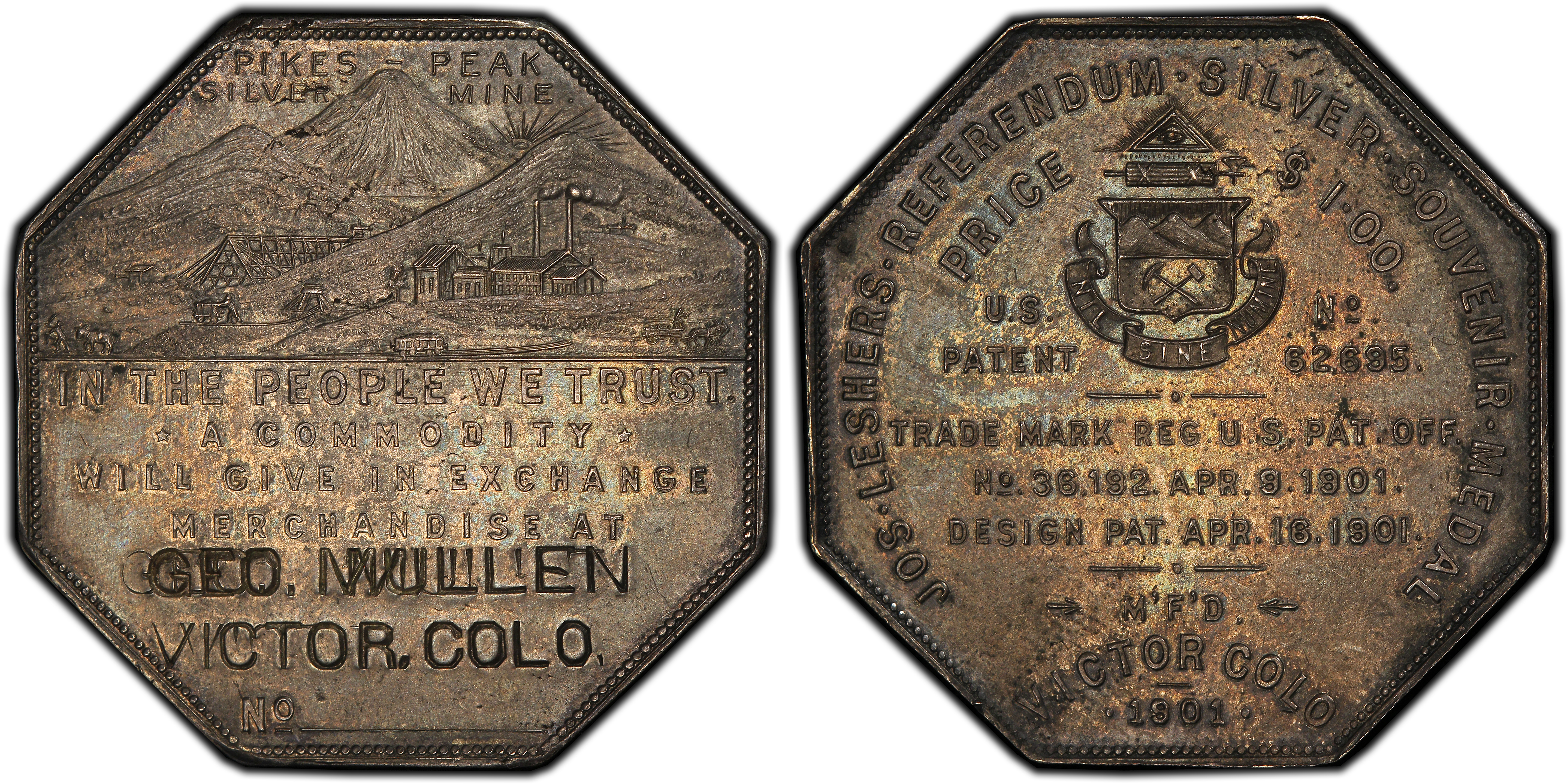
Obverse & Reverse
The Lesher Referendum Dollars represent a fascinating and unique chapter in American monetary history, born from the fiery Populist politics of the late 19th and early 20th centuries. Joseph Lesher, a silver mine owner and staunch advocate for the Free Silver movement, conceived these pieces in Victor, Colorado, amidst the economic turmoil following the Panic of 1893 and the contentious debate over the gold standard. After William Jennings Bryan's defeat in the 1896 and 1900 presidential elections, the cause of 'bimetallism' was effectively dead on the national stage. Frustrated, Lesher decided to take matters into his own hands. Citing a loophole in the U.S. Constitution (Article I, Section 10, which prohibits states, but not individuals, from coining money), he began producing his 'Referendum Souvenirs' in 1900. These octagonal silver medals, with a stated value of $1.25 and containing slightly more silver than a standard U.S. silver dollar, were intended to circulate locally as a form of currency, thereby promoting the use and value of silver. The initial 1900 issue, known as the 'Bumstead' type, was successful enough that Lesher continued the experiment in 1901. For the second series, he lowered the stated trade value to a more manageable $1.00 and offered local merchants the opportunity to have their own names and town locations stamped in the blank reverse space, effectively making them co-sponsors of his monetary vision. This variety, HK-795a, was made for G. Mullen, a grocer in Victor, Colorado. These pieces were not legal tender but were intended to be accepted by participating merchants, functioning as a form of trade token backed by Lesher's silver and the community's agreement. The federal government, under Treasury Secretary Lyman Gage, was not amused. Secret Service agents were dispatched to investigate Lesher's activities, viewing them as a usurpation of the government's sole authority to issue money. While Lesher was never prosecuted, likely because the pieces were not exact copies of federal coinage and were presented as trade items, the pressure was immense. The program ceased by the end of 1901, leaving behind a small but historically rich emission of private coinage that stands as a tangible protest against the era's monetary policy.
Associated EventPopulist Movement / Free Silver Movement
Reason For MintingTo promote the use of silver as a circulating currency and protest the gold standard in defiance of federal monetary policy.
Minter HistoryJoseph Lesher (1838-1918) was a silver mine owner, real estate developer, and passionate advocate for bimetallism. He moved to Colorado in the 1870s and became deeply involved in the silver industry. The economic depression of the 1890s, which many silver producers blamed on the demonetization of silver (the 'Crime of '73'), radicalized him. Believing that the free coinage of silver would bring prosperity back to miners and the nation, he launched his 'Referendum Dollar' scheme as a grassroots effort to prove his point. Though his experiment was short-lived, Lesher is remembered as a determined and innovative figure who literally minted his political beliefs into metal. G. Mullen was a grocer located in Victor, Colorado, who participated in Lesher's 1901 program by agreeing to accept and distribute these dollars, having his name stamped on the reverse.
Historical SignificanceThe Lesher Dollars are one of the most famous and politically charged private issues in U.S. numismatics. They are a physical remnant of the 'Battle of the Standards' between gold and silver, embodying the economic discontent that fueled the Populist movement. Their issuance directly challenged federal authority over currency and serves as a powerful example of local, private monetary experimentation.
N/A
Denomination$1.00 (trade value)
Minting Period1901
Assayer/MinterJoseph Lesher (concept), stamped by various merchants, this one being G. Mullen
Geographic OriginVictor, Colorado
Obverse DescriptionAn intricate design featuring a central depiction of the Colorado State Arms with mountains in the background. A scroll below the arms reads 'PIKES PEAK SILVER MINE'. This is all contained within an inner circle.
Obverse InscriptionJOS. LESHERS REFERENDUM SOUVENIR / PRICE $1.00 / U.S. PATENT / NO. 62655 / A COMMODITY / WILL GIVE IN EXCHANGE / MERCHANDISE OR CASH / AT FACE VALUE / NO. VICTOR, COLO. 1901.
Reverse DescriptionA blank recessed panel at the center, upon which the merchant's name is stamped. This is surrounded by an ornate border.
Reverse InscriptionStamped: G. MULLEN / VICTOR, COLO.
CompositionSilver (with a small amount of copper alloy)
Stated Fineness.950 fine silver (claimed)
Actual FinenessApproximately .950 fine silver
Weight26.57 grams
Diameter35.00 mm
EdgePlain
Approximately 100-200 for all G. Mullen varieties combined
Survival EstimateFewer than 75
Rarity ScaleR-6
Lesher Dollars are highly sought after for their unique octagonal shape, fascinating backstory tied to the Free Silver movement, and their status as a classic American private issue. The G. Mullen variety is one of the more available merchant types, making it a popular entry point into the series.
Key VarietiesThe primary varieties for the G. Mullen issue are distinguished by the presence or absence of a serial number on the obverse. HK-795a is the unnumbered 'Regular Strike' variety. HK-795 is the serially numbered variety. No proof restrikes or patterns are known to exist for this specific merchant issue.
Authentication TipsGenuine Lesher Dollars have a distinct look and feel. The quality of the engraving on the obverse dies is high. The merchant stamp on the reverse should show characteristics of a hand-punched strike, not a cast or engraved feature. Be wary of cast counterfeits, which will have a soapy appearance, lack of detail, and often a seam on the edge. Weight and dimensions should be checked carefully.
Shopping ConsiderationsA premium quality example will exhibit a strong strike, particularly on the complex details of the Colorado State Arms and the tiny letters of 'PIKES PEAK SILVER MINE'. Original, uncleaned surfaces with attractive grey or bluish toning command significant premiums. Check for rim bumps and bruises, as the octagonal shape and soft silver make these pieces susceptible to damage. The quality and centering of the G. MULLEN punch is also a factor; a well-centered, bold stamp is more desirable than a weak or off-center one.
A coin's grade is its condition, rated on a 1-70 scale. For rare coins, this is the most critical factor in determining value, as a tiny difference in preservation can mean a huge difference in price.
Relevant Grade TypesAll original Lesher Dollars were business strikes intended for local commerce and are graded on the Circulated (AU-58 and below) and Mint State (MS-60 to 70) scales. The vast majority of surviving examples are circulated, typically found in the VF to AU grades. No proofs were struck during the original period of issue, and no later-date restrikes exist.
Mint State CharacteristicsAn uncirculated (MS) Lesher Dollar will display full, unbroken mint luster, often with a slightly satiny or frosty texture. The strike can be inconsistent; many show some softness on the shield and eagle in the state arms due to die opposition. High-grade pieces are expected to have sharp details on the lettering. Due to their size and handling, even MS examples can have scattered contact marks or 'cabinet friction' on the highest points.
Circulated Wear PatternsWear first appears on the highest points of the design: the eagle's head and wings within the shield, the scrollwork above the shield, and the globe atop the fasces. On the reverse, the high, flat border surrounding the merchant stamp will show friction first. As wear progresses, the fine details of the mountain range will soften, and the obverse lettering will begin to weaken.
Key Factors For ValueFor Lesher Dollars, value is driven by grade and surface quality. An example with original, undisturbed skin and appealing toning is far more valuable than a cleaned or polished piece of the same grade. Strike quality is also key; a sharply struck coin is always preferred. Eye appeal is paramount; coins that are free from distracting marks, significant rim damage, and harsh cleaning command the strongest prices. A CAC sticker for this series indicates superior quality for the grade and will add a significant premium.
PCGS Price Guide
| Grade | Price | Population |
|---|---|---|
| 63 | $27,500.00 | 1 |