1901 Lesher$ HK-796 Silver Boyd Park with No. (Regular Strike)
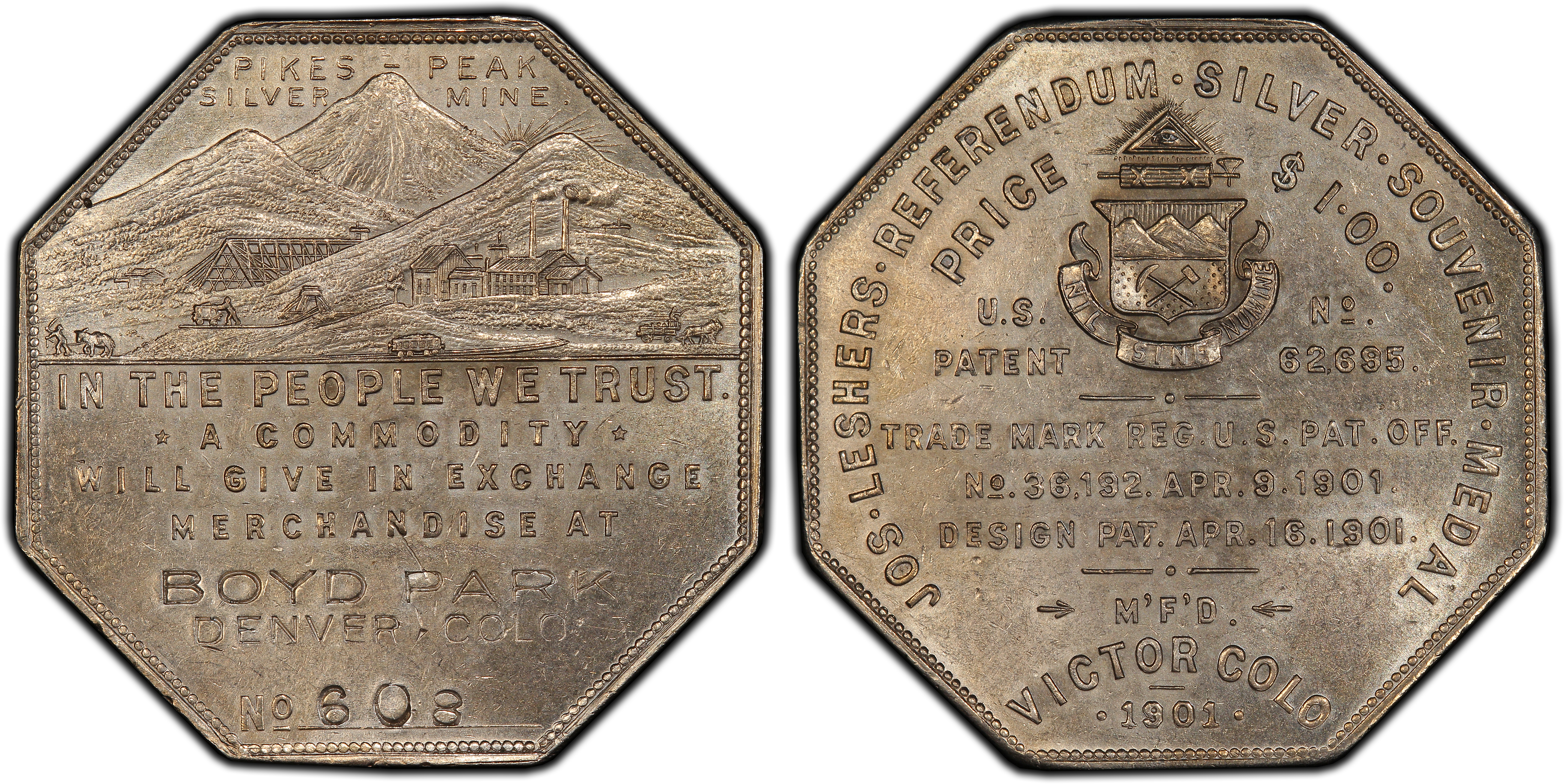
Obverse & Reverse
The 1901 Lesher 'Referendum' Dollar is a tangible artifact of the potent and politically charged 'Free Silver' movement that convulsed the American West in the late 19th and early 20th centuries. In the wake of the 'Crime of '73,' which demonetized silver, and the subsequent economic depressions, mining states like Colorado became hotbeds of Populist sentiment. Proponents of 'Free Silver' advocated for the unlimited coinage of silver at a fixed ratio to gold, believing it would increase the money supply, alleviate the crushing debts of farmers and miners, and restore prosperity. Joseph Lesher, a veteran silver miner, mine owner, and real estate investor in Victor, Colorado, was a fervent believer in this cause. Twice disappointed by the presidential defeats of silver-advocate William Jennings Bryan in 1896 and 1900, Lesher decided to take matters into his own hands. His experiment was a direct challenge to the gold standard and a practical demonstration of his monetary theories. He called his octagonal silver pieces 'Referendum' dollars because they were not legal tender; they were 'referred' to the people for acceptance or rejection in commerce. To avoid conflict with federal anti-counterfeiting laws, he consulted with Senator Henry Teller and deliberately designed his pieces to be distinct from official U.S. coinage—they were octagonal, called 'souvenirs,' and did not imitate government designs. The 1901 issues, including the Boyd Park variety, were a refinement of his initial 1900-dated pieces. The face value was lowered from $1.25 to a more conventional $1.00, and the weight was adjusted to 412.5 grains, identical to a standard U.S. silver dollar. Lesher patented his design (No. 34,359) and trademarked the term 'Referendum' (No. 36,192) in 1901 to prevent imitations, as he personally guaranteed their redemption. This particular piece, HK-796, was part of Lesher's 'Imprint' series, where local merchants could pay to have their name and location stamped into a blank space on the obverse die. This served as a form of advertising and committed the merchant to accepting the tokens, thereby fostering local circulation. Boyd Park, a jeweler located at the prominent intersection of 16th and Curtis in Denver, became the exclusive agent for Lesher's dollars in the city. By distributing these pieces, Park not only supported the silver cause but also attracted customers to his store. The hand-punched serial numbers on each piece were intended to track the tokens, though no systematic numbering system was ever employed. Lesher's enterprise was short-lived, as the Secret Service eventually paid him a visit and, while not confiscating his dies, strongly discouraged the continuation of his private mint. The Lesher dollars remain a fascinating and historically significant series, representing a grassroots monetary rebellion and a unique chapter in American numismatics.
Associated EventFree Silver Movement
Reason For MintingTo promote the use and value of silver as a circulating medium of exchange during a period of economic hardship in silver-mining regions.
Minter HistoryJoseph W. Lesher (1838-1918) was an Ohio native who, after serving in the Civil War, became a quintessential Colorado pioneer. He spent decades working in the silver camps of Georgetown, Leadville, and the San Juans before settling in the booming Cripple Creek mining district town of Victor. Through mining and real estate, he achieved considerable prosperity. Lesher was a passionate advocate for the unlimited coinage of silver, a political stance driven by both personal conviction and economic self-interest, as he owned a silver mine that had become unprofitable after the price of silver collapsed. His 'Referendum Dollar' project, initiated in November 1900, was the culmination of his crusade, creating a private currency that he hoped would demonstrate silver's utility and public appeal.
Historical SignificanceThe Lesher Dollar is one of the most famous and historically important issues in the 'So-Called Dollar' series, embodying the political and economic turmoil of the Free Silver era. It represents a rare and audacious instance of a private citizen attempting to create a circulating medium of exchange to challenge national monetary policy. The involvement of local merchants like Boyd Park illustrates the grassroots nature of the experiment and provides a direct link to the commerce of early 20th-century Colorado.
HK-796
Denomination$1.00
Minting Period1901
Assayer/MinterJoseph Lesher
Geographic OriginVictor, Colorado
Obverse DescriptionOctagonal medal. The upper portion features a detailed vignette of the Pikes Peak silver mine and surrounding buildings, with mountains in the background. Arched above is 'PIKES-PEAK SILVER MINE' and below is 'IN THE PEOPLE WE TRUST'. The central and lower fields contain the inscription 'A COMMODITY / WILL GIVE / IN EXCHANGE / MERCHANDISE AT', followed by a space with the merchant's imprint, in this case hand-stamped 'BOYD PARK / DENVER, COLO.'. Below the imprint is a space for a hand-punched serial number.
Obverse InscriptionPIKES-PEAK SILVER MINE / IN THE PEOPLE WE TRUST / A COMMODITY / WILL GIVE / IN EXCHANGE / MERCHANDISE AT / BOYD PARK / DENVER, COLO. / [Serial Number]
Reverse DescriptionOctagonal medal. The central device is the Colorado State Seal with a banner underneath reading 'NIL SINE NUMINE'. The legend around the periphery contains 'JOS. LESHERS REFERENDUM SOUVENIR MEDAL', the 'PRICE $1.00', and extensive text referencing the patent and trademark registrations.
Reverse InscriptionJOS. LESHERS REFERENDUM SOUVENIR MEDAL • PRICE $1.00 • / U.S. PATENT NO. 62695 TRADE MARK REG. U.S. PAT. OFF. NO. 36192 APR. 9, 1901. DESIGN PAT. APR. 16, 1901. M'F'D VICTOR COLO 1901
CompositionSilver
Stated Fineness0.95
Actual Fineness0.95
Weight26.73 grams
Diameter32.00 mm
EdgePlain
Approximately 150
Survival EstimateFewer than 75
Rarity ScaleR-6
This piece is highly sought after for its unique octagonal shape, direct connection to the populist Free Silver movement, and its status as a privately issued currency from the American West. The specific Boyd Park imprint ties it to the history of Denver, adding another layer of desirability. Its tangible link to a specific merchant makes the story of its intended circulation very personal.
Key VarietiesThe primary variety is HK-796a, which is identical to HK-796 but lacks a serial number on the obverse; it is considered scarcer. No proof restrikes or patterns are known for this specific merchant imprint. The broader Lesher series includes numerous other merchant imprints (A.B. Bumstead, Geo. Mullen, etc.) and the earlier 1900-dated, larger format types valued at $1.25.
Authentication TipsAuthentic examples have a characteristic soft, slightly prooflike luster when uncirculated. The merchant stamp 'BOYD PARK / DENVER, COLO.' should be carefully examined for correct font, size, and placement; it was punched into the finished planchet, so there may be slight displacement of metal around the letters. The serial number was also hand-punched, leading to irregularity in alignment and depth, which is expected. Modern counterfeits often have a cast appearance, incorrect weight, or exhibit lettering details that are too sharp or too soft compared to known genuine examples.
Shopping ConsiderationsA premium quality example for its grade will exhibit a sharp strike, especially on the fine details of the mining scene and the state seal. Many surviving pieces are circulated, but higher-grade examples should retain some original luster in the protected areas. Look for pleasing, original surfaces without harsh cleaning, scratches, or tooling. The merchant stamp and serial number should be bold and fully legible. Pieces with attractive, even, grey toning command a premium. Avoid examples with significant edge bumps or rim damage, to which the octagonal shape makes them susceptible. An uneven strike is common, but pieces with exceptional overall sharpness are particularly desirable.
A coin's grade is its condition, rated on a 1-70 scale. For rare coins, this is the most critical factor in determining value, as a tiny difference in preservation can mean a huge difference in price.
Relevant Grade TypesAll original Lesher Dollars were struck as business strikes, intended for circulation in commerce. Therefore, they are found in Circulated grades (AG-3 to AU-58) and Mint State grades (MS-60 to 70). No proofs were struck during the original period of issue, and there are no known later-date proof restrikes for this variety.
Mint State CharacteristicsAn uncirculated (MS) HK-796 typically displays a semi-prooflike or satiny luster. The strike can be somewhat variable, with the highest points of the design, such as the smoke from the mine's smokestack and the central details of the state seal, sometimes showing slight weakness. The fields are prone to contact marks due to the softness of the high-purity silver. The hand-stamped merchant name and serial number can sometimes cause a slight corresponding flatness on the reverse.
Circulated Wear PatternsWear first appears on the highest points of the design. On the obverse, look for friction on the rooflines of the mining buildings and the letters of 'IN THE PEOPLE WE TRUST'. On the reverse, the fasces, the eye of providence, and the eagle's head on the state seal are the first elements to show wear. In lower grades (Fine and below), the intricate peripheral lettering on the reverse will begin to weaken and merge with the rim.
Key Factors For ValueThe primary value drivers are grade and surface quality. An example with original, undisturbed surfaces and attractive luster will be worth significantly more than a cleaned or polished one of the same grade. The boldness and completeness of the Boyd Park stamp and the serial number are critical; weak or incomplete stamps are less desirable. Eye appeal is paramount; coins with pleasant, original toning often command strong premiums. For a piece of this rarity, certification by a major grading service (PCGS or NGC) is standard, and a CAC sticker indicating premium quality for the grade adds a significant premium.
PCGS Price Guide
| Grade | Price | Population |
|---|---|---|
| 30 | $2,500.00 | 1 |
| 35 | $2,600.00 | N/A |
| 40 | $2,800.00 | 1 |
| 45 | $3,000.00 | 1 |
| 45+ | $3,150.00 | N/A |
| 50 | $3,500.00 | 1 |
| 50+ | $3,600.00 | N/A |
| 53 | $3,750.00 | N/A |
| 53+ | $3,850.00 | N/A |
| 55 | $4,000.00 | 2 |
| 55+ | $4,100.00 | N/A |
| 58 | $4,250.00 | 2 |
| 58+ | $4,400.00 | N/A |
| 60 | $4,800.00 | 1 |
| 61 | $5,000.00 | 1 |
| 62 | $5,750.00 | 7 |
| 62+ | $6,500.00 | N/A |
| 63 | $8,250.00 | 1 |