1901 Lesher $ HK-1019 WF White Merc. (Regular Strike)
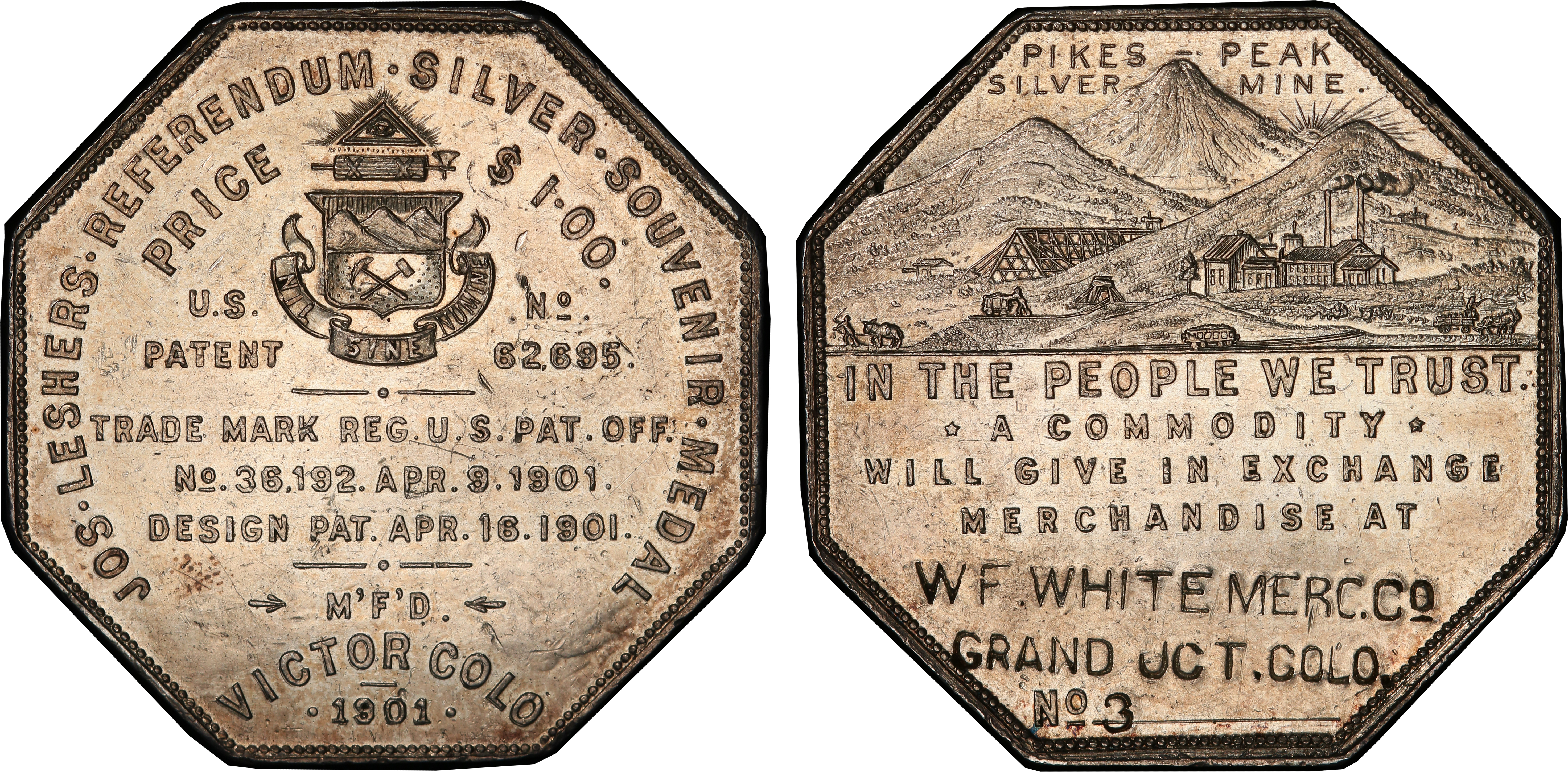
Obverse & Reverse
The Lesher Referendum Dollars of 1900-1901 represent a fascinating and defiant chapter in American monetary history, born from the crucible of the Cripple Creek mining district's economic turmoil and one man's unwavering faith in silver. Their creator, Joseph Lesher, a Civil War veteran, seasoned silver miner, and real estate investor, was a fervent supporter of the 'Free Silver' movement. This political crusade, championed by figures like William Jennings Bryan, advocated for the unlimited coinage of silver to combat the restrictive gold standard, which many Westerners blamed for economic depression and the declining profitability of their silver mines. After Bryan's second presidential defeat in 1900, Lesher, undeterred, decided to take matters into his own hands. On November 13, 1900, from his home in Victor, Colorado—the working man's town of the booming gold district—he began issuing his own octagonal silver 'coins.' Lesher called them 'Referendum Souvenirs' because they were voluntarily 'referred' to the people for acceptance or rejection, a clever turn of phrase to sidestep counterfeiting laws. The initial 1900 issues were struck on one-ounce planchets of .950 fine silver and valued at $1.25, well above their intrinsic silver value of about 65 cents. To ensure their acceptance, Lesher personally guaranteed their redemption in U.S. currency or merchandise. After an initial run of 100 pieces, which were allegedly met with scrutiny from federal agents who confiscated the first set of dies, Lesher collaborated with local merchants to facilitate circulation. In 1901, he modified the planchets to match the weight of a standard U.S. Silver Dollar (412.5 grains) and lowered the face value to $1.00. He also patented his design and registered 'Referendum' as a trademark to prevent counterfeiting. A blank space was left on the obverse for merchants to stamp their name and location, creating numerous varieties. The W.F. White Mercantile Company, a department store in Grand Junction, Colorado, was one of several businesses to participate, ordering a small batch of these pieces to be used in trade, likely as much for advertising as for currency. Lesher's ambitious project eventually ceased, as the concept failed to gain widespread traction. Yet, these 'dollars' remain a powerful physical testament to the populist economic ideals of the era and a bold private challenge to national monetary policy.
Associated EventFree Silver Movement / Cripple Creek Gold Rush
Reason For MintingTo promote the use and value of silver and create a privately backed, circulating medium of exchange during a period of economic uncertainty in Colorado's mining districts.
Minter HistoryJoseph W. Lesher (1838-1918) was an Ohio native who served in the Union Army during the Civil War before moving to Colorado to seek his fortune. He was a pioneer of the state, working in the silver camps of Georgetown, Leadville, and the San Juans before settling in Victor during the Cripple Creek gold boom, where he prospered in mining and real estate. Lesher owned a silver mine near Central City, which became unprofitable after the silver price slump, fueling his passionate advocacy for bimetallism. This conviction led him to create the Lesher Referendum Dollars in 1900 as a practical demonstration of his economic theories. He personally designed the pieces, commissioned dies from Denver engravers Frank Hurd and Herman Otto, and had them struck by a private firm. Despite facing potential legal trouble and limited commercial success, Lesher's experiment resulted in one of the most famous and collectible series of so-called dollars.
Historical SignificanceThe Lesher Dollars are historically significant as a tangible expression of the Populist-era Free Silver movement and a rare instance of privately issued currency intended for general circulation in the 20th century. They highlight the economic tensions between the silver-producing West and the gold-standard-focused federal government. Numismatically, they are a unique and highly sought-after series, representing a bridge between the earlier pioneer gold coins and later privately issued tokens.
N/A
Denomination$1.00
Minting Period1901
Assayer/MinterJoseph Lesher
Geographic OriginVictor, Colorado
Obverse DescriptionAn octagonal planchet featuring a detailed depiction of a mining landscape with mountains in the background, likely representing the Pikes Peak area, with a mining complex at its base. Above the scene is the inscription 'PIKES-PEAK SILVER MINE'. Below the scene, the motto 'IN THE PEOPLE WE TRUST' is inscribed, followed by 'A COMMODITY / WILL GIVE / IN EXCHANGE / MERCHANDISE AT'. The lower segment is counterstamped by the merchant 'W.F. WHITE MERC. CO. / GRAND JCT., COLO.' A unique serial number is typically hand-punched within this area as well.
Obverse InscriptionPIKES-PEAK SILVER MINE / IN THE PEOPLE WE TRUST / A COMMODITY / WILL GIVE / IN EXCHANGE / MERCHANDISE AT / W.F. WHITE MERC. CO. / GRAND JCT., COLO.
Reverse DescriptionThe reverse is dominated by text inscriptions arranged in arcs and horizontal lines, centered around a small shield with a banner. It explicitly states the nature and backing of the piece.
Reverse InscriptionJOS. LESHERS REFERENDUM SOUVENIR MEDAL / PRICE $1.00 / U.S. PATENT NO. 62,695 / TRADE MARK REG. U.S. PAT. OFF. NO. 36,192, APR. 9, 1901 / DESIGN PAT. APR. 16, 1901 / M'F'D / VICTOR, COLO / 1901
CompositionSilver
Stated Fineness.950 Fine Silver (alloyed with copper)
Actual Fineness0.95
Weight26.73 grams
Diameter32.00 mm
EdgePlain
Approximately 50 stamped for W.F. White Merc. Co.
Survival EstimateApproximately 10-12 known
Rarity ScaleR-7 (4-12 known)
This variety is highly coveted for its extreme rarity, its connection to a specific Colorado merchant, and its classic 'Wild West' aesthetic. It combines the allure of so-called dollars, private currency, and Colorado history, making it a centerpiece for advanced collectors.
Key VarietiesThe primary variety is the regular issue with a hand-punched serial number. A key sub-variety, designated HK-1019a, exists without a serial number and may have been a pattern or sample piece; it is considered exceptionally rare, with possibly only one known example. No proof or special collector restrikes were made during the period of issue. Much later, in the 1980s, the ANA authorized restrikes with a different obverse design to raise funds for the restoration of the Lesher house, but these are modern issues and distinct from the originals.
Authentication TipsAuthentic examples have a distinct, somewhat crude style to the merchant counterstamp, which was applied after the piece was struck. The hand-punched serial number digits should also show irregular depth and alignment. The overall strike of the host coin can be soft in areas. Be wary of cast counterfeits, which will have a porous or soapy surface appearance and lack the sharp detail of a struck piece. Tooling around the counterstamp or added/altered serial numbers are potential red flags.
Shopping ConsiderationsA 'premium quality' example for its grade will exhibit a bold, well-centered, and fully legible merchant stamp. The underlying host coin's surfaces are critical; look for original, untampered-with silver-gray toning. Many Lesher dollars have been cleaned over the years, so pieces with original 'skin' command significant premiums. Check for rim bumps and bruises, as the octagonal shape and soft silver make them susceptible to damage. The sharpness of the mining scene on the obverse and the fine text on the reverse are key indicators of a strong strike and minimal wear. Given the rarity, any example is desirable, but those with superior eye appeal and problem-free surfaces are the most sought-after.
A coin's grade is its condition, rated on a 1-70 scale. For rare coins, this is the most critical factor in determining value, as a tiny difference in preservation can mean a huge difference in price.
Relevant Grade TypesAll original Lesher Dollars, including the W.F. White variety, were business strikes intended for commerce and are found in Circulated (1-58) and Mint State (MS, 60-70) grades. No proofs were struck during the original period of issue. The quality of the after-the-fact merchant counterstamp does not affect the coin's numerical grade but is a crucial component of its overall quality and eye appeal.
Mint State CharacteristicsAn uncirculated HK-1019 will exhibit full mint luster, though it is often more satiny than flashy. The strike can be variable; some areas, particularly the mountains on the obverse and the shield on the reverse, may show some softness even on high-grade pieces. Small, scattered contact marks are common due to the soft composition and handling by merchants. The quality of the merchant stamp is paramount; a crisp, perfectly impressed stamp is more desirable than a weak or uneven one.
Circulated Wear PatternsWear first appears on the highest points of the design: the mountain peaks on the obverse and the central shield on the reverse. As wear progresses, the finer details of the mining town and the delicate reverse lettering will begin to soften. On the obverse, the text 'IN THE PEOPLE WE TRUST' is also a high point prone to early wear. In lower grades (VG and below), the merchant stamp and serial number may become faint.
Key Factors For ValueFor the HK-1019, value is driven by several key factors. Absolute rarity is foremost, as so few exist. The grade (condition) is critical, with Mint State examples being exceedingly rare. Surface quality is a major determinant; an example with original, attractive toning and minimal distracting marks will always be prized over a cleaned or damaged piece. The boldness and completeness of the W.F. White counterstamp is a crucial element of eye appeal. Finally, certification by a top-tier grading service (PCGS or NGC) is standard, and a CAC sticker signifying premium quality for the grade would add a significant premium.
PCGS Price Guide
| Grade | Price | Population |
|---|---|---|
| 45 | $14,000.00 | 1 |
| 45+ | $14,500.00 | N/A |
| 50 | $15,500.00 | N/A |
| 50+ | $16,000.00 | N/A |
| 53 | $16,500.00 | 1 |
| 53+ | $17,500.00 | N/A |
| 55 | $19,000.00 | N/A |
| 55+ | $20,000.00 | N/A |
| 58 | $21,000.00 | 1 |
| 58+ | $22,500.00 | N/A |
| 60 | $24,000.00 | N/A |
| 61 | $26,000.00 | N/A |
| 62 | $27,500.00 | 1 |