1901 Lesher $ HK-1021 HH Rosser (Regular Strike)
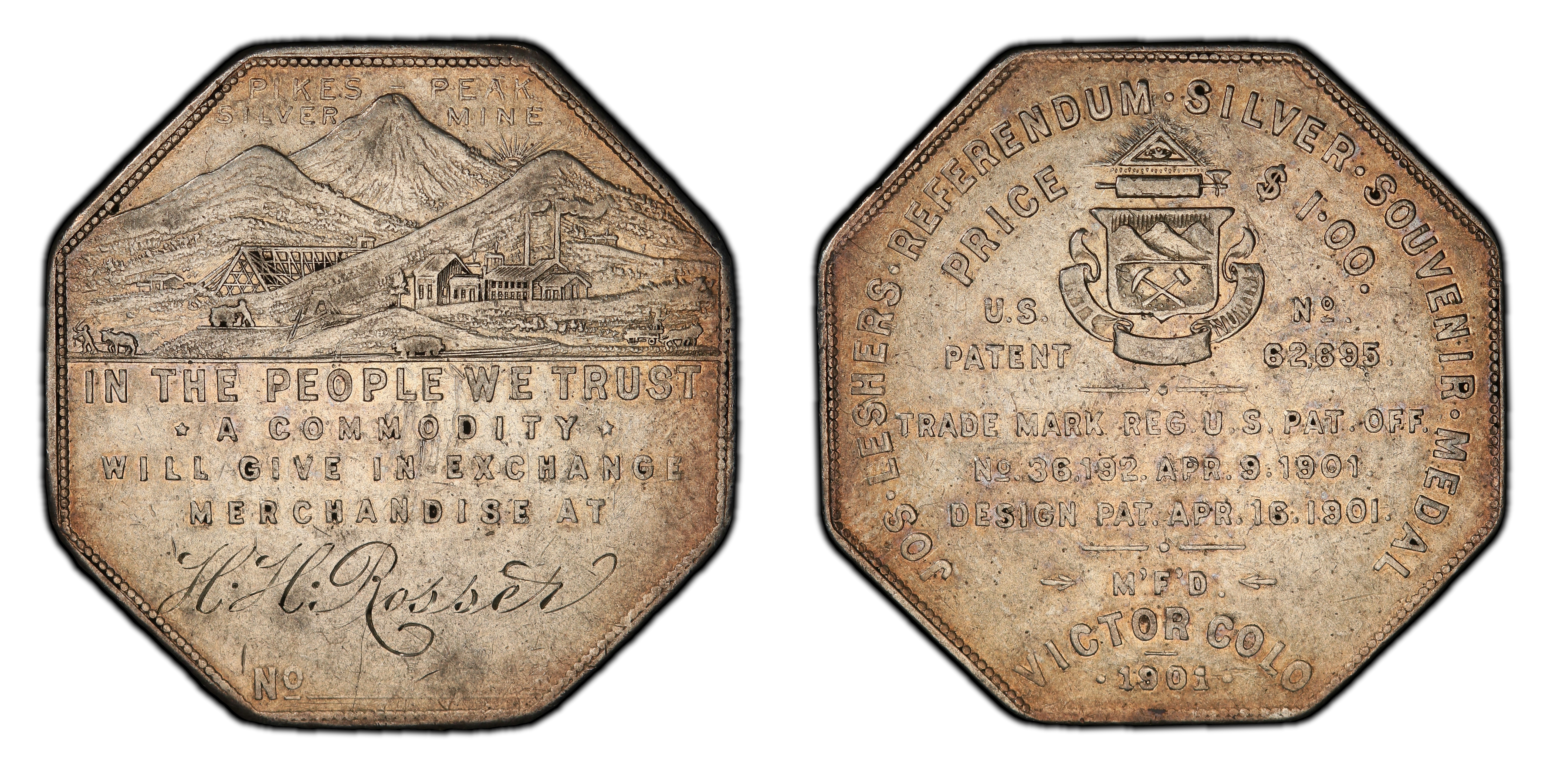
Obverse & Reverse
The Lesher Referendum Dollars are a tangible link to the fiery 'Free Silver' debate that defined late 19th and early 20th century American politics, particularly in the silver-rich state of Colorado. Born from the ideological fervor of Joseph Lesher, a Civil War veteran, silver miner, and real estate investor, these octagonal pieces represent a fascinating, albeit failed, private experiment in local currency. The economic backdrop was the Panic of 1893 and the subsequent depression, which had devastated silver mining communities. The repeal of the Sherman Silver Purchase Act caused silver prices to plummet from over $1.00 to around $0.65 per ounce. For mining towns like Victor, in the heart of the Cripple Creek Mining District, this was an economic catastrophe, idling mines and leaving miners unemployed. Lesher, a staunch silverite, believed passionately that the nation's prosperity was tied to the unlimited coinage of silver at a 16:1 ratio to gold. After William Jennings Bryan's second defeat on a pro-silver platform in 1900, Lesher took matters into his own hands. Starting in late 1900, he began issuing his own silver pieces. He called them 'Referendum Dollars' because they were 'referred to the people for acceptance or rejection.' This was a clever legal and philosophical distinction; he wasn't creating a competing government coin, but a commodity token whose value was backed by his personal guarantee. The initial 1900 issues were valued at $1.25 and contained one ounce of silver. In 1901, Lesher modified the planchets to match the weight of a standard U.S. silver dollar (412.5 grains) and reduced the face value to $1.00. To encourage circulation and avoid the logistical burden of redeeming them all himself, he enlisted local merchants to distribute them. For a fee, merchants could have their name and location stamped into a blank space on the obverse die. One such merchant was H.H. Rosser, proprietor of a pool hall, candy, and cigar store on North 4th Street in Victor. Rosser's participation, along with other local businesses, transformed these pieces from simple silver rounds into a true local currency, accepted in trade for goods and services. Despite Lesher's efforts, including patenting his design to prevent counterfeiting, the project was short-lived. The Secret Service took a keen interest in Lesher's enterprise, viewing it as a usurpation of federal authority. While he was never prosecuted, under pressure from federal agents, Lesher ceased production by the end of 1901. Most of the pieces were likely redeemed and melted, ensuring their rarity for future generations of collectors.
Associated EventFree Silver Movement / Post-Panic of 1893 Economic Conditions
Reason For MintingTo create a local currency that would stimulate the depressed silver-based economy of Victor, Colorado by promoting the use and acceptance of silver at a value far exceeding its market price.
Minter HistoryJoseph W. Lesher (1838-1918) was an Ohio native who served in the Union Army during the Civil War. After the war, he moved to Colorado and became deeply involved in the silver mining industry as a miner and later a mine owner in camps like Leadville and Central City. The silver price crash of 1893 idled his own mine, fueling his passionate advocacy for the 'Free Silver' cause. Relocating to the booming gold camp of Victor, he conceived of his private minting experiment not just as a business venture, but as a political and economic statement. He consulted with Senator Henry Teller to ensure his plan did not explicitly violate federal law, carefully calling his pieces 'souvenirs' or 'medals' to be exchanged for commodities. His enterprise, though brief, makes him one of the most famous and studied figures in the field of private and territorial coinage.
Historical SignificanceThe Lesher Dollars are historically significant as a grassroots manifestation of the populist Free Silver movement. They represent a unique and daring attempt by a private citizen to address a national economic crisis on a local level, challenging the federal government's monetary policy. The H.H. Rosser variety specifically provides a direct connection to the daily commerce of a quintessential Colorado gold rush town, illustrating how this monetary experiment was integrated into the local economy.
N/A
Denomination$1.00
Minting Period1901
Assayer/MinterJoseph Lesher
Geographic OriginVictor, Colorado
Obverse DescriptionOctagonal shape. A detailed vignette of a mining complex is depicted in the center, with mountains in the background, likely representing the local Cripple Creek district. The inscription 'PIKES PEAK' is visible above the mountains. Below the mining scene, in a recessed panel, is the stamped imprint of the distributing merchant: H. H. ROSSER.
Obverse InscriptionPIKES PEAK / H. H. ROSSER
Reverse DescriptionOctagonal shape. The periphery is inscribed with 'JOS. LESHERS • REFERENDUM • SOUVENIR'. The center contains extensive text arranged in several lines, including the price, patent information, and location of manufacture. A unique serial number is typically hand-punched at the bottom.
Reverse InscriptionJOS. LESHERS • REFERENDUM • SOUVENIR / PRICE $1.00 / U.S. / PATENT No. / 62,695 / TRADE MARK REG U.S. PAT. OFF. / No 36,192, APR. 9, 1901 / DESIGN PAT. APR. 16, 1901 / M'F'D / VICTOR, COLO. / *1901*
CompositionSilver, alloyed with copper.
Stated Fineness.950 Silver
Actual Fineness.950 Silver
Weight26.73 grams
Diameter32.00 mm
EdgePlain
Unknown
Survival EstimateFewer than 20 believed to exist
Rarity ScaleR-6+
The H.H. Rosser Lesher Dollar is highly prized for its immense historical appeal, distinctive octagonal shape, and extreme rarity. It connects collectors directly to the Free Silver movement and the daily life of a famous Colorado mining town. Each merchant imprint tells a unique story, and the Rosser variety, linked to a local tobacconist and confectioner, is particularly evocative of the era.
Key VarietiesThe primary variety for this issue is the merchant's stamp itself. All HK-1021 examples share the same obverse and reverse dies, with the only variation being the individually hand-punched serial numbers on the reverse. No proof or special restrike issues from the period of minting are known to exist.
Authentication TipsAuthentic examples have a distinctive, somewhat crude strike. The merchant stamp 'H. H. ROSSER' should be carefully examined for correct font, size, and spacing, comparing it against known genuine examples. The hand-punched serial numbers on the reverse are also a key diagnostic; they should appear irregular in alignment and depth, consistent with manual punching. Counterfeits often have a mushy or cast appearance, incorrect weight or dimensions, or lettering that is too uniform and modern-looking. The edge should be plain and show tooling marks consistent with octagonal planchets of the era.
Shopping ConsiderationsA premium quality example for its grade will possess a bold strike on both the mining scene and the reverse inscriptions. The merchant stamp should be fully legible and well-impressed. Original, undisturbed surfaces with attractive grey or golden toning command a significant premium. Many surviving examples have been cleaned; look for tell-tale hairline scratches or an unnaturally bright appearance. Check for rim bumps or bruises, as the octagonal shape left the corners susceptible to damage. Eye appeal is paramount; a technically lower-grade coin with original skin and a clear stamp is often more desirable than a higher-grade but harshly cleaned specimen.
A coin's grade is its condition, rated on a 1-70 scale. For rare coins, this is the most critical factor in determining value, as a tiny difference in preservation can mean a huge difference in price.
Relevant Grade TypesAll original Lesher Dollars were struck as business strikes, intended for local commerce. They are found in Circulated grades (AG-3 to AU-58) and, very rarely, in Mint State (MS, 60-70). No Proof (PR/PF) examples were struck during the original minting period, and no later-date official restrikes were produced.
Mint State CharacteristicsUncirculated examples are exceptionally rare. A true Mint State specimen would exhibit full, frosty mint luster, often with a slightly satiny texture. The strike is often somewhat soft in the center of the mining scene and on the word 'SOUVENIR' on the reverse. Due to the handling and distribution process by merchants, even uncirculated pieces may show minor contact marks or 'cabinet friction' on the highest points.
Circulated Wear PatternsWear first appears on the highest points of the design: the roof and gables of the central mine building on the obverse, and the central inscriptions ('PRICE $1.00') on the reverse. As wear progresses, the finer details of the mountains and the peripheral lettering will become soft. The hand-punched serial number and the merchant stamp, being recessed, are typically among the last elements to show significant wear.
Key Factors For ValueFor the H.H. Rosser Lesher Dollar, rarity is the primary value driver. Beyond that, the key factors are surface preservation and the quality of the stamps. An example with original, uncleaned surfaces commands a massive premium. The boldness and clarity of both the main design strike and, crucially, the 'H. H. ROSSER' imprint are critical. Weakly stamped or partially effaced merchant names are less desirable. Finally, any example verified by a top-tier grading service (PCGS or NGC), and especially those with a CAC sticker, will realize the highest prices due to the added confidence in authenticity and grade.
PCGS Price Guide
| Grade | Price | Population |
|---|---|---|
| 45 | $32,500.00 | 1 |