1901 SC$ Lesher, HK-792 (Regular Strike)
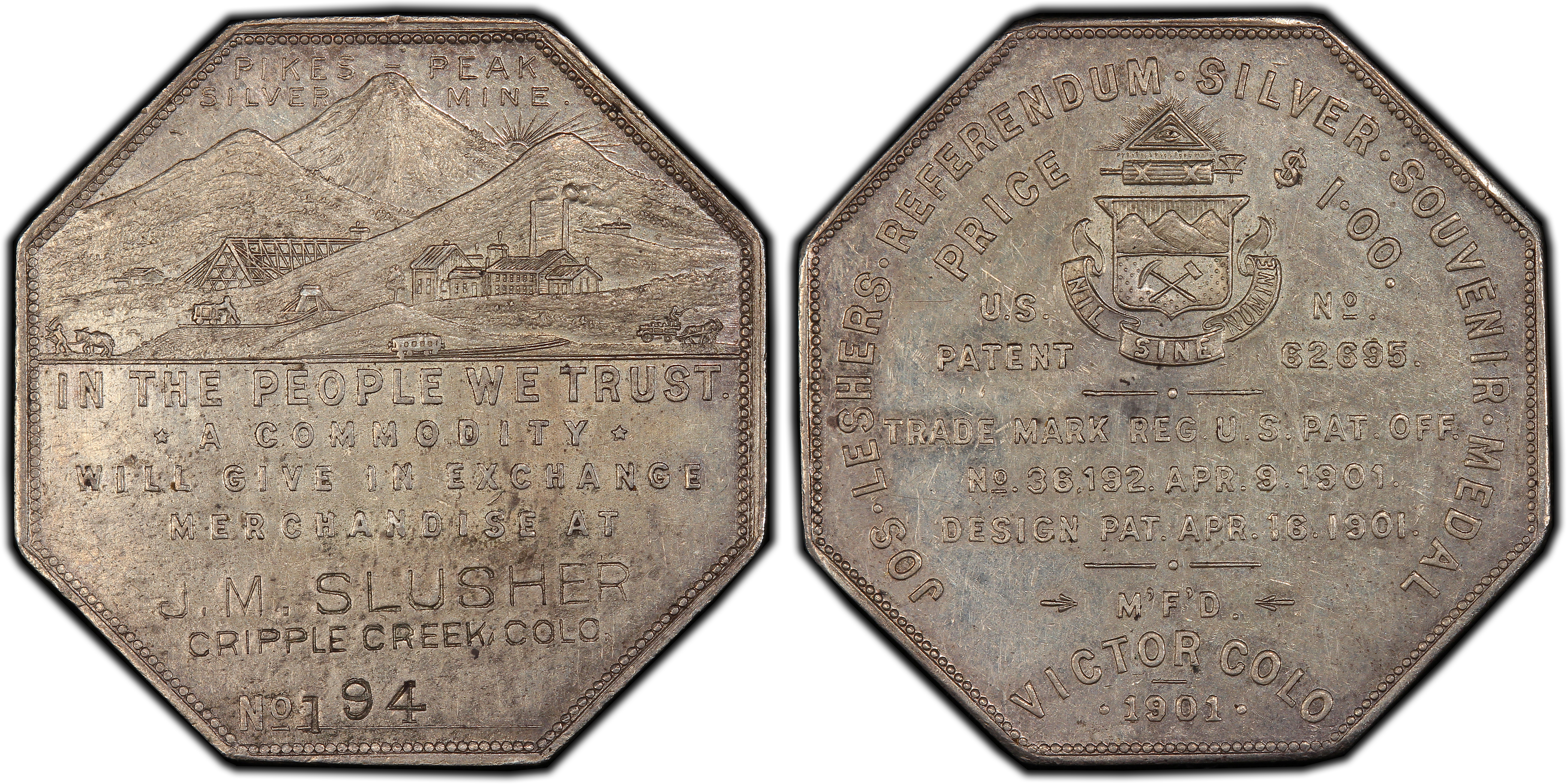
Obverse & Reverse
The Lesher Referendum Dollars are a tangible link to the fiery 'Free Silver' debate that dominated American politics at the turn of the 20th century. Following the Panic of 1893 and the repeal of the Sherman Silver Purchase Act, the price of silver plummeted, devastating mining-dependent states like Colorado. Joseph Lesher, a Civil War veteran, silver miner, and real estate investor in Victor, Colorado, was a staunch silver advocate. He believed the nation's economic woes could be cured by a return to bimetallism and the unlimited coinage of silver. After his political hero, William Jennings Bryan, lost the 1900 presidential election to gold-standard proponent William McKinley, Lesher took matters into his own hands. On November 13, 1900, he began issuing his own octagonal 'coinage' from silver mined in the region. He ingeniously called them 'Referendum' dollars, positing that they were 'referred to the people for acceptance or rejection,' thus making their use voluntary and, he hoped, legal. The 1900 issues were larger, contained a full troy ounce of silver, and were valued at $1.25. In 1901, Lesher modified the planchets to match the weight of a standard U.S. Silver Dollar (412.5 grains) and reduced the face value to $1.00. To further legitimize his enterprise and encourage circulation, he patented his design (No. 34,359) and trademarked the name 'Referendum' (No. 36,192). The 1901 'Imprint' type, of which HK-792 is a prime example, left a blank space on the obverse for local merchants to stamp their name and location. This transformed the pieces from a private currency experiment into a form of trade token or advertisement, further blurring the line with official coinage but increasing their local utility. J.M. Slusher, a grocer at 165 Bennett Avenue in the bustling nearby town of Cripple Creek, became one of the most significant distributors. These pieces circulated as a practical response to a shortage of hard currency and as a political statement, willingly accepted by a populace deeply invested in the future of silver. However, the project was short-lived, as pressure from the Secret Service, concerned with any private minting, likely convinced Lesher to cease production by the end of 1901. Today, these 'so-called dollars' are prized numismatic relics of Western individualism and a fascinating chapter in monetary history.
Associated EventFree Silver Political Movement
Reason For MintingTo promote the use and value of silver and provide a local medium of exchange during a period of economic uncertainty in Colorado's mining districts.
Minter HistoryJoseph W. Lesher (1838-1918) was an Ohio native who, after serving in the Civil War, moved to Colorado and became deeply involved in the silver mining industry. He worked as a miner and eventually became a mine owner and real estate investor, experiencing firsthand the boom-and-bust cycles tied to the metal's value. A passionate believer in bimetallism, he conceived of the Referendum Dollar as a practical and political tool to advocate for silver. He consulted with Senator Henry Teller to ensure his octagonal 'souvenirs' did not illegally imitate U.S. coinage. Lesher personally designed the pieces and had the dies made in Denver, first by Frank Hurd and later by Herman Otto. His venture, based in Victor, Colorado, was a bold act of monetary populism, pledging his own funds to redeem the pieces at their face value.
Historical SignificanceThe Lesher Dollars represent one of the most famous and sophisticated private responses to U.S. monetary policy. They are a physical embodiment of the populist Free Silver movement and a testament to the economic anxieties and independent spirit of the American West. By creating a functional, locally accepted currency substitute, Lesher challenged the federal government's monetary monopoly and demonstrated a grassroots economic theory in action. Their unique design, merchant counterstamps, and direct link to a pivotal political debate make them a cornerstone of the 'so-called dollar' collecting field.
N/A
Denomination$1.00
Minting Period1901
Assayer/MinterJoseph Lesher
Geographic OriginVictor, Colorado
Obverse DescriptionThe obverse features a detailed vignette of a mining complex, complete with buildings and a smokestack, set against a mountain backdrop representing Pikes Peak. Below the scene is a blank panel where 'J.M. SLUSHER / CRIPPLE CREEK, COLO.' is stamped. A unique serial number is typically hand-punched within this panel or nearby.
Obverse InscriptionJOS. LESHERS REFERENDUM SOUVENIR / PIKES PEAK / SILVER MINE / [Merchant Stamp Area]
Reverse DescriptionThe reverse is primarily text-based, containing the denomination, date, and information regarding Lesher's patent and trademark registrations. The center features the motto 'IN THE PEOPLE WE TRUST'.
Reverse InscriptionA COMMODITY / WILL GIVE IN EXCHANGE / MERCHANDISE OR CASH / AT FACE VALUE / PRICE $1.00 / NO. [Serial Number] / M'F'D VICTOR, COLO. / 1901 / U.S. PATENT No 62695 TRADE MARK REG. U.S. PAT. OFF. No 36192 APR. 9. 1901 DESIGN PAT. APR. 16. 1901
CompositionSilver, alloyed with Copper
Stated Fineness0.95
Actual Fineness0.95
Weight26.73 grams
Diameter32.00 mm
EdgePlain
~260
Survival Estimate~75-80
Rarity ScaleR-5
The HK-792 Slusher Dollar is highly sought after for its connection to the Cripple Creek mining district, its clear link to a specific merchant, its iconic Pikes Peak design, and its octagonal shape. It appeals to collectors of territorial issues, so-called dollars, and Western Americana. As the most common of the 1901 merchant imprint types, it is often the first one a specialist collector will acquire.
Key VarietiesThe primary varieties within the Lesher Dollar series are defined by the different merchant stamps on the 1901 'Imprint' type (e.g., A.B. Bumstead, Sam Cohen, Boyd Park). Some pieces, cataloged as HK-791a, were issued without any merchant stamp. No proof strikings or collector restrikes from the original dies were ever made. Later, in the 1980s, the ANA authorized the striking of commemorative silver rounds with a similar reverse design to raise funds for the restoration of the Lesher House, but these are modern issues and distinct from the original pieces.
Authentication TipsAuthentic examples have a distinctive look. The main Pikes Peak design should be well-defined, though strike weakness on high points is common. The merchant stamp 'J.M. SLUSHER / CRIPPLE CREEK, COLO.' was applied after the coin was struck and should show displacement of metal with no corresponding flatness on the reverse. The serial numbers are hand-punched and will show irregular depth and alignment. Counterfeits often have a cast appearance with soft details, incorrect weight, or lettering that appears mushy. Be wary of pieces with perfectly aligned, uniform serial numbers.
Shopping ConsiderationsA premium quality example for its grade will possess attractive, original toning, often a dusky gray with hints of blue or gold. Many Lesher dollars have been cleaned over the years, so pieces with undisturbed 'original skin' command a significant premium. Look for a sharp strike on the mining complex details and clear, fully legible patent information on the reverse. The quality of the Slusher stamp is also a factor; a bold, well-centered stamp is more desirable than a weak or off-center one. Check the flat sides carefully for rim bumps or bruises, as the octagonal shape made them susceptible to damage. Avoid examples with harsh cleaning, scratches, or tooling.
A coin's grade is its condition, rated on a 1-70 scale. For rare coins, this is the most critical factor in determining value, as a tiny difference in preservation can mean a huge difference in price.
Relevant Grade TypesAll original Lesher Dollars are business strikes, intended for local commerce. They are found in Circulated grades (AG-3 to AU-58) and, more rarely, in Mint State (MS-60 to MS-70). No proofs were struck during the original period of issue. Any piece described as a 'Proof' is either a misattribution or a modern, unrelated item.
Mint State CharacteristicsAn uncirculated (MS) HK-792 will exhibit full, unbroken mint luster, which is typically soft and satiny rather than deeply prooflike. The strike can be inconsistent; many show some softness on the highest points of the mountain and the mining building roofs. The fields are susceptible to contact marks from handling and storage, as the pieces were struck from a relatively soft, high-purity silver alloy. The merchant stamp and serial number should be crisp, showing sharp edges from the punches.
Circulated Wear PatternsWear first appears on the highest points of the design: the mountain peak and the rooflines of the mining structures on the obverse. On the reverse, the words 'IN THE PEOPLE WE TRUST' and the $1.00 denomination are the first elements to show flatness. On more heavily worn examples, the fine patent text at the bottom of the reverse will become illegible, and the edges of the merchant stamp will begin to blend into the field.
Key Factors For ValueThe primary drivers of value are grade and surface preservation. An example with original, attractive toning and minimal marks will always be worth more than a harshly cleaned or scratched piece of the same grade. Strike sharpness is also key; a well-struck coin with full detail is highly desirable. The clarity and placement of the J.M. Slusher stamp and the serial number can also influence eye appeal and value. A CAC sticker, indicating premium quality for the grade, adds a significant premium for this series, as it confirms originality and superior eye appeal.
PCGS Price Guide
| Grade | Price | Population |
|---|---|---|
| 6 | $2,100.00 | 1 |
| 8 | $2,250.00 | N/A |
| 10 | $2,400.00 | N/A |
| 12 | $2,600.00 | N/A |
| 15 | $2,750.00 | N/A |
| 20 | $3,000.00 | N/A |
| 25 | $3,250.00 | 1 |
| 30 | $3,350.00 | N/A |
| 35 | $3,500.00 | 1 |
| 40 | $3,650.00 | 1 |
| 45 | $3,800.00 | 1 |
| 45+ | $4,000.00 | N/A |
| 50 | $4,250.00 | 3 |
| 50+ | $4,350.00 | N/A |
| 53 | $4,600.00 | 1 |
| 53+ | $4,750.00 | N/A |
| 55 | $5,000.00 | 6 |
| 55+ | $5,250.00 | N/A |
| 58 | $5,750.00 | 4 |
| 58+ | $6,250.00 | N/A |
| 60 | $7,000.00 | N/A |
| 61 | $7,500.00 | N/A |
| 62 | $9,500.00 | 3 |