1901 Lesher$ Geo. Mullen HK-795 (Regular Strike)
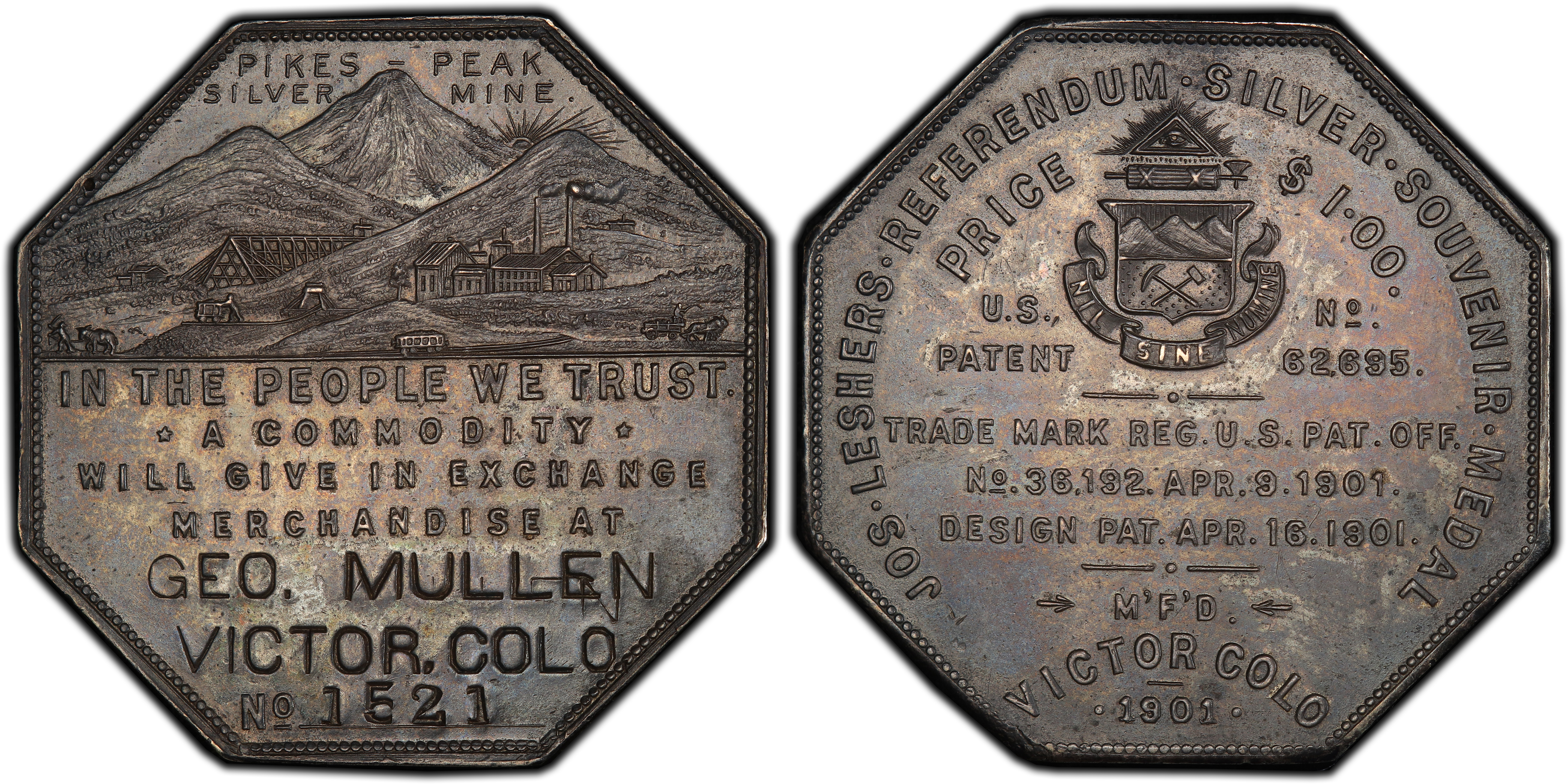
Obverse & Reverse
The Lesher Referendum Dollars emerged from the ashes of the 'Free Silver' movement, a passionate political crusade that defined the American West in the late 19th century. Following the 'Crime of '73,' which demonetized silver, and the subsequent economic depressions, silver-producing states like Colorado suffered immensely. Mine owner and fervent silver advocate Joseph Lesher (1838-1918) conceived a novel plan to stimulate the local economy and promote the cause of silver. In Victor, Colorado, amidst the Cripple Creek Mining District, he began issuing his own octagonal silver tokens in November 1900. He called them 'Referendum' pieces because they were 'referred to the people for acceptance or rejection.' His venture was a direct, private-sector challenge to the nation's gold standard, arguing that silver's intrinsic value was being artificially suppressed. The initial 1900 issue was valued at $1.25 and contained a full ounce of silver. However, after attracting the attention of the Secret Service and having his first set of dies confiscated, Lesher consulted with legal experts to ensure his 1901 series would not be considered illegal coinage. The result was a slightly smaller piece, valued at $1.00 and containing 412.5 grains of .950 fine silver, matching the weight of a standard U.S. Silver Dollar. The key innovation for the 1901 series was the 'Imprint Type' design, which left a blank space on the obverse. Local merchants could purchase the tokens from Lesher (at a reported 80-85 cents each) and have their own name and location stamped into this space, effectively turning the tokens into a form of privately issued, redeemable trade currency. One such merchant was Geo. Mullen, a shoemaker in Victor. The imprint on these pieces often misspells his name as 'Mullen' instead of 'McMullen.' These tokens circulated freely in Victor, Cripple Creek, Colorado Springs, and even Denver, accepted for merchandise or cash at the sponsoring business. Lesher's experiment, though short-lived and localized, stands as a fascinating and tangible artifact of the Populist-era struggle over monetary policy and a testament to one man's defiant belief in silver.
Associated EventFree Silver Movement
Reason For MintingTo protest the gold standard and create a circulating medium that would stimulate local demand for silver during a period of depressed prices.
Minter HistoryJoseph Lesher was born in Fremont, Ohio, in 1838. He served in the Union Army during the Civil War before moving to Colorado to pursue a career in mining. He worked in various silver camps, including Georgetown and Leadville, eventually owning a profitable silver mine near Central City that became idle after the silver price crash of the 1890s. Relocating to the booming gold camp of Victor, he invested in real estate and became a prominent local figure and passionate advocate for the unlimited coinage of silver. His 'Referendum Dollar' enterprise was born from this conviction. After the government effectively halted his private minting in 1901, he remained in Victor, where he passed away in 1918, leaving behind one of the most intriguing legacies in the field of private and territorial coinage.
Historical SignificanceThe Lesher Dollars are a unique physical embodiment of the Populist 'Free Silver' ideology. They represent a rare, grassroots attempt to create an alternative currency based on silver in defiance of federal monetary policy, serving as both a political statement and a practical, albeit limited, solution to a local currency shortage.
K-15 (Zerbe-9, HK-795)
Denomination$1.00
Minting Period1901
Assayer/MinterJoseph Lesher
Geographic OriginVictor, Colorado
Obverse DescriptionOctagonal shape. The obverse features the inscription 'A COMMODITY / WILL GIVE / IN EXCHANGE / MERCHANDISE / AT' above a blank recessed area where the merchant's name is stamped. The Geo. Mullen variety is stamped 'GEO. MULLEN / VICTOR, COLO.' A serial number, individually hand-punched, appears below the imprint space next to 'No.'. The periphery is inscribed 'JOS. LESHERS • REFERENDUM • SOUVENIR •'.
Obverse InscriptionJOS. LESHERS • REFERENDUM • SOUVENIR • / A / COMMODITY / WILL GIVE / IN EXCHANGE / MERCHANDISE / AT / GEO. MULLEN / VICTOR, COLO. / No. [serial #]
Reverse DescriptionThe central device is the Colorado State Seal, with mountains in the background. Around the periphery is the legend 'PRICE $1.00. / M'F'D VICTOR, COLO. / • 1901 •'. Below the state seal are details regarding Lesher's patents and trademark registration.
Reverse InscriptionPRICE $1.00. / M'F'D VICTOR, COLO. / • 1901 • / U.S. / PATENT NO. / 62,695 / TRADE MARK REG. U.S. PAT. OFF / NO. 36,192, APR. 9, 1901 / DESIGN PAT. APR. 16, 1901
CompositionSilver
Stated Fineness0.95
Actual Fineness.950 silver, .050 copper
Weight26.73 grams
Diameter32.00 mm
EdgePlain
Approximately 100 stamped for Geo. Mullen.
Survival Estimate25-30 known (as of 2020).
Rarity ScaleR-6 (Very Rare)
The Geo. Mullen Lesher Dollar is highly prized for its distinctive octagonal shape, direct connection to the 'Free Silver' movement, and its status as a tangible piece of Colorado mining history. The individual merchant counterstamp and unique serial number give each piece a distinct character, appealing to collectors of territorial gold, so-called dollars, and politically-themed exonumia.
Key VarietiesThe primary variety for this issue is HK-795, which bears a hand-punched serial number. A much rarer variety, HK-795a, exists without a serial number; only a few examples are known. No proof or special collector strikings were made during the original period of issue. In the 1980s, private restrikes were produced using the original reverse design to raise funds for the restoration of the Lesher House, but these are modern issues and distinct from the originals.
Authentication TipsAuthentic examples have a distinct 'soft' look from being struck on a screw press. The merchant stamp 'GEO. MULLEN / VICTOR, COLO.' should be properly sunk into the planchet, not engraved or cast. The individual digits of the serial number are hand-punched and thus show slight irregularities in alignment and depth. Counterfeits may appear cast with porous surfaces or have incorrect dimensions, weight, or lettering style. The octagonal edges should be sharp and flat, consistent with the original striking method.
Shopping ConsiderationsA premium quality example for its grade will possess sharp, well-defined details on the State Seal on the reverse and clear, even lettering in the legends. The merchant stamp should be bold and fully legible. Original, undisturbed surfaces with attractive grey or lavender toning are highly desirable and command significant premiums. Buyers should be wary of cleaned, polished, or tooled pieces, which are common in the marketplace. Check for rim bumps or bruises, as the octagonal shape makes the corners susceptible to damage. A sticker from CAC (Certified Acceptance Corporation) is a strong indicator of superior quality and originality for the assigned grade.
A coin's grade is its condition, rated on a 1-70 scale. For rare coins, this is the most critical factor in determining value, as a tiny difference in preservation can mean a huge difference in price.
Relevant Grade TypesAll original Lesher Dollars were business strikes intended for circulation and are found in Circulated (1-58) and Mint State (MS, 60-70) grades. No proofs were struck during the original period of issue. The concept of a 'proof' striking for a piece like this is anachronistic; they were utilitarian items. Any pieces described as proofs are likely modern replicas or fantasy items.
Mint State CharacteristicsUncirculated examples are rare. A typical Mint State specimen exhibits a soft, satiny luster rather than a hard, frosty one. The strike is often somewhat weak in the center of the reverse on the State Seal's shield and the mountain peaks. Small, scattered contact marks are common due to handling and storage, but large, distracting abrasions will lower the grade. The hand-punched serial numbers and merchant stamp are part of the manufacturing process and are not considered damage.
Circulated Wear PatternsWear first appears on the high points of the obverse lettering and the central fasces (bundle of rods) and axe within the shield on the reverse. On the obverse, the edges of the recessed area for the merchant stamp will show rubbing. As wear progresses, the finer details of the mountains and the lettering of the patent information on the reverse will become soft. In lower grades (VG and below), the merchant stamp and serial number may become faint.
Key Factors For ValueSurface preservation is paramount; an example with original, uncleaned surfaces and attractive toning will always be worth more than a brighter, cleaned piece of the same grade. The quality and boldness of the Geo. Mullen stamp are critical—a weak or uneven stamp is less desirable. Eye appeal is a major factor; coins with pleasant toning and minimal distracting marks command the strongest prices. Finally, for a piece of this rarity and complexity, third-party certification from PCGS or NGC is standard, and the addition of a CAC sticker significantly increases its market value, confirming its quality for the grade.
PCGS Price Guide
| Grade | Price | Population |
|---|---|---|
| 3 | N/A | 1 |
| 25 | $5,500.00 | 1 |
| 30 | $6,000.00 | N/A |
| 35 | $6,500.00 | N/A |
| 40 | $7,000.00 | 1 |
| 45 | $7,500.00 | N/A |
| 45+ | $7,650.00 | N/A |
| 50 | $8,000.00 | N/A |
| 50+ | $8,150.00 | N/A |
| 53 | $8,400.00 | N/A |
| 53+ | $8,550.00 | N/A |
| 55 | $9,000.00 | 4 |
| 55+ | $9,200.00 | N/A |
| 58 | $9,500.00 | N/A |
| 58+ | $9,800.00 | N/A |
| 60 | $10,750.00 | N/A |
| 61 | $12,500.00 | 1 |
| 62 | $13,750.00 | N/A |
| 62+ | $15,000.00 | N/A |
| 63 | $17,500.00 | 1 |