1901 Lesher$ HK-1018 JE Nelson & Co. (Regular Strike)
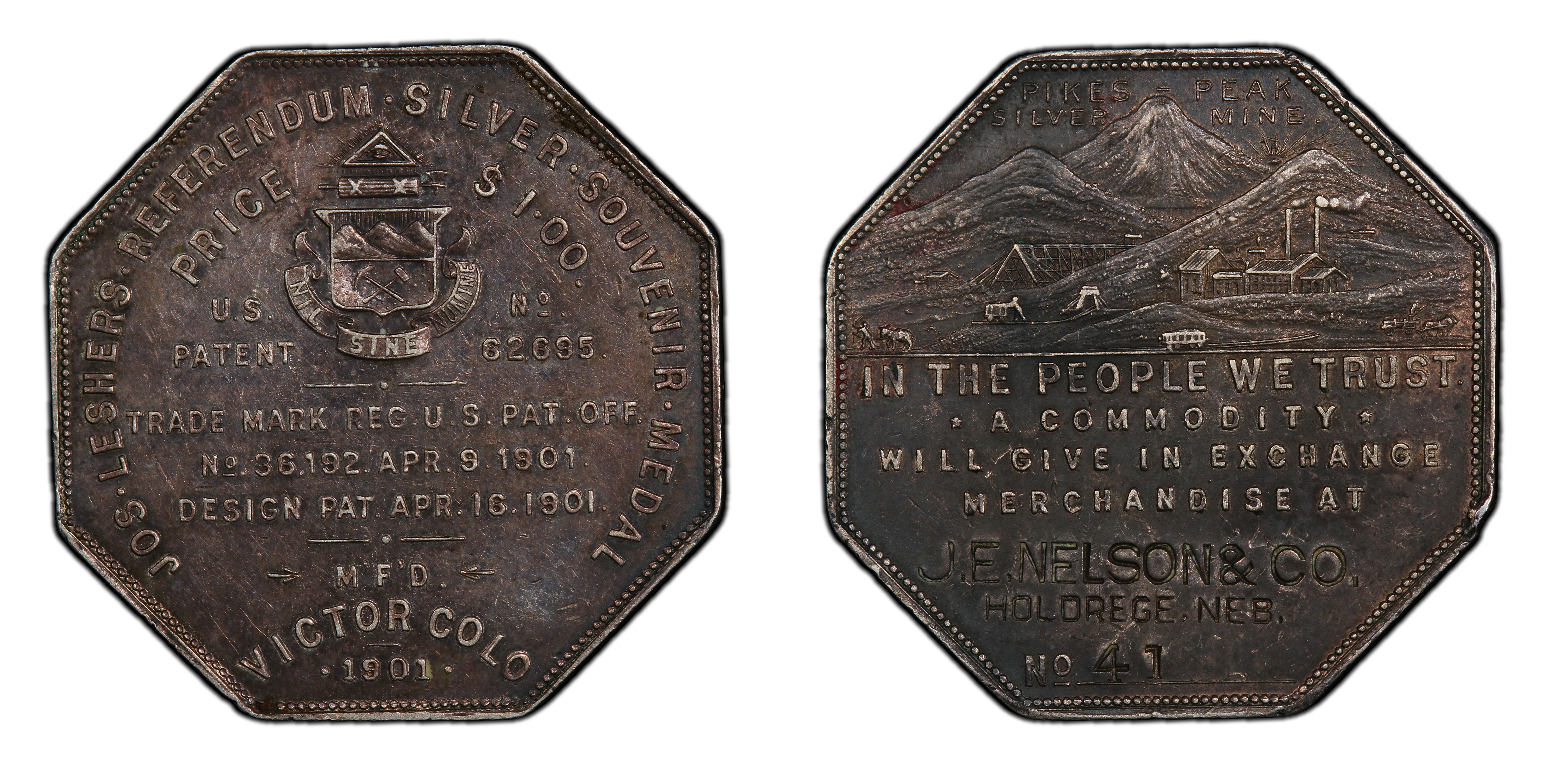
Obverse & Reverse
The Lesher Referendum Dollars of 1900-1901 represent a fascinating and tangible link to the tumultuous 'Free Silver' debate that dominated American politics at the turn of the 20th century. Following the Panic of 1893 and the effective demonetization of silver, mining-dependent states like Colorado suffered a severe economic depression. Joseph Lesher, a silver mine owner and ardent silverite from Victor, Colorado, conceived of a private minting venture to prove his ideological point: that the people would willingly accept silver coinage at a value far exceeding its depressed bullion price, thereby demonstrating its inherent monetary utility and stimulating the local economy. He called his octagonal pieces 'Referendum Dollars' because they were 'referred to the people for acceptance or rejection.' The first issues of 1900 were heavier and valued at $1.25. By 1901, Lesher adjusted the planchets to match the weight of a standard U.S. silver dollar (412.5 grains) and valued them at $1.00. To encourage circulation and avoid conflict with federal anti-counterfeiting laws, he partnered with local merchants who would accept and distribute the pieces. The 1901 issues were designed with a blank space on the obverse, allowing merchants to counterstamp their own name and location. The J.E. Nelson & Co. variety is particularly noteworthy as it is the only known instance of a merchant outside of Colorado participating in Lesher's scheme. John E. Nelson, proprietor of a clothing company in Holdrege, Nebraska, acquired a small batch of these silver tokens. It is believed they were distributed as promotional items during the grand opening of his new store on October 22, 1903. This geographic outlier status adds a unique dimension to its history, illustrating the reach, however limited, of Lesher's experiment beyond the immediate confines of the Cripple Creek mining district. These pieces were not legal tender, but their redemption guarantee by Lesher and the participating merchants gave them transactional legitimacy in their local contexts, making them a potent form of economic protest and a classic example of private scrip during an era of monetary uncertainty.
Associated EventFree Silver Movement
Reason For MintingTo prove that silver could circulate at a value above its bullion price and to privately stimulate a local economy depressed by the demonetization of silver.
Minter HistoryJoseph W. Lesher (1838-1918) was a Civil War veteran, prospector, and silver mine owner who settled in the Cripple Creek Mining District of Colorado. A staunch advocate for bimetallism, he was deeply affected by the economic downturn that followed the repeal of the Sherman Silver Purchase Act. Frustrated by the government's adherence to the gold standard, Lesher took matters into his own hands by designing and commissioning dies for his private 'Referendum' coinage in 1900. He contracted a Denver firm to strike the pieces, which he initially distributed himself in Victor before partnering with merchants. To protect his venture from counterfeiting, Lesher secured a design patent (No. 34,359) and a trademark for the word 'Referendum' (No. 36,192) in 1901. His minting activities were short-lived, ceasing by the end of 1901, but they created one of the most storied and popular series within the realm of So-Called Dollars.
Historical SignificanceThe Lesher Dollar is a historically significant private issue that embodies the economic and political strife of the Free Silver era, serving as a physical manifestation of populist monetary theory and a bold, albeit localized, challenge to the prevailing gold standard.
HK-1018
Denomination$1.00
Minting Period1901
Assayer/MinterJoseph Lesher
Geographic OriginVictor, Colorado
Obverse DescriptionOctagonal medal featuring a detailed mining scene of the Pikes Peak silver mine, with buildings and smoke rising from a smokestack against a mountain backdrop. Above the scene is the inscription 'PIKES PEAK / SILVER MINE'. Below is the motto 'IN THE PEOPLE WE TRUST' and the text 'A COMMODITY / WILL GIVE / IN EXCHANGE / MERCHANDISE AT', followed by a blank space where the merchant's name is stamped. For this variety, the space is stamped 'J. E. NELSON & CO. / HOLDREGE, NEB.' A serial number, individually hand-punched, appears below the merchant stamp.
Obverse InscriptionPIKES PEAK SILVER MINE / IN THE PEOPLE WE TRUST / A COMMODITY / WILL GIVE / IN EXCHANGE / MERCHANDISE AT / J. E. NELSON & CO. / HOLDREGE, NEB. / [Serial Number]
Reverse DescriptionThe central device is the Seal of Colorado, with text arranged in concentric circles around it. The innermost circle contains the denomination and minter's name. The outer circles contain patent and trademark information and the date.
Reverse InscriptionJOS. LESHERS REFERENDUM SOUVENIR MEDAL / PRICE $1.00 / M'F'D. VICTOR, COLO. 1901 / U.S. PATENT NO. 62695. TRADE MARK REG. U.S. PAT. OFF. NO. 36192. APR. 9, 1901. DESIGN PAT. APR. 16, 1901.
CompositionSilver, alloyed with Copper
Stated Fineness0.95
Actual Fineness0.95
Weight26.73 grams
Diameter32.00 mm
EdgePlain
Approximately 50 were presumed to have been ordered and stamped.
Survival EstimateFewer than 10 known today; a 2020 estimate cited only eight known examples.
Rarity ScaleR-7 (4 to 12 known)
This variety is highly sought after due to its extreme rarity and its unique status as the only Lesher Dollar distributed by a merchant outside of Colorado. It combines the appeal of the broader Lesher series—its octagonal shape and historical connection to the Free Silver debate—with the exclusivity of a very low-mintage, geographically distinct issue.
Key VarietiesThe primary variety is the stamp 'J. E. NELSON & CO. / HOLDREGE, NEB.' itself. As each piece was serially numbered by hand, every surviving example is unique in the specific placement, depth, and alignment of its number. No proof or special collector issues are known to have been created during the period of issue.
Authentication TipsAuthentic examples will be octagonal, have a plain edge, and weigh approximately 26.7 grams. The dies used for the underlying 1901 Lesher Dollar should match known genuine examples. The J.E. Nelson stamp should be carefully examined for proper font and placement, consistent with the few known specimens. The hand-punched serial numbers have a characteristic irregularity that is difficult for forgers to replicate convincingly. Modern copies often have a cast appearance, incorrect weight, or exhibit a soft, soapy feel to the details.
Shopping ConsiderationsA premium quality example for its grade will exhibit a sharp strike on the intricate details of the mining scene and the fine text on the reverse. Given the softness of the high-purity silver, problem-free surfaces are rare and command a significant premium. Look for original, undisturbed 'skin' with attractive, honest toning, often a light gray with hints of gold or blue. Avoid examples that have been harshly cleaned, polished, or show evidence of tooling or repairs. The merchant stamp should be bold and fully legible. Because of the hand-punching, some weakness or unevenness in the serial number is expected and does not necessarily detract if the rest of the coin is well-struck.
A coin's grade is its condition, rated on a 1-70 scale. For rare coins, this is the most critical factor in determining value, as a tiny difference in preservation can mean a huge difference in price.
Relevant Grade TypesAll original Lesher Dollars, including the J.E. Nelson & Co. variety, were business strikes intended for local commerce and promotion. They are found in Circulated grades (AG-3 to AU-58) and, very rarely, in Mint State (MS-60 to 70). No Proof (PR/PF) examples were struck during the original period of issue, and no later-date restrikes of this specific merchant variety are known to exist.
Mint State CharacteristicsAn uncirculated example would exhibit full, unbroken mint luster, likely with a soft, satiny texture rather than a brilliant cartwheel effect. The strike on Lesher dollars can be inconsistent; a top-tier MS specimen would display sharp definition on the mountains, mining buildings, and the lettering of the merchant stamp. Contact marks are common due to the octagonal shape and soft metal, so a coin with minimal, well-hidden marks would be considered choice. The hand-punched serial numbers are often not perfectly aligned, which is a feature of minting, not a flaw.
Circulated Wear PatternsWear first appears on the highest points of the design. On the obverse, this includes the peak of the central mountain and the rooflines of the buildings in the mining scene. On the reverse, the high points of the state seal's shield and the eagle's head will show the first signs of friction. In lower grades (VG and below), the finer text of the patent information and the merchant stamp will become weak and eventually illegible.
Key Factors For ValueFor the HK-1018, rarity is the paramount factor, with any example being a significant numismatic prize. Beyond sheer existence, value is driven by surface quality and eye appeal. An example with original, uncleaned surfaces and attractive toning is far more desirable than a brighter, cleaned coin of the same technical grade. The boldness and completeness of the J.E. Nelson & Co. stamp are critical; a weak or partially obliterated stamp will significantly reduce the value. A CAC sticker, indicating premium quality for the grade, adds a substantial premium for this rare and coveted issue.
PCGS Price Guide
| Grade | Price | Population |
|---|---|---|
| 12 | $15,000.00 | 1 |
| 15 | $15,750.00 | N/A |
| 20 | $16,500.00 | N/A |
| 25 | $17,000.00 | 1 |
| 30 | $17,500.00 | N/A |
| 35 | $18,000.00 | N/A |
| 40 | $19,000.00 | N/A |
| 45 | $20,000.00 | N/A |
| 45+ | $20,500.00 | N/A |
| 50 | $21,500.00 | N/A |
| 50+ | $22,500.00 | N/A |
| 53 | $25,000.00 | N/A |
| 53+ | $27,500.00 | N/A |
| 55 | $30,000.00 | 1 |