1901 Lesher $ HK-791a Imprnt Type No# (Regular Strike)
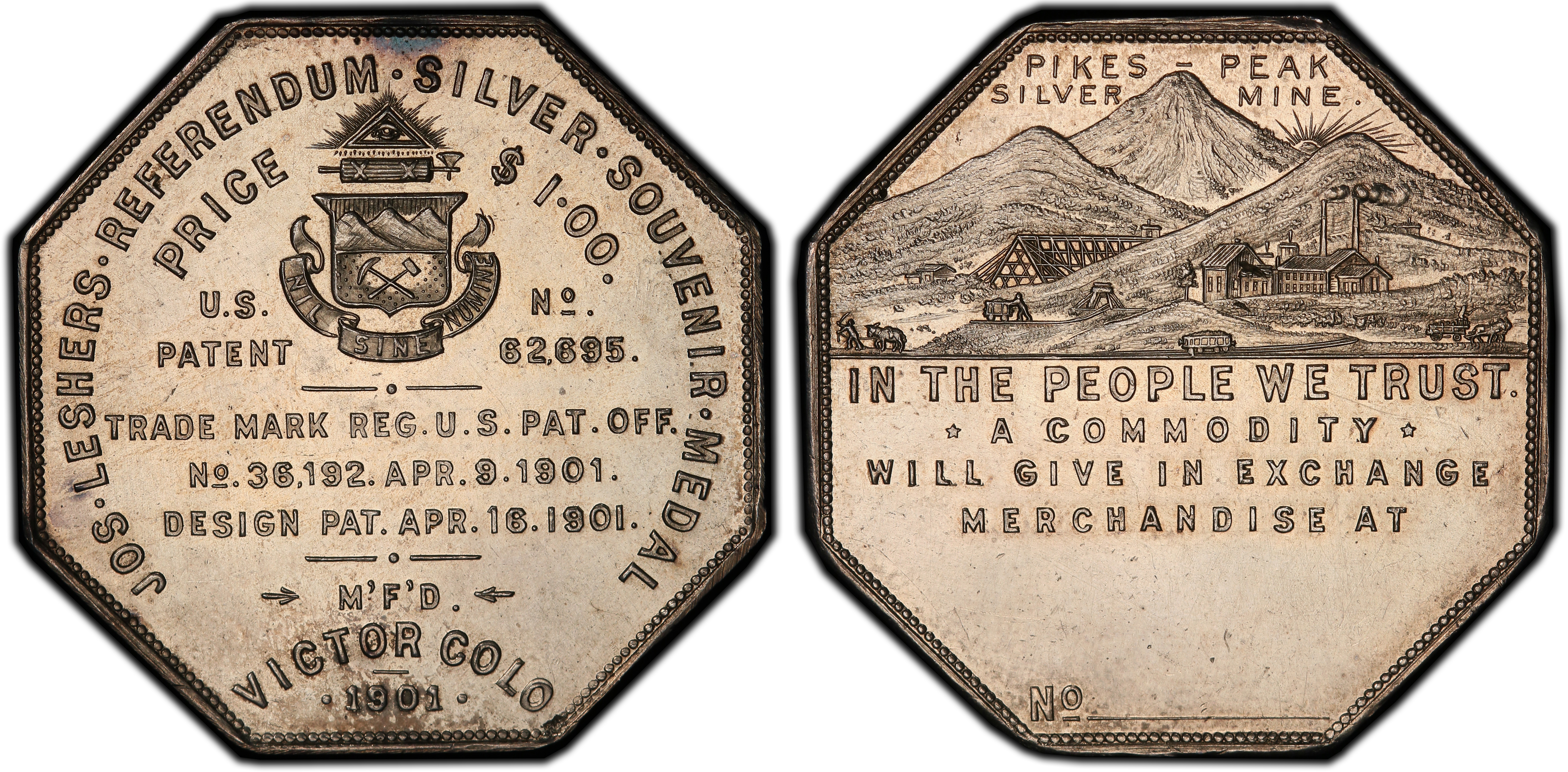
Obverse & Reverse
The Lesher Referendum Dollars are a fascinating and historically significant series of privately issued silver tokens, born from the fiery 'Free Silver' debate that dominated American politics in the late 19th and early 20th centuries. Joseph Lesher, a silver mine owner and ardent silverite from Victor, Colorado, conceived of these pieces as a practical protest against the nation's adherence to the gold standard, which he and many others in mining states believed was economically ruinous. The Coinage Act of 1873, dubbed the 'Crime of '73' by silver proponents, had demonetized silver, causing its price to plummet and devastating the economies of western states like Colorado. Lesher's 'Referendum' plan was a novel attempt to restore silver's monetary role at a local level. He proposed creating octagonal 'dollars' composed of silver from his mines, valued at $1.25 but redeemable for $1.00 in United States currency. The extra 25 cents was intended to cover minting and distribution costs. The 'Referendum' name stemmed from Lesher's concept that their acceptance in commerce by the public would serve as a vote of confidence in silver as money. The first pieces were struck in 1900. The 1901 issues, including this HK-791a variety, represent the continuation and evolution of his experiment. This specific type is known as the 'No Imprint' or 'Blank Reverse' variety. While most Lesher dollars were stamped with the names of local merchants who agreed to accept and distribute them, this variety was left plain, likely intended for broader, non-specific distribution or for merchants to stamp their own names. Lesher's operation was short-lived. The United States Secret Service investigated his activities, viewing them as a potential infringement on the federal government's exclusive right to coin money. While Lesher was never prosecuted, likely because the pieces were carefully denominated as 'A COMMODITY' and 'PRICE $1.00' rather than 'ONE DOLLAR,' the official pressure brought his enterprise to a halt by late 1901. Today, these pieces are not considered coins but are cataloged as 'so-called dollars.' They serve as tangible relics of the Populist movement, the Free Silver crusade, and a unique chapter in American monetary history, embodying one man's determined effort to influence national policy from his small Colorado town.
Associated EventFree Silver Movement
Reason For MintingTo promote the use and remonetization of silver in defiance of the national gold standard, acting as a local monetary experiment.
Minter HistoryJoseph Lesher (1838-1918) was a silver miner, real estate developer, and passionate advocate for the Free Silver cause. He moved to Colorado in the 1890s, drawn by the Cripple Creek Gold Rush, but his primary interest remained in silver. Frustrated by the economic depression that followed the demonetization of silver, he devised the 'Referendum Dollar' scheme as both a political statement and a business venture. He partnered with local merchants and jewelers to strike and distribute his silver pieces. Though his experiment was ultimately curtailed by government scrutiny, Lesher remained a respected figure in Victor, Colorado, until his death.
Historical SignificanceThe Lesher Dollars are a unique physical embodiment of the Populist-era Free Silver debate. They represent a rare instance of a private citizen attempting to create a circulating alternative currency to challenge federal monetary policy, making them a crucial artifact for understanding the economic and political passions of turn-of-the-century America.
K-18a
Denomination$1.00
Minting Period1901
Assayer/MinterJoseph Lesher
Geographic OriginVictor, Colorado
Obverse DescriptionThe central device features a view of the Rocky Mountains with Pikes Peak prominent. Below this is the seal of the State of Colorado. A decorative border of laurel wreaths and berries surrounds the central design.
Obverse InscriptionJOS. LESHERS REFERENDUM SOUVENIR / PIKES PEAK SILVER MINE / (view of mountains) / (Colorado state seal) / A COMMODITY. / WILL GIVE IN EXCHANGE / MERCHANDISE OR CASH AT / PRICE $1.00 / U.S. PATENT / No. 62695.
Reverse DescriptionOctagonal cartouche in the center with a plain, unstamped surface. The surrounding inscription is within a circle.
Reverse InscriptionA GIVT. STAMP IS GOOD FOR FACE VALUE / THIS COIN IS NOT. / BUT IS WORTH ITS BULLION VALUE. / TRADE MARK / DESIGN PATENTED / APLD. FOR. / VICTOR, COLO. / 1901
CompositionSilver and Copper Alloy
Stated FinenessApproximately .950 fine silver
Actual FinenessAnalysis shows a composition of approximately 95% silver and 5% copper, though slight variations exist.
Weight24.88 grams
Diameter35.00 mm
EdgePlain
Approximately 1,000 (for all 1901 varieties combined)
Survival Estimate35-50 (for the HK-791a variety)
Rarity ScaleR-6
This piece is highly sought after for its unique octagonal shape, direct connection to the Free Silver movement, and its status as a classic American 'so-called dollar.' The 'No Imprint' variety is particularly desirable as it represents the stock version of the token before merchant customization.
Key VarietiesThe primary varieties of Lesher Dollars are distinguished by the merchant's name stamped ('imprinted') on the reverse. The HK-791a is the 'No Imprint' or 'Blank' variety. Other varieties from 1901 include imprints for merchants such as A.B. Bumstead, J.M. Slusher, Sam Cohen, and others. There are no known proof restrikes or special collector issues from the period of issue or later.
Authentication TipsGenuine Lesher dollars have a distinct feel and specific gravity due to their high silver content. The engraving style is characteristic of the period; modern counterfeits often have a mushy or tool-marked appearance. Check for die markers and compare the coin's details, particularly the fine lines in the mountain range and state seal, against known genuine examples. The weight should be very close to the 24.88-gram standard. Many fakes are cast and will show pitting or a seam on the edge.
Shopping ConsiderationsA premium quality example for its grade will possess a sharp, well-defined strike, especially on the fine details of the Colorado seal and the mountain ranges. Original, undisturbed surfaces with attractive grey or golden toning are highly prized. Look closely for evidence of cleaning, which will manifest as hairlines or an unnaturally bright, sterile appearance. Damage is common on these pieces, so carefully inspect the rims for bumps and check the flat surfaces for scratches or tooling marks. The central reverse cartouche should be examined for any faint traces of a removed imprint, which would reclassify the piece.
A coin's grade is its condition, rated on a 1-70 scale. For rare coins, this is the most critical factor in determining value, as a tiny difference in preservation can mean a huge difference in price.
Relevant Grade TypesOriginal Lesher Dollars were business strikes intended to circulate as a monetary substitute and are found in Circulated (1-58) and Mint State (MS, 60-70) grades. The vast majority of surviving examples are circulated, often heavily. No proofs were struck during the original period of issue, and there are no known later-date restrikes or special collector strikings.
Mint State CharacteristicsAn uncirculated (MS) Lesher Dollar exhibits full, unbroken mint luster, which is typically soft and satiny rather than frosty. The strike is often somewhat soft in the centers, so a sharply struck example with full detail in the state seal commands a significant premium. Due to the large size and soft metal, even Mint State examples will typically show some light contact marks or 'cabinet friction' from handling and storage over the past century. These are generally accepted as long as they do not impair the overall eye appeal.
Circulated Wear PatternsWear first appears on the highest points of the design. On the obverse, check the upper portions of the mountain range and the central shield and fasces within the Colorado seal. On the reverse, the highest points of the circular border around the central cartouche will show initial friction and flattening. In lower grades (VG and below), the finer text of the inscriptions will become weak and begin to merge with the fields.
Key Factors For ValueFor the HK-791a, value is driven by grade and surface quality. An example with original, uncleaned surfaces and attractive toning is far more valuable than a dipped or cleaned piece of the same grade. The sharpness of the strike is a major factor, with well-struck coins being scarce. Eye appeal is paramount; a coin with fewer distracting marks and a pleasing, honest appearance will always be in higher demand. A CAC sticker, indicating premium quality for the grade, adds a significant premium, as it confirms originality and superior eye appeal to discerning collectors.
PCGS Price Guide
| Grade | Price | Population |
|---|---|---|
| 25 | $2,250.00 | 1 |
| 30 | $2,500.00 | N/A |
| 35 | $2,750.00 | 1 |
| 40 | $3,000.00 | 1 |
| 45 | $3,250.00 | 1 |
| 45+ | $3,500.00 | N/A |
| 50 | $3,750.00 | 1 |
| 50+ | $4,000.00 | N/A |
| 53 | $4,250.00 | 1 |
| 53+ | $4,350.00 | N/A |
| 55 | $4,500.00 | 1 |
| 55+ | $4,600.00 | N/A |
| 58 | $4,750.00 | 1 |
| 58+ | $5,000.00 | N/A |
| 60 | $5,500.00 | N/A |
| 61 | $6,000.00 | N/A |
| 62 | $7,000.00 | N/A |
| 62+ | $7,750.00 | N/A |
| 63 | $9,500.00 | 1 |