1900 Lesher $ HK-1016 Trade Mark Applied (Regular Strike)
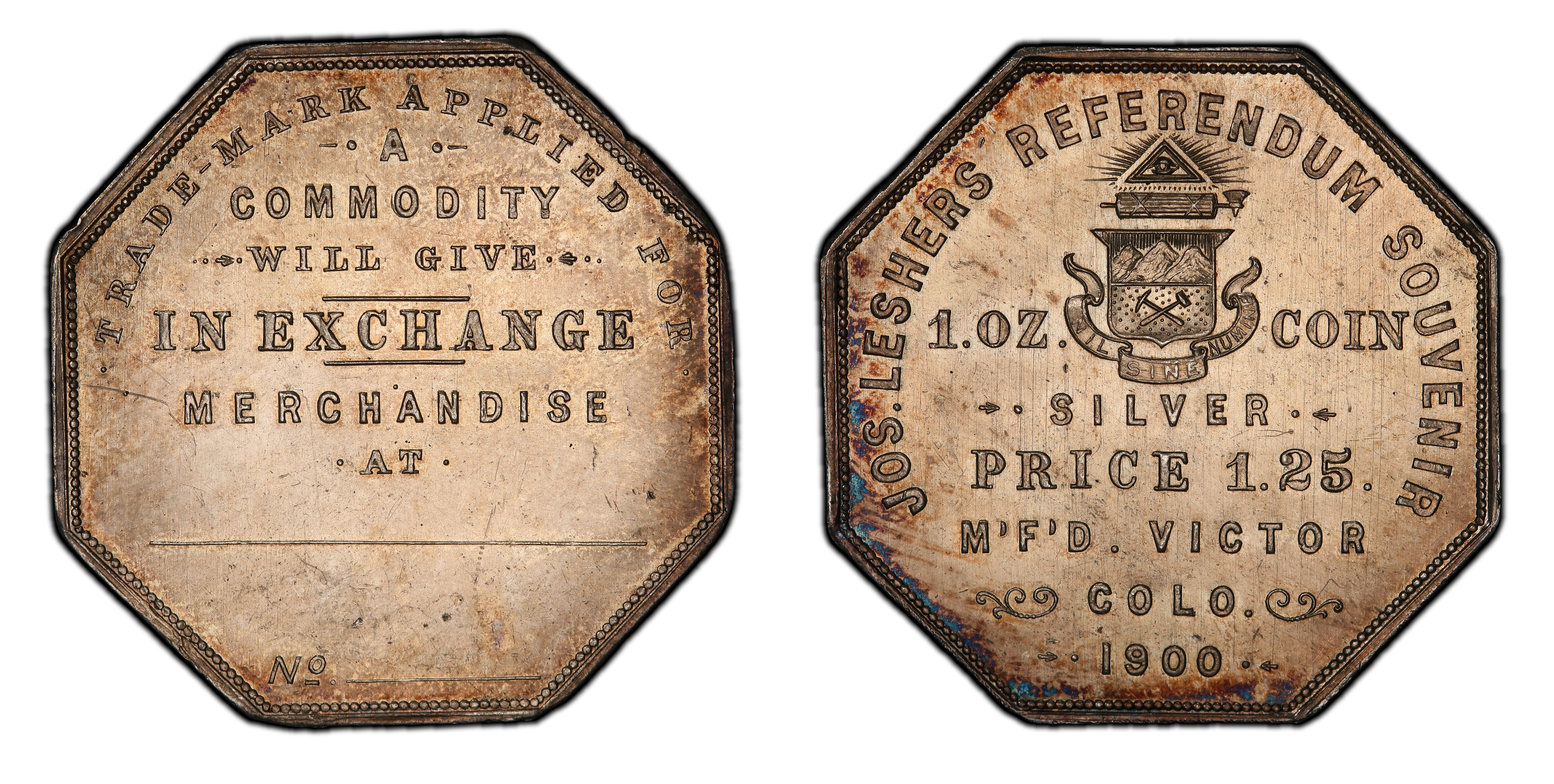
Obverse & Reverse
The Lesher or 'Referendum' Dollars represent a fascinating and uniquely American chapter in the history of private coinage, born from the fiery political crucible of the 'Free Silver' movement. At the turn of the 20th century, the United States was deeply divided over monetary policy. The gold standard, solidified by the election of William McKinley, had devastating effects on silver-producing states like Colorado. The market price of silver plummeted, leading to mine closures, widespread unemployment, and economic depression throughout the region. Joseph Lesher, a Civil War veteran, longtime silver miner, and real estate investor in Victor, Colorado, was a fervent believer in bimetallism. He was convinced that the intrinsic value of silver was far greater than its market price and that its expanded use in commerce would restore prosperity. Following the second defeat of 'Free Silver' champion William Jennings Bryan in the 1900 presidential election, Lesher took matters into his own hands. On November 13, 1900, he began issuing his own octagonal silver 'coins'. To circumvent federal laws against private coinage, Lesher ingeniously labeled them 'Referendum Souvenirs,' asserting they were not legal tender but were instead 'referred' to the people for voluntary acceptance or rejection. He guaranteed to redeem them in U.S. currency or merchandise at a face value of $1.25, well above their silver content of about 65 cents. The specific HK-1016 variety, 'Trade Mark Applied For,' is a unique and pivotal piece in the Lesher series. It is believed to have been a prototype or presentation piece struck in connection with Lesher's application for a trademark on his design, which he filed on February 14, 1901. This theory is supported by the fact that subsequent 1901 issues bear the actual patent and trademark numbers. The obverse of HK-1016 is purely textual, unlike most other Lesher issues which feature a mining scene. This piece links the initial 1900 issues with the later, legally protected 1901 series, marking Lesher's attempt to legitimize and protect his private enterprise from imitators. Though his grand vision of a widespread alternative currency never fully materialized, Lesher's experiment saw limited but successful circulation in the Cripple Creek mining district, with local merchants like A.B. Bumstead accepting and distributing the pieces. Today, these 'dollars' are celebrated as important relics of Western Americana and the populist Free Silver movement.
Associated EventFree Silver Movement / Post-1890s Silver Demise
Reason For MintingTo create a privately issued silver currency to protest the gold standard, promote the use of silver, and provide a medium of exchange in a silver-rich, cash-poor region.
Minter HistoryJoseph W. Lesher (1838-1918) was a Civil War veteran from Ohio who moved to Colorado after the war and became deeply involved in the silver mining industry. He worked as a miner and eventually became a mine owner and real estate investor, witnessing firsthand the economic boom and bust cycles tied to silver politics. A staunch advocate for the free coinage of silver, his 'Referendum Dollar' project was a personal and political crusade to demonstrate silver's utility and inherent value. Lesher designed the pieces himself and commissioned dies from Denver engravers Frank Hurd and Herman Otto. Despite his efforts, the project was short-lived, ending in 1901, but his legacy as a bold monetary experimentalist was cemented in numismatic history.
Historical SignificanceThe Lesher Dollars are tangible artifacts of the populist 'Free Silver' debate that defined late 19th-century American politics. They represent a bold, grassroots challenge to federal monetary policy and stand as one of the last significant examples of private coinage in the continental United States. The HK-1016 variety is singularly important as it documents the transition of Lesher's project from a simple private token to a protected, trademarked enterprise.
Zerbe-17, HK-1016
Denomination$1.00 (implied trade value)
Minting Period1900
Assayer/MinterJoseph Lesher
Geographic OriginVictor, Colorado
Obverse DescriptionThe obverse is purely inscriptional, a stark contrast to the pictorial designs of other Lesher types. The text is arranged in six straight lines at the center with a circular legend around the periphery. A space is left blank at the bottom for a merchant's name to be stamped, though this unique example is unstamped, followed by a placeholder 'No.' for a serial number.
Obverse InscriptionAround periphery: TRADE-MARK APPLIED FOR; Center, in six lines: A / COMMODITY / WILL GIVE / IN EXCHANGE / MERCHANDISE / AT
Reverse DescriptionThe reverse features the Colorado State Seal at the center, with 'JOS. LESHERS REFERENDUM SOUVENIR' in an arch above. The stated weight and composition '1 OZ. COIN SILVER' and the price of '$1.25' are below the seal, followed by the place of manufacture, 'VICTOR, COLO.' and the date '1900'. This reverse die is the same as that used for the A.B. Bumstead Type 2 (HK-789).
Reverse InscriptionJOS. LESHERS REFERENDUM SOUVENIR / 1 OZ. COIN SILVER / PRICE 1.25 / M'F'D VICTOR / COLO. / 1900
CompositionSilver
Stated FinenessCoin Silver
Actual FinenessApproximately 0.950 Silver, 0.050 Copper
Weight31.10 grams
Diameter35.00 mm
EdgePlain
1
Survival Estimate1
Rarity ScaleR-10 (Unique)
The HK-1016 is a landmark rarity in American numismatics. As the only known example of its type, its appeal is absolute. It combines the allure of Western territorial history, the political drama of the Free Silver movement, and its status as a unique prototype that bridges the two major phases of Lesher's coinage experiment. It is a centerpiece for the most advanced collections of So-Called Dollars or private coinage.
Key VarietiesThis coin is itself a unique variety. The broader Lesher series includes several key types issued in 1900 and 1901, differentiated by their inscriptions and the names of the merchants who sponsored them (e.g., A.B. Bumstead, J.M. Slusher). No proof restrikes or special collector issues are known; all Lesher dollars were originally intended for circulation or local trade.
Authentication TipsAs this is a unique, well-documented piece, authentication primarily relies on tracing its provenance. Any new discovery would be met with extreme skepticism. Characteristics to note are the specific die markers shared with the HK-789 reverse, the distinctive lettering style of the obverse, and the octagonal planchet's precise dimensions and weight. The known specimen exhibits prooflike surfaces, a key diagnostic feature.
Shopping ConsiderationsAcquiring this specific coin is a matter of opportunity, as it only appears for sale on rare occasions when a major collection is liquidated. A potential buyer would be focused on its documented pedigree, which includes the Whiteley, Kosoff, and Henderson-Marchase collections. For this unique piece, 'premium quality' is defined by its current certified grade (NGC MS-64). Any signs of impairment, cleaning, or damage not currently noted on the holder would be of paramount concern. Eye appeal, characterized by its reflective surfaces and attractive toning, is a significant factor in its desirability.
A coin's grade is its condition, rated on a 1-70 scale. For rare coins, this is the most critical factor in determining value, as a tiny difference in preservation can mean a huge difference in price.
Relevant Grade TypesAll original Lesher Dollars were business strikes intended for local commerce, thus they are found in Circulated (1-58) and Mint State (MS, 60-70) grades. No proofs were struck during the original period of issue, and no later-date restrikes are known to exist. The unique HK-1016 specimen is a Mint State coin, believed to be a presentation piece, and was never subjected to circulation.
Mint State CharacteristicsAs a unique piece, its characteristics define the standard. The known example is graded MS-64 and is described as having prooflike reflectivity. A theoretical 'perfect' example would exhibit sharp, fully-formed lettering on both sides, deeply mirrored fields, and an absence of any contact marks or hairline scratches. The soft silver is prone to handling marks, so the pristine nature of the known piece is exceptional.
Circulated Wear PatternsWhile this specific coin is uncirculated, a hypothetical circulated example would show wear first on the highest points of the reverse design, specifically the shield and eagle within the Colorado State Seal, and on the letters of 'SILVER' and 'PRICE'. On the purely textual obverse, wear would manifest as a general flattening of the letters across the entire face.
Key Factors For ValueFor this unique item, value is determined by its singular status as a historical artifact. Its certified grade of MS-64 sets the benchmark. Key factors upholding its value are its impeccable provenance, its critical role in the Lesher narrative, and its exceptional eye appeal, which includes notable prooflike surfaces and attractive toning. The value is less about comparing it to other examples and more about its singular place in numismatic history.
PCGS Price Guide
| Grade | Price | Population |
|---|---|---|
| 64 | $115,000.00 | 1 |