1900 SC$ HK-788, Lesher, AB Bumstead (Regular Strike)
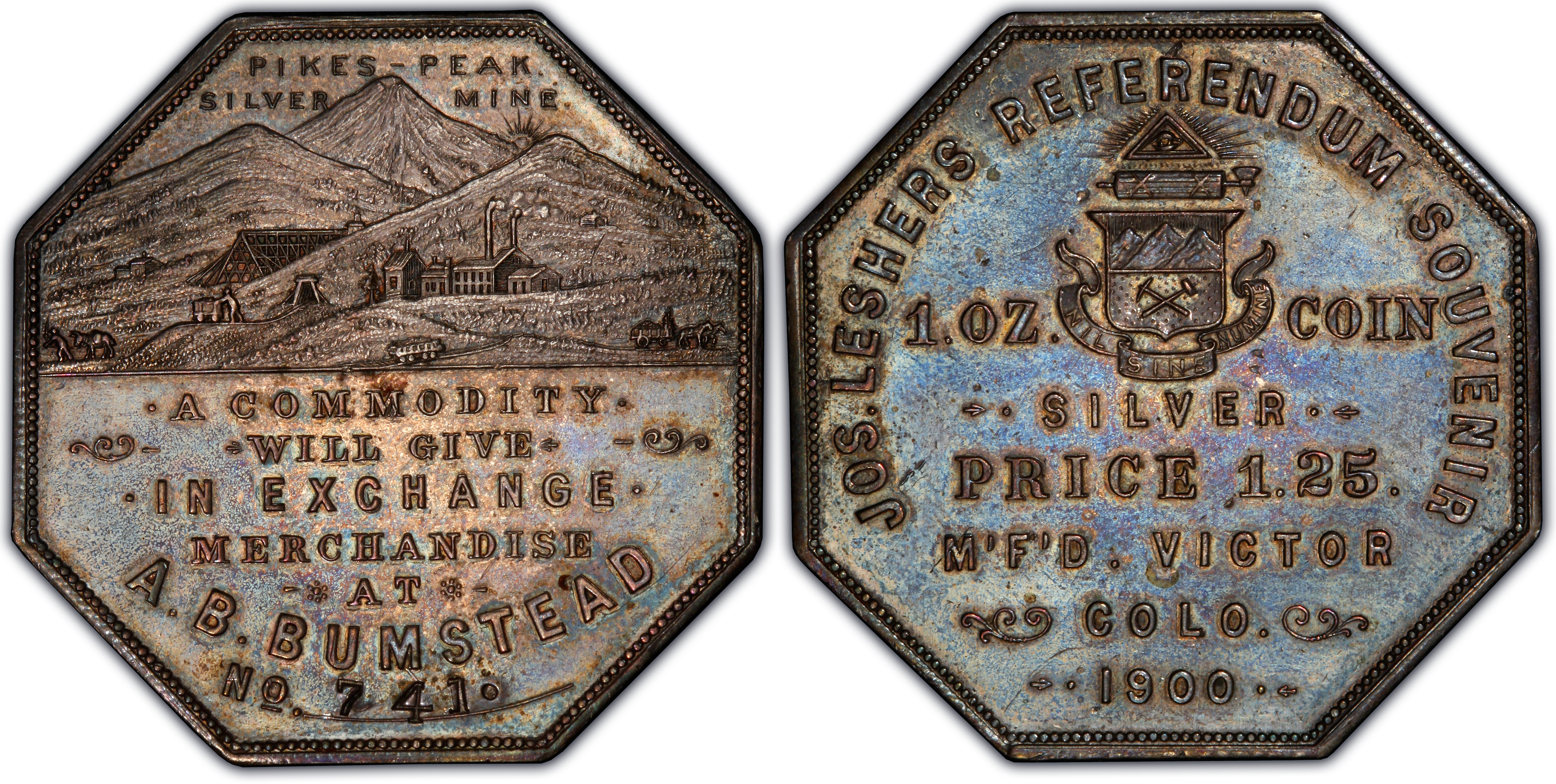
Obverse & Reverse
At the dawn of the 20th century, the American monetary system was a battleground, and Colorado was at its epicenter. The gold standard, solidified by the election of William McKinley in 1896, had devastated silver mining economies. Silver prices plummeted from a government-supported peak to a fraction of their former value, idling mines and creating widespread unemployment in towns like Victor, a key city in the Cripple Creek Mining District. In this climate of economic distress, Joseph Lesher, a Civil War veteran, silver mine owner, and passionate advocate of the 'Free Silver' movement, conceived a radical plan. He believed the intrinsic value of silver was far higher than the market price and sought to prove that the public would willingly accept silver at its 'true' value. His solution was the 'Referendum Dollar,' a privately issued silver piece 'referred' to the people for their acceptance or rejection. Starting in November 1900, Lesher began issuing these distinctive octagonal medals. To avoid conflict with federal anti-counterfeiting laws, he made them eight-sided, called them 'Souvenirs,' and set their 'price' at $1.25, well above their bullion value of about 65 cents. The first issue (HK-787) was distributed by Lesher himself, but he soon realized a partnership with a local merchant was necessary for wider circulation. He enlisted Arthur Bolles (A.B.) Bumstead, a prominent grocer in Victor, to accept and distribute the pieces. The HK-788 variety represents this pivotal collaboration. Struck from dies engraved by Herman Otto of Denver, these pieces featured a detailed mining scene on one side and Lesher's 'Referendum' text on the other. By tying the medals to a specific, trusted merchant, they became a form of token, legally redeemable for merchandise. The experiment was a local success; the public accepted them, and very few were ever returned for redemption. The venture, however, was short-lived. By 1901, the Secret Service took notice, and while no charges were filed, the scrutiny led Lesher to cease production. Today, Lesher Dollars are a tangible link to the Populist-era 'Free Silver' debate, representing a bold, grassroots challenge to national monetary policy and a fascinating chapter in the history of private and territorial coinage.
Associated EventFree Silver Movement / Cripple Creek Gold Rush
Reason For MintingTo protest the gold standard and promote the use and value of silver by creating a privately issued currency the public would voluntarily accept.
Minter HistoryJoseph W. Lesher (1838-1918) was a Civil War veteran from Ohio who moved to Colorado and became a silver miner and real estate investor. An ardent supporter of the 'Free Silver' movement, he owned a silver mine near Central City that became unprofitable after the silver price crash. In 1900, living in Victor, he launched his private minting experiment, producing the 'Referendum Dollars' to demonstrate silver's utility as currency and hopefully revive the local mining economy. He designed the pieces himself and initially struggled with distribution before partnering with merchants like A.B. Bumstead. Though his minting operation only lasted until 1901 due to government pressure, his innovative and defiant act created one of the most famous and collectible series of so-called dollars in American numismatics. He died in Victor in 1918.
Historical SignificanceThe Lesher Dollars are a physical embodiment of the 'Free Silver' political movement, representing a direct, albeit localized, challenge to the national gold standard. They are a rare example of a private citizen attempting to influence monetary policy through direct economic action, creating a de facto local currency during a period of economic hardship in Colorado's mining districts. Their unique octagonal shape and merchant-based redemption system make them a fascinating case study in legal and economic history.
N/A
Denomination$1.25 (Price)
Minting Period1900
Assayer/MinterJoseph Lesher
Geographic OriginVictor, Colorado
Obverse DescriptionA panoramic mountain mining scene, identified as the Pikes Peak Silver Mine, dominates the upper half. Below this scene is the text of the exchange proposition, with the name of the redeeming merchant, A.B. Bumstead, prominently featured. A space for a hand-punched serial number appears at the bottom.
Obverse InscriptionPIKES-PEAK / SILVER MINE / • A Commodity • / WILL GIVE / • IN EXCHANGE • / MERCHANDISE / --*AT*-- / A. B. BUMSTEAD / NO.
Reverse DescriptionThe upper portion features the inscription 'JOS. LESHERS REFERENDUM SOUVENIR' in an arc. The center contains a device from the Colorado State Seal, including the motto 'NIL SINE NUMINE' (Nothing Without God), which separates '1 OZ.' and 'COIN'. Below this is the stated composition and price. The HK-788 variety is distinguished by ornamental scrolls flanking the state seal device and a horizontal line above 'COLO.'.
Reverse InscriptionJOS. LESHERS REFERENDUM SOUVENIR / 1 OZ. COIN / • SILVER • / PRICE 1.25 • / M'F'D VICTOR / COLO. / 1900
CompositionSilver, alloyed with Copper
Stated Fineness.950 Fine Silver
Actual Fineness.950 Fine Silver
Weight31.10 grams
Diameter35.00 mm
EdgePlain
Approximately 210
Survival Estimate100-125
Rarity ScaleR-5
This coin is highly sought after for its unique octagonal shape, direct connection to the 'Free Silver' political movement, its status as a privately issued currency from the Colorado mining boom, and its specific association with the merchant A.B. Bumstead.
Key VarietiesThe primary distinction for the HK-788 is the 'First Reverse,' identified by the presence of ornamental scrolls on either side of the state seal device. The subsequent variety, HK-789, uses the same obverse die but a 'Second Reverse' die without these scrolls. Some examples of both types are known to exist without a hand-punched serial number; these are designated as HK-788a and are scarcer. No proof or special collector strikings were made during the period of issue.
Authentication TipsGenuine examples have a distinct fabric and strike quality from dies engraved by Herman Otto. The hand-punched serial numbers should show irregular depth and alignment, as individual numeral punches were used. Counterfeits often have a cast appearance, weak details, incorrect weight, or unnaturally uniform numerals. Be wary of added or altered serial numbers. The edge must be plain.
Shopping ConsiderationsA premium quality example for its grade will exhibit a sharp strike, particularly on the fine details of the mining scene and the lettering. Original, untoned surfaces are desirable, but many surviving pieces have an attractive, natural 'cabinet' toning of gunmetal-gray or blue, which is highly prized. Check for weakness on the high points of the mountains and the central inscriptions. Common problems include cleaning, which imparts hairline scratches and strips the original skin, and edge bumps or nicks due to the piece's softness and circulation. A CAC sticker confirms premium quality for the assigned grade and is a significant value-add for this series.
A coin's grade is its condition, rated on a 1-70 scale. For rare coins, this is the most critical factor in determining value, as a tiny difference in preservation can mean a huge difference in price.
Relevant Grade TypesAll original Lesher Dollars, including the HK-788, were struck as business strikes intended for circulation and local commerce. They are found in Circulated grades (AG-3 to AU-58) and Mint State grades (MS-60 to 70). No proofs were struck during the original 1900-1901 period. Modern restrikes for collector purposes exist, such as those made to finance the restoration of the Lesher House, but these are entirely separate numismatic items and should not be confused with original issues.
Mint State CharacteristicsAn uncirculated (MS) HK-788 typically displays a soft, satiny luster. The strike can be uneven; some examples are sharply detailed, while others may show slight weakness in the center of the obverse or reverse. Being large, heavy pieces made of soft silver, they are highly susceptible to contact marks. Even high-grade Mint State examples will often show minor bag marks or handling lines on the open fields or the highest points of the design. A truly 'clean' piece with minimal marks and strong luster commands a significant premium.
Circulated Wear PatternsWear first appears on the highest points of the design. On the obverse, this includes the peaks of the mountains in the mining scene. On the reverse, the high points are the central state seal device and the words 'SILVER' and 'PRICE'. On moderately circulated examples (VF-XF), the finer details of the mine buildings will soften, and the lettering will show flatness. In lower grades, the main inscriptions become weak, and the entire piece has a flattened appearance, though the octagonal shape and core design elements remain visible.
Key Factors For ValueThe primary drivers of value are grade and surface preservation. An example with original, undisturbed surfaces and attractive toning is worth significantly more than a cleaned or polished piece of the same grade. Strike sharpness is a key factor; a well-struck coin with full details is always preferred. The specific serial number is generally not a major value factor unless it is particularly low or has a unique characteristic. Finally, certification by a top grading service (PCGS or NGC) is standard, and the addition of a CAC sticker, indicating superior quality for the grade, adds a substantial premium.
PCGS Price Guide
| Grade | Price | Population |
|---|---|---|
| 2 | $1,750.00 | 1 |
| 3 | $1,800.00 | N/A |
| 4 | $1,875.00 | N/A |
| 6 | $1,950.00 | N/A |
| 8 | $2,050.00 | N/A |
| 10 | $2,250.00 | N/A |
| 12 | $2,350.00 | N/A |
| 15 | $2,450.00 | 1 |
| 20 | $2,550.00 | 1 |
| 25 | $2,650.00 | N/A |
| 30 | $2,750.00 | 1 |
| 35 | $2,850.00 | N/A |
| 40 | $3,000.00 | 1 |
| 45 | $3,100.00 | 3 |
| 45+ | $3,150.00 | N/A |
| 50 | $3,250.00 | 2 |
| 50+ | $3,350.00 | N/A |
| 53 | $3,500.00 | 3 |
| 53+ | $3,600.00 | N/A |
| 55 | $3,750.00 | 7 |
| 55+ | $3,850.00 | N/A |
| 58 | $4,000.00 | 12 |
| 58+ | $4,250.00 | N/A |
| 60 | $4,500.00 | N/A |
| 61 | $5,000.00 | 3 |
| 62 | $5,500.00 | 8 |
| 62+ | $6,000.00 | 1 |
| 63 | $6,500.00 | 5 |
| 63+ | $8,500.00 | N/A |
| 64 | $12,500.00 | 2 |
| 65 | N/A | N/A |