1900 SC$ HK-787 (Regular Strike)
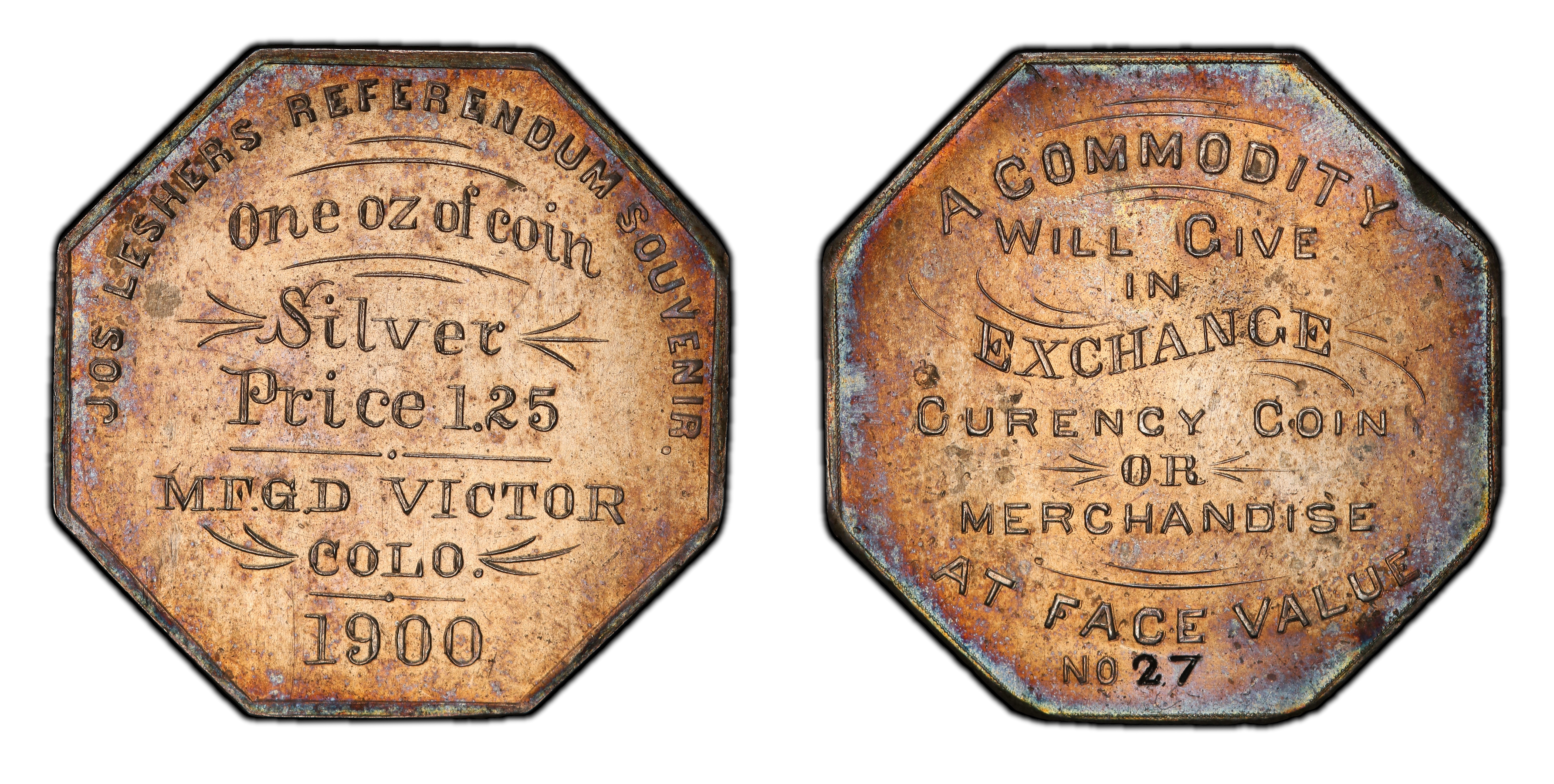
Obverse & Reverse
The Lesher Referendum Dollar of 1900, cataloged as HK-787, stands as a fascinating monument to the 'Free Silver' movement and the defiant spirit of the American West. Born from the economic turmoil following the Panic of 1893 and the demonetization of silver, this private issue was the brainchild of Joseph Lesher, a silver mine owner and staunch populist from Victor, Colorado. At the turn of the 20th century, the official U.S. monetary policy was anchored to the gold standard, a decision that had devastated silver mining economies like Colorado's by causing the price of silver to plummet. Lesher, like many Westerners, was a passionate advocate for bimetallism, believing that the unlimited coinage of silver would expand the money supply, stimulate the economy, and restore prosperity to mining communities. After the defeat of pro-silver presidential candidate William Jennings Bryan in 1896 and 1900, Lesher took matters into his own hands. On November 13, 1900, he began issuing his own octagonal silver 'coins.' He ingeniously called them 'Referendum Souvenirs,' asserting that they were not illegal private coinage but rather items 'referred' to the people for their voluntary acceptance or rejection. The HK-787 was the very first type, a bold experiment sold directly by Lesher himself. Struck from silver mined in the region, each piece contained one troy ounce of .950 fine silver, significantly more than a standard U.S. Morgan Dollar. Lesher set the face value at $1.25, well above the bullion value of silver (around 65 cents per ounce at the time) but close to the long-advocated 16-to-1 silver-to-gold ratio. To guarantee their acceptance, Lesher pledged to redeem them in U.S. currency on demand. Consulting with legal advisors, including Senator Henry Teller, Lesher made the pieces octagonal with a plain edge to avoid accusations of imitating official U.S. coinage. This initial batch of 100 pieces was a trial balloon; Lesher sold them personally to gauge public interest before expanding the program. The pieces circulated locally, a testament to the community's support for the silver cause and trust in Lesher himself. This maverick act of monetary protest eventually led to further varieties involving local merchants like A.B. Bumstead, but it began with this simple, text-heavy design. The Lesher Dollars are not just metallic objects; they are tangible relics of a Populist crusade against Eastern financial interests, a private citizen's bold attempt to create an alternative currency rooted in the wealth of his own region.
Associated EventFree Silver Movement
Reason For MintingTo promote the use and value of silver as a monetary metal and create a locally circulating currency during a period of economic hardship for Colorado's silver mining industry.
Minter HistoryJoseph W. Lesher (1838-1918) was a Civil War veteran from Ohio who, like many, moved west to seek his fortune. He became deeply involved in Colorado's mining industry, working his way up from a miner to a mine owner and real estate investor in the silver camps of Georgetown, Leadville, and finally Victor. A passionate believer in bimetallism, he was profoundly affected by the economic downturn caused by the demonetization of silver. His creation of the 'Referendum Dollars' was a direct, personal protest against the gold standard and an effort to support his local economy. He designed the pieces himself and, after consulting legal counsel to ensure he wasn't breaking counterfeiting laws, commissioned dies and had them struck by a private Denver firm. His experiment lasted through 1901, producing several varieties in partnership with local merchants. Lesher died in Victor in 1918, leaving behind one of the most intriguing and storied legacies in American private coinage.
Historical SignificanceThe Lesher Dollar is a prime example of private currency issued as a form of economic and political protest. It represents a grassroots challenge to federal monetary policy and embodies the ideals of the Free Silver movement. Numismatically, it is one of the most famous and collectible of the 'So-Called Dollars,' a category of medals and tokens that commemorate historical events but were not official government coinage. The entire series provides a unique window into the economic struggles and populist sentiments of the American West at the turn of the 20th century.
N/A
DenominationSC$1.25 (So-Called Dollar)
Minting Period1900
Assayer/MinterJoseph Lesher
Geographic OriginVictor, Colorado
Obverse DescriptionThe design is purely typographic and functional, lacking any pictorial elements. It is arranged in seven horizontal lines of text within the octagonal border.
Obverse InscriptionJOS. LESHERS REFERENDUM SOUVENIR / ONE OZ. OF COIN / SILVER / PRICE 1.25 / M.F.G.D. VICTOR / COLO. / 1900
Reverse DescriptionSimilar to the obverse, the reverse is composed entirely of text arranged in eight horizontal lines. At the bottom is an engraved serial number unique to each piece.
Reverse InscriptionA COMMODITY / WILL GIVE / IN / EXCHANGE / CURENCY COIN / OR / MERCHANDISE / AT FACE VALUE / NO. [engraved number]
CompositionSilver, alloyed with copper.
Stated Fineness.950 fine silver
Actual Fineness.950 fine silver
Weight31.10 grams
Diameter35.00 mm
EdgePlain
100. It is believed that Lesher struck pieces with serial numbers 1 through 100.
Survival EstimateApproximately 40-50 known.
Rarity ScaleR-6 (13 to 30 known)
The HK-787 is highly sought after as the inaugural issue of the iconic Lesher Dollar series. Its appeal lies in its direct connection to Joseph Lesher himself, its extreme rarity, its unique octagonal shape, and its rich historical context tied to the Free Silver movement. It is a cornerstone piece for collectors of So-Called Dollars, Western Americana, and private territorial coinage.
Key VarietiesThe primary variety within the HK-787 issue is the serial number, which was hand-engraved on the reverse, making each piece unique. Unlike later Lesher issues, this first type was not made in partnership with merchants and thus has no merchant-stamped varieties. No proof or special presentation strikings are known to exist for this specific type; all 100 were produced as business strikes intended for potential circulation.
Authentication TipsAuthentic examples have a distinctive, somewhat crude but sharp strike from the original dies. The most critical diagnostic is the hand-engraved serial number on the reverse; the style of the engraving should be consistent across known genuine examples. A key detail noted by researchers is the intentional misspelling of 'CURRENCY' as 'CURENCY' on the reverse, which Lesher hoped would provide legal cover. Counterfeits are known to exist and often feature incorrect weight, mushy details, or cast surfaces. Be wary of pieces with punched rather than engraved serial numbers, as the original 100 were all engraved.
Shopping ConsiderationsWhen acquiring an HK-787, originality is paramount. Look for examples with original, undisturbed surfaces, often displaying attractive grey, blue, or russet toning. Since these pieces were intended to circulate, most will show some degree of wear. A premium quality example for its grade will be free of significant, distracting marks, cleaning, or rim damage. The strike is generally consistent, but check for full boldness in the central inscriptions. The quality of the engraved serial number can also impact eye appeal. Given the rarity and value, purchase of a certified example from a major grading service (PCGS or NGC) is strongly recommended.
A coin's grade is its condition, rated on a 1-70 scale. For rare coins, this is the most critical factor in determining value, as a tiny difference in preservation can mean a huge difference in price.
Relevant Grade TypesAll original HK-787 Lesher Dollars were struck as business strikes for potential circulation. Therefore, they are found in Circulated grades (AG-3 to AU-58) and, very rarely, in Mint State (MS-60 to 70). No Proof (PR/PF) examples were struck during the original period of issue, and no later-date restrikes are known to exist.
Mint State CharacteristicsAn uncirculated HK-787 will exhibit full mint luster, typically with a soft, satiny texture rather than a deep, prooflike flash. Due to the hand-fed striking process and the softness of the silver, even high-grade Mint State examples will often show minor contact marks or handling lines from the minting and distribution process. The strike is generally full and sharp, with clear definition on all letters. Any surviving luster is a significant value determinant.
Circulated Wear PatternsWear first appears on the highest, flattest surfaces of the piece. On both the obverse and reverse, the centers of the fields will show rubbing and loss of luster first. As wear progresses, the letters in the central lines of text (e.g., 'SILVER / PRICE 1.25' on the obverse and 'EXCHANGE / CURENCY COIN' on the reverse) will begin to flatten. In lower grades (VG and below), the inscriptions near the octagonal borders will start to become weak and merge with the rim.
Key Factors For ValueFor the HK-787, the primary value drivers are the grade and surface originality. Examples with attractive, original toning command significant premiums. Freedom from problems such as harsh cleaning, rim bumps, or scratches is crucial. The sharpness of the strike and the clarity of the engraved serial number contribute to eye appeal. Given its R-6 rarity, any example is valuable, but high-grade (AU and MS) specimens are exceptionally rare and prized. A CAC sticker indicating premium quality for the grade will add a substantial premium.
PCGS Price Guide
| Grade | Price | Population |
|---|---|---|
| 20 | $2,500.00 | 1 |
| 25 | $2,750.00 | 1 |
| 30 | $3,000.00 | N/A |
| 35 | $3,350.00 | 1 |
| 40 | $4,000.00 | 4 |
| 45 | $4,250.00 | 4 |
| 45+ | $4,500.00 | N/A |
| 50 | $4,750.00 | 3 |
| 50+ | $5,000.00 | N/A |
| 53 | $5,250.00 | N/A |
| 53+ | $5,500.00 | N/A |
| 55 | $5,750.00 | 4 |
| 55+ | $6,000.00 | N/A |
| 58 | $6,250.00 | 2 |
| 58+ | $6,500.00 | N/A |
| 60 | $6,750.00 | N/A |
| 61 | $7,000.00 | 2 |
| 62 | $7,250.00 | 3 |
| 62+ | $7,500.00 | N/A |
| 63 | $9,500.00 | N/A |
| 63+ | $11,500.00 | N/A |
| 64 | $15,000.00 | 1 |