1900 Lesher $ HK-789, A.B. Bumstead T-2 (Regular Strike)
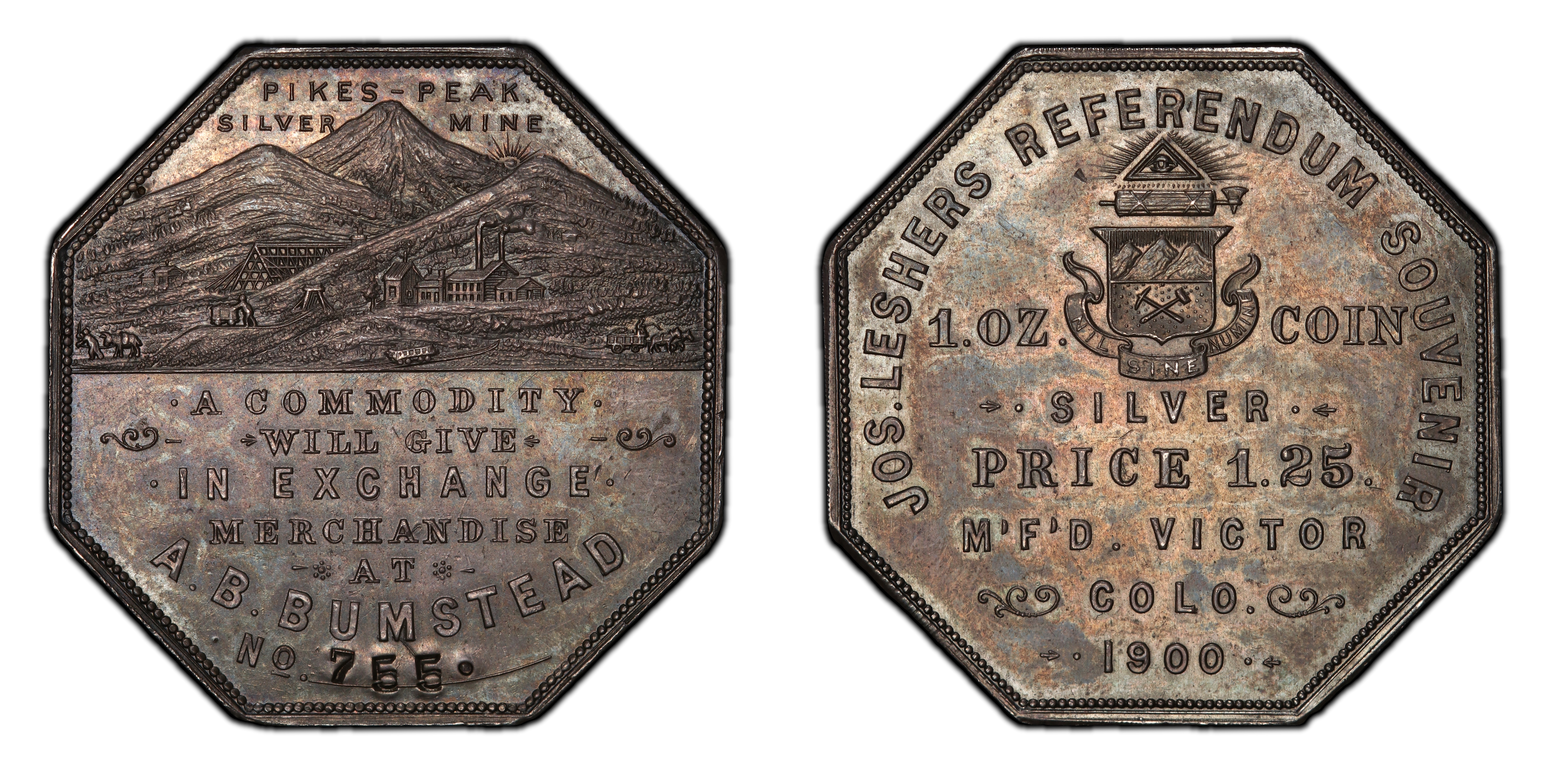
Obverse & Reverse
The Lesher Referendum Dollars are a tangible artifact of the fiery 'Free Silver' debate that defined late 19th-century American politics. In the wake of the 'Crime of '73,' which demonetized silver, and the subsequent political defeats of silver champion William Jennings Bryan in 1896 and 1900, sentiment in mining states like Colorado remained intensely pro-silver. Joseph Lesher, a silver mine owner and real estate investor in the booming Cripple Creek mining district, was a fervent believer in the cause. He conceived a plan to prove the public's willingness to accept silver as a medium of exchange at a value far exceeding its depressed market price. On November 13, 1900, he began issuing his own octagonal silver 'coins.' To circumvent federal laws against private coinage, Lesher meticulously labeled his creations 'Referendum Souvenirs,' arguing they were not legal tender but were instead 'referred' to the people for voluntary acceptance or rejection. He guaranteed redemption in U.S. currency, merchandise, or services. The initial batch was distributed by Lesher himself, but this proved impractical. He soon partnered with A.B. Bumstead, a prominent local grocer in Victor, who agreed to accept and distribute the pieces. The HK-789 variety represents the second type distributed by Bumstead. The dies for the first reverse (HK-788) apparently broke during production, and a new reverse die was hastily prepared by Denver die-sinker Herman Otto. This new die (used for HK-789) is distinguished by the absence of scrolls flanking the state seal and the lack of a line above 'COLO.' The pieces were struck in Denver from silver that was .950 fine, alloyed with copper, and each contained a full troy ounce of silver. Lesher priced them at $1.25, despite the silver bullion value being only about 65 cents an ounce at the time. The project was a localized success, with hundreds circulating in the Cripple Creek district, but it never achieved Lesher's grand vision and ceased by 1901. The Secret Service investigated Lesher's activities but ultimately did not prosecute, as the pieces were sufficiently different from official U.S. coinage. Today, these 'dollars' are prized numismatic treasures, representing a unique intersection of economic theory, political protest, and private enterprise.
Associated EventFree Silver Movement
Reason For MintingTo prove the public's willingness to accept silver coinage at a value above its market price and to promote the use of silver during a period of its political demonetization.
Minter HistoryJoseph W. Lesher (1838-1918) was a Civil War veteran from Ohio who moved to Colorado and became deeply involved in the silver mining industry. He worked in various mining camps before settling in Victor, where he became a mine owner and real estate investor. A passionate advocate for the free coinage of silver, he was frustrated by the nation's adherence to the gold standard. His 'Referendum Dollar' experiment was a personal crusade to demonstrate his economic principles. He patented his octagonal design on April 16, 1901, to prevent counterfeiting of his privately guaranteed tokens. While his coinage experiment was short-lived, his legacy is immortalized in these unique and historically significant pieces.
Historical SignificanceThe Lesher Dollars are one of the most famous and historically important so-called dollars, acting as a form of private scrip and a powerful political statement during the decline of the Free Silver Movement. They represent a final, tangible protest against the gold standard and a bold experiment in private, commodity-backed currency.
HK-789
Denomination$1.25 (Face Value)
Minting Period1900
Assayer/MinterJoseph Lesher (issuer); A.B. Bumstead (distributor)
Geographic OriginVictor, Colorado
Obverse DescriptionAn intricate scene depicting the Pike's Peak mining district, with mine buildings, ore carts on tracks, and mountains in the background. The central vignette is surrounded by legends.
Obverse InscriptionJOS. LESHERS. REFERENDUM. SOUVENIR / PIKES PEAK / SILVER MINE / (mining scene) / 1.OZ.COIN. / SILVER / PRICE 1.25. / M'F'D. VICTOR, COLO. / 1900
Reverse DescriptionThe central device is a shield containing the inscription, surmounted by a space for the serial number. The name of the distributor, A.B. BUMSTEAD, is prominently stamped across the center.
Reverse InscriptionA COMMODITY. / WILL GIVE IN EXCHANGE / MERCHANDISE AT / A.B. BUMSTEAD / NO. [Hand-stamped serial number]
CompositionSilver, alloyed with Copper
Stated Fineness0.95
Actual FinenessApproximately 0.950
Weight31.10 grams
Diameter35.00 mm
EdgePlain
Approximately 500 struck. It is believed about 1,000 total Bumstead pieces (Types 1 & 2) were made.
Survival EstimateApproximately 150-175 known examples.
Rarity ScaleR-5 (Very Scarce)
Sought for its unique octagonal shape, direct connection to the Free Silver movement, status as a classic Territorial-era issue, and the romance of the Cripple Creek mining district. Each piece is unique due to its hand-stamped serial number.
Key VarietiesThe primary variety is the HK-788, the 'Type 1' reverse, which features prominent scrolls flanking the Colorado state seal and a line above 'COLO.' The HK-789 is the 'Type 2' reverse, lacking these scrolls and the line. A small number of un-numbered trial pieces (HK-789a) are known and are extremely rare. No later restrikes or Proof issues were ever produced.
Authentication TipsAuthentic examples have a distinct 'feel' and ring. The serial numbers are a key diagnostic; they were hand-punched, resulting in numerals of varying depth, spacing, and alignment. Be wary of pieces with perfectly aligned, machine-engraved numbers. Cast counterfeits will have a porous, soapy surface and weak details, particularly in the fine lines of the mining vignette. Check the weight and dimensions carefully.
Shopping ConsiderationsA premium quality example for its grade will possess an even, well-balanced strike; many show some weakness in the center of the mining scene or on the reverse legends. Original, undisturbed surfaces with attractive 'old silver' toning command significant premiums. Avoid examples that have been harshly cleaned, polished, or show evidence of tooling or repairs, especially around the serial number. The quality and boldness of the hand-stamped serial number can also affect eye appeal and value.
A coin's grade is its condition, rated on a 1-70 scale. For rare coins, this is the most critical factor in determining value, as a tiny difference in preservation can mean a huge difference in price.
Relevant Grade TypesAll original Lesher Dollars were business strikes intended for local commerce and are found in Circulated (1-58) and Mint State (MS, 60-70) grades. No Proof (PR/PF) examples were struck during the original period of issue, and no later presentation or restrike Proofs are known to exist. Any piece described as a 'Proof' should be regarded with extreme skepticism.
Mint State CharacteristicsUncirculated examples typically exhibit a soft, satiny luster rather than a hard, brilliant one. Due to the private nature of the striking process, the quality can be inconsistent. Weakness on the highest points of the mountains and the mine buildings on the obverse is common. Small, scattered contact marks are expected due to the large size and soft metal, but large, distracting gouges will limit the grade. Original, uncleaned surfaces are paramount.
Circulated Wear PatternsWear first appears on the highest points of the obverse: the roofs of the mine buildings and the central mountain peak. On the reverse, friction will first be evident on the flat fields and the edges of the A.B. BUMSTEAD counterstamp. In lower grades (VG and below), the finer details of the mining scene will merge, and the peripheral inscriptions will begin to weaken.
Key Factors For ValueValue is primarily driven by grade (condition). However, for this series, eye appeal is crucial. An example with original, attractive gray and golden toning will be worth significantly more than a bright white, dipped-out coin of the same grade. A sharp, well-executed strike is highly desirable. Finally, the specific serial number is not a major value factor unless it is a particularly low number (e.g., under 100) or a special-order number, though documentation for the latter is scarce. A CAC sticker confirming quality for the grade adds a strong premium.
PCGS Price Guide
| Grade | Price | Population |
|---|---|---|
| 15 | $2,100.00 | 2 |
| 20 | $2,250.00 | N/A |
| 25 | $2,350.00 | N/A |
| 30 | $2,500.00 | 1 |
| 35 | $2,600.00 | 2 |
| 40 | $2,700.00 | 2 |
| 45 | $2,850.00 | 5 |
| 45+ | $3,000.00 | N/A |
| 50 | $3,150.00 | 5 |
| 50+ | $3,250.00 | N/A |
| 53 | $3,350.00 | 9 |
| 53+ | $3,500.00 | N/A |
| 55 | $3,750.00 | 11 |
| 55+ | $4,000.00 | N/A |
| 58 | $4,250.00 | 10 |
| 58+ | $4,500.00 | N/A |
| 60 | $4,750.00 | N/A |
| 61 | $5,250.00 | 2 |
| 62 | $5,750.00 | 6 |
| 62+ | $6,250.00 | N/A |
| 63 | $7,500.00 | 9 |
| 63+ | $9,250.00 | N/A |
| 64 | $12,000.00 | 4 |