1900 Lesher $ HK-790 Bank Type (Regular Strike)
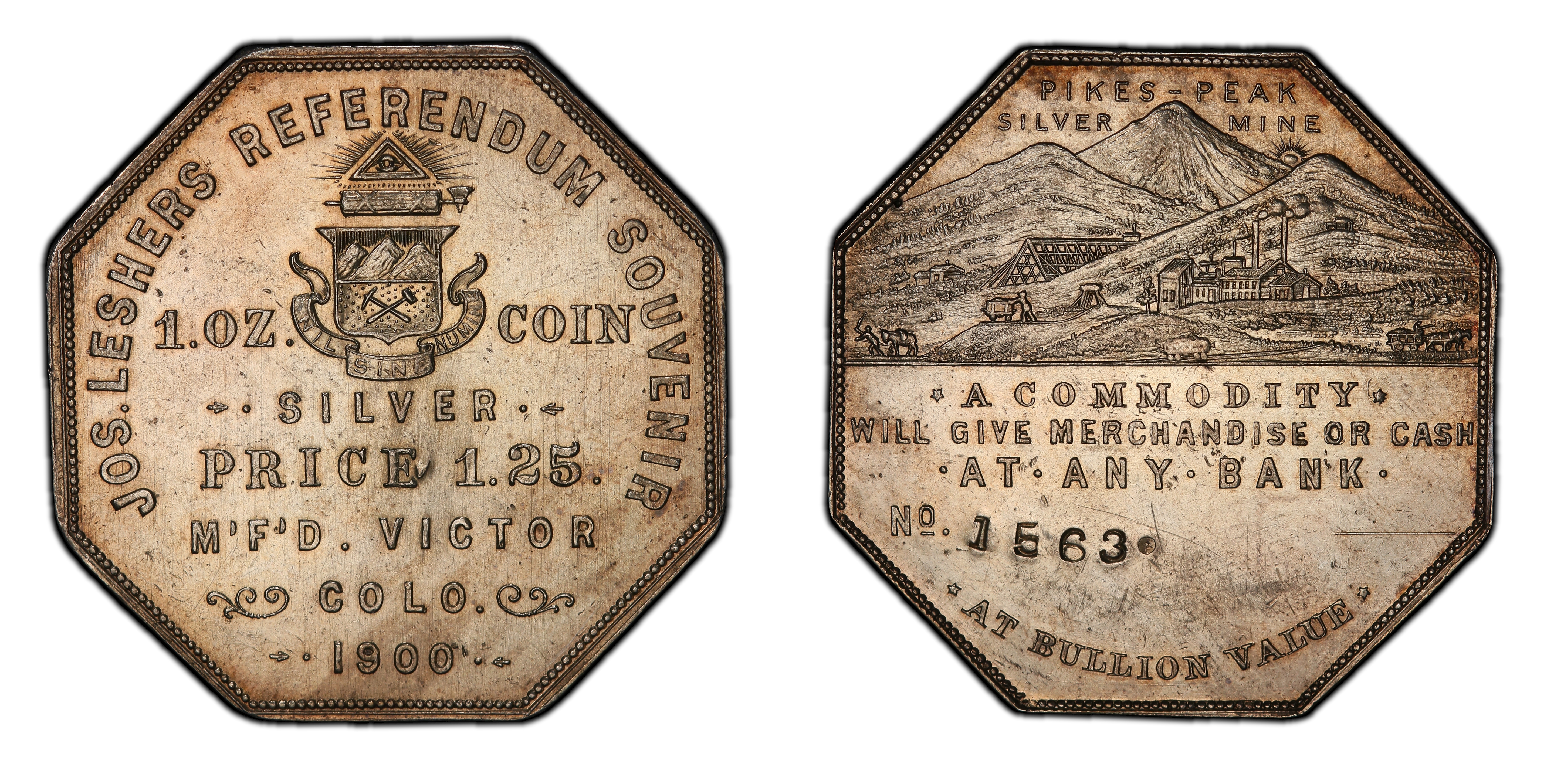
Obverse & Reverse
The 1900 Lesher 'Bank Type' Referendum Dollar represents a fascinating and extremely rare chapter in the story of America's 'Free Silver' movement. At the turn of the 20th century, Colorado's economy was reeling from the repeal of the Sherman Silver Purchase Act and the subsequent 'Panic of 1893,' which demonetized silver and caused its market price to collapse. This devastated mining towns and left a lingering distrust of the gold standard. In the heart of the Cripple Creek Mining District, a silver mine owner and passionate silver advocate named Joseph Lesher devised a bold plan. A Civil War veteran who had moved to Colorado and prospered in mining and real estate, Lesher believed the intrinsic value of silver was far greater than its market price and sought to prove that a silver-backed currency could thrive if the people simply had faith in it. His solution was the 'Referendum Dollar,' so-named because it was 'referred' to the people for acceptance, not mandated by any government. To circumvent federal laws against private coinage, Lesher consulted with attorneys and designed his pieces to be octagonal, a shape distinct from any official U.S. currency. He also carefully labeled them 'Souvenir Medals.' Struck by a private firm in Denver with dies created by Herman Otto, the 1900 issues contained one troy ounce of .950 fine silver, significantly more than a Morgan Dollar, and bore a face value of $1.25, which Lesher pledged to redeem in U.S. currency. The HK-790 'Bank Type' was a pivotal but ultimately failed experiment within this series. Following the successful local circulation of his initial types through merchants like grocer A.B. Bumstead, Lesher conceived a grander vision: a piece that could be redeemed for cash at any bank. This would have given his private issues unparalleled legitimacy and utility. The reverse die was altered to state the commodity would be exchanged for 'MERCHANDISE OR CASH / • AT • ANY • BANK •'. This bold declaration, however, stepped too close to the prerogatives of the federal government. It is believed that upon realizing the immense legal risk and potential for intervention by the Secret Service, Lesher quickly abandoned the plan. The 'Bank' punch was discarded, and only a handful of pieces—estimated at perhaps six to ten—were ever struck, likely as die trials to test the concept. These few survivors are the only tangible evidence of Lesher's most ambitious plan, a testament to a private citizen's audacious attempt to create a regional, silver-based currency system in defiance of the gold standard.
Associated EventFree Silver Movement / Colorado Silver Crisis
Reason For MintingTo create a privately issued, locally accepted silver currency to promote the use of silver and combat its low market price following the Panic of 1893.
Minter HistoryJoseph Lesher (1838-1918) was an Ohio native who served in the Union Army during the Civil War before moving to Colorado. He became deeply involved in the state's mining industry, working his way up from a miner to a mine owner and real estate investor in camps like Leadville and Central City before settling in Victor. A staunch proponent of bimetallism and the 'Free Silver' cause, he was personally and financially motivated to increase the metal's circulation. Frustrated by the political defeats of William Jennings Bryan and the continued dominance of the gold standard, he launched his private minting experiment in 1900. His venture was short-lived, ending in 1901, but his octagonal 'dollars' became a lasting and iconic numismatic legacy of the era.
Historical SignificanceThe Lesher Dollars are tangible artifacts of the populist 'Free Silver' movement. The HK-790 'Bank Type' is particularly significant as it represents the zenith of Lesher's ambition and the legal boundary he dared to approach. Its extreme rarity underscores the swift abandonment of the plan, highlighting the immense legal and practical challenges faced by private minters in the United States.
HK-790 (Hibler-Kappen), Z-4 (Zerbe)
Denomination$1.25 (Stated Face Value)
Minting Period1900
Assayer/MinterJoseph Lesher
Geographic OriginVictor, Colorado
Obverse DescriptionA detailed mining scene of the Pikes Peak area, showing mine buildings, smokestacks, and rolling hills. The inscription 'PIKES • PEAK • SILVER • MINE' is above. Below the scene, text is arranged in several lines.
Obverse InscriptionPIKES • PEAK • SILVER • MINE / A COMMODITY / WILL GIVE / MERCHANDISE OR CASH / • AT • ANY • BANK • / NO. [Hand-punched serial number]
Reverse DescriptionThe central device is the Colorado State Seal with mountain peaks behind it. Text surrounds the seal, indicating the issuer, series, composition, and date.
Reverse InscriptionJOS • LESHERS • REFERENDUM • SILVER • SOUVENIR • MEDAL • / ONE OZ. COIN / SILVER / PRICE / $1.25 / VICTOR, / COLO. / 1900
CompositionSilver, alloyed with Copper
Stated Fineness0.95
Actual Fineness0.95
Weight31.10 grams
Diameter35.00 mm
EdgePlain
Approximately 6 to 10 pieces struck as die trials.
Survival EstimateFewer than 10 known.
Rarity ScaleR-7 (4-12 known)
This is one of the great rarities in the So-Called Dollar series. Its appeal stems from its direct connection to the Free Silver movement, its unique octagonal shape, its status as a private issue, and its extreme rarity as a trial piece for a concept deemed too legally risky to pursue.
Key VarietiesThe primary variety is HK-790a, which is identical but lacks a serial number. This specific 'Bank Type' is a key variety within the broader Lesher series, which includes types issued with the names of various merchants (A.B. Bumstead, J.M. Slusher, etc.) who agreed to accept them. No later-date restrikes or special collector issues are known to exist.
Authentication TipsAuthentic examples exhibit a sharp strike from high-quality dies. The lettering should be crisp and well-defined. The hand-punched serial numbers have a characteristic irregularity in alignment and depth that is difficult for forgers to replicate. Counterfeits may appear cast, with soft details, porous surfaces, or exhibit incorrect weight. The unique 'AT • ANY • BANK •' legend should be carefully examined for tooling or alteration from a more common type, though this is unlikely given the piece's rarity.
Shopping ConsiderationsFor a specimen of this rarity, any example offered is a major event. A 'premium quality' piece would be one that is well-struck, particularly on the fine details of the mining scene and the state seal. Look for original, undisturbed surfaces with attractive grey or golden-brown toning. Marks and scratches are to be expected, but severe impairments like harsh cleaning, edge dings, or tooling would significantly detract from the value. Given the hand-punched nature, the clarity and boldness of the serial number can also be a factor in eye appeal.
A coin's grade is its condition, rated on a 1-70 scale. For rare coins, this is the most critical factor in determining value, as a tiny difference in preservation can mean a huge difference in price.
Relevant Grade TypesOriginal period issues were business strikes intended for local circulation and are found in Circulated (1-58) and Mint State (MS, 60-70) grades. However, as the HK-790 were likely die trials that never circulated, most known examples are found in high grades, from About Uncirculated (AU) to Mint State (MS). No Proof (PR/PF) examples were struck during the original period of issue, and no later restrikes are known.
Mint State CharacteristicsUncirculated examples of Lesher Dollars typically exhibit a soft, satiny luster rather than a hard, frosty one. The strike can be uneven; a sharp strike on the central mining scene and the fine details of the state seal is highly desirable but not always present. Due to the large size and handling, even Mint State examples may show minor contact marks or 'bag marks.' Original, uncleaned surfaces are paramount.
Circulated Wear PatternsAlthough most known examples are high grade, were a circulated piece to exist, wear would first appear on the highest points of the design. On the obverse, this includes the roofs and smokestacks of the mining buildings. On the reverse, wear would be evident on the shield and Phrygian cap within the state seal, and on the surrounding letters of the inscription.
Key Factors For ValueRarity is the dominant factor for the HK-790. Beyond its mere existence, value is driven by surface preservation and eye appeal. An example with minimal contact marks, original toning, and no evidence of cleaning or alteration will command a significant premium. A sharp, well-centered strike adds to the desirability. The presence of a CAC sticker, indicating premium quality for the assigned grade, would be a major value driver for a piece of this caliber.
PCGS Price Guide
| Grade | Price | Population |
|---|---|---|
| 30 | N/A | N/A |
| 35 | $23,500.00 | 1 |
| 40 | $26,500.00 | N/A |
| 45 | $30,000.00 | 2 |
| 45+ | $32,500.00 | N/A |
| 50 | $35,000.00 | N/A |
| 50+ | $37,500.00 | N/A |
| 53 | $40,000.00 | N/A |
| 53+ | $42,500.00 | N/A |
| 55 | $47,500.00 | 1 |
| 55+ | $50,000.00 | N/A |
| 58 | $55,000.00 | N/A |
| 58+ | $60,000.00 | N/A |
| 60 | $65,000.00 | N/A |
| 61 | $70,000.00 | N/A |
| 62 | $80,000.00 | 1 |