(1961) CSA 1C Bashlow Restrike, Bronze, RB (Regular Strike)
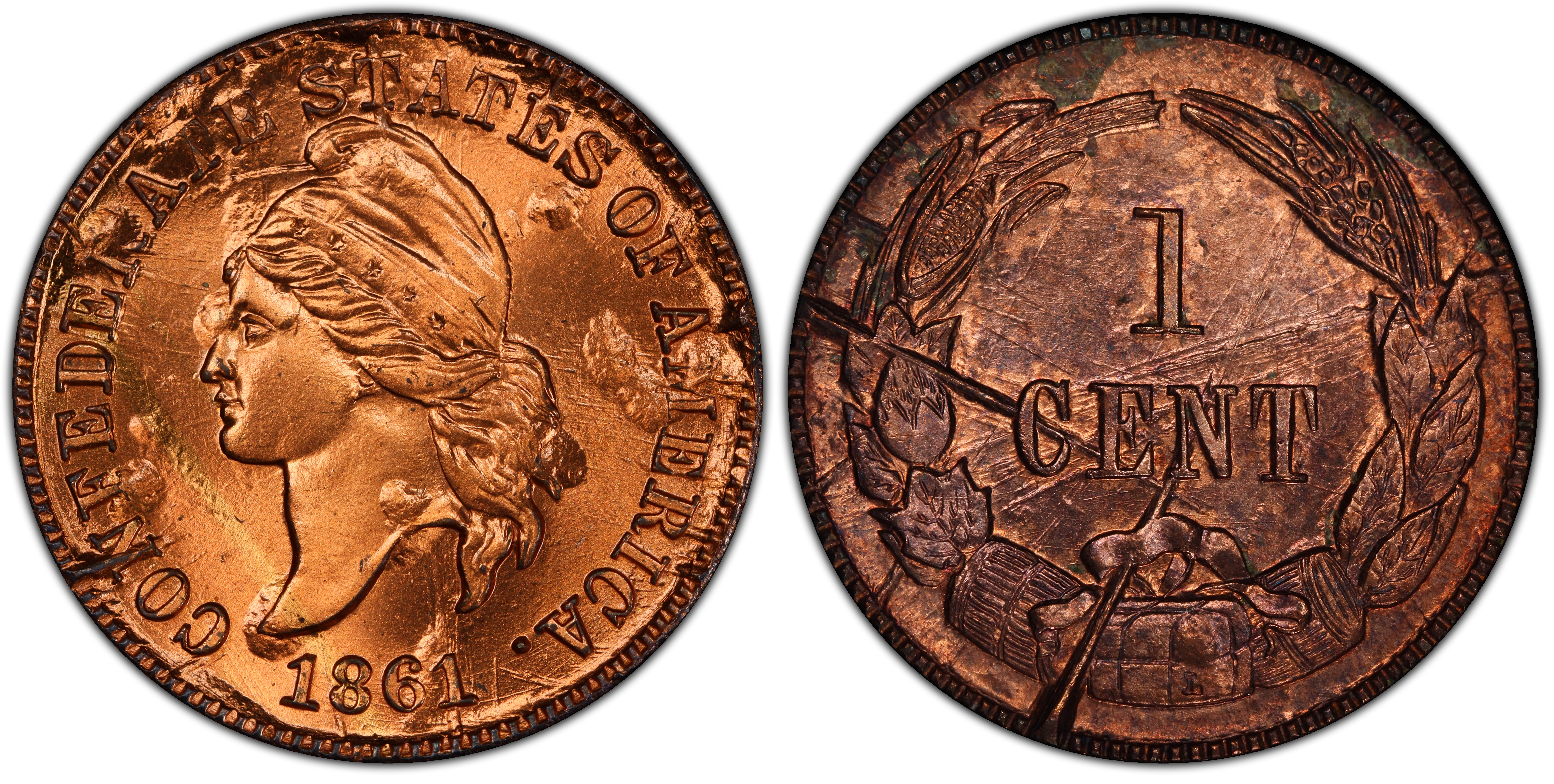
Obverse & Reverse
The story of the 1961 Bashlow Restrike is inextricably linked to one of the greatest 'what-ifs' of American numismatics: the original 1861 Confederate Cent. In the charged atmosphere just before the outbreak of the Civil War, agents of the fledgling Confederacy commissioned Robert Lovett, Jr., a talented die-sinker in Philadelphia, to design and produce a cent coinage. Lovett created a classic 'French Liberty Head' design for the obverse and a wreath of Southern agricultural staples—cotton, corn, tobacco, and wheat—for the reverse. He reportedly struck a dozen or so specimens in copper-nickel, the standard alloy for U.S. cents at the time. However, as war became a reality, Lovett grew fearful of being charged with treason for aiding the enemy. He ceased his work, hiding the coins and the dies in his cellar, and the project was abandoned. The existence of the Confederate Cent remained unknown until 1873 when Lovett accidentally spent one of his originals. The coin was recognized by a collector, and the story came to light. The dies were eventually purchased by Captain John W. Haseltine, who produced a small number of restrikes (the 'First Restrikes') in gold, silver, and copper in 1874 before the dies were defaced to prevent further unauthorized coining. The dies, now rusted and bearing cancellation marks, faded into obscurity for decades. They resurfaced in 1961, when they were acquired by the enterprising New York coin dealer and promoter, Robert Bashlow. Recognizing the immense historical appeal of the Confederate cent and capitalizing on the Civil War Centennial, Bashlow arranged to have new dies created from the originals. This was accomplished through a transfer process at the August C. Frank Co. in Philadelphia, which faithfully copied not only Lovett's original design but also all the subsequent damage—the rust pits, die cracks, and chisel marks. These new dies were used to strike what are known as the Bashlow Restrikes or 'Second Restrikes.' To avoid any potential issues with the Secret Service for creating coins that could be mistaken for originals, the vast majority of Bashlow's restrikes were struck on planchets approximately double the thickness of a standard cent. He launched an aggressive marketing campaign, and struck the pieces in a variety of metals to appeal to a wide range of collectors. The most common of these were the 20,000 pieces struck in bronze. These restrikes are not Confederate coins, but rather historical tokens that carry the full story of Lovett's fear, Haseltine's opportunism, and Bashlow's promotional savvy, making a once-great rarity accessible to the collecting public.
Associated EventAmerican Civil War Centennial (1961-1965)
Reason For MintingTo create a collectible, historically significant token for the Civil War Centennial by reviving the design of the legendary 1861 Confederate Cent.
Minter HistoryRobert Bashlow was a prominent New York coin dealer and numismatic promoter active in the mid-20th century. Known for his entrepreneurial and sometimes eccentric ventures, he had a keen eye for historical rarities that could be marketed to a broad audience. His most famous project was the restriking of the Confederate Cent and the Confederate Half Dollar reverse design in 1961-1962. He acquired the original, albeit defaced, dies for the cent and commissioned transfer dies to produce tens of thousands of restrikes in various metals. This project made the iconic design available to collectors who could never hope to own an original. After the restrike project was completed, Bashlow donated the historic original dies to the Smithsonian Institution, where they reside today.
Historical SignificanceThe Bashlow restrikes democratized one of the most famous and unobtainable rarities in U.S. numismatics. They serve as a tangible link to the original 1861 Confederate Cent and its fascinating history, encapsulating not only the story of the Confederacy's coinage aspirations but also the subsequent life of the dies themselves. For most collectors, the Bashlow restrike is the only way to own a piece bearing the authentic, albeit transferred, design of Robert Lovett's masterpiece.
N/A
Denomination1 Cent
Minting Period1961-1962
Assayer/MinterRobert Bashlow
Geographic OriginPhiladelphia, Pennsylvania
Obverse DescriptionA left-facing bust of Liberty wearing a Phrygian cap, often referred to as a 'French Liberty Head.' The design is surrounded by the inscription. The surfaces exhibit numerous raised lumps and artifacts, which are transfers from the rusted and damaged original dies.
Obverse InscriptionCONFEDERATE STATES OF AMERICA / 1861
Reverse DescriptionAn agricultural wreath composed of stalks of corn, sheaves of wheat, sprigs of tobacco, and strands of cotton. At the bottom center is a bale of cotton, upon which Robert Lovett's initial 'L' can be faintly seen. Within the wreath is the denomination '1 CENT.' The fields show evidence of the cancellation marks (chisel cuts) from the defaced original reverse die.
Reverse Inscription1 CENT
CompositionBronze
Stated Fineness Actual Fineness Diameter19.00 mm
EdgePlain
20,000
Survival Estimate10,000-15,000
Rarity ScaleCommon
This token is highly popular as an affordable and historically rich substitute for the prohibitively rare original 1861 Confederate Cent. It appeals to Civil War enthusiasts, collectors of exonumia, and those who appreciate the multi-layered story of the dies from their creation to their eventual resting place in the Smithsonian.
Key VarietiesThe Bashlow restrikes were issued in several metals. The standard issues include: - **Bronze:** The most common variety with a mintage of 20,000. - **Goldine:** A brassy alloy with a mintage of 5,000. - **Silver:** Struck with a mintage of 5,000. - **Platinum:** Extremely rare, with a reported mintage of only 3. Additionally, Bashlow produced a number of trial pieces and other special issues, including approximately 50 each in tin, lead, zinc, aluminum, and nickel-silver. Uniface strikes are also known, as are impressions of the dies side-by-side on heavy bronze ingots, often called 'paperweights'.
Authentication TipsAuthenticity is rarely an issue due to their commonality. Key diagnostics are the prominent, raised imperfections transferred from the damaged dies. Look for the distinctive pattern of rust pits on the obverse, particularly around Liberty's face and the letters. The reverse should show clear evidence of the chisel marks used to deface the original die. Most importantly, authentic Bashlow restrikes are typically very thick, roughly twice the thickness of a standard U.S. cent, a deliberate feature to distinguish them from the originals.
Shopping ConsiderationsA premium quality example will be a fully-struck, high-grade Mint State piece. Look for coins designated 'RD' (Red) by grading services, indicating they retain their original bright copper luster. Since all examples carry the die damage, this is not a detriment. Instead, focus on finding a specimen free from post-strike damage like scratches, rim bumps, or spotting. Eye appeal is paramount. A coin with vibrant, unimpaired red or red-brown (RB) surfaces is far more desirable than a dull or stained brown (BN) example. Sharpness of the strike should be consistent, showing all the fine details of the wreath and Liberty's hair, alongside the transferred die artifacts.
A coin's grade is its condition, rated on a 1-70 scale. For rare coins, this is the most critical factor in determining value, as a tiny difference in preservation can mean a huge difference in price.
Relevant Grade TypesAll original period Bashlow restrikes were business strikes (MS) sold directly to collectors and were never intended to circulate. Therefore, they are typically found in Mint State (MS, 60-70) grades. It is highly unusual to find a circulated example. No Proof (PR/PF) versions of the standard bronze restrike were made. The grading designation (RD for Red, RB for Red-Brown, BN for Brown) is a critical component of the grade for bronze coins, with RD coins commanding the highest premiums.
Mint State CharacteristicsIn uncirculated grades, quality is determined by surface preservation and color. A top-tier example will exhibit brilliant, frosty or satiny mint luster with its original red copper color. Because they were mass-produced for the collector market, contact marks from handling and storage can be common. The strike should be sharp, but the defining characteristics are the crisply defined lumps and lines from the damaged dies, which should not be mistaken for post-strike damage. A premium MS coin has minimal distracting marks and vibrant, original color.
Circulated Wear PatternsAs these tokens were not made for circulation, wear is almost never encountered. If a hypothetical circulated example existed, wear would first appear on the high points: Liberty's cheek, cap, and hair on the obverse, and the upper leaves of the wreath and the cotton bale on the reverse. Any such wear would drastically reduce its value, as the piece's appeal lies in its uncirculated state.
Key Factors For ValueThe primary drivers of value for a Bashlow restrike are grade and surface color. A Gem MS-65 or higher example is significantly more valuable than one in lower Mint State grades. The color designation is crucial: a fully Red (RD) coin is worth substantially more than a Red-Brown (RB) or Brown (BN) coin of the same numerical grade. Surface quality is key; seek out examples with clean, mark-free fields and strong eye appeal. A CAC sticker will add a premium, confirming that the coin is of high quality for its assigned grade.
PCGS Price Guide
| Grade | Price | Population |
|---|---|---|
| 64 | N/A | 2 |
| 66 | N/A | 2 |
| 68 | N/A | N/A |