(1961) CSA 1C Bashlow Restrike, Bronze, RD (Regular Strike)
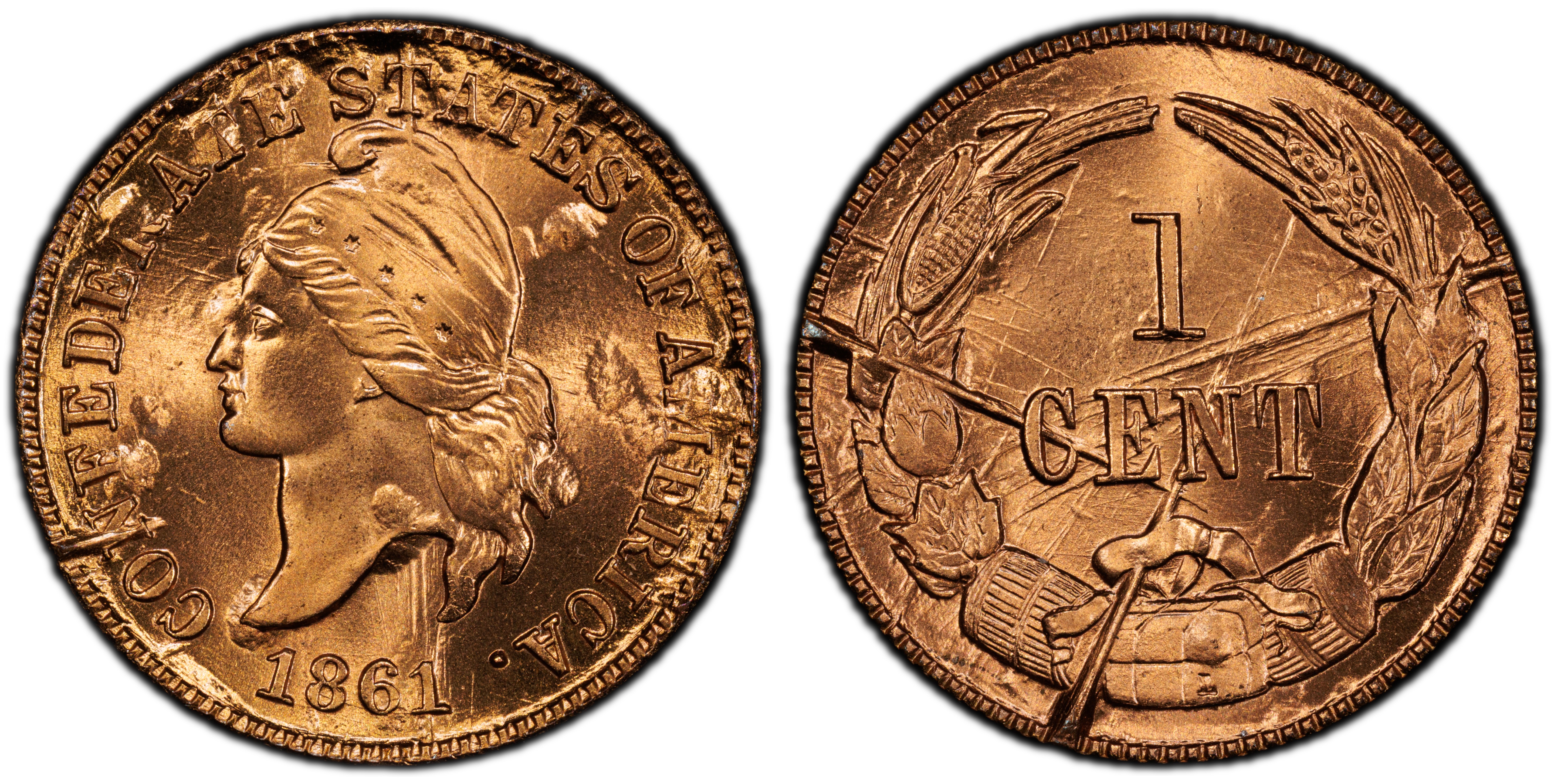
Obverse & Reverse
The story of the Bashlow Restrike is inextricably linked to one of the greatest mysteries of the Civil War: the original 1861 Confederate Cent. In early 1861, just as the Confederacy was forming, agents are believed to have commissioned Robert Lovett Jr., a talented die sinker in Philadelphia, to design and produce a cent coinage. Lovett created a beautiful and now-iconic design featuring a Liberty cap portrait (often called 'French Liberty') and a reverse wreath of distinctly Southern agricultural products. However, as the political climate intensified and war became imminent, Lovett grew fearful of being charged with treason for aiding the enemy. He allegedly struck only a dozen or so pieces in copper-nickel before hiding the dies and the coins in his cellar. For over a decade, their existence was unknown to the numismatic world. The secret was revealed in 1873 when Lovett reportedly spent one of his originals at a Philadelphia tavern. The unusual piece was noticed and soon came to the attention of prominent coin dealer John W. Haseltine. Haseltine tracked down Lovett and purchased the remaining originals and, crucially, the dies themselves. In 1874, Haseltine produced a small number of 'First Restrikes' in gold, silver, and copper. Over the subsequent decades, the dies passed through several hands and were eventually defaced with chisel marks and suffered from rust and cracking. Their story went quiet until 1961, when New York coin dealer and entrepreneur Robert Bashlow acquired the historic, albeit damaged, dies. Recognizing the immense interest in the Civil War surrounding its centennial, Bashlow saw a commercial and historical opportunity. He commissioned the August C. Frank Company in Philadelphia to create new transfer dies from Lovett's originals. This process faithfully copied every detail, including all the rust pits, cracks, and cancellation marks, forever locking the dies' late-state history into the new strikings. From these transfer dies, Bashlow produced what are known as the 'Second Restrikes,' striking them in large quantities for collectors. The most common of these, with a mintage of 20,000, was the bronze version. Struck on thick planchets to prevent them from being mistaken for the originals, these pieces became an instant collectible, allowing thousands of enthusiasts to own a tangible piece of Confederate numismatic history.
Associated EventAmerican Civil War Centennial
Reason For MintingTo create a widely available collectible for the Civil War Centennial by using the historic, original (but defaced) dies of the 1861 Confederate Cent.
Minter HistoryRobert Socrates Bashlow (1930-1979) was a New York coin dealer, publisher, and numismatic promoter known for his flamboyant marketing and significant contributions to the hobby. He is most famous for his restriking of the Confederate Cent and the Confederate Half Dollar. After acquiring the defaced original dies of the Confederate Cent, he had transfer dies made and struck thousands of pieces in various metals in the early 1960s to coincide with the Civil War Centennial. He later donated the original Lovett dies to the Smithsonian Institution in 1962, ensuring their preservation.
Historical SignificanceThe Bashlow Restrike is significant not as a coin of the Confederacy, but as a popular and accessible numismatic collectible that tells the story of the original 1861 Confederate Cent. It preserves the famous Lovett design and, because it was struck from transfer dies of the damaged originals, serves as a direct physical link to a mysterious and legendary Civil War-era pattern. For most collectors, it is the only way to own a representation of this historic issue.
N/A
DenominationOne Cent
Minting Period1961-1962
Assayer/MinterRobert Bashlow
Geographic OriginPhiladelphia, Pennsylvania
Obverse DescriptionA bust of Liberty facing left, wearing a Phrygian cap (Liberty cap). The cap is tied with a ribbon, with flowing hair below. The portrait is surrounded by the inscription, with the date below.
Obverse InscriptionCONFEDERATE STATES OF AMERICA 1861
Reverse DescriptionThe denomination '1 CENT' is centered within a wreath composed of Southern agricultural products. The wreath includes cotton, corn, tobacco, and maple. At the bottom, a cotton bale is flanked by two barrels. The initial 'L' for the designer, Robert Lovett Jr., is visible on the cotton bale.
Reverse Inscription1 CENT
CompositionBronze
Stated Fineness Actual Fineness EdgePlain
20,000
Survival EstimateMost of the mintage is believed to survive, likely 15,000-20,000.
Rarity ScaleCommon (within the context of specialized collectibles)
This piece offers an affordable way to own the famous Confederate Cent design, struck from dies directly descended from the 1861 originals. Its connection to Civil War history and its distinctive appearance, including the die damage, make it a popular collectible.
Key VarietiesThe primary issue is the business strike in bronze. Bashlow also produced several other versions as part of this project, which are collected alongside the bronze pieces: - Silver Restrike: 5,000 struck. - Goldine (brass alloy) Restrike: 5,000 struck. - Proof Restrikes: A small number of proof strikings were made in various metals. - Trial Pieces: Very small mintages (reportedly 50 each) were struck in experimental metals such as nickel-silver, lead, zinc, tin, and aluminum, as well as red fiber. These are considerably scarcer. - Gold and Platinum Restrikes: Extremely rare, with only a handful of pieces struck in each metal, primarily for presentation. - Copper 'Paperweights': Bashlow also had the obverse and reverse dies impressed into large copper ingots; these are rare collector's items.
Authentication TipsAuthentication is straightforward as the Bashlow restrikes are defined by the state of the transfer dies. Look for the prominent, raised die artifacts that were transferred from the damaged Lovett originals. Key diagnostics include a series of rust pits and lumps on both sides, a notable die crack on the reverse extending from the rim through the 'N' in CENT, and various chisel/cancellation marks. These 'defects' are the primary sign of authenticity. Modern replicas or fantasy pieces will lack these precise, historically consistent die markers.
Shopping ConsiderationsNearly all examples are found in high Mint State grades (MS-63 or better). A 'premium quality' example is defined primarily by its surface preservation and color. Look for pieces with full, original mint red ('RD') color, which command a significant premium over red-brown ('RB') or brown ('BN') examples. The strike is typically sharp, but luster can vary from frosty to semi-prooflike. Examine the surfaces for distracting contact marks or carbon spots, as the cleanest examples with the best eye appeal are the most desirable. Since the die defects (rust lumps, etc.) are part of the strike, they should not be considered post-mint damage.
A coin's grade is its condition, rated on a 1-70 scale. For rare coins, this is the most critical factor in determining value, as a tiny difference in preservation can mean a huge difference in price.
Relevant Grade TypesAll 1961 Bashlow restrikes were business strikes sold directly to collectors and never intended for circulation. Therefore, they are almost exclusively found and graded as Mint State (MS, 60-70). While a few may have entered circulation and show wear, any circulated example (grades 1-58) would be highly unusual. No proofs were part of the main bronze mintage, although separate, special proof strikings exist and are designated as Proof (PR/PF).
Mint State CharacteristicsIn uncirculated grades, the quality of a Bashlow restrike is judged by factors beyond the inherent die flaws. The luster should be vibrant and unbroken; top-grade examples often exhibit a satiny or even semi-prooflike texture. The color is critical: fully 'Red' (RD) pieces are the most sought after. Surfaces should be free of distracting contact marks, hairlines, or carbon spots. The strike is generally strong, so weakness is not a typical concern. A key part of grading this issue is recognizing that the raised lines and lumps from the defaced dies are part of the coin's character and not considered damage.
Circulated Wear PatternsAs these pieces were made for collectors and did not circulate, wear is almost never encountered. If a piece were to circulate, wear would first appear on the highest points: the cheek and hair of Liberty on the obverse, and the edges of the wreath's leaves and the cotton bale on the reverse. Any circulation would likely dull the mint luster first.
Key Factors For ValueThe primary drivers of value for a Bashlow bronze restrike are the grade and the color designation. An MS-67 RD is worth substantially more than an MS-63 RB. Surface quality is paramount: look for clean, mark-free fields and strong, original luster. Eye appeal is also a key factor; a coin with brilliant, blazing red color will always be prized. Because these are common, collectors often seek the highest possible grades, making Gem (MS-65 and above) examples the market standard. A CAC sticker will add a premium, confirming that the coin is of superior quality for its assigned grade.
PCGS Price Guide
| Grade | Price | Population |
|---|---|---|
| 63 | N/A | N/A |
| 64 | $130.00 | 2 |
| 64+ | $145.00 | N/A |
| 65 | $165.00 | 8 |
| 65+ | $180.00 | N/A |
| 66 | $200.00 | 30 |
| 66+ | $235.00 | N/A |
| 67 | $275.00 | 46 |
| 67+ | $300.00 | N/A |
| 68 | $325.00 | 24 |
| 68+ | $375.00 | N/A |
| 69 | $475.00 | 2 |