(1874) CSA 1C Hasteltine Restrike, Silver, CAM (Proof)
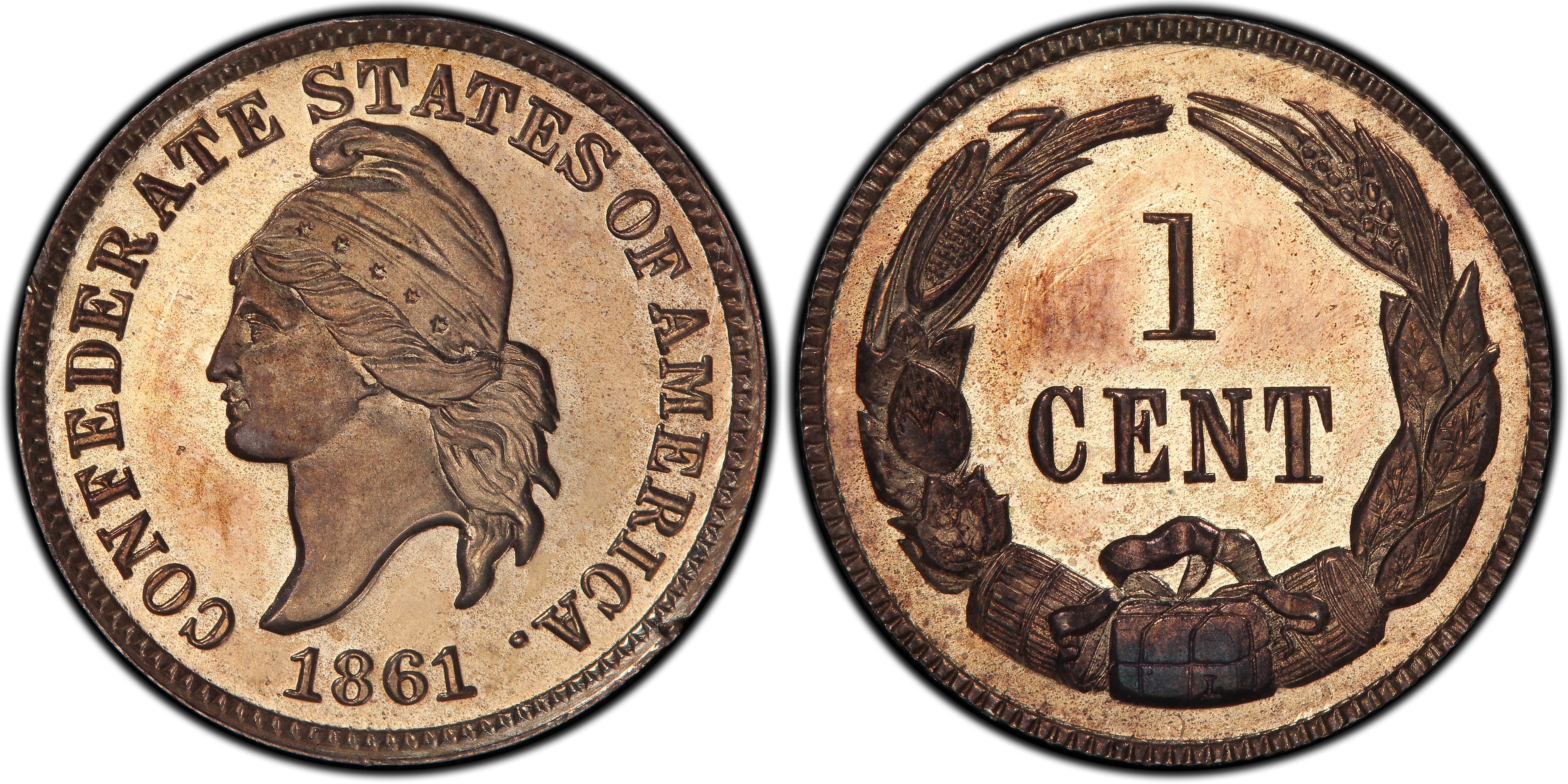
Obverse & Reverse
The 1874 Haseltine Restrike of the Confederate Cent is a numismatic artifact born from a fascinating and clandestine chapter of the Civil War. The story begins in 1861 when agents of the newly formed Confederate States of America sought to establish their own national coinage. They secretly commissioned Robert Lovett, Jr., a talented die sinker and engraver in Philadelphia, to design and produce dies for a one-cent piece. Lovett, likely working through the jewelry firm Bailey, Banks & Biddle, accepted the commission and produced a masterful design: a classical bust of Liberty in a Phrygian cap (often called a 'French Liberty Head') for the obverse, and a rich agricultural wreath of cotton, corn, tobacco, wheat, and maple on the reverse, surrounding the denomination. He struck a small number of pattern cents, perhaps a dozen, in copper-nickel. However, as the Civil War escalated, Lovett grew terrified of being arrested and tried for treason for aiding the Confederacy. Fearing the death penalty, he abruptly halted the project, never delivered the dies or the coins, and concealed them in his basement. For over a decade, the existence of a Confederate cent was unknown to the numismatic community. The secret broke in 1873 when Lovett, by then a frequent patron of a local bar, accidentally spent one of his original copper-nickel cents. The unusual coin was noticed and eventually found its way to Captain John W. Haseltine, a prominent Philadelphia coin dealer and Civil War veteran. A skilled numismatist, Haseltine recognized its significance, tracked down Lovett, and persuaded the still-fearful engraver to sell him the hidden dies and the remaining original specimens. Seeing a commercial opportunity and a chance to share this historic discovery, Haseltine decided to produce a limited number of 'restrikes' for collectors in 1874. To distinguish them from the copper-nickel originals, and to create desirable rarities, he struck them in different metals. The offering included 55 pieces in copper, 7 in gold, and a mere 12 in silver, all struck in Proof format from Lovett's original, undamaged dies. These restrikes are prized not only for their connection to the Confederacy but as a direct product of the original dies, preserving Lovett's elegant design. The dies later passed through other hands and were eventually defaced; later restrikes made by Robert Bashlow in the 1960s are easily distinguished by the prominent cancellation marks, making the pristine Haseltine issues the premier examples of this historic 'what if' coinage.
Associated EventAmerican Civil War
Reason For MintingThis coin was privately struck by a coin dealer from the original 1861 dies to sell to collectors as a numismatic curiosity and historical artifact.
Minter HistoryCaptain John White Haseltine (1838-1925) was a prominent Philadelphia coin dealer, auctioneer, and numismatist in the late 19th and early 20th centuries. A veteran of the Union Army, he possessed a keen sense for historically significant items. After acquiring Robert Lovett, Jr.'s original dies for the 1861 Confederate Cent in 1873, he partnered with J. Colvin Randall and Peter L. Krider to produce and market a small number of restrikes in gold, silver, and copper. His actions preserved the legacy of Lovett's design and created a classic series of American numismatic rarities. Haseltine's catalogs and auction sales are still referenced by historians today.
Historical SignificanceThe Haseltine Restrikes are the first publicly available strikings of the only cent ever designed for the Confederacy. They are a tangible link to the CSA's nascent efforts to create a national identity and are struck directly from the original, secret dies, making them a pivotal part of American numismatic history.
Breen-8007
Denomination1 Cent
Minting Period1874
Assayer/MinterJohn W. Haseltine
Geographic OriginPhiladelphia, Pennsylvania
Obverse DescriptionThe obverse features a left-facing bust of Liberty wearing a Phrygian or Liberty Cap, stylistically similar to contemporary French coinage. The portrait is surrounded by the legend.
Obverse InscriptionCONFEDERATE STATES OF AMERICA
Reverse DescriptionThe reverse features a wreath composed of primary Southern agricultural products: a cotton bale at the bottom center (bearing Lovett's initial 'L'), flanked by two barrels, with stalks of corn, wheat, tobacco, and maple leaves extending upwards. The denomination '1 CENT' is in the center.
Reverse Inscription1 CENT
CompositionSilver
Stated Fineness Actual Fineness Diameter19.00 mm
EdgePlain
12
Survival Estimate10-12
Rarity ScaleR-7 (High)
This issue combines extreme rarity with a legendary backstory tying it directly to the Civil War. As one of only 12 silver examples struck from the original, undamaged Confederate dies, it is a trophy coin for advanced collectors of U.S. patterns, territorial issues, and Civil War-era numismatics.
Key VarietiesThe primary varieties are the original 1861 copper-nickel patterns (approx. 12-16 known). The 1874 Haseltine restrikes are a distinct collector issue and include three metallic variations: Gold (7 struck), Silver (12 struck), and Copper (55 struck). All Haseltine pieces are Proofs. A later series of 'Second Restrikes' was produced by Robert Bashlow in 1961-62 from the now-defaced dies; these are much more common and are easily identified by heavy die rust and cancellation marks (chisel cuts), making them a separate and less valuable collecting category.
Authentication TipsA genuine Haseltine restrike must be struck from perfect dies, showing no evidence of the cancellation marks, heavy rust, or die breaks seen on the later Bashlow issues. The strike should be sharp and in the Proof format. The fields should be reflective, though the level of cameo contrast may vary. As a high-value rarity, it is a frequent target for counterfeiters; authentication and certification by a leading third-party grading service (PCGS or NGC) is essential for any transaction.
Shopping ConsiderationsFor a premium quality example, a buyer should seek a specimen with deeply mirrored fields and significant frosty contrast on the devices, earning the 'CAM' (Cameo) or, ideally, 'DCAM' (Deep Cameo) designation from the grading service. Surface preservation is paramount; look for coins free of distracting marks, hairlines, or evidence of cleaning, which would impair the delicate proof surfaces. The strike should be full and sharp on the high points, such as Liberty's hair and the details of the wreath. Original, untoned silver examples are rare and desirable, but attractive, even toning is also highly prized by many collectors.
A coin's grade is its condition, rated on a 1-70 scale. For rare coins, this is the most critical factor in determining value, as a tiny difference in preservation can mean a huge difference in price.
Relevant Grade TypesAll Haseltine restrikes were specifically struck as Proofs (PR/PF) for collectors and were never intended for circulation. Therefore, they are graded on the 60-70 Proof scale. The 'CAM' (Cameo) and 'DCAM' (Deep Cameo) designations are critical for this issue. They are awarded to coins exhibiting strong to exceptional frosty contrast between the design elements (devices) and the mirrored background (fields). No original business strikes or circulation-strike versions of the Haseltine issues exist.
Mint State CharacteristicsAs a Proof striking, quality is defined by the perfection of its features. A high-grade example will display deeply mirrored, liquid-like fields with no distracting marks or hairlines. The devices (Liberty's portrait, the lettering, and the wreath) should be sharply struck and covered in a thick, frosty texture. The degree of this frost determines the 'Cameo' designation. Early strikes from the dies tend to have the strongest cameo contrast. The planchets used were highly polished, and any imperfections, even minor, are immediately apparent and will limit the grade.
Circulated Wear PatternsThese coins were not made for circulation, and any wear is considered post-mint damage (PMD) from mishandling. On a mishandled proof, friction would first appear as a flattening of the frost and hairlines in the mirrored fields. The highest points of the design—Liberty's hair above the eye and ear, and the high points of the cotton bale and barrels on the reverse—would show rubbing first.
Key Factors For ValueThe single most important factor for value is the coin's certified grade (e.g., PR63, PR64, PR65). A secondary, but nearly as important, factor is the presence and quality of a CAM or DCAM designation, which can multiply the coin's value. Eye appeal is crucial; coins with pristine, mark-free surfaces and strong visual contrast are paramount. Original, uncleaned surfaces are essential. The presence of a CAC sticker, indicating a premium quality coin for its grade, adds a significant premium for this elite issue.
PCGS Price Guide
| Grade | Price | Population |
|---|---|---|
| 64 | N/A | 1 |