1861 1C CSA Restrike-Gold, DCAM (Proof)
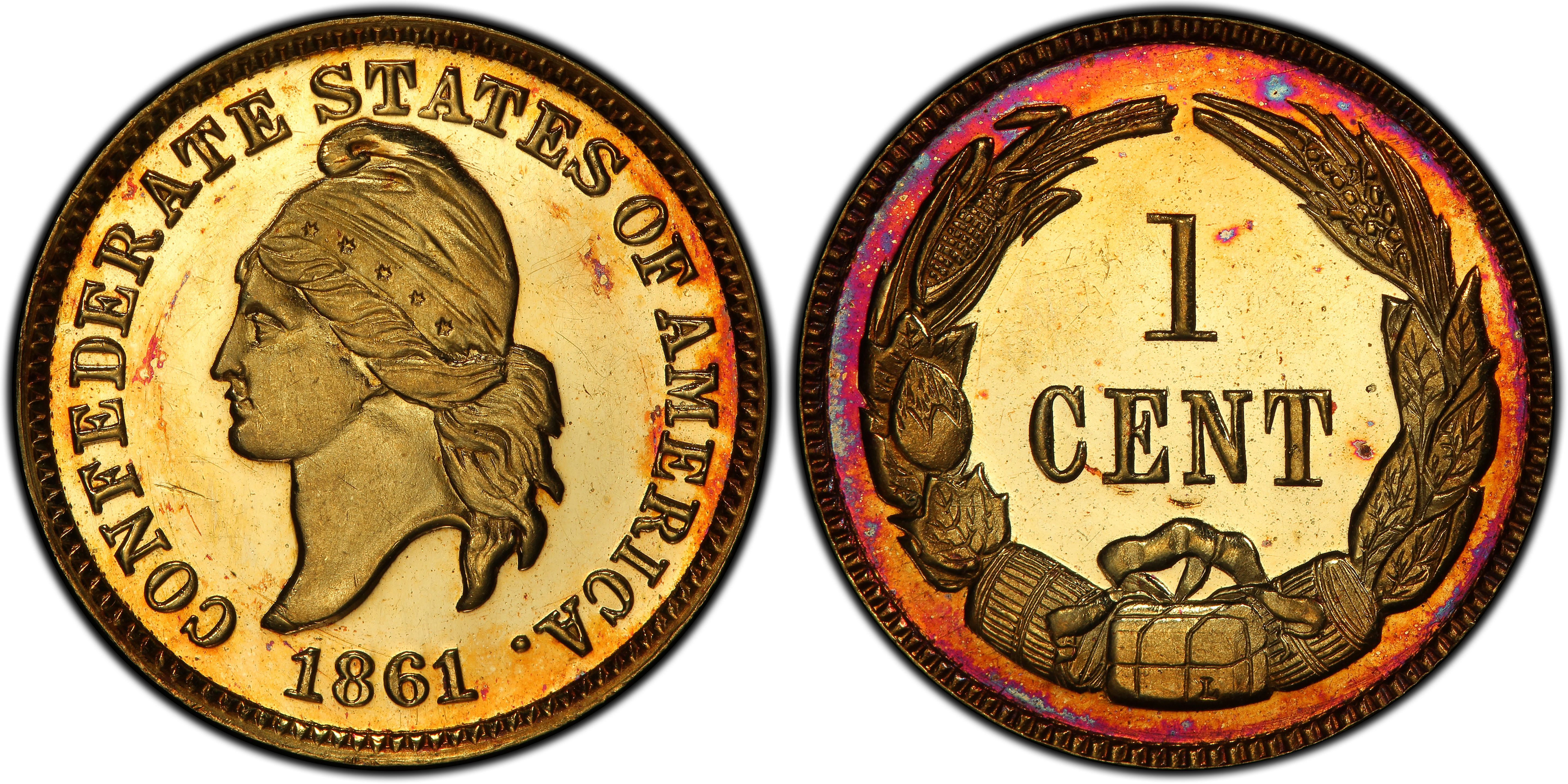
Obverse & Reverse
The story of the 1861 Confederate Cent is one of the most storied and complex in American numismatics, a tale of wartime intrigue, fear, and rediscovery. In early 1861, as the Confederacy was forming, agents or sympathizers of the Southern cause reportedly commissioned Robert Lovett, Jr., a respected die sinker in Philadelphia, to design and produce a pattern for a one-cent piece. Lovett, using a Minerva or 'French Liberty Head' motif he had previously employed on store cards, created a masterfully designed coin. The obverse featured this elegant head of Liberty in a Phrygian cap, surrounded by 'CONFEDERATE STATES OF AMERICA 1861'. The reverse bore a wreath of quintessentially Southern agricultural products—cotton, corn, tobacco, and wheat—around the denomination '1 CENT'. Lovett's initial 'L' is subtly placed on the bale of cotton. He struck a very small number of pattern cents, perhaps only 12 to 16, in a copper-nickel alloy similar to the U.S. Indian Head cent of the era. However, as the Civil War erupted in April 1861, Lovett grew profoundly fearful. As a resident of Philadelphia, the heart of the Union, he rightly feared that producing coinage for the enemy could lead to charges of treason, a crime punishable by death. Gripped by this fear, he ceased all work on the project, never delivered the dies or the struck patterns to the Confederacy, and concealed them in his cellar, where they lay dormant and unknown for over a decade. The secret was finally broken in 1873. According to numismatic legend, Lovett, while at a local tavern, accidentally spent one of his original copper-nickel cents. The unusual piece was noticed by the proprietor and soon came to the attention of Captain John W. Haseltine, an astute Philadelphia coin dealer and Civil War veteran. Haseltine traced the coin back to Lovett and, after some persuasion, purchased the original dies and the remaining handful of patterns. Recognizing the immense historical appeal and collector interest in these previously unknown Confederate pieces, Haseltine decided to produce a series of restrikes in 1874. He marketed these special collector issues with a circular, announcing a limited striking of 55 in copper, 12 in silver, and, most fantastically, just 7 in gold. These were not intended for circulation but were struck as Proofs for the era's most advanced collectors. The gold specimens, in particular, represented the ultimate prize. Struck from Lovett's original, unaltered dies, they are crisp, often with deep-mirrored fields, and are today considered among the greatest rarities associated with Confederate numismatics. The dies were later sold, eventually becoming rusted and defaced, leading to a second generation of 'Bashlow' restrikes in the 1960s, which are identifiable by the die damage. The Haseltine restrikes, and especially the seven gold examples, remain the definitive and most desirable private productions from the original Confederate dies.
Associated EventAmerican Civil War
Reason For MintingThis specific item was not minted by the Confederacy, but was a private restrike created in 1874 by John W. Haseltine to sell to collectors after he acquired the original 1861 dies.
Minter HistoryJohn White Haseltine (1838-1925) was a prominent Philadelphia coin dealer, auctioneer, and numismatist. A Union Army veteran of the Civil War, he became a key figure in the post-war numismatic community. He is most famous for his acquisition of the original dies for the 1861 Confederate Cent from their creator, Robert Lovett, Jr. In 1874, Haseltine produced and sold a very limited number of restrikes from these dies in copper, silver, and gold, creating some of the most sought-after prizes in the field of Confederate-related coinage. His catalogs and writings are important records of 19th-century American numismatics.
Historical SignificanceThe Haseltine gold restrike is a direct, tangible link to the Confederacy's unfulfilled numismatic ambitions. While not an official issue, it was struck from the original dies intended for a Confederate national coinage. Its extreme rarity and romantic backstory make it a legendary numismatic object, representing the pinnacle of collecting for specialists in Civil War-era patterns and tokens.
N/A
Denomination1 Cent (Pattern)
Minting Period1874
Assayer/MinterJohn W. Haseltine (from original 1861 dies by Robert Lovett, Jr.)
Geographic OriginPhiladelphia, Pennsylvania
Obverse DescriptionA left-facing portrait of Liberty, often referred to as a 'French Liberty Head' or Minerva, wearing a Phrygian or Liberty cap. Thirteen stars are implied by the surrounding legend.
Obverse InscriptionCONFEDERATE STATES OF AMERICA 1861
Reverse DescriptionA wreath composed of Southern agricultural staples: a large bale of cotton at the bottom center (bearing the designer's initial 'L'), flanked by two barrels, with sprays of corn, wheat, tobacco, and maple leaves encircling the central denomination.
Reverse Inscription1 CENT
CompositionGold
Stated Fineness Actual Fineness Weight6.46 grams
Diameter19.00 mm
EdgePlain
7
Survival Estimate6
Rarity ScaleR-8 (based on mintage)
As one of only seven struck, this gold piece is a paramount rarity in American numismatics. It combines the allure of the Confederacy, the intrigue of a secret Civil War-era pattern, and the cachet of being struck in gold from the original dies. It is a centerpiece for any world-class collection.
Key VarietiesThe Haseltine Restrikes of 1874 are the first and most important collector strikings. They are distinct from the original 12-16 copper-nickel patterns struck by Lovett in 1861. They are also vastly superior to the Second Restrikes made by Robert Bashlow in 1961-62 from the same dies, which by then were heavily rusted and defaced. Bashlow also produced strikings in various metals, including a few in gold, but these are easily distinguished by the prominent die rust and raised lumps. There are no known major varieties of the seven Haseltine gold restrikes themselves.
Authentication TipsAuthentication hinges on die characteristics. A genuine Haseltine restrike must be from the same dies as the known originals (now housed in the Smithsonian). Crucially, the fields will be free of the extensive rust, cracks, and defacement marks that characterize all later Bashlow restrikes. The strike should be of Proof quality, with sharp details and mirrored fields. Any softness or casting evidence should be viewed with extreme suspicion. Given its value, professional certification by a top-tier grading service is mandatory.
Shopping ConsiderationsFor a coin of this magnitude, the definition of 'premium quality' is simply existence and originality. However, among the 6 known survivors, eye appeal is paramount. A specimen with deep, watery mirrors and a strong cameo contrast between the devices and fields would command a significant premium. Look for pristine surfaces free of distracting marks, hairlines, or evidence of cleaning; a slight coppery toning around the periphery is sometimes seen and considered attractive. Any noted damage, such as gouges, scratches, or evidence of having been in jewelry, will severely impact the value, although even an impaired example remains a trophy coin. A CAC sticker on an already-certified coin would provide the highest level of market confidence.
A coin's grade is its condition, rated on a 1-70 scale. For rare coins, this is the most critical factor in determining value, as a tiny difference in preservation can mean a huge difference in price.
Relevant Grade TypesAll seven of the original 1874 Haseltine gold restrikes were special collector issues struck as Proofs (PR or PF). They were never intended for circulation. Therefore, they are only legitimately found and graded with the Proof designation. No business strikes (MS) or circulated examples (1-58) from this striking exist. Any piece showing circulation wear would be an impaired Proof and graded as such (e.g., 'PF Details - XF Damage').
Mint State CharacteristicsAs these are Proof strikings, one evaluates them based on the quality of their mirrored fields and frosted devices. An ideal example would exhibit a 'Deep Cameo' (DCAM) or 'Ultra Cameo' (UCAM) effect, with a stark, black-and-white contrast. The strike should be exceptionally sharp, rendering full detail on the strands of Liberty's hair and the intricate elements of the wreath. The fields should be deeply mirrored and free of distracting marks, although minor hairlines from careful handling over 150 years are common. The luster should be brilliant and unbroken.
Circulated Wear PatternsAs a Proof-only issue not intended for commerce, wear patterns are not applicable. Any wear seen on a genuine example would be considered post-striking damage and would result in a 'Details' grade, with the specific impairment noted (e.g., Scratched, Cleaned, Rim Damage).
Key Factors For ValueWith only six survivors, the primary value driver is simply availability. Beyond that, value is determined by the quality of the Proof striking and surface preservation. A high-grade, problem-free example with a strong cameo contrast will sell for multiples of one that is graded lower, has been cleaned, or has surface impairments. The provenance, or ownership history, of a specific piece can also add a significant premium, particularly if it was part of a legendary collection like the Eliasberg sale. A CAC sticker is a powerful endorsement of quality and eye appeal for this issue.
PCGS Price Guide
| Grade | Price | Population |
|---|---|---|
| 63+ | N/A | 1 |