(1874) CSA 1C Haseltine Restrike, Silver (Proof)
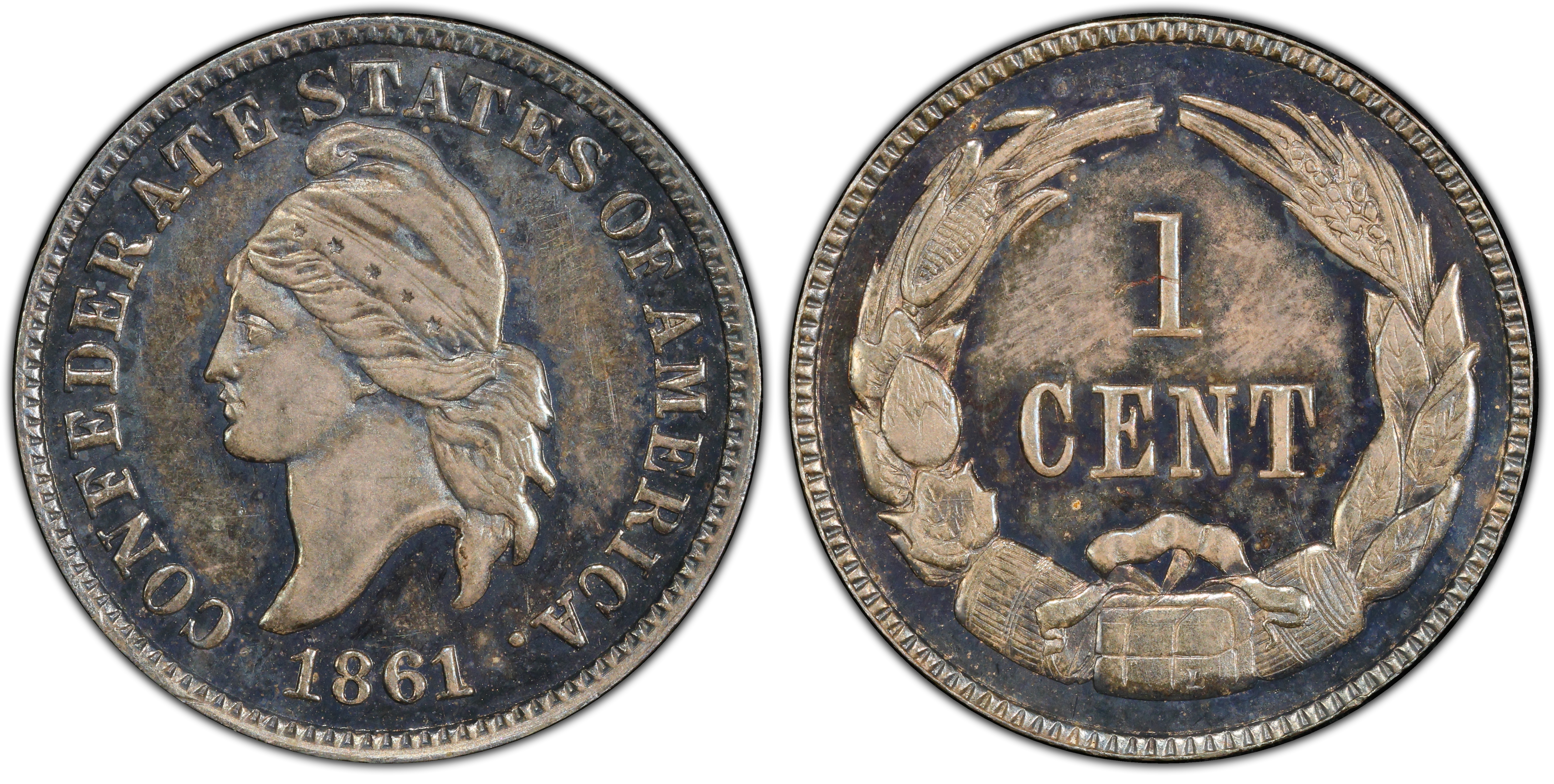
Obverse & Reverse
The story of the Haseltine restrike is inextricably linked to the original, clandestine 1861 Confederate cent. In the nascent months of the Confederacy, agents sought to establish a distinct coinage and contracted Robert Lovett, Jr., a talented die sinker in Philadelphia, to produce dies for a one-cent piece. Lovett completed the dies and struck a small number of pattern cents, reportedly around 12, in copper-nickel. However, as the Civil War erupted, Lovett grew fearful of being charged with treason for aiding the Confederacy. He ceased all work, never delivered the dies or the coins, and secreted them away in his cellar. For over a decade, the existence of the Confederate cent was unknown to the numismatic world. The secret was finally broken in 1873 when Lovett, purportedly after having too much to drink at a local bar, accidentally spent one of his original copper-nickel cents. The unusual coin quickly drew attention and came into the possession of Captain John W. Haseltine, a prominent Philadelphia coin dealer and Civil War veteran. A shrewd numismatist, Haseltine tracked down Lovett and, after some persuasion, purchased the original 1861 dies and the remaining handful of original specimens. Recognizing a commercial opportunity, Haseltine decided to produce 'restrikes' for fellow collectors. In 1874, he struck a small series of pieces from Lovett's original, undamaged dies. To distinguish them from the copper-nickel originals and to create desirable rarities, he used different metals. He produced a reported 55 in copper, 12 in silver, and 7 in gold. These were struck as Proofs, with mirrored fields and sharp details, catering to the collector market of the day. Haseltine's venture was short-lived; he claimed the collar broke after the 55th copper strike, and the dies were supposedly damaged, a claim later proven false. The dies were later sold, passed through several hands (including the Chapman brothers), and were eventually acquired by Robert Bashlow in the 1960s, who produced a second, larger series of restrikes from the now-defaced dies. The Haseltine restrikes, particularly the silver and gold versions, are revered today as the first generation of collector pieces tied to this legendary and mysterious Confederate issue, bridging the gap between the original patterns and the later commercial reproductions.
Associated EventPost-Civil War Numismatic Collecting Boom
Reason For MintingThis coin was created as a collectible restrike by a private dealer to satisfy numismatic demand for a newly discovered and historic pattern coin.
Minter HistoryCaptain John White Haseltine (1838-1925) was a well-known and influential coin dealer, auctioneer, and numismatist based in Philadelphia during the late 19th and early 20th centuries. A veteran of the Civil War, he established himself as a major figure in the coin collecting community. He is perhaps most famous for his acquisition of the original Confederate cent dies from Robert Lovett, Jr., and his subsequent production of the 1874 restrikes. His catalogs and auction sales were significant events, and his handling of the Confederate cent story secured his place in numismatic history.
Historical SignificanceThe Haseltine restrikes are historically significant as they were the first public issuance of the Confederate cent design, struck from the original 1861 dies. They confirmed the existence of Lovett's work and created a tangible, collectible link to the Confederacy's numismatic ambitions. Their extreme rarity, especially in silver and gold, has made them trophy pieces for advanced collectors of American coinage and historical artifacts.
N/A
Denomination1 Cent
Minting Period1874
Assayer/MinterJohn W. Haseltine (using original 1861 dies by Robert Lovett, Jr.)
Geographic OriginPhiladelphia, Pennsylvania
Obverse DescriptionThe obverse features a left-facing bust of Liberty, often referred to as a 'French Liberty Head,' wearing a Phrygian or Liberty cap inscribed with 'LIBERTY' (though often weak or incomplete on restrikes). Her hair flows down her neck. The portrait is encircled by the legend 'CONFEDERATE STATES OF AMERICA' with the date '1861' below.
Obverse InscriptionCONFEDERATE STATES OF AMERICA 1861
Reverse DescriptionThe reverse displays a wreath composed of primary agricultural products of the South. Clockwise from the lower left are stalks of corn, a branch of maple, strands of wheat, and a branch of tobacco. At the bottom is a bale of cotton with Lovett's initial 'L' faintly visible, tied with a bow, flanked by two barrels. Within the wreath is the denomination '1 CENT'.
Reverse Inscription1 CENT
CompositionSilver
Stated Fineness Actual Fineness Diameter19.00 mm
EdgePlain
12
Survival Estimate10-12
Rarity ScaleR-7
This coin is a classic American numismatic rarity, combining the allure of the Confederacy with an incredibly low mintage and a fascinating backstory involving a secret production, accidental discovery, and entrepreneurial restriking. As one of only 12 pieces struck in silver, it is a trophy coin sought by the most advanced collectors.
Key VarietiesThe primary varieties are defined by metal composition. The 1874 Haseltine restrikes were struck from the original, perfect dies in three metals: Copper (55 struck, Breen-8008), Silver (12 struck, Breen-8007), and Gold (7 struck). These should not be confused with the later (1961-62) Bashlow restrikes, which were made from transfer dies after the original dies had been heavily rusted and defaced with cancellation marks.
Authentication TipsAuthentic Haseltine restrikes must be struck from perfect, un-rusted, and un-cancelled dies. Compare the coin's surfaces to high-resolution images of confirmed examples. The strike should be sharp, with prooflike or semi-prooflike surfaces. There should be no evidence of the heavy rust pitting or chisel marks seen on the later Bashlow restrikes. The weight and silver composition should be consistent with known genuine examples. Due to their high value, certification by a top-tier grading service (PCGS or NGC) is essential.
Shopping ConsiderationsFor a 'premium quality' example, a buyer should seek a specimen with deeply mirrored fields and frosty devices, exhibiting strong cameo contrast. The strike should be full and crisp across all elements, which is not always the case. Look for pristine surfaces free of distracting carbon spots, hairlines, or handling marks, as any imperfection is magnified on a proof surface. Attractive, original toning, ranging from light champagne to deep iridescent hues, is highly desirable and can add a significant premium. Avoid coins that have been harshly cleaned, polished, or show evidence of rim bumps or damage, as these will be heavily discounted.
A coin's grade is its condition, rated on a 1-70 scale. For rare coins, this is the most critical factor in determining value, as a tiny difference in preservation can mean a huge difference in price.
Relevant Grade TypesThe (1874) Haseltine restrikes were special collector issues struck with a Proof finish (PR/PF). They were never intended for circulation and thus are not found in Circulated (1-58) or standard Mint State (MS) grades. All 12 known silver examples are presentation pieces. No business strikes or proofs were issued during the original 1861 period of the die's creation; the only originals were a handful of copper-nickel patterns.
Mint State CharacteristicsAs these are Proofs, not Mint State coins, quality is judged by the standards of proof coinage. An ideal example will exhibit sharp, squared-off rims and a full strike on the highest points of the design, such as Liberty's hair and the details of the wreath. The fields should be deeply mirrored and free of haze or distracting marks. Cameo contrast, with frosted devices set against watery fields, is highly desirable and commands a premium. Minor die polish lines are a characteristic of the striking process and are acceptable.
Circulated Wear PatternsThese coins were never circulated. Any wear-like appearance would be considered post-striking impairment or damage from mishandling. On a proof coin, this typically manifests as hairlines (fine scratches from wiping), contact marks, or friction that dulls the mirrored fields. The highest points, such as Liberty's cheekbone and the cotton bale on the reverse, would be the first to show evidence of such mishandling.
Key Factors For ValueThe primary drivers of value for this great rarity are the grade and surface quality. A higher numerical grade (e.g., PR65 vs. PR63) corresponds to a massive price increase. The degree of cameo contrast is a major factor; a 'Deep Cameo' or 'Ultra Cameo' designation will bring a significant premium over a standard Proof. Eye appeal is paramount: coins with attractive, original toning and flawless, deeply mirrored fields are the most sought-after. A CAC sticker, indicating premium quality for the grade, adds another layer of desirability and value.
PCGS Price Guide
| Grade | Price | Population |
|---|---|---|
| 55 | N/A | 1 |
| 62 | N/A | 3 |
| 63 | N/A | 2 |
| 64 | N/A | N/A |
| 66 | N/A | N/A |
| 67 | N/A | N/A |