(1961) CSA 1C Bashlow Restrike, Silver (Regular Strike)
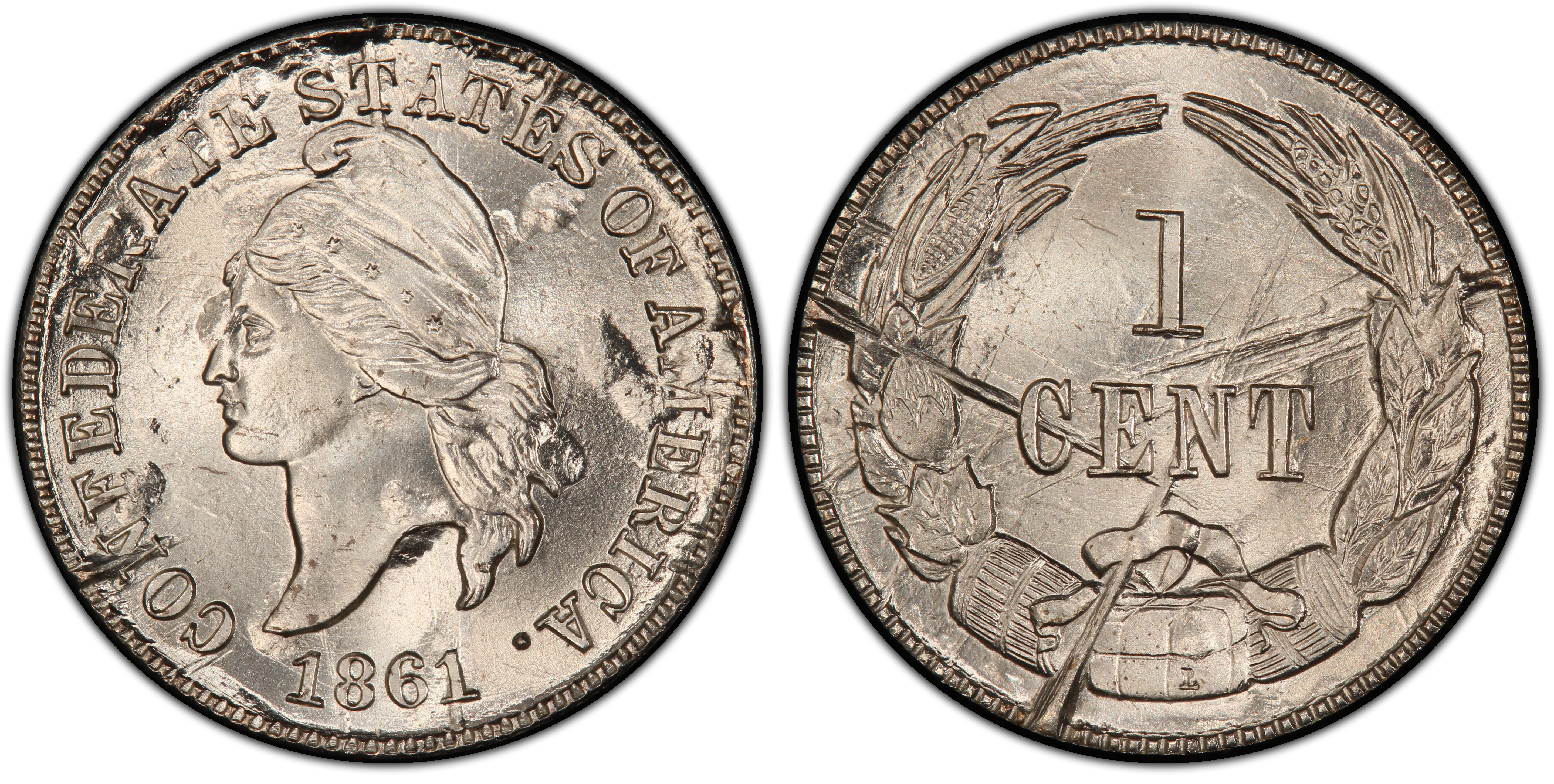
Obverse & Reverse
The story of the 1961 Bashlow Restrike is a fascinating multi-generational numismatic saga that begins with the Civil War itself. In 1861, the newly formed Confederate States of America sought to establish its own coinage. Through intermediaries at the Philadelphia jewelry firm Bailey, Banks & Biddle, they secretly commissioned a talented local engraver, Robert Lovett, Jr., to design and produce a one-cent piece. Lovett created a design featuring a classical bust of Liberty (Minerva) on the obverse and a wreath of southern agricultural products—cotton, corn, tobacco, and wheat—on the reverse. He struck a mere dozen or so pattern cents in copper-nickel, the standard alloy for U.S. cents at the time. However, fearing he would be arrested and tried for treason for aiding the enemy, Lovett ceased work, hiding the approximately 12 coins and the dies in his basement. The project remained a secret for over a decade. In 1873, Lovett accidentally spent one of his originals in a Philadelphia bar. The unusual coin was noticed and eventually traced back to him by prominent collector Capt. John W. Haseltine. Haseltine acquired the dies and remaining coins from Lovett and, in 1874, produced a small number of 'First Restrikes' in gold, silver, and copper. The dies then passed through several hands and were eventually defaced with chisel marks to prevent further unauthorized striking. They fell into obscurity until 1961, the centennial of the Civil War's outbreak. Entrepreneur and coin dealer Robert Bashlow of New York located the heavily rusted and damaged original dies. Recognizing their historical importance and commercial potential, he commissioned the August C. Frank & Company in Philadelphia to create new transfer dies from the originals. These new dies faithfully reproduced every detail of Lovett's design, but also every imperfection the originals had acquired over a century—the rust pits, die cracks, and cancellation marks. Using these copy dies, Bashlow produced a large quantity of 'Second Restrikes' in various metals to sell to collectors as Civil War Centennial commemoratives. These are not coins, but private tokens, and their 1861 date is purely historical.
Associated EventCentennial of the American Civil War
Reason For MintingTo create and market a collectible commemorative token for the 100th anniversary of the Civil War, utilizing the recently rediscovered original Confederate cent dies.
Minter HistoryRobert Socrates Bashlow (1930-1979) was a New York City coin dealer, publisher, and numismatic entrepreneur known for his aggressive marketing and several significant private restrike projects. His most famous endeavor was the restriking of the 1861 Confederate Cent in 1961-62. He acquired the heavily damaged original dies made by Robert Lovett, Jr. and had transfer dies created to produce thousands of restrikes in various metals. This venture was a commercial success, capitalizing on the heightened interest in Civil War history during its centennial. After the striking was complete, Bashlow donated the historic original dies to the Smithsonian Institution in 1962, ensuring their permanent preservation.
Historical SignificanceThe Bashlow restrikes are significant not as Confederate coins, but as popular and accessible numismatic tokens that tell the story of the original, extremely rare 1861 CSA cent patterns. They made a famous design available to the masses and preserved the final state of the defaced Lovett dies for posterity. Their creation and marketing during the Civil War Centennial reflect a period of intense national interest in that historical conflict.
N/A
Denomination1 Cent (Restrike Token)
Minting Period1961-1962
Assayer/MinterRobert Bashlow
Geographic OriginPhiladelphia, Pennsylvania
Obverse DescriptionFeatures a left-facing bust of Liberty wearing a Phrygian or Liberty cap. The portrait is surrounded by the legend. The surfaces prominently display lumps and raised areas, particularly in the fields, which are direct transfers of rust pits from the damaged original 1861 die.
Obverse InscriptionCONFEDERATE STATES OF AMERICA / 1861
Reverse DescriptionAn open wreath composed of Southern agricultural products: cotton (at bottom, above the bow), corn, tobacco, and wheat. Inside the wreath is the denomination '1 CENT'. The entire design shows evidence of the transfer process from damaged dies, including various die cracks and chisel marks used to cancel the original dies decades earlier. Lovett's initial 'L' is not visible on the restrikes.
Reverse Inscription1 CENT
CompositionSilver
Stated Fineness Actual Fineness Diameter19.00 mm
EdgePlain
5,000
Survival EstimateNear Mintage (Most were saved as collectibles)
Rarity ScaleR-1 (Common)
This piece offers an affordable way to own a direct descendant of one of the greatest rarities in American numismatics. It is sought after for its connection to the Confederacy, the intriguing story of the dies' century-long journey, and as a tangible memento of the Civil War Centennial. The visible die rust and cancellation marks serve as physical proof of its unique history.
Key VarietiesThe Bashlow restrikes were a large-scale commercial venture with several distinct issues: - **Bronze:** The most common variety, with a reported mintage of 20,000. - **Silver:** A popular precious metal version with a mintage of 5,000. - **Goldine:** A brassy alloy, with a mintage of 5,000. - **Gold:** Extremely rare, only 3 or 4 pieces were struck as presentations, typically in piedfort (double thickness). - **Platinum:** Extremely rare, with a reported mintage of 3. - **Minor Metals:** Small runs of 50 pieces each were struck in trial metals like tin, lead, zinc, and aluminum. - **Die Trial Pieces/Ingots:** Bashlow also struck the dies onto rectangular bronze ingots, creating paperweight-like items.
Authentication TipsAuthentic Bashlow restrikes are defined by their imperfections. Look for the prominent rust pits (raised lumps on the coin) on the obverse fields, especially around the portrait and letters. The reverse should show clear evidence of the chisel marks used to deface the original die. The quality of strike is generally sharp. Modern copies of the Bashlow restrike exist, but they often have a mushy or cast-like appearance and fail to accurately replicate the specific placement and texture of the die rust and cancellation marks.
Shopping ConsiderationsA premium quality example for its grade will be well-struck and lustrous. For the silver version, attractive original toning, ranging from light gray to deep cabinet blues and golds, is highly desirable and commands a premium. While technically Mint State, these pieces were not handled with the same care as official government issues and may have minor contact marks or hairline scratches from storage in original packaging. Examine the surfaces for distracting spots or evidence of harsh cleaning, which would reduce the eye appeal and value. A coin with sharp details and attractive, original surfaces is the ideal.
A coin's grade is its condition, rated on a 1-70 scale. For rare coins, this is the most critical factor in determining value, as a tiny difference in preservation can mean a huge difference in price.
Relevant Grade TypesAll Bashlow restrikes were produced as collectibles and sold directly to the public, so they are properly categorized as tokens. They were never intended for circulation. Therefore, they are only encountered and graded in Mint State (MS, 60-70) condition. No Proof (PR/PF) versions of the regular silver restrike were made, though the finish can sometimes be prooflike. The vast majority of surviving examples grade between MS-63 and MS-67.
Mint State CharacteristicsIn uncirculated grades, the key is surface preservation and luster. A high-end example (MS-66 or higher) will exhibit booming mint luster, often with a semi-prooflike or satiny texture. The strike is typically sharp and full. Crucially, the diagnostic rust pits and cancellation marks must be present and distinct; they are part of the design, not post-strike damage. The most common marks are minor bag marks or scuffs from handling over the decades. The silver pieces are susceptible to toning, which can range from attractive to unsightly.
Circulated Wear PatternsAs these pieces were never intended to circulate, wear is not a factor. Any piece with circulation wear would be considered damaged and would trade at a significant discount. The evaluation is based entirely on the preservation of the original mint surfaces.
Key Factors For ValueThe primary drivers of value are grade and eye appeal. A higher numerical grade from a top-tier grading service (PCGS or NGC) commands a significant premium. Eye appeal is paramount for the silver version; coins with attractive, original toning are prized far more than brilliant white or unattractively toned examples. Surface quality is key: minimal contact marks and clean fields are essential for a high-end grade. While common, a top-population, beautifully toned example will always be in demand.
PCGS Price Guide
| Grade | Price | Population |
|---|---|---|
| 63 | $90.00 | 1 |
| 63+ | $105.00 | N/A |
| 64 | $125.00 | 2 |
| 64+ | $145.00 | N/A |
| 65 | $165.00 | 8 |
| 65+ | $180.00 | N/A |
| 66 | $200.00 | 21 |
| 66+ | $215.00 | N/A |
| 67 | $240.00 | 15 |
| 67+ | $300.00 | N/A |
| 68 | $450.00 | 2 |
| 69 | N/A | N/A |