(1961) CSA 1C Bashlow Restrike, Brass (Regular Strike)
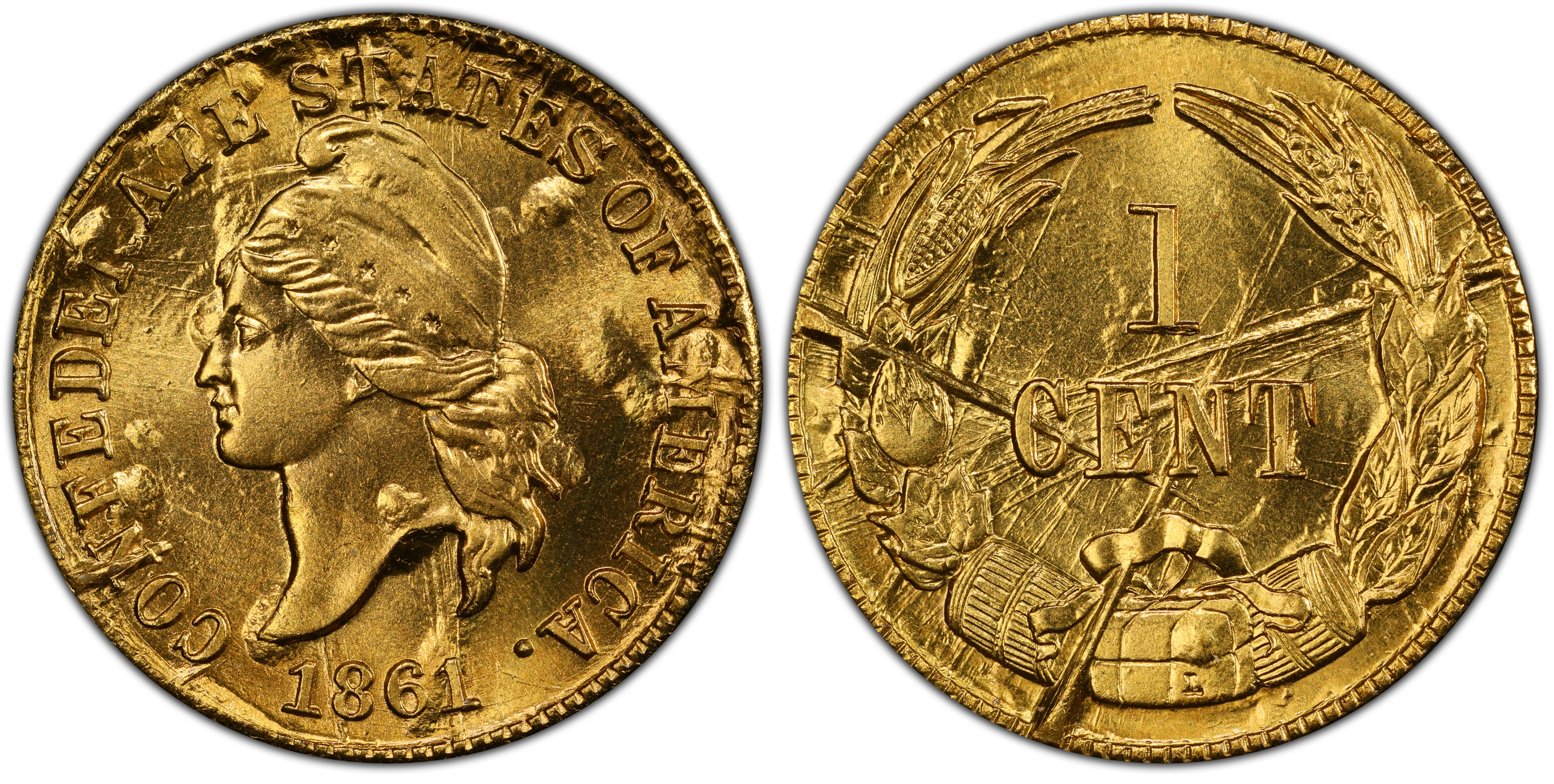
Obverse & Reverse
The story of the 1861 Confederate Cent is one of the great legends of American numismatics, and the Bashlow restrikes are its final, fascinating chapter. The tale begins in 1861 when Philadelphia die sinker Robert Lovett, Jr. was commissioned by Confederate agents to design and produce a one-cent piece. Lovett created a design featuring a French-style Liberty head on the obverse and a wreath of Southern agricultural staples—cotton, corn, tobacco, wheat—on the reverse. After striking a mere dozen pieces in copper-nickel, Lovett grew fearful of being arrested and executed for treason. He ceased production, hid the twelve coins and the dies in his cellar, and told no one of his work. The secret held for over a decade until 1873, when Lovett, after drinking at a local tavern, spent one of the original cents. The coin's unusual nature brought it to the attention of Captain John W. Haseltine, a prominent coin dealer. Haseltine tracked down Lovett and purchased the remaining coins and the original dies. In 1874, Haseltine produced a series of 'First Restrikes' in gold, silver, and copper for eager collectors. Sometime after this, the dies were defaced with chisel marks and began to rust. They disappeared from the numismatic scene for decades, resurfacing in 1961 when they were acquired by New York coin dealer Robert Bashlow. To commemorate the centennial of the Civil War, Bashlow decided to create a 'Second Restrike' series. Because the original dies were heavily rusted and damaged, he commissioned the August C. Frank & Company of Philadelphia to create new transfer dies. These new dies faithfully copied every detail from the originals, including all the rust pits, cracks, and cancellation marks, forever preserving their then-current state. From these transfer dies, Bashlow struck large quantities of cents in 1961 and 1962, making a historically inaccessible design available to the collecting public. After the minting was complete, Bashlow donated the original, historic dies to the Smithsonian Institution, where they reside today. The brass (marketed as 'Goldine') version was part of this large-scale commemorative issue.
Associated EventCentennial of the American Civil War (1961-1965)
Reason For MintingTo commemorate the 100th anniversary of the Civil War by making an iconic but unobtainable Confederate coin design accessible to collectors.
Minter HistoryRobert Bashlow was a notable New York coin dealer and numismatist active in the mid-20th century. He gained fame primarily for his role in acquiring the original, defaced dies of the 1861 Confederate Cent. A savvy promoter, he capitalized on the interest surrounding the Civil War Centennial by commissioning a large-scale production of restrikes from these dies in 1961. He worked with the medallic art firm August C. Frank & Company in Philadelphia to create transfer dies and strike the cents in various metals, including bronze, silver, and brass ('Goldine'). His actions preserved the story and the state of the damaged dies for future generations of collectors. In 1962, he cemented his place in numismatic history by donating the original dies to the Smithsonian Institution.
Historical SignificanceThe Bashlow restrikes serve as a tangible link to one of the rarest and most storied issues in American numismatics. While the originals are virtually unobtainable, these restrikes, made from transfer dies of the damaged originals, allow collectors to own a piece of the story. They are historically important as they document the final state of Lovett's dies, complete with a century of damage and purposeful defacement, and represent a popular commemorative issue tied to the Civil War Centennial.
N/A
Denomination1 Cent
Minting Period1961-1962
Assayer/MinterRobert Lovett, Jr. (Original Die Engraver); Robert Bashlow (Restrike Issuer)
Geographic OriginPhiladelphia, Pennsylvania
Obverse DescriptionA bust of Liberty facing left, her hair tied in a bun, wearing a Phrygian cap (often called a Liberty Cap). The style is reminiscent of contemporary French coinage.
Obverse InscriptionCONFEDERATE STATES OF AMERICA 1861
Reverse DescriptionAn open agricultural wreath composed of (clockwise from top left) a stalk of corn, a branch of maple, strands of wheat, and a branch of tobacco. At the bottom, a cotton bale (inscribed with Lovett's initial 'L') is flanked by two barrels.
Reverse Inscription1 CENT
CompositionBrass (Marketed as 'Goldine')
Stated Fineness Actual Fineness EdgePlain
5,000
Survival EstimateNear 5,000
Rarity ScaleR-1
This coin offers an affordable opportunity to own a piece of the famous 1861 Confederate Cent legacy. The direct lineage from the defaced original dies, combined with the fascinating backstory of Lovett's fear and Bashlow's promotional savvy, makes it a popular collectible. It is the most accessible way to include the iconic design in a collection of Civil War-era numismatics.
Key VarietiesThe 1961-62 Bashlow restrikes were issued in several metals. The most common are Bronze (20,000 mintage), Silver (5,000), and this Brass/'Goldine' version (5,000). Far rarer are the initial die trials, with approximately 50 pieces struck in Nickel-Silver, Lead, Zinc, and Red Fiber. A few ultra-rare examples in Platinum and Gold are also known. These 'Second Restrikes' are distinct from the 1874 Haseltine 'First Restrikes,' which were struck before the dies were significantly damaged and are much rarer and more valuable.
Authentication TipsAuthenticity is confirmed by the presence of the specific die flaws transferred from the damaged original dies. Look for a prominent die crack on the reverse near the '1' in the denomination. The surfaces should also exhibit a field of fine rust pits and several intentional chisel marks, which are most noticeable around the lettering. Fakes of the restrike exist, but they often fail to accurately replicate this unique, complex pattern of defects.
Shopping ConsiderationsA premium quality example for its grade will be certified by a major third-party service (PCGS or NGC). For the 'Goldine' variety, look for coins with a brilliant, consistent, and attractive brassy-gold luster. Avoid examples with distracting carbon spots, stains, or excessive contact marks. While the strike is generally sharp, the key is to find a piece where the inherent die flaws are crisp and clear, confirming its authenticity, but without any post-strike damage. High-grade examples (MS-67 and above) are readily available but command a premium.
A coin's grade is its condition, rated on a 1-70 scale. For rare coins, this is the most critical factor in determining value, as a tiny difference in preservation can mean a huge difference in price.
Relevant Grade TypesThese pieces were struck in 1961 as business strikes (MS) and sold directly to the numismatic community; they were not intended for circulation. Therefore, they are graded on the Mint State (MS, 60-70) scale. No Proof (PR/PF) versions of the Bashlow restrikes were produced.
Mint State CharacteristicsAn uncirculated Bashlow restrike should exhibit full, unbroken mint luster. The 'Goldine' pieces have a bright, satiny brass luster. The quality of the strike is typically sharp and consistent across all examples. The defining characteristics are the numerous pre-existing flaws from the transfer dies, including rust pits and cancellation marks. A higher grade (e.g., MS-67 vs. MS-65) is determined by the near-absence of post-strike contact marks, scrapes, or impairments to the luster.
Circulated Wear PatternsAs these tokens were sold to collectors, circulated examples are very scarce. If wear were present, it would first manifest on the highest points: Liberty's cheek, hair above the ear, and the cap's fold on the obverse. On the reverse, wear would first appear on the upper leaves of the wreath, the bands of the barrels, and the 'L' on the cotton bale.
Key Factors For ValueThe single most important factor for value is the numerical grade assigned by PCGS or NGC. Higher grades, particularly MS-67 and above, carry significant premiums. Surface quality is paramount; collectors seek examples with vibrant, original luster and without distracting spots or haze. Eye appeal is also key, with well-struck pieces exhibiting a pleasing and consistent brassy-gold color being the most desirable. A CAC sticker for any grade indicates a premium-quality piece and will increase its value.
PCGS Price Guide
| Grade | Price | Population |
|---|---|---|
| 65 | $175.00 | 5 |
| 65+ | $200.00 | N/A |
| 66 | $235.00 | 7 |
| 66+ | $260.00 | N/A |
| 67 | $325.00 | 17 |
| 67+ | $350.00 | N/A |
| 68 | $400.00 | 14 |
| 69 | N/A | 1 |