(1874) CSA 1C Haseltine Restrike, Copper, BN (Proof)
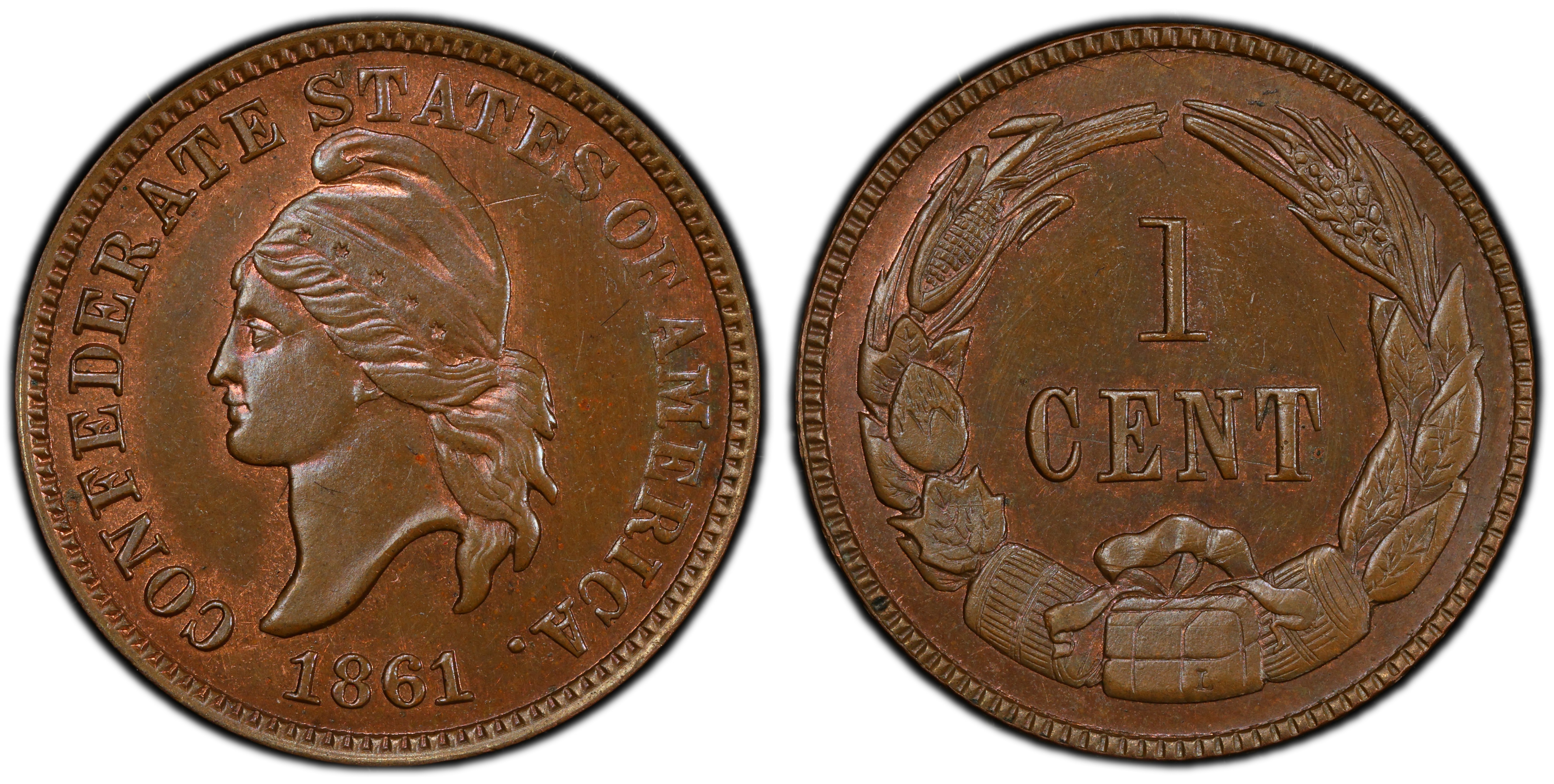
Obverse & Reverse
The story of the Confederate Cent is one of the most intriguing and romanticized in American numismatics, born from a clandestine agreement at the dawn of the Civil War and resurrected by a shrewd numismatist years later. In 1861, agents representing the newly formed Confederate States of America sought to establish a legitimate coinage system. They secretly approached Robert Lovett, Jr., a talented private die sinker in the Union city of Philadelphia, to design and produce dies for a one-cent piece. Lovett, part of a family dynasty of engravers, accepted the commission. He created a design featuring a French-style Liberty Head (Minerva) on the obverse, surrounded by 'CONFEDERATE STATES OF AMERICA' and the date '1861'. The reverse featured a wreath of Southern agricultural staples—cotton, corn, tobacco, and wheat—around the denomination '1 CENT'. Lovett struck a small number of pattern cents, believed to be just twelve, in a copper-nickel alloy similar to the Union's Indian Head cents. However, as the Civil War escalated, Lovett grew fearful of being charged with treason for aiding the enemy. He ceased all work, hiding the dies and the dozen coins he had struck in his cellar, and the project was abandoned before it ever truly began. The existence of these coins remained a secret for over a decade. The tale resumes in 1873, when Lovett, reportedly after having too much to drink at a local tavern, accidentally spent one of his original Confederate cents. The unusual piece was quickly noticed and found its way to Captain John W. Haseltine, a prominent Philadelphia coin dealer, auctioneer, and Civil War veteran. Recognizing Lovett's distinctive engraving style, Haseltine tracked him down and, after some persuasion, purchased the hidden dies and remaining original coins from the now-terrified engraver. In 1874, Haseltine saw a commercial opportunity and decided to produce a limited series of 'restrikes' for the burgeoning collector market using Lovett's original, pristine dies. He intentionally struck them in different metals to distinguish them from Lovett's original copper-nickel patterns: 7 in gold, 12 in silver, and 55 in copper. These Proof-quality strikings, made before the dies showed any significant wear or damage, are known as the Haseltine Restrikes. He falsely advertised that the coining collar broke after the 55th copper piece to enhance their rarity and exclusivity. The dies were later sold, eventually falling into the hands of Robert Bashlow, who produced a second, much larger series of restrikes in 1961-62 from the now heavily rusted and defaced dies, making the clean-die Haseltine issues far more desirable and historically significant.
Associated EventAmerican Civil War
Reason For MintingThis coin was a private restrike issued in 1874 to satisfy numismatic demand, using the original dies from a proposed 1861 national coinage for the Confederate States of America.
Minter HistoryJohn White Haseltine (1838-1925) was a notable Philadelphia coin dealer, auctioneer, and a Union Army veteran of the Civil War. A key figure in 19th-century numismatics, he was known for his sharp eye and entrepreneurial spirit. He famously acquired the original dies for the Confederate Cent from their creator, Robert Lovett, Jr., and produced a small number of restrikes in gold, silver, and copper in 1874. His actions preserved the design for posterity and created a classic numismatic rarity. Haseltine also employed the famous Chapman brothers, Henry and Samuel, early in their careers. Robert Lovett, Jr. was a prolific private die sinker from a family of engravers, responsible for numerous tokens, medals, and store cards in Philadelphia during the mid-19th century.
Historical SignificanceThe Haseltine Restrike is a direct link to the Confederacy's unfulfilled ambition of creating a national coinage. Struck from the original 1861 dies, it preserves a design that was nearly lost to history due to its creator's fear of prosecution for treason. It represents a fascinating intersection of wartime secrecy and post-war numismatic entrepreneurship, making it one of the most storied and sought-after issues related to the Civil War.
N/A
Denomination1 Cent
Minting Period1874
Assayer/MinterJohn W. Haseltine (from original dies by Robert Lovett, Jr.)
Geographic OriginPhiladelphia, Pennsylvania
Obverse DescriptionA left-facing bust of Liberty, often described as Minerva or a 'French Liberty Head', wearing a Phrygian or Liberty cap. Her hair is tied in the back with long tresses flowing down her neck. The portrait is encircled by the legend.
Obverse InscriptionCONFEDERATE STATES OF AMERICA 1861
Reverse DescriptionAn agricultural wreath composed of stalks of corn, sheaves of wheat, and leaves of tobacco and maple. At the bottom center is a bale of cotton, prominently marked with the engraver's initial 'L' for Lovett. Above the bale is a small bow. Two barrels are visible within the wreath on the left. The denomination '1 CENT' is in the center.
Reverse Inscription1 CENT L
CompositionCopper
Stated Fineness Actual Fineness Diameter19.00 mm
EdgePlain
55
Survival EstimateApproximately 40-50
Rarity ScaleR-5
The Haseltine Copper Restrike is highly coveted for its immense historical appeal, direct connection to the Civil War, extreme rarity, and its status as the 'first restrike' from the perfect, original dies. Its romantic backstory of secrecy, rediscovery, and limited production makes it a centerpiece for advanced collectors of U.S. numismatics.
Key VarietiesThe primary varieties of the Confederate Cent are defined by who struck them and when. They are: 1. **1861 Originals:** 12 pieces struck by Robert Lovett, Jr. in copper-nickel. Exceedingly rare. 2. **1874 Haseltine First Restrikes:** Struck in Proof from the pristine original dies. Varieties include Copper (55 struck), Silver (12 struck), and Gold (7 struck). These are the subject of this entry. 3. **Post-1874 Chapman Restrike:** A mule combining the Confederate Cent reverse die with a George Washington obverse die created by Henry Chapman after he acquired the dies from Haseltine. 4. **1961-62 Bashlow Second Restrikes:** Struck by Robert Bashlow from transfer dies made from the original Lovett dies, which by then were heavily rusted, cancelled, and broken. These are easily identified by die rust, pitting, and cancellation marks on the finished coins and were produced in large quantities in various metals.
Authentication TipsThe primary diagnostic for an authentic Haseltine Restrike is the quality of the dies. The fields should be clean, reflective, and free of the significant rust, die cracks, and chisel marks that plague the later Bashlow restrikes. The strike is sharp and in Proof format. Haseltine struck his copper restrikes on pure copper planchets, unlike Lovett's copper-nickel originals. Any specimen exhibiting heavy die rust, pitting, or obvious die breaks (especially on the reverse) is likely a much more common and less valuable Bashlow issue. Third-party certification by a major grading service is highly recommended for authentication.
Shopping ConsiderationsFor a Haseltine Copper Restrike, a premium quality example is defined by its pristine Proof surfaces and original color. Look for examples with deep, reflective mirror fields and sharp contrast with the devices. The most desirable pieces retain significant original mint red coloration ('RD' or 'RB' designation), though attractive, uniform chocolate brown ('BN') examples are also highly valued. Scrutinize the surfaces for any signs of harsh cleaning, hairlines, or carbon spots, as these are common and will significantly impact value. The high points, such as Liberty's cheek and the cotton bale, should be crisply struck. Eye appeal is paramount; an example with smooth, undisturbed surfaces and attractive coloration will always command a significant premium. Given the rarity, even repaired or slightly impaired examples are valuable, but a problem-free coin is the ultimate goal.
A coin's grade is its condition, rated on a 1-70 scale. For rare coins, this is the most critical factor in determining value, as a tiny difference in preservation can mean a huge difference in price.
Relevant Grade TypesAll 1874 Haseltine Restrikes were specifically struck as Proofs (PR or PF) for sale to collectors and were never intended for circulation. Therefore, they are not found in circulated grades (1-58) or standard Mint State (MS) grades. Any wear on a Haseltine restrike is considered post-mint damage and would result in a 'Details' grade. No Proofs were struck during the original 1861 period. The later Bashlow restrikes from 1961-62 are a separate numismatic issue and are typically found in Mint State or Prooflike grades, but are distinct from these original-die Proof restrikes.
Mint State CharacteristicsAs these are Proof strikings, quality is judged by the standards of Proof coinage. A superior example will exhibit deep, liquid-like mirrored fields with a strong cameo contrast against frosted devices (Liberty's portrait and the wreath). The strike should be exceptionally sharp, rendering full detail on the cotton bale, the strands of hair, and the leaves in the wreath. Luster is not the primary factor; instead, the quality of the mirrored surfaces is key. Minor contact marks or hairlines, common on 19th-century Proofs due to handling, will determine the grade. A top-tier example is virtually free of such imperfections.
Circulated Wear PatternsAs these are exclusively Proof issues not made for circulation, wear patterns are not applicable. Any circulation would be considered damage. The first areas to show friction or mishandling would be the highest points: Liberty's cheekbone and the hair above her ear on the obverse, and the top of the cotton bale and the high points of the wreath on the reverse. Any dulling or flatness in these areas on a Proof coin is a sign of impairment.
Key Factors For ValueThe primary drivers of value for a Haseltine Copper Restrike are the numerical Proof grade and the coin's original coloration. An example graded PR65 will be exponentially more valuable than one graded PR62. The color designation is critical: 'RD' (Red) examples are the most prized and rare, followed by 'RB' (Red-Brown), and then 'BN' (Brown). Surface preservation is paramount; a coin with clean, 'un-messed-with' surfaces and exceptional eye appeal will command the highest prices. The presence of a CAC sticker, indicating premium quality for the grade, adds a significant premium for this classic rarity.
PCGS Price Guide
| Grade | Price | Population |
|---|---|---|
| 40 | $11,500.00 | 1 |
| 45 | $12,500.00 | N/A |
| 45+ | $13,000.00 | N/A |
| 50 | $14,000.00 | N/A |
| 50+ | $15,000.00 | N/A |
| 53 | $16,000.00 | N/A |
| 53+ | $17,000.00 | N/A |
| 55 | $18,000.00 | N/A |
| 55+ | $19,000.00 | N/A |
| 58 | $20,000.00 | 1 |
| 58+ | $21,500.00 | N/A |
| 60 | $23,500.00 | N/A |
| 61 | $27,500.00 | N/A |
| 62 | $32,500.00 | 2 |
| 62+ | $37,500.00 | N/A |
| 63 | $42,500.00 | 2 |
| 63+ | $50,000.00 | N/A |
| 64 | $65,000.00 | 4 |