1861 1C CSA Original (Special Strike)
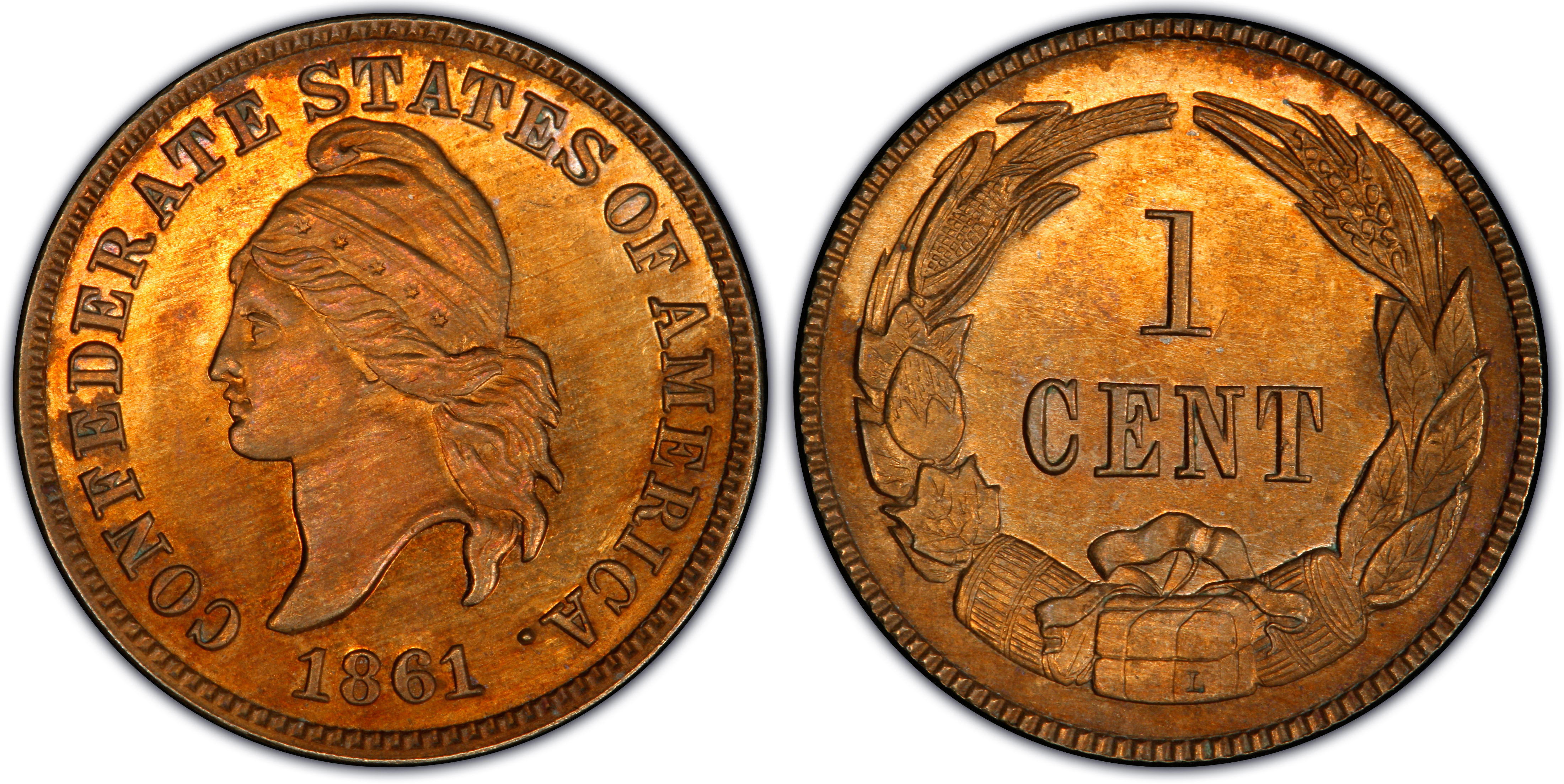
Obverse & Reverse
The 1861 Confederate Cent is one of the most enigmatic and storied issues in American numismatics, a coin born of rebellion but paradoxically struck in the heart of the Union. In early 1861, with the Confederacy newly formed but the Civil War not yet in full blaze, agents or sympathizers of the Confederate States of America sought to establish a distinct coinage. They secretly commissioned Robert Lovett, Jr., a talented and well-regarded die sinker and medalist in Philadelphia, to design and produce dies for a one-cent piece. The exact details of the commission are lost to history, with some accounts suggesting it came through the jewelry firm of Bailey & Co., while others posit Lovett undertook the project speculatively. Lovett proceeded to create a unique and elegant design. For the obverse, he used a Greco-Roman bust of Minerva (often called a 'French Liberty Head') wearing a Phrygian cap, a motif he had previously used on one of his store cards. The reverse featured a detailed agricultural wreath composed of Southern staples: cotton, corn, wheat, and tobacco, with two barrels and a prominent cotton bale at the bottom. Lovett discreetly placed his initial 'L' on the cotton bale. Using these dies, he struck a small number of pattern or trial pieces, estimated to be between 12 and 16 examples, on copper-nickel planchets identical to those used for U.S. Indian Head cents of the era. However, as the political climate intensified and Fort Sumter fell, Lovett grew fearful. The act of producing coinage for an enemy government constituted treason, a crime punishable by death. Compounded by a crack that developed in the reverse die during the striking process, Lovett abandoned the project entirely. He delivered neither the coins nor the dies to the Confederacy, instead hiding them in his cellar, where they remained a secret for over a decade. The existence of the Confederate cent remained unknown until 1873. The popular, though likely embellished, story recounts that Lovett, while drinking in a Philadelphia saloon, accidentally spent one of the original cents. The astute bartender noticed the strange coin, and it eventually came to the attention of numismatists, most notably Captain John W. Haseltine. Haseltine traced the coin back to a reluctant Lovett, who eventually confessed and sold Haseltine the remaining original cents and the dies. This discovery created a sensation in the numismatic community, cementing the coin's legendary status as a tangible, if unfulfilled, artifact of the Confederacy's aspirations for nationhood.
Associated EventAmerican Civil War
Reason For MintingIntended as a prototype or pattern coinage for the newly formed Confederate States of America to assert its sovereignty and facilitate commerce.
Minter HistoryRobert Lovett, Jr. (c. 1818-1879) was a skilled engraver, die sinker, and medalist based in Philadelphia. He came from a family of engravers and was known for producing a variety of medals, store cards, and political tokens for a wide range of clients, including tokens for both Abraham Lincoln and his opponent George McClellan during the 1864 election. His commission to create the Confederate cent was clandestine, and his fear of being prosecuted for treason led him to hide the coins and dies, which inadvertently created one of America's greatest numismatic rarities.
Historical SignificanceThe 1861 Confederate Cent is the primary numismatic representation of the Confederacy's attempt to create a national minor coinage. Though it never circulated and was struck in the North, its existence provides a direct link to the nascent government's efforts to build the institutions of a sovereign nation. Its mysterious origin, clandestine production, and dramatic rediscovery have elevated it from a mere pattern coin to an iconic artifact of the Civil War.
N/A
Denomination1 Cent
Minting Period1861
Assayer/MinterRobert Lovett, Jr.
Geographic OriginPhiladelphia, Pennsylvania
Obverse DescriptionA left-facing bust of Liberty, often identified as Minerva, wearing a Phrygian or Liberty cap. The cap is adorned with a band featuring six stars. The portrait is sharply defined with a truncated neck.
Obverse InscriptionCONFEDERATE STATES OF AMERICA / 1861
Reverse DescriptionThe denomination '1 CENT' is centered within a wreath composed of Southern agricultural products. The wreath includes stalks of corn and cotton on the left, and wheat and tobacco on the right. Below the denomination and tying the wreath is a large bale of cotton flanked by two barrels, with the engraver's initial 'L' visible on the right side of the cotton bale.
Reverse Inscription1 CENT
CompositionCopper-Nickel
Stated Fineness Actual Fineness Weight4.67 grams
Diameter19.00 mm
EdgePlain
12-16
Survival Estimate12-16
Rarity ScaleR-7+
The 1861 Original CSA Cent is a classic American rarity, sought after for its immense historical significance, compelling backstory, and extreme rarity. It appeals to collectors of Civil War artifacts, Confederate material, and elite numismatic patterns and territorials. Owning an original is a pinnacle achievement in numismatics.
Key VarietiesOriginals: The 12-16 pieces struck by Lovett in 1861 in copper-nickel are the primary issue. Key collector issues are the later restrikes made after the dies were rediscovered. - **1874 Haseltine Restrikes:** After acquiring the dies, John W. Haseltine struck a series of Proof restrikes. He purposefully used different metals to distinguish them from the originals. The known mintages are approximately 55 in Copper, 12 in Silver, and 7 in Gold. These are highly collectible in their own right. - **1961 Bashlow 'Second Restrikes':** In 1961, for the Civil War centennial, Robert Bashlow acquired the now-rusted and cancelled (defaced) dies. He had transfer dies made that copied every detail, including the rust and cancellation marks. He struck large quantities of these 'second restrikes' in various metals, including Bronze (20,000), Silver (5,000), Goldine (5,000), and a few rare trial pieces in Platinum, Lead, and Zinc. These are affordable and popular collectibles related to the original.
Authentication TipsAuthentication of an original is paramount and requires expert examination. Key diagnostics include the weight (4.67g) and composition (copper-nickel). All originals exhibit a prominent die crack on the reverse, often running from the rim through the 'T' in CENT and into the wreath. A second, finer crack often appears near the cotton bale. The strike is sharp, with a prooflike or specimen surface. The 'L' for Lovett on the cotton bale is sharp and clear. Numerous modern replicas exist; most are cast or have incorrect weight, composition, and mushy details. Comparison with high-resolution images of known genuine examples is essential.
Shopping ConsiderationsFor an original 1861 Cent, certification by a top-tier grading service (PCGS or NGC) is mandatory. A 'premium quality' example would exhibit sharp details, particularly on Liberty's hair and the intricate wreath on the reverse. Look for smooth, original surfaces with minimal contact marks and some remaining mint luster, often described as having a 'specimen' or 'prooflike' finish. Eye appeal is critical; coins without distracting marks or discoloration command significant premiums. Given the coin's rarity, any example is a major acquisition, but buyers should still scrutinize for signs of cleaning, tooling, or other impairments. Provenance to a famous collection adds significant value and desirability.
A coin's grade is its condition, rated on a 1-70 scale. For rare coins, this is the most critical factor in determining value, as a tiny difference in preservation can mean a huge difference in price.
Relevant Grade TypesOriginal 1861 issues were special strikes, not intended for circulation, and are thus graded as either Proof (PR/PF) by NGC or Specimen (SP) by PCGS. No originals were struck as business strikes for circulation, so circulated grades (1-58) are not applicable. The later-date 1874 Haseltine restrikes were also produced as Proofs for collectors and are graded as such. The 1961 Bashlow restrikes were generally business strikes, although some may exhibit prooflike qualities. These restrikes are entirely separate numismatic items from the original 1861 special strikes.
Mint State CharacteristicsAs these are considered Specimen or Proof strikes, an ideal example would have sharply detailed design elements, particularly on the highest points like Liberty's hair curls and the cotton bale. The fields are typically not fully mirrored like a modern proof but have a distinct semi-prooflike or satiny texture. Luster is original and vibrant. Because they were carefully handled from the moment of their creation, significant contact marks are unusual, but minor hairlines or ticks from brief cabinet friction may be present. The presence of the distinctive reverse die crack is a key characteristic, not a flaw.
Circulated Wear PatternsOriginal 1861 cents were never intended to circulate, so wear is not a typical grading consideration. Any example showing circulation would be highly unusual and likely the result of being used as a pocket piece long after its creation. If wear were present, it would first appear on the high points: Liberty's cheek, the hair above the ear, and the upper portions of the wreath and cotton bale on the reverse.
Key Factors For ValueFor an original 1861 CSA Cent, value is determined by several key factors. The primary factor is the certified grade; each point on the 70-point scale represents a massive jump in value. Surface quality is paramount; an example with clean, original, and undisturbed surfaces is far more desirable than one that has been cleaned, polished, or hairlined. Sharpness of the strike and overall eye appeal, including attractive original toning, contribute significantly. A CAC sticker, indicating premium quality for the grade, adds a substantial premium. Finally, a strong and well-documented provenance to famous collectors of the past can greatly enhance a specimen's value and prestige.
PCGS Price Guide
| Grade | Price | Population |
|---|---|---|
| 40 | N/A | N/A |
| 50 | N/A | N/A |
| 58 | N/A | 1 |
| 61 | N/A | 1 |
| 62 | N/A | 3 |
| 63 | N/A | 1 |
| 63+ | N/A | 1 |
| 64 | N/A | 1 |
| 64+ | N/A | 1 |