(1879) WM 50C CSA, Scott Restrike (Regular Strike)
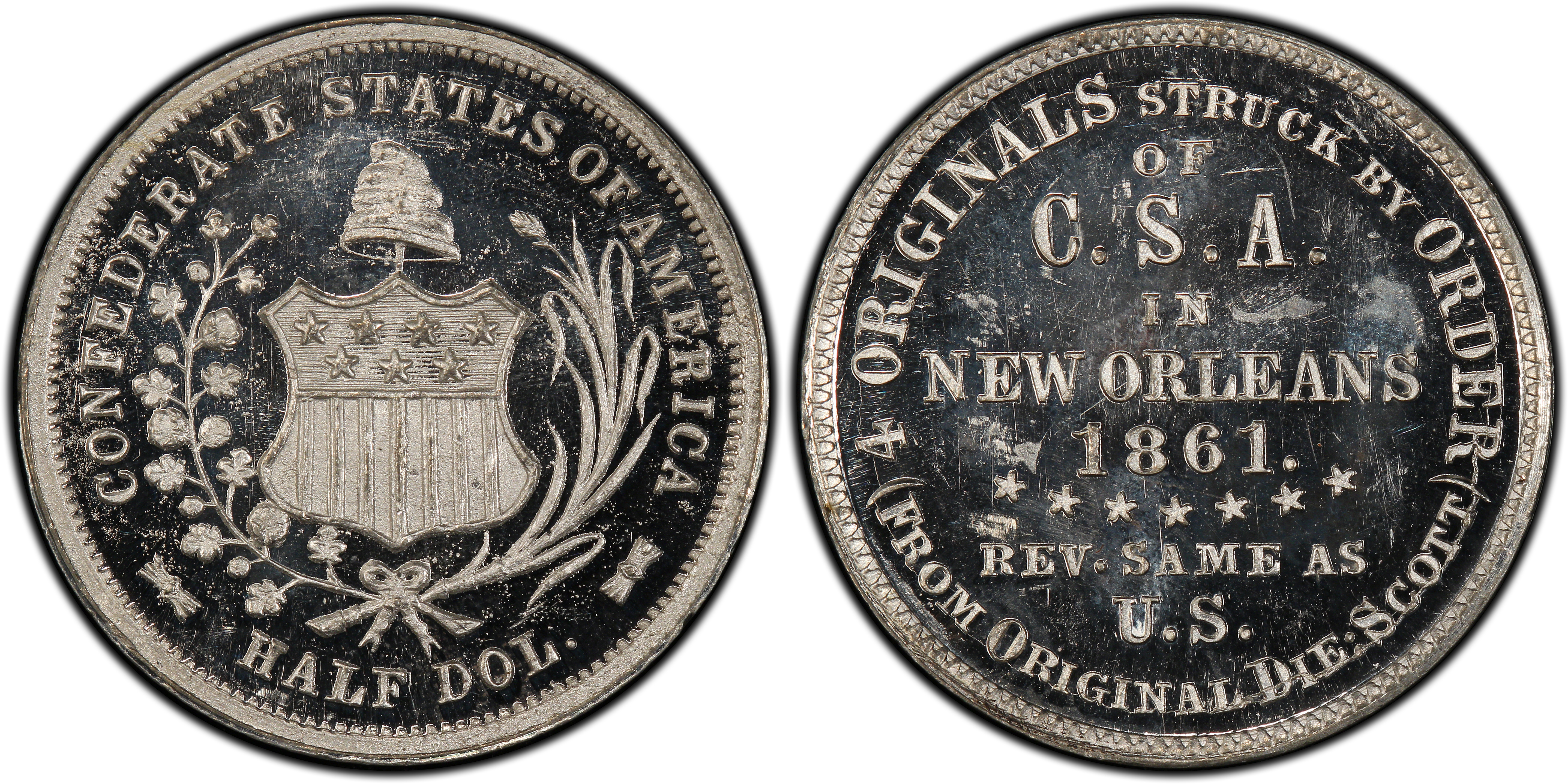
Obverse & Reverse
The story of the Scott Restrike is inextricably linked to one of the greatest rarities in American numismatics: the original 1861 Confederate States of America Half Dollar. In April 1861, after seizing the New Orleans Mint, the Confederacy authorized a new coinage. Using a locally produced reverse die and a standard Union Seated Liberty obverse die, Chief Coiner Dr. B.F. Taylor oversaw the striking of just four pattern half dollars. The reverse, designed by A.H.M. Patterson, featured a shield with seven stars (for the initial seceding states), a Liberty Cap on a pole, and a wreath of cotton and wheat. With the pressures of the Civil War mounting, the ambitious coinage project was abandoned, and the four originals, along with the reverse die, faded into obscurity. For nearly two decades, the existence of these coins was unknown to the numismatic world. After the war, Dr. Taylor, fearing prosecution for his role in the Confederate mint, kept the die and one of the original coins hidden. In 1879, he finally felt safe enough to reveal their existence in a New Orleans newspaper article. This announcement electrified the collecting community. Prominent Philadelphia dealer Ebenezer Locke Mason, Jr. promptly contacted Taylor and purchased both the coin and the invaluable reverse die. Mason, in turn, sold the die to John W. Scott, an enterprising New York coin and stamp dealer with a keen sense for marketing. Scott recognized the immense historical appeal and commercial potential of owning the only official Confederate coin die. Scott devised a plan to create facsimiles for eager collectors. The die, however, had suffered from years of improper storage and was visibly rusted. Concerned it might shatter under the pressure of striking silver coins, Scott first tested it by striking 500 tokens in a soft white metal. The obverse of these tokens described the history of the original coins, serving as both a collectible and an advertisement for Scott's ventures. Once the die proved durable enough, Scott proceeded with his main project. He acquired 500 circulated 1861-O Seated Liberty half dollars, the very coins the Confederacy had once issued with Union dies. In a rather crude but effective process, the reverse of each host coin was planed off, creating a blank canvas. These prepared coins were then placed in a collar and struck on a screw press with the Confederate die. To protect the Seated Liberty obverse from complete obliteration, it was reportedly placed on a soft surface, like a brass or leather pad, during striking. This process resulted in a new 'Confederate' reverse, but inevitably flattened and softened the details of the original Union obverse. These 500 pieces, known as the Scott Restrikes, were marketed to collectors for $2 each and became an instant classic, offering a tangible connection to the legendary, unobtainable originals.
Associated EventAmerican Civil War
Reason For MintingTo create and sell collectible facsimiles of the exceedingly rare original 1861 Confederate Half Dollar to the public.
Minter HistoryJohn Walter Scott (1845-1919) was a pioneering English-born American stamp and coin dealer. He is best known for founding the Scott Stamp and Coin Company and publishing the first Scott Catalogue of stamps in 1868. A brilliant marketer and entrepreneur, Scott recognized the burgeoning collector market in the late 19th century. His acquisition and use of the original Confederate half dollar die in 1879 is a testament to his business acumen, creating a highly desirable and historically significant collectible that remains popular over a century later. His company became a dominant force in the philatelic world, and his name is synonymous with the hobby.
Historical SignificanceThe Scott Restrike is one of the most famous and sought-after issues in American numismatics. It is not a coin issued by a government authority, but a privately-issued historical restrike. Its significance lies in its direct physical link to the Confederacy's only attempt at coinage, having been struck from the original 1861 reverse die. It provided collectors of the era, and today, with the only accessible way to own an object created by an official Confederate die, forever cementing its place in the story of Civil War-era coinage.
Breen-8002
Denomination50C
Minting Period1879
Assayer/MinterJohn W. Scott
Geographic OriginNew York, New York
Obverse DescriptionThe standard 1861 Seated Liberty half dollar design by Christian Gobrecht. Features Liberty seated on a rock, holding a pole with a Liberty Cap. Her right hand supports a shield inscribed with 'LIBERTY'. Thirteen stars surround the periphery. The date '1861' is below the base. On Scott restrikes, the obverse is noticeably flattened with weak details, particularly on the high points of Liberty's figure and the shield, due to the pressure of the reverse striking.
Obverse InscriptionLIBERTY, 1861, and thirteen stars.
Reverse DescriptionStruck from the original Confederate die. A shield with seven vertical stripes and a field of seven stars at the top (representing the first seven states to secede). A Liberty Cap on a pole rises from behind the shield. The shield is flanked by a wreath composed of a cotton branch on the left and a wheat stalk on the right.
Reverse InscriptionCONFEDERATE STATES OF AMERICA HALF DOL.
CompositionSilver (.900), Copper (.100) - struck over existing US 1861-O half dollars.
Stated Fineness0.9
Actual Fineness0.9
Weight12.00 grams
Diameter30.60 mm
EdgeReeded
500
Survival Estimate350-450
Rarity ScaleR-4
This issue is immensely popular due to its direct connection to the Confederacy and the fabled four original specimens. It is an affordable alternative to the multi-million dollar originals, struck from the actual Confederate die, making it a cornerstone piece for any collection of Civil War numismatics or US type coins.
Key VarietiesThe primary variety is the silver restrike (Breen-8002), struck over a planed-down 1861-O half dollar. A very small number of 'prototype' restrikes (Breen-8001) were made by striking the die directly over the reverse of a regular 1861-O half, leaving traces of the Union design visible underneath; these are exceptionally rare. Additionally, Scott produced 500 white metal tokens (Breen-8003) using the Confederate die on the reverse and an informational, advertising obverse; these are also collected but are distinct from the silver half dollar restrikes. There are no later-date restrikes or collector issues from the Scott period. Subsequent 20th-century copies by figures like Robert Bashlow were made from copy dies and are considered entirely separate issues.
Authentication TipsAuthentic Scott Restrikes always show a flattened, somewhat mushy Seated Liberty obverse. The reverse, struck from the rusted die, will exhibit characteristic diagnostics, including raised rust pits and lumps, particularly around the Liberty Cap and near the letters 'ER' in AMERICA. A key diagnostic is a small die chip on the edge above 'ER'. The weight should be slightly less than a standard 12.44-gram Seated Liberty half due to the planing of the reverse. Modern forgeries often have incorrect weight, a reverse that is too sharp or lacks the specific rust pit markers, or an obverse that is not an authentic, flattened 1861 Seated Liberty half.
Shopping ConsiderationsSince these pieces are graded based on the quality of the reverse, a prospective buyer should focus on that side. A premium quality example will have a sharp, well-defined strike on the Confederate shield, wreath, and legends, with minimal distractions. Original, attractive toning—often ranging from light gold to deep gunmetal gray—adds significant eye appeal and value. While the obverse is expected to be flat, examples with more remaining detail than average are desirable. Check for signs of harsh cleaning, re-toning, or scratches on the reverse, which can significantly impair value. An example with a CAC sticker is highly prized as it indicates superior quality for the grade.
A coin's grade is its condition, rated on a 1-70 scale. For rare coins, this is the most critical factor in determining value, as a tiny difference in preservation can mean a huge difference in price.
Relevant Grade TypesAll original Scott Restrikes are considered business strikes (MS) or circulated survivors (grades 1-58), though they were made for collectors and not for circulation. They are graded almost exclusively on the condition of the Confederate reverse, as the obverse was intentionally flattened during production and was struck on a previously circulated host coin. No proofs were struck by Scott. Later reproductions by other parties, such as the Bashlow restrikes, are entirely different numismatic items.
Mint State CharacteristicsAn uncirculated (MS) Scott Restrike is defined by the quality of the reverse. Luster on the reverse can range from satiny to semi-prooflike. The strike can be inconsistent; many examples show weakness at the top of the letters in 'CONFEDERATE'. High-grade examples will show sharp details on the shield and wreath. Small, raised die artifacts from the rusted die are characteristic of the issue and are not considered defects. Contact marks on the reverse from handling over the years are the primary determinant of the specific MS grade.
Circulated Wear PatternsAlthough created for collectors, some Scott Restrikes did circulate. Wear on the reverse first appears on the highest points: the Liberty Cap, the upper edges of the wreath leaves, and the horizontal lines at the top of the shield. As wear progresses, the finer details of the cotton and wheat will soften, and the legends will begin to merge with the fields.
Key Factors For ValueThe value of a Scott Restrike is overwhelmingly determined by the grade and eye appeal of the Confederate reverse. A sharp strike, clean surfaces free of distracting marks or cleaning, and attractive, original toning command significant premiums. The amount of detail remaining on the obverse has a minor influence but is secondary to the reverse. Pieces certified by a major grading service (PCGS or NGC) are standard, and a CAC sticker for this issue confirms premium quality and adds substantial value, as it attests to the coin's superior eye appeal and originality for its assigned grade.
PCGS Price Guide
| Grade | Price | Population |
|---|---|---|
| 45 | $3,700.00 | 1 |
| 45+ | $3,850.00 | N/A |
| 50 | $4,100.00 | 2 |
| 50+ | $4,150.00 | N/A |
| 53 | $4,200.00 | N/A |
| 53+ | $4,250.00 | N/A |
| 55 | $4,400.00 | 1 |
| 55+ | $4,450.00 | N/A |
| 58 | $4,650.00 | 5 |
| 58+ | $4,700.00 | N/A |
| 60 | $4,850.00 | N/A |
| 61 | $5,000.00 | 4 |
| 62 | $5,250.00 | 26 |
| 62+ | $5,500.00 | N/A |
| 63 | $5,750.00 | 24 |
| 63+ | $6,500.00 | N/A |
| 64 | $8,750.00 | 19 |
| 64+ | $10,000.00 | 1 |
| 65 | $15,000.00 | 3 |
| 65+ | $17,500.00 | N/A |
| 66 | $22,500.00 | 1 |
Graysheet Price Guide
| Coin | Price Range |
|---|---|
| 1861 50c CSA, Original MS | $840,000 - $1,173,000 |
| 1861 50c CSA, Restrike MS | $3,150 - $40,500 |
| 1861 50c CSA, Scott Restrike MS | $2,750 - $17,500 |