1962 50C Bashlow CSA Restrike, Brass (Regular Strike)
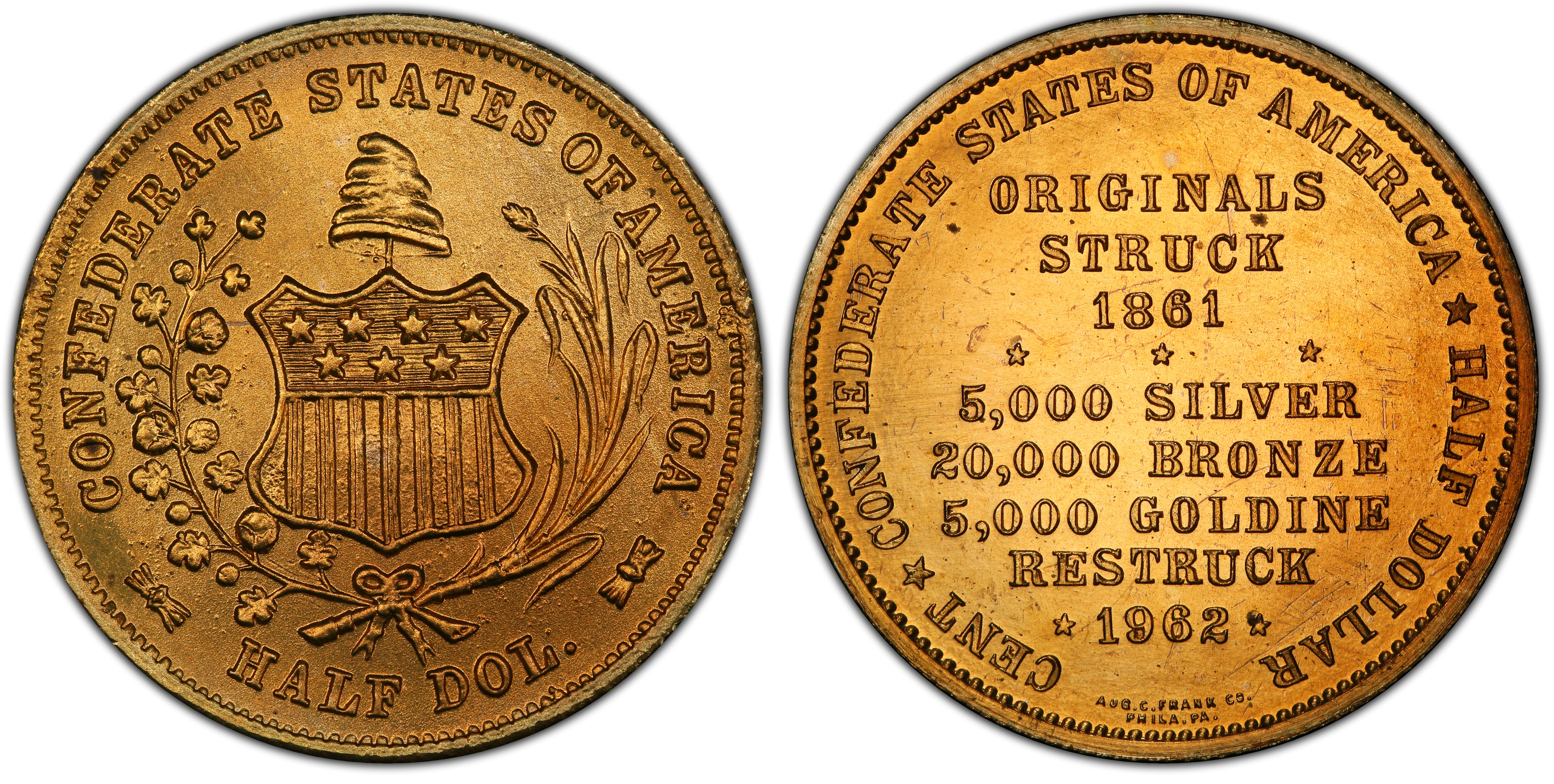
Obverse & Reverse
The 1962 Bashlow Confederate States of America (CSA) Half Dollar token is not a coin, but a privately issued medal created to commemorate the centennial of the American Civil War. Its story, however, is deeply entwined with one of the greatest rarities of Confederate numismatics: the original 1861 CSA Half Dollar. In April 1861, just four pattern half dollars were struck at the New Orleans Mint, which had been seized by the Confederacy. These coins used a standard Union Seated Liberty obverse die paired with a unique Confederate reverse die featuring a shield and Liberty cap within a wreath of cotton and sugar cane. The original reverse die, created by A.H.M. Patterson, was of such high relief it was deemed unsuitable for mass production. After the striking of the four patterns, the die was returned to Chief Coiner Dr. B.F. Taylor, who preserved it for nearly two decades. In 1879, the die was discovered and sold to prominent coin and stamp dealer John Walter Scott. Scott, a master promoter, decided to produce 'restrikes.' He acquired 500 original 1861-O Seated Liberty half dollars, planed off their reverses, and struck them with the original Confederate die. These are known as the Scott Restrikes and are highly valuable numismatic items in their own right. The story then lay dormant until 1961, when the New York coin dealer and entrepreneur Robert S. Bashlow acquired what were believed to be the original, now heavily rusted and defaced, Confederate dies (both for the cent and the half dollar). To capitalize on the surging interest in the Civil War centennial, Bashlow commissioned the August C. Frank & Co. of Philadelphia to produce a series of commemorative pieces. Crucially, Bashlow did not use the fragile original dies directly. Instead, he had transfer dies created, which faithfully copied the design, including the imperfections and damage on the source die. For the 'half dollar,' Bashlow's production was technically a mule: the obverse used the design of the original *reverse* of the 1861 CSA half dollar. The reverse of Bashlow's token was entirely new, consisting of text only, detailing the planned mintage figures for the different metallic compositions. These tokens were marketed aggressively to collectors, offering an affordable way to own a tangible piece of the Confederate coinage story.
Associated EventAmerican Civil War Centennial (1961-1965)
Reason For MintingTo create a widely available and affordable commemorative piece for collectors during the Civil War Centennial, capitalizing on the fame of the rare original 1861 Confederate half dollar.
Minter HistoryRobert Socrates Bashlow (1939-1979) was a flamboyant and controversial New York coin dealer and promoter. Beginning as a teenager in the 1950s, he became known for his aggressive marketing of items like 1955 doubled die cents and bulk demonetized British coins. In the early 1960s, he acquired the defaced dies for the original Confederate Cent and a die related to the Confederate Half Dollar, from which he commissioned transfer dies to produce thousands of 'restrikes' for the collector market. His promotional activities and production of various private issues led to his expulsion from the American Numismatic Association (ANA) in 1962. Despite the controversy, his productions are now a distinct and collectible part of the numismatic landscape. Bashlow died in a hotel fire in Zaragoza, Spain, in 1979.
Historical SignificanceThe Bashlow restrikes made the iconic and unobtainable design of the Confederate half dollar accessible to the average collector for the first time. While technically medals or tokens, they serve as an important epilogue to the story of the original Confederate coinage and the subsequent 19th-century Scott restrikes. They are a widely recognized and collected series that introduced a generation of numismatists to the allure of CSA coinage.
Bertram-B861-219 (for Goldine/Brass)
Denomination50C (Nominal)
Minting Period1962
Assayer/MinterRobert S. Bashlow (producer); August C. Frank & Co. (manufacturer)
Geographic OriginPhiladelphia, Pennsylvania
Obverse DescriptionThe design is a copy of the original 1861 Confederate half dollar reverse. It features a Union-style shield at the center with seven vertical stripes and a chief bearing seven stars, representing the first seven seceding states. Behind the shield rests a Phrygian cap (Liberty Cap) atop a pole. The shield is flanked by a wreath composed of a branch of sugar cane on the left and a branch of cotton, including open bolls, on the right.
Obverse InscriptionCONFEDERATE STATES OF AMERICA / HALF DOL.
Reverse DescriptionThe reverse is purely inscriptional, arranged in horizontal lines of text.
Reverse InscriptionC.S.A. / 1861 / HALF DOLLAR / REPLICA / 5,000 SILVER / 5,000 GOLDINE / 20,000 BRONZE
CompositionBrass (Marketed by Bashlow as 'Goldine')
Stated Fineness Actual Fineness Weight15.00 grams
Diameter30.60 mm
EdgeReeded
5,000 (Stated mintage on reverse; the actual number distributed may be lower)
Survival EstimateHigh; likely several thousand survive as they were sold directly to collectors.
Rarity ScaleCommon
These tokens are popular for their direct historical link to the legendary 1861 CSA half dollar, affordability, and the story of their controversial creator, Robert Bashlow. They allow collectors to fill a space in their collections with a representative design of an extreme rarity.
Key VarietiesThe primary varieties are based on the metal composition as struck in 1962. The regular issues are: - Bronze (Purported mintage of 20,000) - Silver (Purported mintage of 5,000) - Brass/'Goldine' (Purported mintage of 5,000) No patterns, proofs, or later restrikes of the Bashlow half dollar token are known or widely collected. The series should not be confused with the original 1861 CSA patterns or the 1879 Scott restrikes, which are entirely different and vastly more valuable numismatic items.
Authentication TipsAuthentication is straightforward as these are modern private issues. They should not be confused with 19th-century originals or restrikes. Key diagnostics include the purely textual reverse detailing the mintages and the characteristic 'soft' look resulting from being struck with transfer dies copied from a damaged source. The obverse design is the *reverse* of an actual coin, another key giveaway. Counterfeits are not a significant concern for this common token.
Shopping ConsiderationsA premium quality example for its grade will exhibit a sharp, full strike, particularly on the cotton bolls and the stars on the shield. The 'Goldine' (brass) pieces often have a bright, yellow-gold luster when in high grade (e.g., MS65 or better). Look for pieces free of distracting carbon spots, stains, or fingerprints, which are common on this alloy. As these were never intended for circulation, most examples are Mint State, and collectors should seek certified examples to ensure the highest technical grade and surface preservation.
A coin's grade is its condition, rated on a 1-70 scale. For rare coins, this is the most critical factor in determining value, as a tiny difference in preservation can mean a huge difference in price.
Relevant Grade TypesAll original 1962 Bashlow tokens were business strikes (MS) sold to collectors and were not intended for circulation. Therefore, they are primarily graded as Mint State (MS, 60-70). Circulated examples (1-58) exist but are uncommon and hold little value. No Proof (PR/PF) versions of this token were ever struck by Bashlow.
Mint State CharacteristicsUncirculated examples are defined by their original mint luster. The brass 'Goldine' pieces should have a bright, flashy yellow luster. The quality of the strike can vary, with some pieces showing minor weakness on the highest points of the cotton and sugar cane. As these were mass-produced collector items, they are susceptible to small contact marks from handling and storage, but high-grade examples (MS65 and above) should be largely free of noticeable imperfections on the main devices and in the fields.
Circulated Wear PatternsOn the rare occasion a circulated example is encountered, wear will first appear on the highest points of the design: the upper leaves of the cotton and sugar cane wreath, the rim of the shield, and the high points of the Liberty Cap. With more advanced wear, the finer details within the wreath and the stars on the shield will begin to merge and fade.
Key Factors For ValueThe primary drivers of value are grade and eye appeal. A high-grade certified piece (e.g., MS65, MS66) commands a significant premium over a raw or low-grade uncirculated example. Eye appeal is crucial for the 'Goldine' variety; tokens with brilliant, untoned, and spot-free surfaces are the most desirable. A CAC sticker will add a premium, confirming that the piece is of superior quality for its assigned grade.
PCGS Price Guide
| Grade | Price | Population |
|---|---|---|
| 64 | $300.00 | 3 |
| 64+ | $335.00 | N/A |
| 65 | $375.00 | 4 |
| 65+ | $425.00 | N/A |
| 66 | $500.00 | 2 |
| 66+ | $625.00 | 1 |
| 67 | $800.00 | 5 |