1861 50C CSA Restrike (Regular Strike)
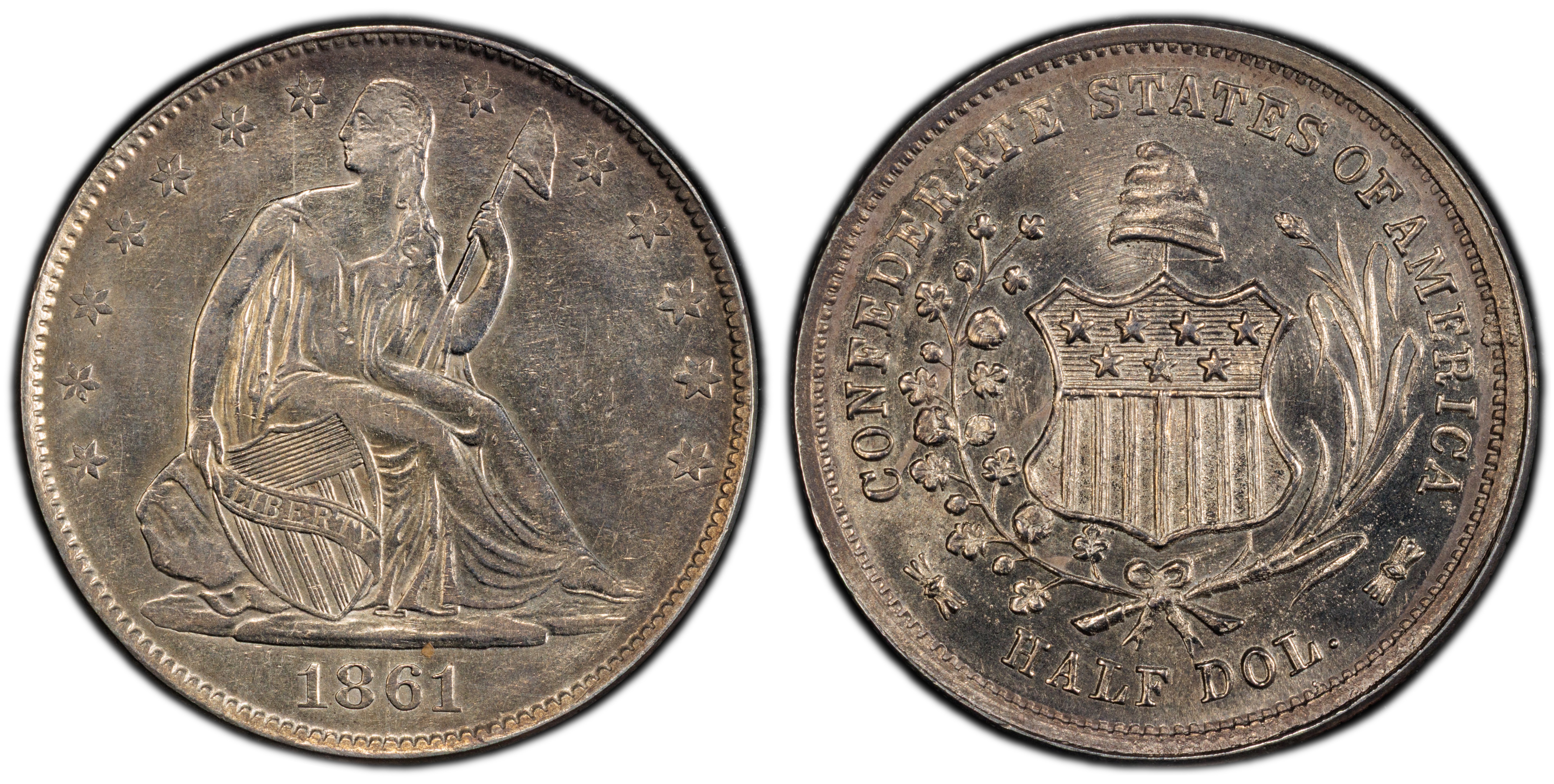
Obverse & Reverse
The story of the 1861 Confederate Half Dollar is one of the most compelling in American numismatics, a direct consequence of the Civil War's outbreak. In early 1861, after Louisiana seceded from the Union, the U.S. Branch Mint at New Orleans was seized first by the state and then by the Confederate States of America. C.S.A. Treasury Secretary Christopher Memminger authorized the creation of a distinctly Confederate coinage. The Chief Coiner of the New Orleans Mint, Dr. B.F. Taylor, was tasked with this project. A new reverse die, designed by A.H.M. Patterson, was created featuring a shield with seven stars (for the initial seven seceding states) topped by a Liberty Cap, all enclosed within a wreath of sugar cane and cotton. This Confederate die was paired with a regular U.S. Seated Liberty obverse die, dated 1861, which was on hand at the mint. Using a hand-operated screw press, only four pattern coins were struck. These prototypes were presented to Confederate officials, including President Jefferson Davis, but the immense pressures of the war and logistical difficulties prevented mass production, and the project was abandoned. The existence of these four coins and the reverse die remained a secret for years. Dr. Taylor, fearing prosecution for treason after the war, kept his specimen and the die hidden. It was not until 1879 that he revealed their existence in a New Orleans newspaper article. This revelation caught the attention of the burgeoning numismatic community. Philadelphia coin dealer Ebenezer Locke Mason, Jr. promptly contacted Taylor and purchased both the original coin and the reverse die. Mason then sold the die to the enterprising New York coin and stamp dealer, John W. Scott. Scott, a brilliant promoter, recognized a commercial opportunity. He decided to create 'restrikes' to sell to collectors who could never hope to own one of the four priceless originals. He acquired 500 circulated 1861-O U.S. Seated Liberty half dollars to use as host coins. His initial attempts at striking the Confederate design over the existing U.S. reverse proved unsatisfactory, as details from both designs were visible. To solve this, he had the reverses of the host coins planed smooth, creating a blank canvas. These planed coins were then placed in a collar and struck with the original, now somewhat rusted, Confederate die. This process inevitably caused a slight flattening of the Seated Liberty obverse, a key diagnostic of these restrikes today. Scott marketed these 500 pieces to the public, creating a collectible that was directly linked to the original Confederate die and the history of the Civil War, making them a tangible piece of that turbulent era.
Associated EventAmerican Civil War
Reason For MintingThis restrike was created as a commercial venture by J.W. Scott to satisfy collector demand for the unobtainable original 1861 Confederate half dollar.
Minter HistoryJohn Walter Scott (1845-1919) was a prominent English-born American stamp and coin dealer based in New York City. He is best known for founding the Scott Stamp and Coin Company and for publishing the 'Scott Catalogue of postage stamps,' which remains a standard reference. A savvy entrepreneur, Scott recognized the historical and commercial value of the original Confederate half dollar die and undertook the ambitious project of creating and marketing 500 restrikes, forever linking his name to this famous issue.
Historical SignificanceThe Scott Restrike is one of the most popular and historically significant pieces related to the Confederacy. While not an official issue of the C.S.A., it was struck from the original Confederate reverse die, providing the only tangible link for collectors to the Confederacy's numismatic ambitions. Its unique creation story—using circulated U.S. coins as planchets—and its direct connection to the original die make it a classic and highly sought-after piece of American history.
N/A
Denomination50C
Minting Period1879
Assayer/MinterJohn W. Scott
Geographic OriginNew York, New York
Obverse DescriptionStandard United States Seated Liberty half dollar obverse, designed by Christian Gobrecht. Features Liberty seated on a rock, holding a pole with a Phrygian cap, her left hand resting on a Union shield. Thirteen stars surround the upper periphery, with the date 1861 below. This side is invariably flattened to some degree from the pressure of the reverse strike.
Obverse Inscription1861
Reverse DescriptionA shield with seven vertical stripes and seven stars in the canton, representing the first seven states to secede. The shield is surmounted by a Phrygian cap on a pole. The shield is flanked by a wreath composed of a cotton branch on the left and a sugar cane stalk on the right. The legend is above and the denomination is below.
Reverse InscriptionCONFEDERATE STATES OF AMERICA / HALF DOL.
CompositionSilver (host coin is 90% Silver, 10% Copper)
Stated Fineness0.9
Actual Fineness0.9
Weight12.00 grams
Diameter30.60 mm
EdgeReeded
500
Survival Estimate300-400
Rarity ScaleR-4
The Scott Restrike is immensely popular as it is the only way most collectors can own a coin struck from an official Confederate die. It appeals to collectors of Civil War memorabilia, U.S. half dollars, and classic numismatic curiosities. Its unique backstory and tangible connection to the Lost Cause make it a perennial favorite.
Key Varieties1. J.W. Scott Restrike (this item): Struck on a planed-down 1861-O half dollar. Mintage of 500. 2. J.W. Scott White Metal Token: Scott also used the Confederate reverse die paired with a new obverse die of his own creation (describing the history of the originals) to strike 500 tokens in white metal. These are a separate but related collectible, often cataloged as Breen-8003. 3. Bashlow Restrikes: In 1962, Robert Bashlow used transfer dies made from the original, heavily rusted Confederate die to produce a large number of 'second restrikes' for the Civil War centennial. These are easily distinguished by their poor quality and different fabric.
Authentication TipsGenuine Scott restrikes always have a flattened obverse (the Seated Liberty side). The host coins were circulated, so the obverse will show wear beneath the flattening. The reverse will show die characteristics consistent with the original die, including minor rust pitting and a small die flaw near the letters 'ER' in AMERICA. The weight will be slightly less than a standard 1861 half dollar (12.44 grams) due to the planing of the reverse. Modern fakes often have incorrect details, mushy lettering, or attempt to replicate the design on a non-authentic planchet.
Shopping ConsiderationsWhen purchasing a Scott restrike, the grade is determined almost exclusively by the condition of the Confederate reverse. A premium quality example will have a sharp, well-defined strike on the reverse with minimal marks and attractive original luster. Some pieces exhibit attractive toning. The degree of flattening on the obverse is expected and does not detract from the grade, although some collectors prefer examples with more remaining obverse detail. Look for pieces that are free from harsh cleaning, scratches, or other post-striking damage. A CAC sticker is highly desirable for this issue, confirming the quality for the assigned grade.
A coin's grade is its condition, rated on a 1-70 scale. For rare coins, this is the most critical factor in determining value, as a tiny difference in preservation can mean a huge difference in price.
Relevant Grade TypesAll original Scott restrikes are considered business strikes. They are graded based on the condition of the reverse, from Circulated (AU-50 to AU-58, as few truly circulated) to Mint State (MS, 60-70). The obverse of the host coin was circulated and then flattened, so its condition does not determine the grade. No Proofs were struck by Scott. Later restrikes, such as the Bashlow issues, are entirely separate numismatic items.
Mint State CharacteristicsIn uncirculated grades, the key is the quality of the Confederate reverse. An MS example will display full mint luster, which is often satiny in appearance. The strike can be uneven; a coin with a sharp strike across all of the shield, wreath, and legends is highly desirable. Minor planchet imperfections or light die rust impressions from the aged die are common and acceptable. Contact marks on the reverse fields or high points are the primary determinants of the specific grade from MS-60 upwards.
Circulated Wear PatternsWhile most Scott restrikes did not circulate extensively after they were sold to collectors, those that did will show wear first on the highest points of the reverse design. This includes the upper portion of the shield, the high points of the cotton and sugar cane leaves in the wreath, and the rim. Because the reverse is the side graded, any friction or loss of luster on these elements will result in a circulated (typically AU) grade.
Key Factors For ValueThe value of a Scott restrike is driven almost entirely by the grade and eye appeal of the Confederate reverse. A sharp, lustrous, and mark-free reverse will command a significant premium. Coins with attractive, original toning are highly prized. While the obverse does not determine the grade, some collectors may pay a small premium for examples that retain more of the underlying Seated Liberty detail. The presence of a CAC sticker is a major value-driver, confirming that the coin is a premium example for its designated grade.
PCGS Price Guide
| Grade | Price | Population |
|---|---|---|
| 20 | $4,250.00 | N/A |
| 25 | $4,750.00 | 1 |
| 30 | $5,350.00 | N/A |
| 35 | $6,000.00 | 1 |
| 40 | $6,750.00 | 1 |
| 45 | $7,750.00 | 6 |
| 45+ | $8,000.00 | N/A |
| 50 | $8,500.00 | 4 |
| 50+ | $8,750.00 | N/A |
| 53 | $9,250.00 | 6 |
| 53+ | $9,500.00 | N/A |
| 55 | $10,000.00 | 22 |
| 55+ | $10,250.00 | N/A |
| 58 | $10,850.00 | 27 |
| 58+ | $11,000.00 | N/A |
| 60 | $11,500.00 | 4 |
| 61 | $12,500.00 | 27 |
| 62 | $13,000.00 | 38 |
| 62+ | $14,000.00 | N/A |
| 63 | $16,500.00 | 25 |
| 63+ | $17,500.00 | N/A |
| 64 | $22,500.00 | 13 |
| 64+ | $27,500.00 | N/A |
| 65 | $47,500.00 | 2 |
NGC Price Guide
1861 CSA RESTRIKE UNDERTYPE VISIBLE 50C MS
| Grade | Price |
|---|---|
| 64 | $18,500 |