1853 G50C BG-302 "Peacock" (Regular Strike)
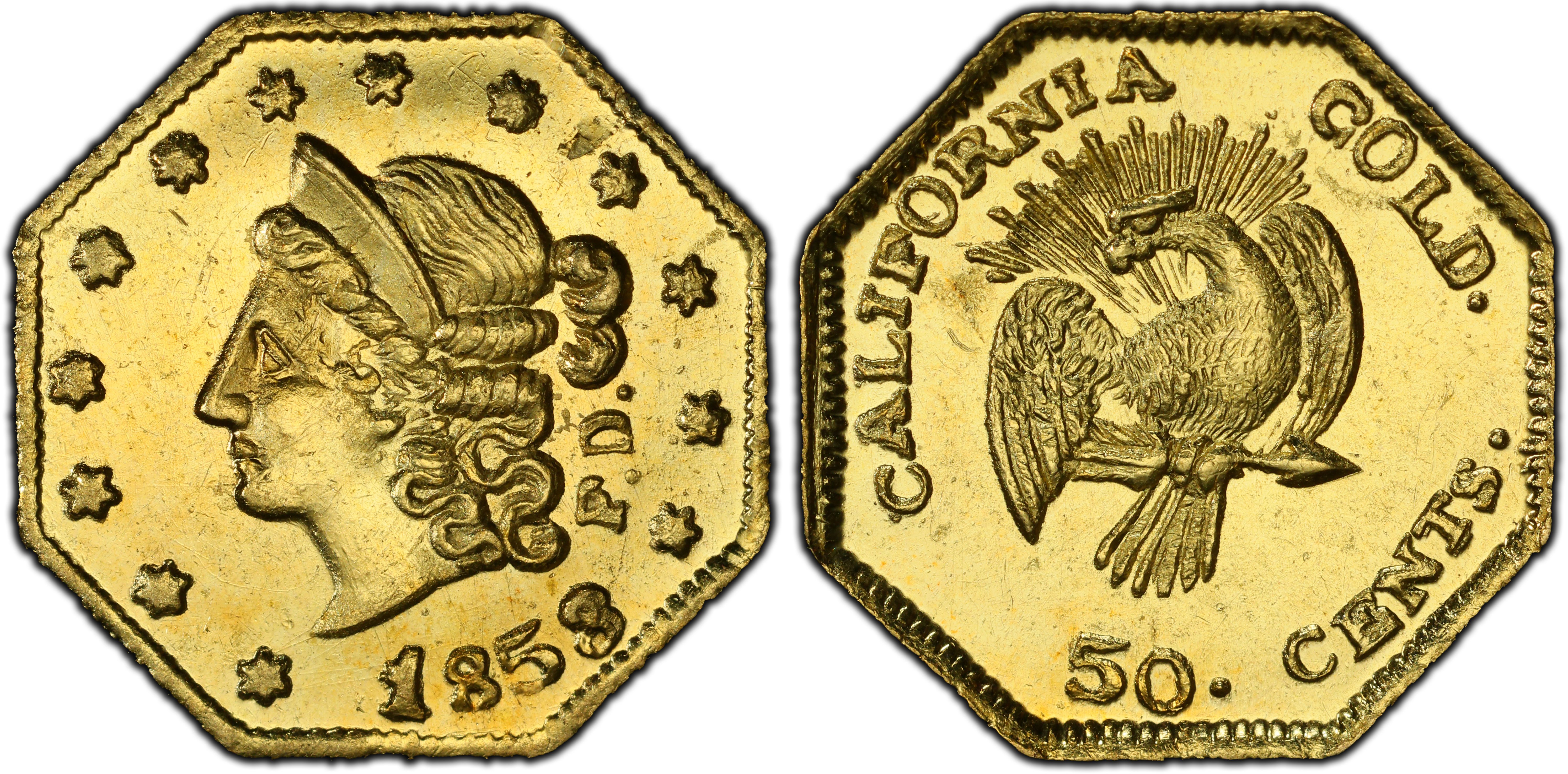
Obverse & Reverse
The 1853 'Peacock' Half Dollar is one of the most iconic and eagerly sought-after issues within the entire California Fractional Gold series. Its existence is a direct consequence of the chaotic and economically primitive conditions of the early California Gold Rush. Following the discovery of gold in 1848, a massive influx of population created a burgeoning economy, yet the region was starved for circulating coinage, particularly for small daily transactions. Gold dust, weighed in 'pinches,' proved to be an imprecise and untrustworthy medium of exchange. While several private mints began issuing larger denomination coins ($5 to $50), the need for fractional currency to supplant the confusing mix of foreign silver coins was acute. Manufacturing jewelers in San Francisco stepped into this void. The firm of Frontier, Deviercy & Co., active from 1852-1856, is credited with producing this specific piece. These tiny, octagonal gold coins were intended to pass for fifty cents in local commerce. They were crudely but effectively made using the 'hammer method,' where dies were struck by hand, leading to significant variations in strike quality. While their intrinsic gold value was often less than their face value, they were indispensable for a time. However, their minuscule size made them impractical and easy to lose, and as the official San Francisco Mint ramped up production of federal coinage after 1854, these private issues quickly fell out of favor for circulation. They soon found a new, enduring purpose as popular souvenirs and keepsakes—small, affordable tokens of the California adventure that could be easily mailed back East. The BG-302, with its distinctive and artistically appealing reverse, was a particular favorite, ensuring a higher survival rate than many of its more prosaic contemporaries. Today, it stands as a tangible link to the rugged commerce of the Gold Rush and the ingenuity of the private minters who served a vital economic need.
Associated EventCalifornia Gold Rush
Reason For MintingTo alleviate a severe shortage of small-denomination coinage for daily commercial transactions in Gold Rush-era San Francisco.
Minter HistoryFrontier, Deviercy & Co. was a prominent jewelry and watchmaking firm in San Francisco during the early 1850s. Composed of Constant-Jules Frontier and Amédée G. Deviercy, the company was one of several jewelers that transitioned into private minting to meet the region's desperate need for coinage. Their issues are often attributed to the hand of die-sinker Antoine Louis Nouizillet, a French engraver who produced many of the finest and most artistic dies of the period. The firm's creations, including the famed 'Peacock' variety, are noted for their relatively high quality of design and execution compared to other contemporary fractional gold pieces. They ceased coining operations around 1856 as the new U.S. Branch Mint in San Francisco began producing sufficient federal coinage to meet local needs.
Historical SignificanceThe BG-302 'Peacock' is a premier example of a 'Period One' California Fractional Gold coin, struck with the genuine intention of serving as circulating currency. Its popularity and memorable design have made it a cornerstone of the series, representing the resourcefulness of private enterprise in the absence of federal infrastructure during one of America's most pivotal economic and social migrations. It is a direct artifact of the transition from a gold dust economy to a standardized monetary system on the American frontier.
N/A (Breen-Gillio: BG-302)
DenominationG50C (Gold 50 Cents)
Minting Period1853
Assayer/MinterFrontier, Deviercy & Co. (Attributed to Antoine Louis Nouizillet)
Geographic OriginSan Francisco, California
Obverse DescriptionA Liberty Head, facing left, with a coronet inscribed LIBERTY. The head is surrounded by thirteen six-pointed stars arranged in an arc above and to the sides. The date, 1853, is below the bust.
Obverse InscriptionLIBERTY / 1853
Reverse DescriptionA heraldic eagle with outstretched wings, clutching an olive branch and arrows in its talons. A key diagnostic is the dramatic fan of 15 long, thin rays emanating from behind the eagle's head and wings, resembling a peacock's tail, which gives the coin its popular nickname. The denomination 1/2 is below the eagle.
Reverse InscriptionCALIFORNIA GOLD / 1/2
CompositionGold
Stated Fineness Actual FinenessVariable, typically 14 to 22 karats for Period One issues.
Weight0.75 grams
Diameter10.80 mm
EdgePlain
Unknown
Survival Estimate150-200
Rarity ScaleR-4 (Low)
The 'Peacock' is one of the most visually striking and popular designs in the entire field of fractional gold. It is prized by collectors as a key representative of the Period One issues that were made for actual circulation. Its memorable nickname and artistic reverse make it a highly sought-after type coin.
Key VarietiesThere are no major die varieties of the BG-302 recognized from the original minting period. As a Period One issue, there are no known later-date Proof restrikes or special collector issues; all known examples are business strikes intended for commerce or use as souvenirs at the time.
Authentication TipsGenuine examples exhibit a sharp, if sometimes uneven, strike from hand-hammered dies. The planchets are often slightly irregular. The surfaces should possess the characteristic luster of genuine gold, not the soapy or glassy look of many modern replicas. The details of the 'Peacock' rays and Liberty's hair should be finely engraved, not crude or mushy. Weight and diameter should conform to known specifications. Many counterfeits exist, often made of brass or thinly plated base metal; expertise is required for authentication.
Shopping ConsiderationsA premium quality example for the grade is defined by a bold, well-centered strike. Look for sharpness on the high points: Liberty's coronet and hair details, and the eagle's head and feathers. Weakness at the peripheries is common and acceptable, but central sharpness is key. Original, uncleaned surfaces with some remaining mint luster command significant premiums. Many surviving examples have been cleaned, polished, or used as jewelry, so searching for a coin with undisturbed 'skin' and pleasing eye appeal is paramount. Avoid examples with significant scratches, rim damage, or evidence of tooling or repair.
A coin's grade is its condition, rated on a 1-70 scale. For rare coins, this is the most critical factor in determining value, as a tiny difference in preservation can mean a huge difference in price.
Relevant Grade TypesAll original 1853 BG-302 'Peacock' coins are business strikes, produced for circulation and as souvenirs. They are found in Circulated grades (AG-3 to AU-58) and Mint State grades (MS-60 to MS-70). No Proof examples were struck during the original period of issue, and no later-date Proof restrikes are known to exist for this variety.
Mint State CharacteristicsUncirculated examples of the BG-302 are prized for their luster, which is typically frosty and radiant rather than deeply prooflike. The quality of the strike varies significantly due to the hand-hammering process; a well-struck MS example will show full detail on Liberty's hair and the eagle's feathers. Weakness is often seen on the peripheral stars and legends. Due to the softness of the gold and rudimentary handling, even high-grade Mint State coins will typically display some light contact marks or planchet imperfections.
Circulated Wear PatternsWear first becomes evident on the highest points of the design. On the obverse, friction will first appear on Liberty's cheek, the hair above her ear, and the letters of the coronet. On the reverse, the high points of the eagle's head, breast, and the upper portions of its wings will show the first signs of smoothing. In lower grades (VG and below), the date and stars will become faint, and the fine details of the peacock rays will begin to merge.
Key Factors For ValueFor the BG-302, value is driven by several key factors. First is strike: a sharply struck coin with full central details is always worth more than a weakly struck example of the same grade. Second is surface preservation; an example with original, lustrous surfaces free from harsh cleanings, polishing, or scratches is highly desirable. Eye appeal, including attractive original reddish-gold toning, adds a premium. Finally, certification by a top-tier grading service (PCGS or NGC) is standard, and a CAC sticker indicating premium quality for the assigned grade will often result in a significant price increase.
PCGS Price Guide
| Grade | Price | Population |
|---|---|---|
| 20 | $1,200.00 | 1 |
| 25 | $1,250.00 | N/A |
| 30 | $1,300.00 | 1 |
| 35 | $1,350.00 | N/A |
| 40 | $1,400.00 | 1 |
| 45 | $1,500.00 | N/A |
| 45+ | $1,520.00 | N/A |
| 50 | $1,600.00 | 1 |
| 50+ | $1,640.00 | N/A |
| 53 | $1,800.00 | N/A |
| 53+ | $1,820.00 | N/A |
| 55 | $1,900.00 | 5 |
| 55+ | $1,950.00 | N/A |
| 58 | $2,000.00 | 30 |
| 58+ | $2,100.00 | N/A |
| 60 | $2,200.00 | 4 |
| 61 | $2,250.00 | 9 |
| 62 | $2,850.00 | 29 |
| 62+ | $3,150.00 | N/A |
| 63 | $3,750.00 | 29 |
| 63+ | $4,200.00 | 1 |
| 64 | $5,850.00 | 15 |
| 64+ | $7,000.00 | N/A |
| 65 | $10,000.00 | 3 |
| 65+ | $12,000.00 | N/A |
| 66 | $20,000.00 | 1 |