1853 G50C BG-420 (Regular Strike)
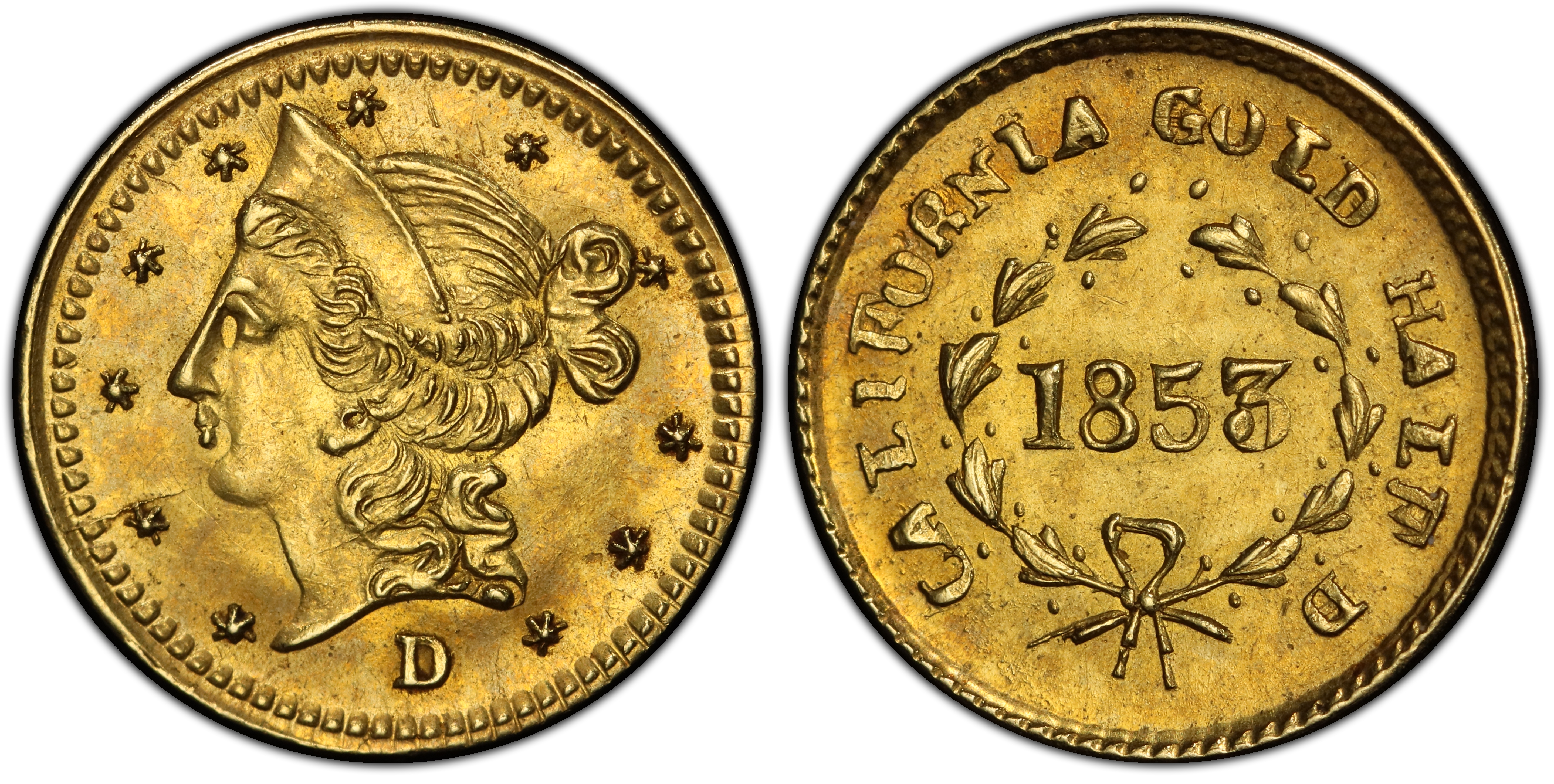
Obverse & Reverse
The 1853 BG-420 50-cent piece stands as a tangible artifact from the most chaotic and formative era of the California Gold Rush. Following the discovery of gold in 1848, a massive influx of over 300,000 people descended upon California, transforming it from a sparsely populated territory into a booming, chaotic economy. While vast quantities of gold were being extracted, a severe shortage of circulating small-denomination coinage crippled daily commerce. Transactions for everyday goods and services were often conducted with awkward pinches of gold dust, a system prone to waste and dispute. The United States Mint was slow to respond, with the San Francisco Mint not becoming fully operational until 1856. Into this monetary vacuum stepped a number of private assayers and jewelers, who began striking their own coins to facilitate trade. These 'Period One' (1852-1857) issues, unlike later souvenir pieces, were created out of genuine commercial necessity and were generally made to a high standard of weight and fineness, intended to circulate as a trusted medium of exchange. Among these pioneering minters was M. Deriberpie, a San Francisco jeweler. In 1853, at the height of the coinage shortage, Deriberpie produced several varieties of fractional gold, including this round 50-cent piece. These coins were likely struck using the 'hammer method,' where a planchet was placed between two dies on an anvil and struck with a sledgehammer, resulting in coins of varying strike quality. The BG-420 is a testament to this private enterprise, a direct response to the failure of the federal government to meet the economic needs of its newest and most dynamic population center. Its extreme rarity today suggests a very small original mintage, likely produced to satisfy the immediate needs of Deriberpie's local clientele before being supplanted by the eventual flood of federal coinage.
Associated EventCalifornia Gold Rush
Reason For MintingTo alleviate a severe shortage of small-denomination coinage for daily commerce in Gold Rush-era San Francisco.
Minter HistoryM. Deriberpie was a French jeweler operating in San Francisco during the early 1850s. Along with other craftsmen like Antoine Louis Nouizillet, he was one of the primary producers of 'Period One' fractional gold pieces. His issues are identified by his initial, 'D', placed prominently on the obverse. Deriberpie's coinage, particularly his dollar and half-dollar varieties, played a crucial, albeit unofficial, role in the region's economy prior to the establishment of full-scale operations at the San Francisco Mint.
Historical SignificanceThe BG-420 is a prime example of privately issued coinage created to solve a critical economic problem during America's westward expansion. It represents the ingenuity and initiative of local merchants in the absence of federal infrastructure and is one of the rarest surviving examples of the fractional gold pieces that actually circulated during the height of the Gold Rush.
K-Unlisted
Denomination50 Cents
Minting Period1853
Assayer/MinterM. Deriberpie
Geographic OriginSan Francisco, California
Obverse DescriptionFeatures a Liberty Head portrait facing left, stylistically similar to the contemporary U.S. Coronet gold coinage. The hair is tied in a bun at the back. Thirteen stars encircle the portrait. The date, 1853, is below the truncation of the neck. The minter's initial, a small, crisp 'D' for Deriberpie, is located in the field below the chin, between the bust tip and the date.
Obverse Inscription1853
Reverse DescriptionA simple wreath composed of two branches tied together by a bow at the bottom encircles the denomination. The denomination is expressed as '1/2' in the center.
Reverse Inscription1/2
CompositionGold
Stated Fineness Actual FinenessPeriod One issues were typically made from native California gold, which was naturally alloyed with silver, resulting in a fineness ranging from 14 to 22 karats.
Weight0.85 grams
Diameter11.00 mm
EdgePlain
Unknown, but presumed to be extremely small.
Survival EstimateApproximately 13 known examples, according to the 2003 revision of the Breen-Gillio reference. Census reports from PCGS and NGC combined show only a handful have been professionally graded.
Rarity ScaleLow R-7 (13-30 known)
This coin is highly sought after as it combines extreme rarity (Low R-7), a link to the authentic commercial period of the Gold Rush ('Period One'), and attribution to a known, named minter, M. Deriberpie. Its status as a circulating private issue makes it a cornerstone piece for advanced collectors of territorial gold.
Key VarietiesThe BG-420 itself is a single, distinct die marriage. No major varieties, patterns, or restrikes from the original period are known. Later souvenir pieces and modern replicas exist for the general type, but they are not considered part of the original BG-catalogued series and are typically uniface or bear fantasy reverses with bears.
Authentication TipsThe key diagnostic is the small, sharp 'D' of Deriberpie below the bust on the obverse. Genuine examples are very thin, roughly the thickness of a business card. They should exhibit the characteristics of a hammer strike, which may include a slightly uneven surface or minor strike weakness opposite high-relief areas. Fakes are often thicker, have a soapy or cast-like appearance, incorrect details, and often feature a bear on the reverse instead of the simple '1/2' within a wreath. Any piece appearing weakly struck is more likely to be genuine than modern replicas, which are often sharply defined.
Shopping ConsiderationsFor a coin of this rarity, any example is a major acquisition. A 'premium quality' specimen would be one that is well-centered and sharply struck for the issue, with a bold date and minter's initial. Look for original, undisturbed surfaces that may exhibit a soft, satiny luster; some examples are known with semi-reflective or prooflike qualities. Given the softness of the gold and the primitive minting process, small planchet flaws or adjustment marks are not uncommon and may not significantly detract. Avoid examples that have been harshly cleaned, polished, or mounted in jewelry, as this drastically reduces value. Pay close attention to the integrity of the fields and the high points of the design for any signs of tooling or repair.
A coin's grade is its condition, rated on a 1-70 scale. For rare coins, this is the most critical factor in determining value, as a tiny difference in preservation can mean a huge difference in price.
Relevant Grade TypesAll original 1853 BG-420 half dollars were struck as business strikes for circulation and are graded on the Circulated (1-58) and Mint State (MS, 60-70) scales. The vast majority of survivors are in high circulated (AU) or lower Mint State grades. No true Proofs were struck during the original minting period, and there are no known authorized restrikes.
Mint State CharacteristicsAn uncirculated BG-420 is defined by the presence of original mint luster. This luster is typically soft and satiny, though some are known with more reflective, prooflike fields. Strike quality varies due to the hammer-striking process; a full strike with sharp detail on Liberty's hair and the wreath's leaves is highly desirable. Even Mint State examples may show minor planchet imperfections or handling marks due to the primitive production and the softness of the high-karat gold.
Circulated Wear PatternsWear first appears on the highest points of the design. On the obverse, this includes Liberty's cheek, the hair above the ear, and the eyebrow. On the reverse, the high points of the wreath's leaves and the bow will show initial friction and flattening. In lower grades (VF and below), the stars and the date will begin to lose their sharpness, eventually merging with the fields.
Key Factors For ValueRarity is paramount, so any certified, problem-free example is valuable. Within a given grade, value is driven by strike and surface quality. A sharply struck coin with minimal distracting marks and original, attractive coloration (often a rich yellow or rose-gold) will command a significant premium. Eye appeal is critical; examples with smooth, lustrous fields are prized over those with choppy or heavily abraded surfaces. A CAC sticker for this issue would be a strong endorsement of quality for the grade and would add a substantial premium.
PCGS Price Guide
| Grade | Price | Population |
|---|---|---|
| 50 | N/A | N/A |
| 58 | $9,750.00 | 2 |
| 58+ | $10,250.00 | N/A |
| 60 | $10,750.00 | N/A |
| 61 | $11,500.00 | N/A |
| 62 | $12,000.00 | 3 |
| 62+ | $12,750.00 | N/A |
| 63 | $13,250.00 | 2 |
| 63+ | $15,000.00 | N/A |
| 64 | $20,000.00 | N/A |