1854 G25C BG-105 (Regular Strike)
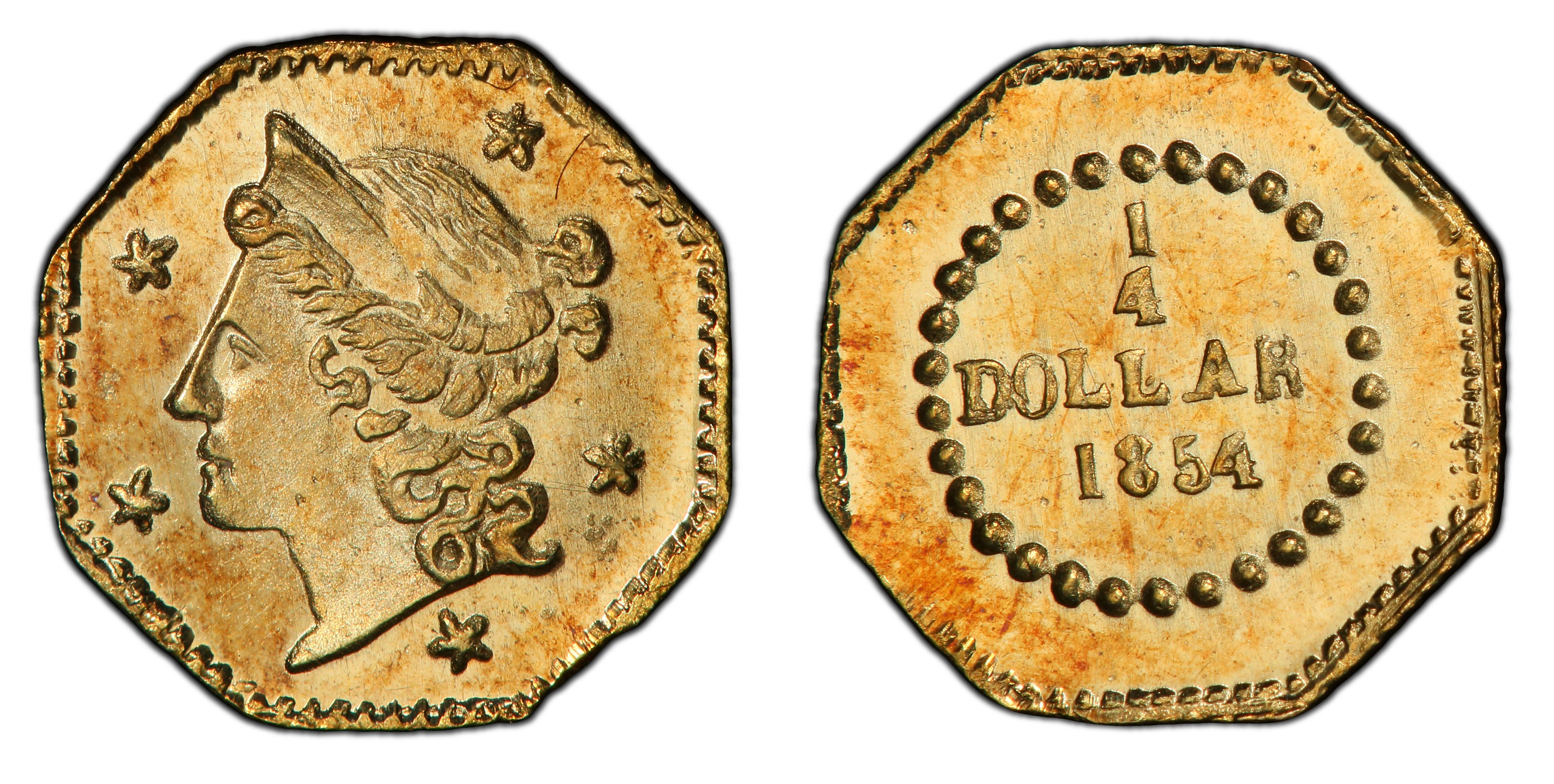
Obverse & Reverse
The 1854 Octagonal 25 Cents, cataloged as Breen-Gillio 105, is a quintessential artifact from the chaotic and economically vibrant zenith of the California Gold Rush. This period, now known to numismatists as 'Period One' (1852-1857), was marked by a peculiar monetary paradox: a land awash in raw gold, yet starved for small-denomination coinage to facilitate everyday transactions. Gold dust, while the basis of all wealth, was an impractical and often inequitable medium for minor purchases, subject to spillage, theft, and inconsistent measurement. The newly opened U.S. Branch Mint in San Francisco in 1854 focused its initial efforts on larger gold denominations and had yet to produce sufficient federal silver coinage to satisfy the booming city's commercial needs. Into this vacuum stepped a group of enterprising and often anonymous private minters, typically jewelers of French or German extraction, who possessed the skills and tools for die-sinking and striking. These craftsmen began producing their own fractional gold coins in quarter-dollar, half-dollar, and dollar denominations. The BG-105 was one such issue, created not as a souvenir, but as a genuine attempt to provide a circulating medium of exchange. Struck by hand using crude screw or hammer presses, these coins were notoriously underweight relative to their face value, a fact largely ignored by a commerce-starved public who preferred the convenience of a tangible gold token to the uncertainty of gold dust. These 'Period One' issues were accepted in trade, circulated freely in the saloons, laundries, and general stores of San Francisco, and served their purpose until the mid-1850s when federal coinage finally became plentiful. The BG-105, like its contemporaries, represents a fascinating chapter of monetary improvisation and the entrepreneurial spirit that defined one of America's most transformative eras.
Associated EventCalifornia Gold Rush
Reason For MintingTo alleviate a severe shortage of small change for daily commerce in Gold Rush-era San Francisco.
Minter HistoryThe specific maker of the BG-105 variety is unknown, a common trait for many 'Period One' fractional gold pieces. Research by numismatists like Walter Breen and Ronald J. Gillio attributes the majority of these anonymous issues to a small community of manufacturing jewelers operating in San Francisco. These individuals, such as M. Deriberpe, Antoine Louis Nouizillet, and the firm of Frontier, Deviercy & Co., possessed the requisite skills for creating dies and striking coins. They operated in a legal gray area, producing what was essentially a necessary form of token money. Their primary business was jewelry, but the pressing local demand for coinage presented a lucrative opportunity. The workmanship on these early pieces varies from crude to surprisingly refined, reflecting the varied skill levels of their makers. The minter of BG-105 was clearly competent, producing a well-defined, if simple, design that was suitable for its utilitarian purpose.
Historical SignificanceThe BG-105 is a tangible link to the primitive but functional economy of the California Gold Rush, representing a period before federal coinage became ubiquitous in the West. It is a prime example of private enterprise stepping in to solve a critical monetary problem, demonstrating how commerce adapted in the absence of government-supplied infrastructure. Its existence validates contemporary accounts of these pieces being used in daily transactions, making it a key historical document of American economic development.
N/A
Denomination25 Cents
Minting Period1854
Assayer/MinterUnknown San Francisco Jeweler
Geographic OriginSan Francisco, California
Obverse DescriptionA large, somewhat crude Liberty Head facing left, her hair tied in a bun. She is surrounded by five, five-pointed stars arranged in an arc above her head and to the left and right.
Obverse Inscription Reverse DescriptionThe denomination '25 CENTS' is arranged in two lines at the center, surrounded by a circle of periods or beads. The date '1854' appears below the denomination, also within the circle.
Reverse Inscription25 CENTS 1854
CompositionGold
Stated Fineness Actual FinenessVaries, but typically struck from native California gold with natural silver alloys, resulting in fineness between .800 and .900.
Weight0.25 grams
Diameter9.50 mm
EdgePlain
Unknown
Survival Estimate200-300 coins
Rarity ScaleR-3 (Scarce)
The BG-105 is highly sought after as a representative 'Period One' issue, the class of fractional gold that is believed to have genuinely circulated. Its octagonal shape and clear date make it a visually appealing and historically significant type coin for collectors of Gold Rush-era numismatics. Its relative affordability compared to rarer varieties makes it an accessible entry point into this fascinating field.
Key VarietiesThe primary variety is the regular strike BG-105. No known major variations, patterns, or restrikes from the original minting period exist. It is crucial to distinguish this and other denominated 'Period One' and 'Period Two' issues from the vast number of non-denominated, often gold-plated brass tokens or 'charms' made from the late 19th century onward, which have little numismatic value.
Authentication TipsGenuine BG-105 coins must have the denomination '25 CENTS'. The style of the Liberty head and the reverse lettering should match known examples. Many counterfeits are cast, exhibiting a mushy appearance and sometimes a seam on the edge. Genuine pieces were struck and often show signs of a weak or uneven strike, particularly at the centers or periphery, due to the crude manufacturing process. Be wary of pieces with perfect, full strikes. The weight should be very low, approximately 0.25 grams. Replicas are often made of gilt brass and are non-magnetic, so weight and specific gravity tests are key. Authentication by a major grading service (PCGS or NGC) is highly recommended.
Shopping ConsiderationsA premium quality BG-105 for its grade will exhibit a sharp strike for the variety, particularly on Liberty's hair details and the numerals of the date. Look for clean, original surfaces that have not been harshly cleaned or polished; a natural, slightly subdued luster is desirable. Due to the thinness of the planchets, some weakness is expected, but examples with exceptional central detail command a premium. Avoid coins that are bent, have rim damage, or show evidence of having been mounted in jewelry, as this was a common fate for these small gold pieces. Attractive, original reddish-gold or greenish-gold toning from the native alloy is a significant plus for eye appeal.
A coin's grade is its condition, rated on a 1-70 scale. For rare coins, this is the most critical factor in determining value, as a tiny difference in preservation can mean a huge difference in price.
Relevant Grade TypesOriginal period issues of BG-105 were business strikes intended for circulation. They are found in Circulated grades (AG-3 to AU-58) and, more commonly for this issue, in Mint State (MS, 60-70) due to their novelty and tendency to be saved. No proofs were struck during the original period of issue, and there are no known later-date proof restrikes.
Mint State CharacteristicsUncirculated examples of BG-105 are defined by their luster, which is typically satiny rather than deeply prooflike. The strike is a critical factor; many were weakly struck and may show flatness on the high points even in MS grades. A well-struck example with full central details is rare and desirable. Small planchet flaws, fissures, or adjustment marks are common from the crude manufacturing process and may not detract from the grade if they are not distracting. Contact marks are common due to the softness of the gold.
Circulated Wear PatternsWear first appears on the highest points of Liberty's hair, cheek, and the coronet. On the reverse, the numerals '25' and the date will show initial friction and loss of detail. On lower grade examples (VF and below), the stars on the obverse will become faint and the legends on the reverse will begin to merge with the fields. The sharp corners of the octagonal shape are also susceptible to wear and rounding.
Key Factors For ValueBeyond the numerical grade, value is driven by three main factors: 1) Surface Quality: An example with original, uncleaned 'skin' and attractive luster is far more valuable than a cleaned, hairlined, or polished specimen of the same grade. 2) Strike: A sharp, well-centered strike is a significant value driver, as many BG-105s are softly struck. 3) Eye Appeal: Coins with a pleasing, original color and mark-free surfaces are highly prized. A CAC sticker for this issue indicates premium quality for the grade and will result in a significant price premium.
PCGS Price Guide
| Grade | Price | Population |
|---|---|---|
| 50 | $250.00 | 2 |
| 50+ | $260.00 | N/A |
| 53 | $275.00 | 2 |
| 53+ | $285.00 | N/A |
| 55 | $300.00 | 7 |
| 55+ | $310.00 | N/A |
| 58 | $325.00 | 13 |
| 58+ | $340.00 | N/A |
| 60 | $365.00 | 3 |
| 61 | $400.00 | 13 |
| 62 | $475.00 | 49 |
| 62+ | $525.00 | N/A |
| 63 | $575.00 | 53 |
| 63+ | $625.00 | N/A |
| 64 | $675.00 | 75 |
| 64+ | $750.00 | N/A |
| 65 | $850.00 | 22 |
| 65+ | $1,150.00 | N/A |
| 66 | $1,650.00 | 7 |
| 66+ | $2,350.00 | N/A |
| 67 | $4,000.00 | 1 |