1854 G25C BG-103 (Regular Strike)
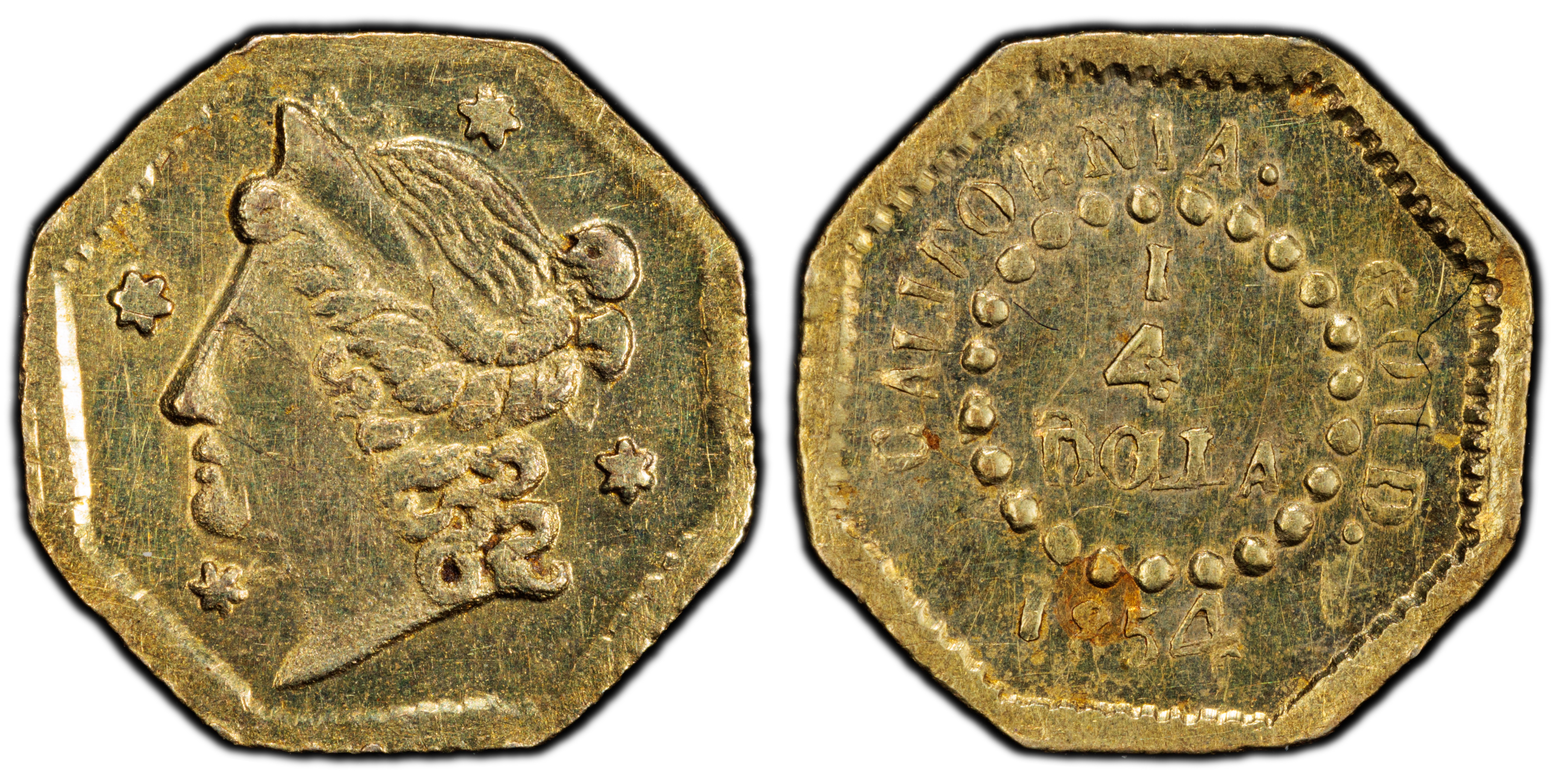
Obverse & Reverse
The 1854 BG-103 25 Cents represents a fascinating and exceedingly rare artifact from the chaotic, commerce-starved economy of Gold Rush California. In the early 1850s, the massive influx of population driven by the discovery of gold created a paradoxical economic crisis: an abundance of gold dust and large-denomination coins, but a severe shortage of small change for daily transactions. A 'pinch' of gold dust, imprecise and prone to dispute, was a poor substitute for standardized coinage for buying a drink or a loaf of bread. Federal efforts were inadequate; the new San Francisco Mint, established in 1854, produced only a small quantity of gold dollars and silver coins, most of which were hoarded or exported. Into this void stepped private jewelers and metallurgists, many of French origin, who began striking their own small-denomination gold pieces. These 'Period One' issues, struck from 1852-1856, were intended for actual circulation and generally resembled the designs of official U.S. coinage to foster public acceptance. Frontier, Deviercy & Co. was one such firm of San Francisco jewelers who produced these necessary tokens. Their method, like their contemporaries, was often crude, employing hand-cut dies and manual screw or hammer presses, resulting in coins of varying quality and frequent die imperfections. The BG-103 is a prime example of this expediency. It was struck using a deteriorating obverse die from a previous issue (BG-102), showing crumbling stars, paired with a new reverse die notable for a dramatic 'DOLLA' spelling error. These pieces were vital lubricants of commerce, though they were technically illegal private issues and were generally underweight for their stated value. By 1857, sufficient federal coinage had entered circulation, rendering these private issues obsolete. Most were eventually melted, contributing to the immense rarity of survivors today. The BG-103, with only two or three examples believed to exist, is a ghost of this vibrant and tumultuous era, representing a tangible link to the daily life of a 49er and the resourcefulness that defined the Gold Rush frontier.
Associated EventCalifornia Gold Rush
Reason For MintingTo alleviate a severe shortage of small denomination coinage for everyday commercial transactions in Gold Rush-era California.
Minter HistoryPierre Frontier and Eugene Deviercy were San Francisco-based jewelers and die-sinkers active during the Gold Rush. Like many such craftsmen in the city, they were of French origin and applied their skills to meet the region's desperate need for circulating small change. Their firm, Frontier, Deviercy & Co., produced a variety of octagonal and round fractional gold pieces, typically marked with an 'FD' monogram or their full names. Their work is characteristic of 'Period One' issues: functional, intended for commerce, but often exhibiting die varieties, errors, and hasty production. After the initial period, the firm continued under various partnerships, producing souvenir 'jeweler's issues' into the 1870s.
Historical SignificanceAs a 'Period One' issue, the BG-103 is a historically significant piece that served as an essential money substitute during the formative years of California's economy. Its existence demonstrates the failure of the federal government to adequately supply coinage to the rapidly growing West and the ingenuity of private enterprise in solving the problem. Its extreme rarity makes it a premier numismatic treasure and a key artifact of American economic history.
BG-103
Denomination25 Cents
Minting Period1854
Assayer/MinterFrontier, Deviercy & Co.
Geographic OriginSan Francisco, California
Obverse DescriptionA large Liberty Head facing left, her hair tied in a bun and wearing a coronet inscribed LIBERTY. The portrait is flanked by four, five-pointed stars, which are visibly crumbling and ill-defined due to the advanced state of die deterioration.
Obverse InscriptionLIBERTY
Reverse DescriptionThe central inscription '1/4 DOLLA 1854' is surrounded by a circle of dots. This variety is defined by the prominent misspelling of 'DOLLAR' as 'DOLLA' and a sharply repunched letter 'D'.
Reverse Inscription1/4 DOLLA 1854
CompositionGold
Stated Fineness Actual FinenessPeriod One fractionals were typically made from native California gold, which contained natural silver alloys, resulting in fineness ranging from .800 to .900. Specific analysis for this variety is unknown.
Weight0.44 grams
Diameter9.00 mm
EdgePlain
Extremely low; likely struck until the reverse die failed.
Survival Estimate2 or 3 specimens known.
Rarity ScaleR-8 (per the Sheldon Scale, indicating 2-3 known)
This coin is a 'holy grail' for specialists in California Fractional Gold. Its appeal lies in its absolute rarity, unique and dramatic 'DOLLA' blunder, and its direct connection to the authentic commercial activity of the Gold Rush. It is a landmark rarity that defines an advanced collection.
Key VarietiesThe BG-103 itself is the key variety, defined by the marriage of the late-state, crumbling BG-102 obverse die with the 'DOLLA' reverse. No major variations from its original minting are known. No later-date restrikes or special collector issues of the BG-103 variety have ever been identified.
Authentication TipsThe primary diagnostic is the clear 'DOLLA' spelling on the reverse, paired with a repunched 'D'. The obverse must show characteristics of a late die state, specifically weakness and a crumbling or 'fuzzy' appearance to the stars. The overall fabric should be consistent with hand-struck Period One fractionals, which can appear crude. Fakes are often too sharp, too thick, or have incorrect lettering fonts. Any piece not matching published photos in the Breen-Gillio reference should be considered suspect.
Shopping ConsiderationsAcquisition of a BG-103 is a major numismatic event. A 'premium quality' example would simply be one that is authenticated and graded by a top-tier service (PCGS or NGC). Given the extreme rarity, any specimen is desirable. A buyer should prioritize sharpness of the legends, particularly the 'DOLLA' error. Original, uncleaned surfaces with some remaining luster would be extraordinary. Faint scratches on Liberty's cheek have been noted on known examples and can serve as provenance markers. Due to the crudeness of manufacture, some areas of weak strike are to be expected and are not necessarily a detriment.
A coin's grade is its condition, rated on a 1-70 scale. For rare coins, this is the most critical factor in determining value, as a tiny difference in preservation can mean a huge difference in price.
Relevant Grade TypesOriginal period issues of BG-103 were business strikes intended for circulation, found in Circulated (1-58) and Mint State (MS, 60-70) grades. Given the coin's immediate rarity and likely very brief period of issue, all known survivors are in high grades (AU or MS). No Proof (PR/PF) examples were struck during the original period of issue, and no later-date Proof restrikes of this variety are known to exist.
Mint State CharacteristicsAn uncirculated BG-103 would be defined primarily by its surface preservation and luster. Luster is typically satiny and can be somewhat reflective in the fields. The strike is often bold on the central devices but may show weakness at the periphery. The obverse stars are inherently weak due to the late die state. Small planchet flaws or adjustment marks are common for the series and generally accepted. The presence of faint, old scratches on Liberty's cheek may be a pedigree marker for one of the known specimens.
Circulated Wear PatternsOn this octagonal Liberty Head type, wear would first appear on the highest points: Liberty's cheekbone, the hair above her eye and ear, and the coronet's edge. On the reverse, the numerals of the date and the letters in 'DOLLA' would be the first elements to show friction and lose their sharpness.
Key Factors For ValueFor a coin of this magnitude, authentication is the paramount factor. Value is then determined by the grade assigned by PCGS or NGC. A Mint State example would command a world-record price for a fractional gold piece. Surface quality is critical; an example with original, undisturbed luster and minimal contact marks would be considered superior. The 'eye appeal,' derived from factors like attractive straw-gold coloration and a bold impression of the key 'DOLLA' error, significantly influences value. A CAC sticker would provide a further premium, confirming quality within the assigned grade.
PCGS Price Guide
| Grade | Price | Population |
|---|---|---|
| 58 | N/A | N/A |
| 62 | $110,000.00 | 3 |
| 62+ | $120,000.00 | N/A |
| 63 | $135,000.00 | 1 |