1853 G$1 BG-530 (Regular Strike)
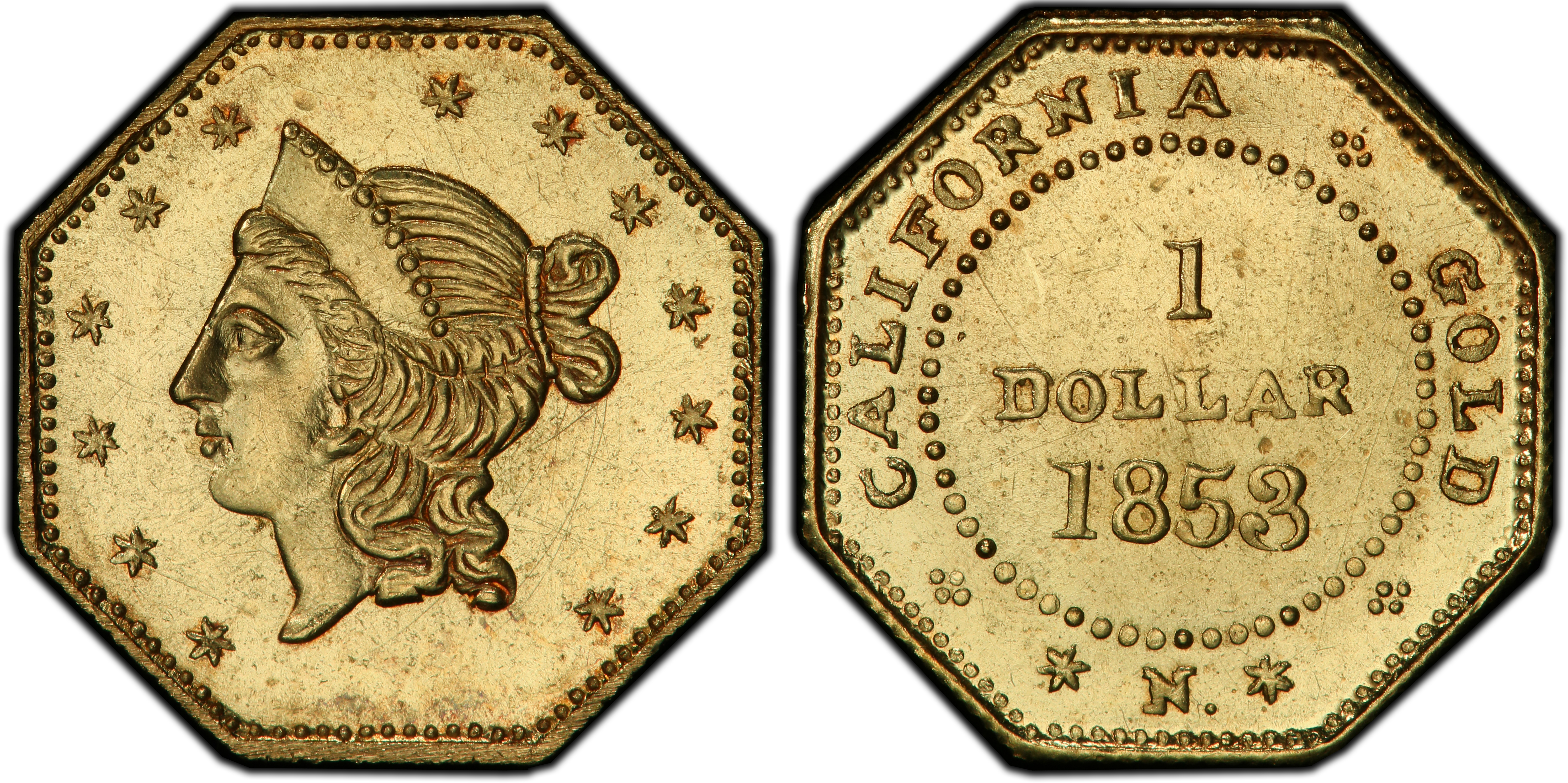
Obverse & Reverse
The 1853 Octagonal Gold Dollar, cataloged as Breen-Gillio 530, is a quintessential artifact of the California Gold Rush. Following the discovery of gold at Sutter's Mill in 1848, a massive influx of over 300,000 people descended upon California, creating a vibrant but chaotic economy. A critical problem arose almost immediately: a severe shortage of small-denomination coinage for everyday transactions. Federal coins were scarce on the West Coast, and shipping them was slow and perilous. In the early days, commerce was often conducted with pinches of gold dust, an imprecise and fraught method. To fill this monetary void, private jewelers and metallurgists in San Francisco began striking their own coins in 25-cent, 50-cent, and one-dollar denominations. These are known today as California Fractional Gold. The BG-530 belongs to 'Period One' (1852-1856) of this coinage, a time when the pieces were genuinely intended to circulate and alleviate the coin shortage. Unlike later 'Period Two' issues, which were often underweight and made as souvenirs, Period One coins were generally of honest weight and fineness, closely mimicking the design of the official U.S. Liberty Head gold dollars. The manufacturing process was crude; planchets were often hand-cut, and the coins were struck using a hammer method. This involved placing a blank between two dies and striking the top die with a sledgehammer, resulting in coins of varying strike quality and irregular shapes. The BG-530's octagonal form was a popular design choice, distinguishing it from federal coinage while still being practical. These coins were indispensable to the regional economy, allowing miners and merchants to conduct daily business, from buying supplies to paying for a drink. The era of private coinage began to wane as the San Francisco Mint started producing federal coins in 1854, and the Coinage Act of 1864 eventually made the practice illegal. Most fractional gold pieces were eventually melted down, contributing to their modern-day rarity and historical allure.
Associated EventCalifornia Gold Rush
Reason For MintingTo alleviate a severe shortage of small-denomination circulating coinage for daily commerce in Gold Rush-era California.
Minter HistoryThe minter of BG-530, like many Period One California Fractional Gold issuers, is unknown. The pieces were produced anonymously by various jewelers and artisans in San Francisco who possessed the skills to work with gold but often chose not to mark their products. This anonymity may have been a way to avoid scrutiny or simply a reflection of the informal and urgent nature of their production. These private minters were essential to the functioning of the local economy before the establishment and full operation of the federal San Francisco Mint.
Historical SignificanceThe BG-530 is a tangible link to the chaotic, entrepreneurial-driven economy of the California Gold Rush. It represents a period of American history where private citizens stepped in to fulfill a basic governmental function—the creation of money—out of sheer necessity. As a 'Period One' issue, it is a genuine circulating coin of the era, not a later souvenir, making it a key piece for understanding the economic realities faced by the 'Forty-Niners'.
BG-530
Denomination$1
Minting Period1853
Assayer/MinterAnonymous
Geographic OriginSan Francisco, California
Obverse DescriptionA bust of Liberty facing left, her hair tied in a bun. She is surrounded by thirteen stars, representing the original colonies.
Obverse InscriptionCALIFORNIA GOLD
Reverse DescriptionThe denomination '1 DOLLAR' and the date '1853' are enclosed within a simple wreath.
Reverse Inscription1 DOLLAR 1853
CompositionGold
Stated Fineness Actual FinenessVaries, but Period One issues are generally of relatively high fineness for the series.
Diameter11.50 mm
EdgePlain
Unknown
Survival EstimateFewer than 500
Rarity ScaleR-4 (Scarce)
This coin is highly sought after for its direct connection to the California Gold Rush, its distinctive octagonal shape, and its status as a circulating 'Period One' issue. It offers a more accessible entry point into the world of pioneer gold than the larger, prohibitively expensive slugs and territorial coins.
Key VarietiesThe primary variety is the regular business strike. There are no known proofs, restrikes, or patterns from the period of issue for this specific variety. Collectors should distinguish this and other Period One (1852-1856) issues, which were made for commerce, from Period Two (1859-1882) 'jeweler's issues' that were often underweight and made as souvenirs, and Period Three issues which were illegally and clandestinely made with backdates.
Authentication TipsDue to the high number of counterfeits and modern replicas, third-party certification by PCGS or NGC is highly recommended. Genuine pieces have a characteristic crude, hand-made quality. Look for a somewhat soft strike and natural, antique gold toning. Replicas are often brassy, have a soapy or prooflike sheen, and may feature incorrect design details or modern-style lettering. The weight and specific gravity can also be key indicators of authenticity.
Shopping ConsiderationsA premium quality example for its grade will exhibit a bold strike for the issue, especially on Liberty's hair and the digits of the date. Seek out coins with minimal distracting marks and original, uncleaned surfaces that show a nice 'old gold' patina. Weakness of strike is common due to the hammer-striking process, but examples with better-than-average central detail command significant premiums. Avoid coins that have been used as jewelry, which may show evidence of mounting, tooling, or excessive cleaning. Eye appeal is paramount for this series.
A coin's grade is its condition, rated on a 1-70 scale. For rare coins, this is the most critical factor in determining value, as a tiny difference in preservation can mean a huge difference in price.
Relevant Grade TypesAll original 1853 BG-530 dollars are business strikes intended for circulation. They are found in Circulated grades (AG-3 to AU-58) and, more rarely, in Mint State grades (MS-60 to MS-70). No Proof (PR/PF) examples were struck during the original period of issue, and no later-date Proof restrikes are known to exist for this variety. Any piece described as a 'Proof' is almost certainly a modern replica.
Mint State CharacteristicsAn uncirculated BG-530 will display original mint luster, which is typically soft and satiny rather than bright and flashy. Due to the crude manufacturing process, even Mint State examples can show significant strike weakness, particularly on the highest points of Liberty's hair and the wreath on the reverse. Small planchet flaws, fissures, or adjustment marks are not uncommon and are often accepted as part of the coin's character. Contact marks are common due to the softness of the gold.
Circulated Wear PatternsWear first appears on the high points of the design. On the obverse, check for flatness on Liberty's cheek, the hair above her eye, and the top of her ear. On the reverse, the highest parts of the wreath and the digits of the date will show wear first. In lower grades (VG and below), the stars and letters in the legends will begin to merge with the fields.
Key Factors For ValueFor the BG-530, value is primarily driven by grade (condition) and surface quality. An example with original, uncleaned surfaces will always be worth more than a cleaned or polished coin of the same grade. Strike sharpness is a major factor; a well-struck coin with full details is rare and commands a substantial premium. Eye appeal, including attractive original toning and a lack of distracting marks, is critical. Certification by a top-tier service (PCGS or NGC) is essential for market acceptance, and a CAC sticker indicating premium quality for the grade will add a further premium.
PCGS Price Guide
| Grade | Price | Population |
|---|---|---|
| 40 | $400.00 | 2 |
| 45 | $425.00 | 9 |
| 45+ | $435.00 | N/A |
| 50 | $475.00 | 28 |
| 50+ | $500.00 | N/A |
| 53 | $525.00 | 32 |
| 53+ | $550.00 | N/A |
| 55 | $625.00 | 89 |
| 55+ | $675.00 | N/A |
| 58 | $775.00 | 126 |
| 58+ | $825.00 | N/A |
| 60 | $900.00 | 10 |
| 61 | $1,000.00 | 33 |
| 62 | $1,300.00 | 49 |
| 62+ | $1,450.00 | N/A |
| 63 | $1,750.00 | 16 |
| 63+ | $2,500.00 | 1 |
| 64 | $3,500.00 | 2 |