1853 G$1 BG-524 (Regular Strike)
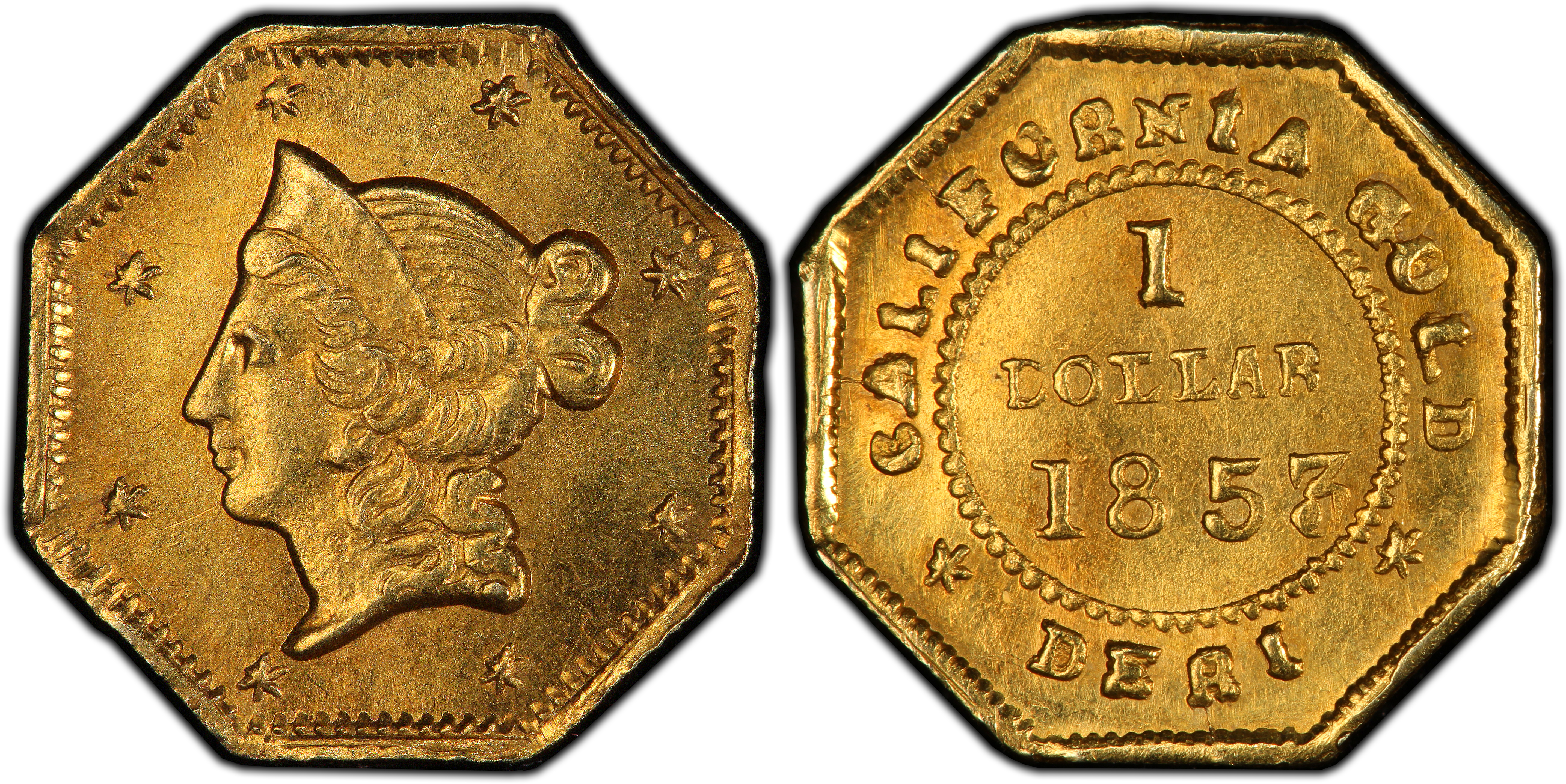
Obverse & Reverse
The 1853 Octagonal Gold Dollar, cataloged as Breen-Gillio 524, is a quintessential artifact from the chaotic and economically vibrant era of the California Gold Rush. Following the discovery of gold at Sutter's Mill in 1848, a massive influx of prospectors and merchants flooded into California, creating a dynamic economy almost overnight. While gold dust and large-denomination private ingots served for substantial transactions, the region suffered from a chronic and crippling shortage of small-denomination coinage for everyday commerce. A shave, a drink, or a meal could not be easily purchased with a pinch of gold dust, a notoriously inaccurate and inconsistent method of exchange. Into this monetary vacuum stepped a number of enterprising jewelers and metalsmiths in San Francisco who began striking their own fractional-denomination coins in 25-cent, 50-cent, and one-dollar values. These 'Period One' issues, struck from 1852 to 1857, were intended to and did function as circulating currency, albeit unofficially. The BG-524 was one such issue, attributed to the hand of M. Deriberpie, a French jeweler whose mark 'DERI' often appeared on his work. These tiny gold pieces were crudely but effectively manufactured, typically by the 'hammer method,' where dies were struck by hand. This resulted in coins of variable strike quality, often with weakness in some areas. While intended to facilitate trade, their intrinsic gold value was consistently less than their face value, making them a highly profitable venture for the minters and a form of token coinage for the public. Despite being underweight, they were generally accepted in local commerce out of sheer necessity. However, as federal coinage from the newly established San Francisco Mint (1854) became more plentiful, the need for these private issues waned. By the late 1850s, many fractional gold pieces had transitioned from being essential currency to being popular souvenirs of the Gold Rush, easily mailed back East. The BG-524 stands as a testament to the ingenuity and ad-hoc capitalism that defined the Gold Rush, a tangible piece of the financial infrastructure built by private hands before official systems could take root.
Associated EventCalifornia Gold Rush
Reason For MintingTo alleviate a severe shortage of small-denomination circulating coinage for daily commercial transactions in Gold Rush-era California.
Minter HistoryM. Deriberpie was one of the prominent French jewelers active in San Francisco during the 1850s who turned to private coining to meet commercial demand. Along with contemporaries like Antoine Louis Nouizillet and the firm of Frontier, Deviercy & Co., he produced a variety of octagonal and round fractional gold pieces. His work is identified by the abbreviation 'DERI' or 'DERIB' found on the reverse of his coins. Deriberpie's issues, including the BG-524, are characteristic of Period One fractionals: functional in design, imitating federal motifs like the Liberty Head, and struck with the primary intent of circulation. The discovery of die marriages and progressive die states among his coins, such as the BG-526a which mules an 1853 obverse with an 1854 reverse, indicates a significant and ongoing minting operation to produce these octagonal dollars.
Historical SignificanceThe BG-524 is a historically significant representative of America's private coinage era, showcasing how immediate economic needs were met with private enterprise in the absence of sufficient government currency on the frontier. It is a direct link to the daily life and commerce of the '49ers.
K-Unlisted (Territorial Slug), Breen-Gillio-524
Denomination$1
Minting Period1853
Assayer/MinterM. Deriberpie
Geographic OriginSan Francisco, California
Obverse DescriptionA beaded border surrounds a depiction of a Liberty Head, facing left, modeled after the contemporary U.S. federal gold dollars designed by James B. Longacre. She wears a coronet inscribed LIBERTY, and her hair is tied in a bun at the back. The field is surrounded by thirteen six-pointed stars.
Obverse InscriptionLIBERTY
Reverse DescriptionA beaded border matching the obverse. The periphery is inscribed CALIFORNIA GOLD at the top and the minter's mark DERI at the bottom. Within a central beaded circle, the denomination 1 DOLLAR and the date 1853 are inscribed in two lines.
Reverse InscriptionCALIFORNIA GOLD / 1 / DOLLAR / 1853 / DERI
CompositionGold
Stated Fineness Actual FinenessVaries, but typically between .800 and .900, often containing a natural silver alloy common to native California gold.
Weight0.97 grams
Diameter11.50 mm
EdgePlain
Unknown, but extremely small.
Survival EstimateFewer than 20 believed to exist. The NGC census reports 6 graded examples.
Rarity ScaleHigh R-6 (13-30 known)
The BG-524 is highly prized for its extreme rarity, its direct connection to the height of the Gold Rush, and its status as a tangible piece of private, circulating currency from one of the most romanticized periods of American history. Its octagonal shape and crude but charming manufacture add to its allure.
Key VarietiesThe primary variety is the regular business strike. No known patterns, trial pieces, or official restrikes of the BG-524 variety exist. The broader Deriberpie series includes several die marriages from 1853 and 1854, with some (like the BG-526a) being unique mule pairings of dies from different years, highlighting the ad-hoc nature of production. Collectors should be aware that modern replicas and fantasy pieces are extremely common and bear no relation to these original issues.
Authentication TipsAuthentic Period One fractionals like the BG-524 must be denominated; fakes often say 'CAL GOLD' instead of 'DOLLAR'. Genuine examples were hammer-struck and are often weakly struck in areas, particularly at the centers or peripheries, whereas modern fakes are typically sharp and uniform. The fabric of a genuine piece will show the characteristic soft, lustrous surfaces of high-purity gold. Replicas are often brassy or gold-plated and feel light. Compare the specific lettering style and star placement to high-resolution images of certified examples, as counterfeit dies often have incorrect fonts or crude details. Professional authentication by a major grading service (PCGS or NGC) is highly recommended.
Shopping ConsiderationsA 'premium quality' example for this issue is one that exhibits an unusually sharp strike for the variety, particularly on the highest points of Liberty's hair and the date on the reverse. Original, uncleaned surfaces with some remaining mint luster command a significant premium. The color should be a natural, rich yellow-gold, sometimes with slight reddish or greenish hues from the native silver and copper alloys. Avoid examples that are holed, bent, or show evidence of being mounted in jewelry, as this is common for the type and drastically reduces value. Pay close attention to any tooling or smoothing in the fields, which may have been done to hide damage. A strong, problem-free strike with good eye appeal is paramount for this crude but historic issue.
A coin's grade is its condition, rated on a 1-70 scale. For rare coins, this is the most critical factor in determining value, as a tiny difference in preservation can mean a huge difference in price.
Relevant Grade TypesOriginal period issues were business strikes intended for circulation. They are found in Circulated grades (AG-3 to AU-58) and, very rarely, in Mint State (MS, 60-70). No proofs were struck during the original minting period. Any piece described as a 'Proof' is almost certainly a modern replica or fantasy item and not a genuine Period One fractional gold coin.
Mint State CharacteristicsUncirculated examples of BG-524 are exceedingly rare. A true Mint State specimen would be defined by full, unbroken mint luster, which is typically soft and satiny rather than deeply prooflike. Due to the hammer-striking process, a perfect strike is not to be expected; some central weakness on Liberty's hair or the word 'DOLLAR' can be present even on a high-grade example. The surfaces are very soft and prone to contact marks; a few scattered ticks are acceptable, but large or distracting marks will limit the grade.
Circulated Wear PatternsWear first appears on the highest points of the design. On the obverse, check the hair above Liberty's eye and ear, and the coronet. On the reverse, the high points of the numbers in the date and the letters in 'DOLLAR' will show initial friction and smoothing. On lower grade examples (VF and below), the stars on the obverse will begin to lose their points and the fine details of the hair will merge. The minter's mark 'DERI' is often weak and can be one of the first elements to fade.
Key Factors For ValueFor the BG-524, rarity is the primary value driver. Beyond that, the key factors are surface preservation and strike. An example with original, uncleaned surfaces and minimal distracting marks is far more valuable than a cleaned or damaged piece of the same grade. Strike quality is critical; a coin with a bold date, clear 'LIBERTY' on the coronet, and sharp stars will command a substantial premium over a weakly struck counterpart. Eye appeal, driven by attractive original color and a clean appearance, is paramount. Given the prevalence of counterfeits, certification by PCGS or NGC is not just a value-add but an absolute necessity for establishing authenticity and marketability.
PCGS Price Guide
| Grade | Price | Population |
|---|---|---|
| 30 | $350.00 | 1 |
| 35 | $365.00 | N/A |
| 40 | $400.00 | 1 |
| 45 | $450.00 | N/A |
| 45+ | $460.00 | N/A |
| 50 | $500.00 | 2 |
| 50+ | $600.00 | N/A |
| 53 | $900.00 | 1 |
| 53+ | $1,000.00 | N/A |
| 55 | $1,250.00 | 2 |
| 55+ | $1,400.00 | N/A |
| 58 | $1,750.00 | 8 |
| 58+ | $2,000.00 | N/A |
| 60 | $3,000.00 | N/A |
| 61 | $4,000.00 | N/A |
| 62 | $4,750.00 | 2 |
| 62+ | $5,250.00 | N/A |
| 63 | $6,000.00 | N/A |
| 63+ | $7,000.00 | N/A |
| 64 | $8,500.00 | 2 |