1866 G25C BG-708 (Regular Strike)
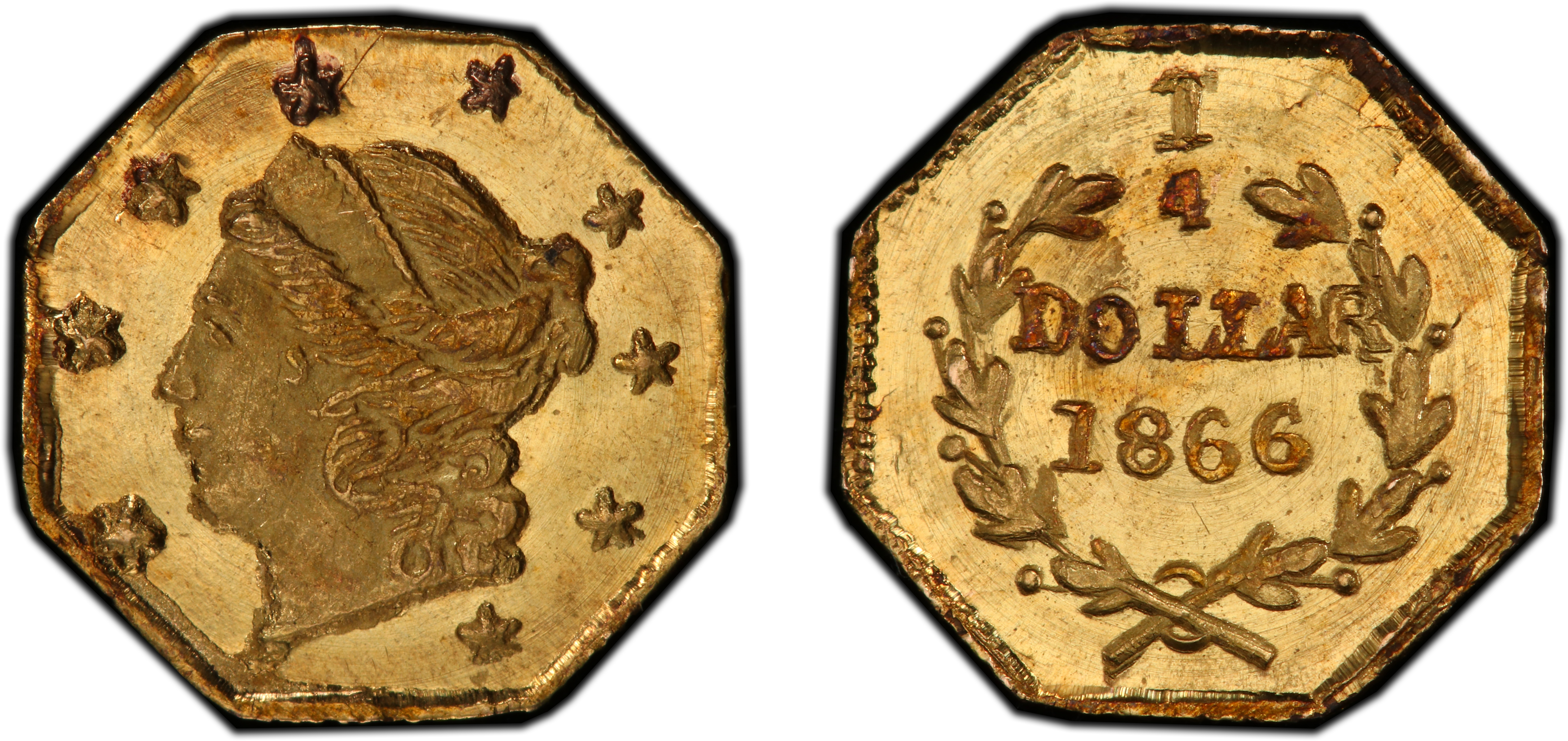
Obverse & Reverse
The 1866 BG-708 25 Cents is a quintessential example of a 'Period Two' or 'Jeweler's Issue' of California Fractional Gold. The initial wave of fractional gold, struck from 1852 to 1856 ('Period One'), arose from a genuine and severe shortage of small denomination coinage for daily commerce in the booming Gold Rush economy. Miners and merchants were forced to transact with pinches of gold dust, a clumsy and inaccurate system. Private minters filled this void with quarter dollar, half dollar, and dollar coins that, while not legal tender, were widely accepted. By 1866, the situation had evolved. The San Francisco Mint, opened in 1854, was in full production, alleviating the acute coin shortage. The Coinage Act of 1864 had also explicitly forbidden the private issuance of coinage. However, the law was not strictly enforced against these small, popular pieces until the early 1880s. This legal gray area, combined with a burgeoning tourism industry and a nostalgic fondness for the Gold Rush era, created a new market. Jewelers, many of them French immigrants with fine metalworking skills, began producing a wide variety of fractional gold pieces. These 'Period Two' coins were not primarily intended to circulate as money but were sold as souvenirs, keepsakes, and curiosities. The BG-708 variety, with its classic Liberty Head motif, harkens back to the designs of federal coinage, which added to its appeal. Struck crudely by hand with a hammer and anvil, each piece is unique, exhibiting variations in strike quality and planchet preparation. These pieces were often deliberately made with a gold content slightly below their face value, ensuring a profit for the jeweler who made them. Today, they are not just historical artifacts but numismatic links to the post-Gold Rush period of California's development, representing a transition from utilitarian necessity to commercial nostalgia.
Associated EventCalifornia Gold Rush Aftermath & Reconstruction Era
Reason For MintingPrimarily created as souvenirs and keepsakes for a growing tourist trade and local market nostalgic for the Gold Rush, rather than to alleviate a coin shortage.
Minter HistoryThe specific maker of the BG-708 dies is unknown, which is typical for the vast majority of Period Two California Fractional Gold. These pieces are collectively known as 'jeweler's issues' and are believed to have been produced by various San Francisco jewelers and artisans, many of whom were of French origin. Firms like Deriberpe & Nouizillet (D.N.) and Frontier & Deviercy (F.D.) are known to have produced some varieties, but most, including BG-708, remain anonymous, their creators lost to history.
Historical SignificanceThe BG-708 represents the second phase of fractional gold production, where the motive shifted from fulfilling a transactional need to capitalizing on tourism and nostalgia. It is a tangible piece of post-Gold Rush California commerce and demonstrates the persistence of private minting despite federal laws. Its existence highlights a unique numismatic and economic niche in 19th-century America.
BG-708
Denomination25 Cents
Minting Period1866
Assayer/MinterUnknown Private Minter
Geographic OriginSan Francisco, California (presumed)
Obverse DescriptionA beaded border surrounds a classic Liberty Head facing left. She wears a coronet inscribed with 'LIBERTY', though the inscription is often weak or incomplete due to the small size and crude strike. Her hair is tied in a bun at the back. Thirteen stars, representing the original colonies, encircle the bust.
Obverse InscriptionLIBERTY
Reverse DescriptionA simple wreath, open at the top, encircles the denomination. The date, 1866, is positioned below the wreath.
Reverse Inscription1/4 DOL.
CompositionGold
Stated Fineness Actual FinenessVariable, but typically between .500 and .800 fine. Period Two issues are known for being underweight and of lower purity than Period One coins.
Diameter9.00 mm
EdgePlain
Unknown
Survival Estimate75-150
Rarity ScaleR-4+ (Rare)
This variety is popular as a representative of the fascinating 'jeweler's issue' period of Cal Gold. Its octagonal shape and classic Liberty Head design are highly appealing. As a dated type from a well-documented series, it is sought after by specialists and type collectors alike.
Key VarietiesThe BG-708 is a specific die marriage and has no major recognized varieties from the period of issue. No contemporary proofs, patterns, or official restrikes were ever created. All known examples are business strikes produced for private sale. Later souvenir tokens from the 20th century exist but are stylistically different and not considered part of the Breen-Gillio classification system.
Authentication TipsGenuine examples have a characteristic crude, hand-struck appearance, often with misaligned dies and uneven strike depth. The surfaces may show fine die polishing lines. The style of the lettering and stars should match known examples; modern fakes often have a 'soapy' or cast look, incorrect letter fonts, or feature designs (like bears) never used on genuine pieces. All genuine Period Two issues must be denominated (e.g., 'DOL.', 'CENTS', etc.). Be wary of pieces that appear too perfectly made or have unusual surface characteristics like tool marks or added mintmarks.
Shopping ConsiderationsA premium quality example for this issue will exhibit an uncommonly sharp strike, particularly on the word 'LIBERTY' in the coronet and the numerals of the date. Seek out coins with minimal planchet flaws, such as cracks or unstruck areas. Original, uncleaned surfaces with a hint of reddish-gold or greenish-gold toning are highly desirable and command significant premiums. Avoid examples that have been harshly cleaned, polished, or mounted in jewelry, as this is common for the series and drastically reduces value. Look for evidence of original mint luster in the protected areas around the devices.
A coin's grade is its condition, rated on a 1-70 scale. For rare coins, this is the most critical factor in determining value, as a tiny difference in preservation can mean a huge difference in price.
Relevant Grade TypesAll original BG-708 pieces are considered business strikes intended for private sale, not circulation in the traditional sense. They are found in Circulated grades (AU-50 to AU-58 are most common) and Mint State (MS, 60-70). No Proof (PR/PF) examples were struck during the original period of issue, and no official later-date restrikes exist. Any piece described as a 'Proof' is either a misattribution or a modern fantasy piece.
Mint State CharacteristicsIn uncirculated grades, the BG-708 typically displays a soft, satiny luster. Strike quality is a key differentiator; many are weakly struck in the center, affecting the details of Liberty's hair and the word 'LIBERTY' on the coronet. A well-struck MS example is rare and sought-after. Due to the hand-hammering process, planchets are often uneven, and minor adjustment marks or flaws are common and should not be confused with post-strike damage.
Circulated Wear PatternsWear first appears on the highest points: Liberty's cheekbone, the hair above her eye, and the coronet. On the reverse, the leaves and bow of the wreath will show the first signs of friction. On lower-grade circulated examples (though few exist below AU), the stars and date will begin to lose their sharpness and merge with the fields.
Key Factors For ValueThe primary value drivers for a BG-708 are grade and surface quality. An example with original, uncleaned surfaces will always be worth substantially more than a cleaned one of the same grade. Strike sharpness is the next critical factor; a coin with a full 'LIBERTY' on the coronet can bring a 50% premium or more over a softly struck contemporary. Eye appeal, including attractive original toning and a lack of distracting planchet flaws, is paramount. Certification by a top-tier grading service (PCGS or NGC) is standard, and a CAC sticker indicating premium quality for the grade adds a significant premium.
PCGS Price Guide
| Grade | Price | Population |
|---|---|---|
| 50 | $170.00 | 1 |
| 50+ | $175.00 | N/A |
| 53 | $180.00 | N/A |
| 53+ | $185.00 | N/A |
| 55 | $190.00 | N/A |
| 55+ | $195.00 | N/A |
| 58 | $200.00 | 4 |
| 58+ | $210.00 | N/A |
| 60 | $250.00 | 1 |
| 61 | $275.00 | 5 |
| 62 | $325.00 | 10 |
| 62+ | $350.00 | N/A |
| 63 | $425.00 | 9 |
| 63+ | $450.00 | 1 |
| 64 | $525.00 | 16 |
| 64+ | $600.00 | 1 |
| 65 | $875.00 | 11 |
| 65+ | $1,050.00 | N/A |
| 66 | $1,550.00 | 3 |
| 66+ | $1,750.00 | N/A |
| 67 | $2,250.00 | 1 |